manifestation 101
369 Manifestation Method with Dream-Self Audio
Use the 369 manifestation method with a 3-minute Dream-Self audio: write less, listen daily, and let repetition make your intention feel near.
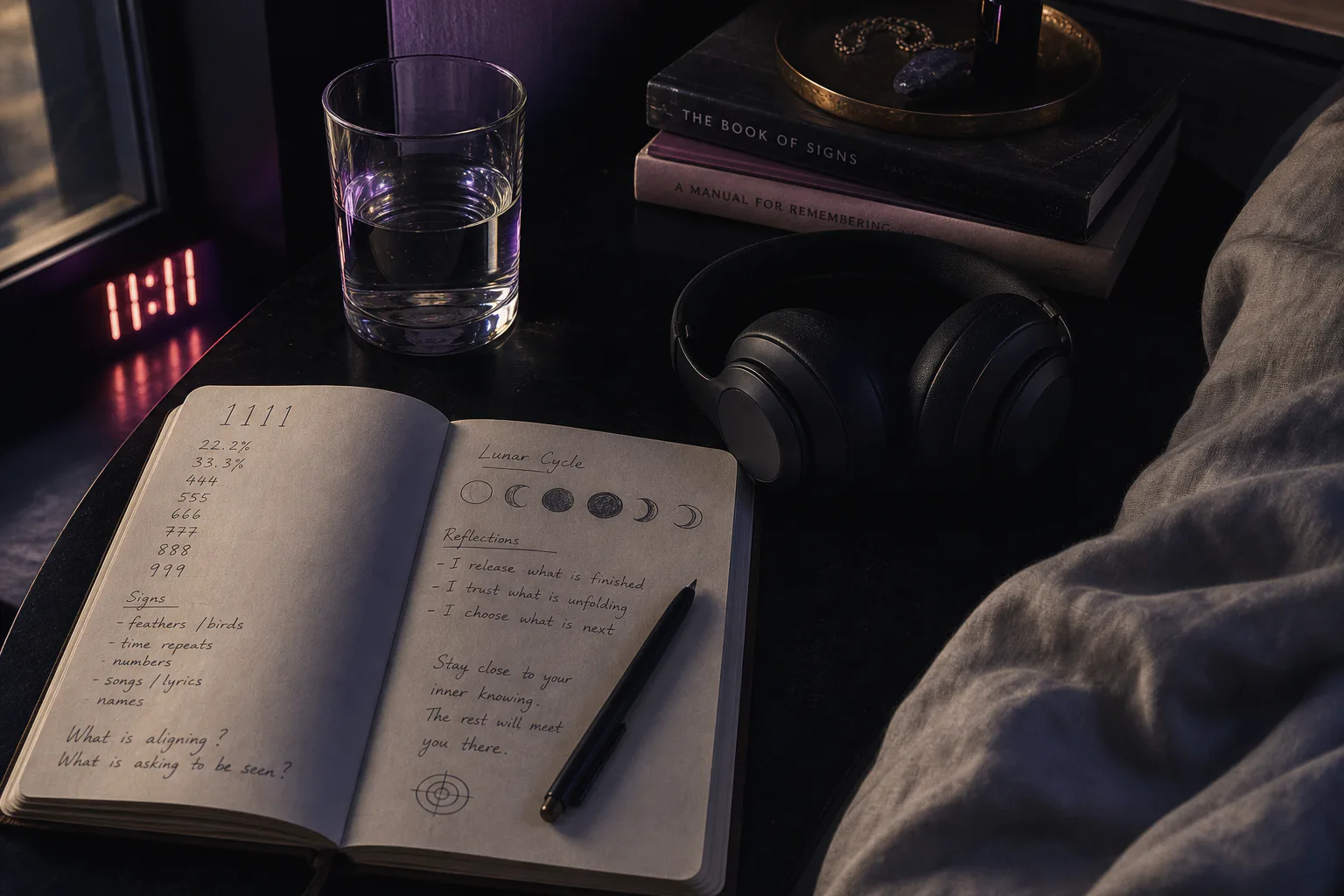
A pen beside the bed. Headphones charging in the dark. The 369 manifestation method works best when one clear intention is written 3, 6, and 9 times, then heard once as a 3-minute Dream-Self audio. Writing gives shape. Audio gives closeness. Repetition does the quiet work.
What is the 369 manifestation method, really?
The 369 manifestation method is a daily repetition ritual built around writing one intention 3 times in the morning, 6 times midday, and 9 times at night.
It is often linked online to Nikola Tesla because of his fascination with the numbers 3, 6, and 9. There is no solid historical evidence that Tesla used this exact manifestation method. That matters. The practice is better understood as a modern focus ritual with numerological roots, not as a lost scientific formula. A 2023 Pew Research Center report found that 41% of U.S. adults say they believe in psychics, astrology, or similar practices at least somewhat, which helps explain why number-based rituals still feel familiar to many people.
The plain value is repetition. You choose one sentence and meet it three times a day. That simple return gives your mind fewer doors to run through. The Manifestation pillar names this clearly: manifestation is not wishing harder. It is learning to live with the inner posture of the life you intend, then letting behavior catch up.
The numbers give rhythm. Morning is 3. Midday is 6. Night is 9. That rhythm is not magic on demand. It is a container. In small studies on implementation intentions, led by psychologist Peter Gollwitzer, people who formed specific if-then plans were more likely to act than people who only named a goal. The 369 method works best when the writing is paired with a next cue: after coffee, after lunch, before sleep.
One sentence, repeated honestly, can become a place you return to.
Here is the clean version:
| Time | Repetitions | Job of the session |
|---|---|---|
| Morning | 3 | Name the intention before the day gets loud |
| Midday | 6 | Interrupt the old pattern and choose one small act |
| Night | 9 | Let the future feel familiar before sleep |
If you are new to this, begin with one intention for 33 days. Thirty-three is common in modern 369 practice because it is long enough to build rhythm, but not so long that the ritual becomes a personality test. Habit researchers Phillippa Lally and colleagues reported in the European Journal of Social Psychology that automaticity took a median of 66 days, with a wide range from 18 to 254 days. So 33 days is a beginning, not a verdict.
Why add a 3-minute Dream-Self audio to it?
A 3-minute Dream-Self audio helps the written sentence become something you can hear, recognize, and emotionally rehearse.
Writing is exact. Audio is intimate. When you hear your future self described in ordinary detail, your nervous system gets a different kind of cue. You are not only seeing words on a page. You are receiving a scene. A voice can carry timing, warmth, certainty, and rest. That is why the audio should stay short. Three minutes is long enough to enter the feeling and short enough to repeat without negotiation.
This is where the AYA Method comes in without making a fuss. The AYA Method is a daily audio manifestation practice. Each day you listen to a short personalized recording — your Dream-Self Moment — narrated from the version of you who has already manifested the life you intend. Listening is the practice. Repetition is the work. The audio is the method.
Audio also reduces the strain of getting the words perfect every time. In a 2018 review in Nature Reviews Neuroscience, researchers described mental simulation as a way the brain prepares for possible futures by drawing on memory and imagination. Not every imagined scene changes behavior, of course. But when a scene is repeated with a cue and a small action, it becomes easier to recognize the next step.
The future becomes less dramatic when you hear it in your own morning voice.
Keep the roles clear. The audio is the main practice inside AYA. The daily affirmation and Manifestation Board can support it, especially if you like seeing your intention in one sentence or one image. But they are complements. They are not the center. The center is the Dream-Self Moment, listened to daily.
A 3-minute audio works beautifully with 369 because both are built on return. You write. You hear. You come back later. You do not have to force belief. You only have to make the future familiar enough that the next honest action has somewhere to land.
How do you choose the right intention?
The right intention is specific, believable enough to repeat, and emotionally true without sounding like a performance.
Start smaller than your ego wants. I say this as someone who kept vision boards at sixteen with magazine cutouts, glitter glue, and no budget for the life I was apparently scheduling. Big images can be useful. But the sentence for the 369 manifestation method needs to fit in your hand. If it sounds like a speech, cut it down.
Use present tense, but do not lie to yourself. There is a difference between “I am a calm, paid, respected writer” and “I am the world’s most successful writer by Friday.” Your body knows the second one is theatre. Research on self-affirmation theory, including work by Claude Steele and later health behavior studies in the Journal of Behavioral Medicine, suggests affirmations are more helpful when they connect to real values rather than empty self-praise.
Try this 4-part filter before you commit:
- Is it one desire, not five? Choose one door.
- Can you picture ordinary proof? A calendar invite, a paid invoice, a calmer conversation.
- Can you act from it today? One email. One walk. One boundary.
- Does it soften your body by 5%? Not fireworks. Just a little truth.
A good intention does not shout. It sits down beside you and waits.
Here are examples:
- “I am steady and well-paid in work that respects my time.”
- “I speak clearly in love, and I am met with care.”
- “My home feels simple, clean, and truly mine.”
- “I trust my body enough to keep one gentle promise today.”
If your intention is about love, money, health, or creative work, keep it grounded in your part of the pattern. You can want a relationship. But do not write another person into a script they did not consent to. You can intend more income. But include the actions, skills, and requests that make receiving possible. Neville Goddard often wrote about assuming the feeling of the wish fulfilled; even then, the practice lands best when it does not erase reality.
For wording help, the Affirmations pillar is useful. One strong affirmation can become the sentence you repeat in your 369 pages, while the Dream-Self audio gives it breath and scene.
How do you record the 3-minute Dream-Self audio?
Record the audio as if your future self is speaking gently from an ordinary day that already contains the intention.
You do not need a studio. You need a quiet room, a phone, and one page of notes. Three minutes is about 390 to 450 spoken words at a calm pace, since common narration speed sits near 130 to 150 words per minute. Keep it slow. Let there be space. The recording should not sound like a sales pitch to your own soul.
Before recording, write five details:
- Where are you when this future feels real?
- What is one visible sign that things have changed?
- What does your body do differently?
- What small choice did you make today?
- What old fear no longer runs the room?
Then speak in first person, present tense. You might begin: “I wake up and there is no rush in my chest. The room is quiet. I check the calendar and see work that fits the life I said I wanted.” Keep naming ordinary proof. An invoice. A clean sink. A kinder text. A ten-minute walk. Your future self needs evidence, not smoke.
Dr. Andrew Huberman has often discussed how repeated cues can shape attention and behavior, especially when paired with clear actions and nervous system state. You do not have to accept every wellness claim around neuroplasticity to use the practical part: attention repeated at the same cue becomes easier to find. The audio gives the cue a voice.
Try this structure:
- First 30 seconds: arrive in the body and the room.
- Next 90 seconds: describe ordinary proof that the intention is real.
- Next 45 seconds: name the version of you who made one small choice.
- Final 15 seconds: end with one sentence you can carry into the day.
Keep the recording private. That helps. A 2022 Statista report estimated that hundreds of millions of people listen to audio content weekly, but this is not content. It is not for applause. It is a note from you to you. The less it performs, the more useful it becomes.
What is the exact daily schedule?
The simplest schedule is 3 written repetitions after waking, 6 written repetitions midday, and 9 written repetitions before bed, with the Dream-Self audio played once.
You can use the audio at any of the three points, but I like night. The day is done. The room has fewer opinions. Sleep research has long shown that the pre-sleep period is a sensitive window for memory and emotional processing; a 2021 review in Sleep Medicine Reviews described sleep as central to memory consolidation. This does not mean your sentence becomes fact overnight. It means the final input of the day matters.
Here is a 7-minute version:
| Moment | Practice | Time |
|---|---|---|
| Morning | Write the intention 3 times | 1 minute |
| Midday | Write it 6 times and choose one small act | 2 minutes |
| Night | Write it 9 times, then listen to the audio | 4 minutes |
Do not scroll between writing and listening. That sounds tiny because it is. Tiny is the point. A 2019 RescueTime analysis of users found people averaged more than 3 hours a day on phones, and heavy users spent over 4 hours. Your practice does not need to compete with the whole internet. It only needs one clean minute before the internet enters.
A sample day:
- Morning: “I am steady and well-paid in work that respects my time.” Write it 3 times. Put the notebook down.
- Midday: Write it 6 times. Send one invoice, proposal, or clear reply.
- Night: Write it 9 times. Listen to the 3-minute Dream-Self audio. Stop checking.
This is also where astrology and manifestation can be used softly if it is part of your language. A new moon can mark day 1. A full moon can mark a check-in. But the moon is not doing your repetitions for you. The practice remains yours.
The schedule works because it removes decision fatigue. You do not ask, “Am I in the mood?” You ask, “Which repetition is this?” That is kinder. It makes the ritual small enough to keep.
What should you do when doubt shows up?
When doubt shows up, do not argue with it; make the sentence smaller, then keep the appointment.
Doubt is not failure. It is often your mind checking for danger, embarrassment, or disappointment. If your intention creates instant resistance, you may have written too far ahead. Bring it closer. “I am wildly confident” might become “I am willing to speak one true sentence today.” The second one has a door handle.
Cognitive behavioral research has shown for decades that thoughts, feelings, and behaviors influence one another in loops. You do not have to feel fully certain before acting. In fact, behavioral activation studies for depression often begin with small scheduled actions before mood improves. The order is humble: act a little, feel a little, repeat.
Here is how to edit doubt without quitting:
- If the sentence feels fake, make it more specific.
- If the sentence feels huge, make the time frame shorter.
- If the sentence feels numb, add a body detail.
- If the sentence feels grasping, add one action you can take.
- If the sentence feels dependent on one person, return to your own pattern.
Doubt does not need to be defeated. It needs to be included without being made the author.
Joe Dispenza speaks often about rehearsing a future state until the body begins to recognize it. Some of his claims are debated, and you do not need to treat every statement as settled science. The useful piece is simple: rehearsal changes what you notice and what you practice. In psychology, that part has company. Mental rehearsal has been studied in sports and skill learning for decades, with benefits strongest when paired with real practice.
If you miss a session, do not restart the whole 33 days unless restarting feels clean. Just continue at the next session. Perfection makes people dramatic. Rhythm makes people honest. The notebook is not keeping score like a judge. It is keeping the door open.
How do you know it is working?
You know the practice is working when your attention, choices, and emotional baseline begin to change before the outer result is complete.
Look for earlier signs than the big result. Are you noticing different chances? Are you replying with more care? Are you less addicted to checking? Are you taking the small action faster? These are not consolation prizes. They are the ground changing under your feet.
The Princeton Engineering Anomalies Research lab studied mind-matter questions for nearly 28 years, and its findings remain debated. It is worth naming because many manifestation communities cite Princeton loosely. The safer claim is this: research around intention is mixed, but research around attention, rehearsal, habit cues, and written goals is much clearer. Writing and repeating a goal can sharpen awareness and support action.
A famous study often attributed to Harvard about written goals is widely repeated but poorly sourced, so do not build your faith on that story. Better evidence comes from goal-setting research by Edwin Locke and Gary Latham, who found across many studies that specific, challenging goals tend to improve performance compared with vague goals, especially when feedback is present. For this practice, feedback can be weekly notes.
Use a 7-day check-in:
| Question | What to note |
|---|---|
| Did I repeat the sentence most days? | Count sessions, not worthiness |
| Did I take one related action? | Name the act, however small |
| Did my wording still feel true? | Keep it or soften it |
| Did I see ordinary proof? | Record signs without forcing meaning |
This is where a Manifestation Board can help as a complement. One image, one phrase, one date. Not a shrine to wanting. A visual reminder of what you are practicing hearing. If you want the broader frame, return to the manifestation guide and keep the audio at the center.
The result may come as an opportunity, a steadier mood, a cleaner decision, or a conversation you used to avoid. Keep your eyes plain. Real change often arrives wearing normal clothes.
What mistakes make the 369 manifestation method feel heavy?
The method feels heavy when you make it too grand, too long, too public, or too dependent on proof arriving by a fixed hour.
The first mistake is changing the intention every day. That keeps the ritual exciting and useless. Choose one sentence and give it time. In habit research, consistency of context matters because the cue starts doing some of the remembering for you. If your morning repetition happens beside the same mug for 33 days, the mug becomes part of the practice. Very glamorous. Very effective.
The second mistake is using language you would never say in real life. I have interviewed enough artists, founders, and tender skeptics on my podcast to know this: people abandon practices that make them feel ridiculous. Not playful. Ridiculous. Let your sentence sound like you. If you are dry, let it be dry. If you are soft, let it be soft. Truth has better endurance than decoration.
The third mistake is treating the audio as a reward after you prove yourself. No. Listen daily. The audio is the method inside AYA. The writing is the 369 container around it. The app also includes a daily affirmation and Manifestation Board, but those support the Dream-Self Moment. If you only do one thing, listen.
The fourth mistake is stalking the result. Checking every hour trains the mind to rehearse lack. Use weekly review instead. A 2020 American Psychological Association stress report found that uncertainty is a major stressor for many adults; constant checking rarely calms that stress for long. A practice should not become another way to monitor yourself.
Keep these rules close:
- One intention for 33 days.
- One 3-minute audio.
- Three writing sessions.
- One small action daily.
- One weekly review.
The method is not asking you to become someone else. It is asking you to keep meeting the self you keep postponing.
For the wider structure, the AYA Method can hold the daily listening, while your 369 notebook holds the written rhythm. Simple. Almost annoyingly simple. Which is often why it works.
Put the pen down before you start pleading.