frequencies binaural
432 Hz Manifestation With Dream-Self Audio
Use 432 Hz manifestation as a quiet audio layer with Dream-Self listening, not a magic shortcut: timing, repetition, and attention do the work.

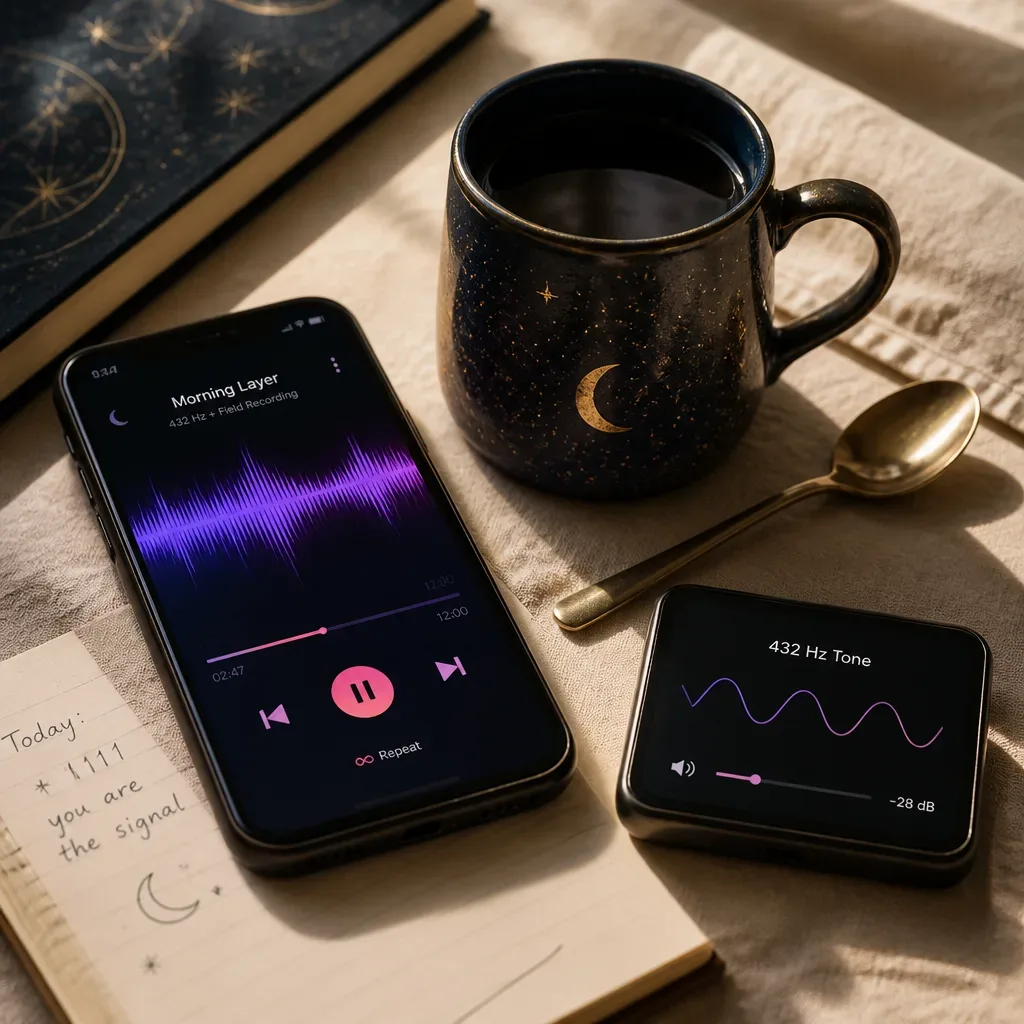
432 Hz manifestation works best when the tone supports a clear daily listening practice, not when it becomes the whole ritual. Pair a low 432 Hz track with your Dream-Self audio, keep the words primary, repeat at the same time each day, and let the frequency act as a signal for attention.
The first time I tried it, the kitchen clock read 4:32. Of course it did. I had coffee on the stove, salt near my notebook, and headphones coiled beside a spoon. Most people would call that timing. I called it the dial lining up.
What is 432 Hz manifestation actually doing?
432 Hz manifestation is using a tone or music track tuned around 432 Hz to help the body settle while the mind rehearses a chosen reality.
The claim around 432 Hz is old in internet years and complicated in music history. Modern concert pitch commonly places A4 at 440 Hz, and ISO 16 formalized that reference in 1975. A4 at 432 Hz is simply a lower tuning standard, 8 cycles per second beneath 440. That number sounds mystical because it arrives cleanly. It is still a tuning choice, not a law of physics handing you a receipt.
That does not make it useless. Music changes state. A 2013 review in Frontiers in Psychology described how music can affect stress, mood, arousal, and social bonding through several pathways, including rhythm, memory, and expectation. If a 432 Hz track helps your shoulders drop by even 10 percent, the tone has done something practical. A softened body is often a better witness than a clenched one.
The mistake is treating frequency as the chef instead of the flame. The main ingredient is attention. In the AYA Method, the audio is central: The AYA Method is a daily audio manifestation practice. Each day you listen to a short personalized recording, your Dream-Self Moment, narrated from the version of you who has already manifested the life you intend. Listening is the practice. Repetition is the work. The audio is the method.
A tone can set the room, but it cannot name your life for you.
For deeper grounding on the broader practice, keep the Manifestation pillar nearby. Frequencies are useful only when they serve a real intention, a real pattern, and a real day on the calendar.
How do you pair 432 Hz with Dream-Self audio?
You pair them by making the Dream-Self audio the lead voice and the 432 Hz tone the quiet room underneath it.
Think of a pot of beans. The salt matters. The clay pot matters. The flame matters. But if you cannot taste the beans, the ritual has lost the plot. Your Dream-Self recording should stay audible, intimate, and easy to follow. The 432 Hz track should sit low enough that you notice it only when it disappears.
A clean setup takes less than 3 minutes:
- Choose a 432 Hz track without lyrics, ads, or dramatic swells.
- Start your Dream-Self audio first and set the narration at a comfortable level.
- Add the tone at 20 to 30 percent of that volume.
- Use headphones if they help you focus, but speakers are fine for a quiet room.
- Listen once without multitasking for at least 7 minutes.
Volume is not a spiritual achievement. The World Health Organization has warned that more than 1 billion young people are at risk of hearing damage from unsafe listening practices, especially through personal audio devices. Keep the sound gentle. Manifestation does not require punishment by decibel.
If you use affirmations, treat them as a closing spice, not the main dish. The Affirmations pillar can help you refine one sentence after the audio, but the daily listening stays at the center. Write one line if it helps: I move like the person who already knows what is mine to build.
Repetition turns sound into a gate. After 11 mornings, the first note may begin to tell your body: we are here again, on cue.
When is the best time of day to listen?
The best time is the one you can repeat without negotiation for at least 11 days.
Morning has a clean advantage because attention has not been spent yet. Dr. Andrew Huberman often points to the first hour after waking as a key window for setting circadian signals, especially through light exposure and behavior. If you already make coffee, feed a child, stretch, or step outside, you can attach the audio to that existing cue. Habit researchers call this anchoring. Grandmothers call it common sense.
Evening works differently. It is better for release than command. If you listen before sleep, lower the volume and simplify the intention. The American Academy of Sleep Medicine commonly advises protecting the wind-down period from stimulation; many sleep clinicians suggest 30 to 60 minutes of calmer behavior before bed. A low 432 Hz track can help mark that threshold, especially if your mind likes to audit the day at midnight.
Use this table to choose your gate:
| Time | Best for | Watch for | Suggested length |
|---|---|---|---|
| Morning | Identity rehearsal and decision tone | Rushing into messages | 7 to 12 minutes |
| Midday | Resetting attention after stress | Treating it like a productivity hack | 5 to 9 minutes |
| Evening | Softening, trust, and nervous system downshift | Falling into analysis | 8 to 15 minutes |
The number 11 has a reason to appear here beyond brand poetry. In numerology, 11 is considered a master number, associated with intuition and signal. You do not need to outsource your choices to numerology to use it well. Eleven days is simply long enough to notice whether a practice has traction and short enough that your mind cannot turn it into a life sentence.
If you track lunar timing or repeating numbers, the Astrology and manifestation guide can help you place the practice inside a larger cycle without letting the cycle boss you around.
What should you focus on while the tone plays?
Focus on receiving the Dream-Self narration as present-tense evidence, then let the tone hold the edges of the room.
The mind will try to work. It will ask whether you are doing it correctly, whether 432 Hz is the right track, whether another video with 9 million views might be stronger. Name that as noise. Return to the voice. In contemplative practice, Tara Brach often teaches the power of pausing, noticing, and returning. That return is not a failure. It is the rep.
Your focus should move through 3 layers:
- Body: jaw, tongue, shoulders, belly, hands.
- Voice: the exact phrases in your Dream-Self audio.
- Evidence: one ordinary action today that matches the person being described.
This keeps the practice honest. If your audio says you are calm with money, the evidence might be opening the account without drama. If it says you are loved well, the evidence might be answering the kind message instead of testing it. If it says your work is ready, the evidence might be sending the proposal before 3 p.m.
Specificity is the antidote to fantasy. A 2021 Pew Research Center report found that 31 percent of U.S. adults say they are online almost constantly. That means attention is not a vague spiritual asset; it is contested territory. Your 432 Hz manifestation practice is partly a refusal to let every notification vote on your future.
Joe Dispenza often speaks about rehearsing a future state until the body begins to recognize it. You do not have to adopt every claim to respect the useful part: the nervous system learns through repeated state and story. When the same tone, same voice, and same daily gate arrive together, the body gets a pattern it can remember.
A practice is serious when it changes what you do at 2:17 p.m., not only what you feel at 6:00 a.m.
How loud should 432 Hz be under the audio?
The 432 Hz layer should be quiet enough that every word of the Dream-Self audio remains easy to understand.
Use a simple ratio: narration first, tone second. If your phone volume is at 50 percent, place the 432 Hz track around 10 to 15 percent if your app allows separate controls. If not, choose a track that is naturally soft and steady. Avoid tracks with bells, thunder, cinematic bass, or whispered promises. The room does not need more drama. It needs a clean signal.
Sound engineers often mix background beds far below the spoken voice because intelligibility depends on contrast. In speech research, even a few decibels of competing sound can reduce comprehension, especially when words carry emotional weight. Your Dream-Self audio is not wallpaper. It is the sentence you came to hear.
Here is the quick test:
- Play the Dream-Self audio alone for 30 seconds.
- Add the 432 Hz tone.
- Close your eyes and repeat the last sentence you heard.
- If you cannot repeat it exactly, the tone is too loud.
- Lower it and test again.
This is where the Manifestation pillar matters again. The aim is not to create a prettier ritual. The aim is to train identity through repeated attention. Tools that blur the message are not tools. They are decorations with good lighting.
If you share a home, use the kitchen rule: do not season for the room, season for the person eating. Headphones can protect the intimacy of the practice. A low speaker can also work if the house is still. Either way, keep the words clean.
What can you write after a 432 Hz manifestation session?
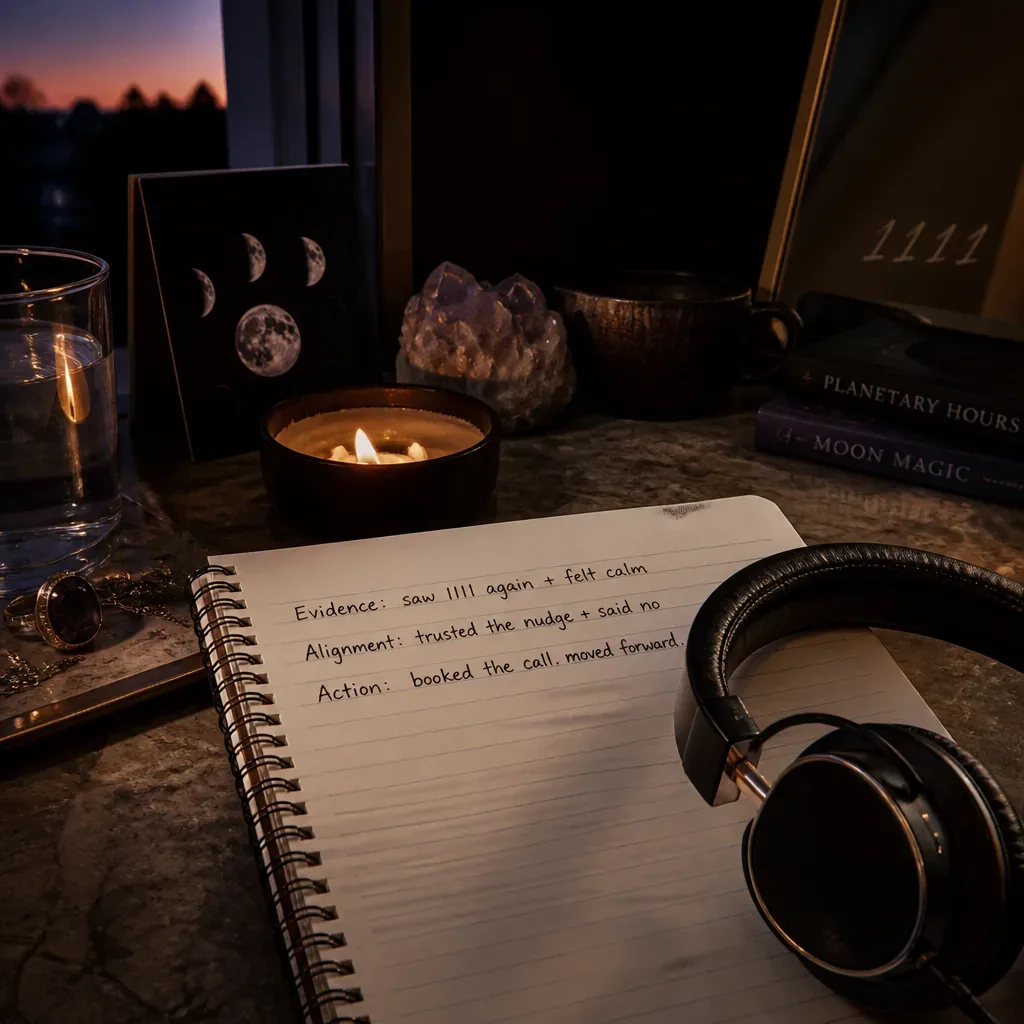
Write one line of evidence, one line of alignment, and one line of action.
Do not turn the practice into paperwork. Three sentences are enough. In expressive writing studies, including research by James Pennebaker and colleagues, short structured writing sessions have been linked to emotional processing and health-related benefits in some groups. The point here is not therapy by notebook. It is closure. You are telling the mind where the signal landed.
Use this 90-second format:
- Evidence: One thing I noticed in the audio was…
- Alignment: Today I can live that by…
- Action: Before the day closes, I will…
For example: One thing I noticed in the audio was how steady my voice sounded. Today I can live that by not apologizing before I make my point. Before the day closes, I will send the email at 10:30.
That is stronger than writing 2 pages of fog. A daily affirmation can help here if it is precise. The Affirmations pillar has useful structure, but remember the order: audio first, affirmation as complement. The sentence seals the listening. It does not replace it.
You can also track repeating numbers if they genuinely appear. 4:32, 11:11, 2:22. Treat them as punctuation, not instruction. Doreen Virtue popularized angel numbers for a wide audience, though her later public position changed; the cultural footprint remains. Use numbers as mirrors. Do not hand them the steering wheel.
A sign is most useful when it sends you back to the practice.
How do you know if the practice is working?
You know it is working when your daily choices begin to match the identity your audio has been naming.
Do not measure only mood. Mood is weather. Look for behavior across a 30-day cycle: cleaner decisions, quicker recovery after stress, fewer negotiations with what you already know, more honest timing. If you listen daily for 11 days, then 22, then 33, you have a natural numerology ladder and a practical habit review. Master numbers 11, 22, and 33 may carry symbolic charge, but they also give you checkpoints.
Track 4 signs:
- You start the session with less resistance.
- You remember phrases from the Dream-Self audio during the day.
- You take one aligned action without overexplaining it.
- You recover faster when doubt arrives.
In small habit studies, consistency usually beats intensity. BJ Fogg of Stanford has written extensively about tiny habits and the role of prompts, ability, and motivation. A 10-minute practice you repeat 25 times in a month gives your nervous system more data than a single heroic ritual with candles, crystals, and no follow-through.
You can support the practice with timing systems if they help. Lunar cycles, angel numbers, and personal dates can add texture. The Astrology and manifestation page is useful when you want the calendar to become a witness rather than a judge. But if the moon says rest and your audio says send the invoice, send the invoice after a nap.
The cleanest measurement is this: are you becoming easier to believe in your own life?
Keep the tone low. Keep the voice close.