affirmations
Affirmations That Work Better as Future-Self Audio
Affirmations that work often feel specific, repeated, and believable. Future-self audio helps your nervous system hear the new identity daily.
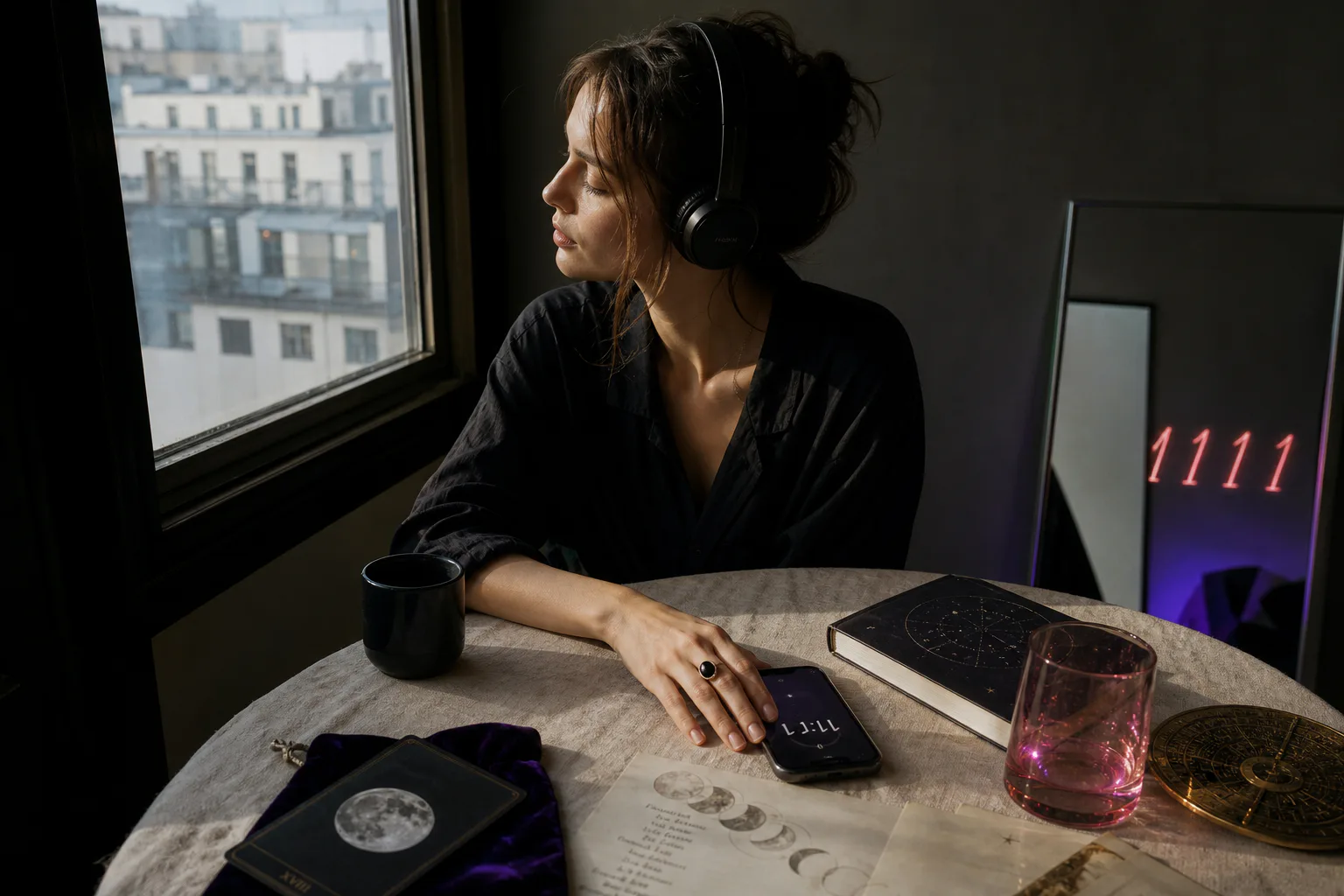
The phone is face down. Your headphones are already in. Affirmations that work are not louder sentences; they are believable identity cues, repeated often enough for your body to recognize them. Future-self audio helps because you hear the change as a lived memory, not a demand.
Why do some affirmations stop working on the page?
Some affirmations stop working because they ask your mind to accept a sentence your body still reads as false.
A written affirmation can be clean and beautiful. Still, it may sit outside you. You read, I am safe, while your shoulders are near your ears. You write, I trust myself, then spend the next hour asking five people what to do. The problem is not the sentence. The problem is the distance between the sentence and the felt self.
Psychologist Claude Steele introduced self-affirmation theory in 1988, and the core idea was not pretending. It was protecting a stable sense of self by remembering values that are real. Later health psychology research found self-affirmation can reduce defensiveness and support behavior change, especially when tied to identity rather than empty praise. A 2016 Social Cognitive and Affective Neuroscience study by Cascio and colleagues found self-affirmation activated brain regions linked with self-related processing and valuation.
That matters here. Your nervous system is listening for proof. A line like I am rich in every way can feel too wide, too bright, too far away. A line like I answer the hard email before noon and my chest stays soft gives the mind something observable. One sentence becomes a place you can stand.
Affirmations fail when they become a performance of certainty. They begin to work when they become a rehearsal of recognition.
Here is the quiet difference:
| Flat affirmation | Future-self audio version |
|---|---|
| I am confident | I speak slowly in the meeting and let the room wait |
| I am loved | I let myself receive the kind message without explaining it away |
| I am successful | I finish the first clean hour of work before checking my phone |
| I trust myself | I choose, then I stay with the choice long enough to learn |
If you want a broader base for this practice, the Affirmations pillar gives the language more room. The sentence is not a spell. It is a cue. A cue works best when it tells the truth softly enough to enter.
What makes future-self audio different from a written affirmation?
Future-self audio works differently because it lets you hear identity as tone, rhythm, and ordinary proof.
When you read a sentence, you supply the voice. When you listen, the voice arrives for you. That small shift matters. Auditory memory has been studied for decades; researchers have found that spoken words can carry timing, emphasis, and emotional information that silent reading does not always hold. In learning research, repeated audio cues are often used because they reduce the amount of effort needed to begin.
This is where the AYA Method becomes simple. The AYA Method is a daily audio manifestation practice. Each day you listen to a short personalized recording — your Dream-Self Moment — narrated from the version of you who has already manifested the life you intend. Listening is the practice. Repetition is the work. The audio is the method.
The future-self frame changes the grammar. Instead of I want to be calm, you hear I remember how calm became normal in my body. Instead of I will become someone who finishes, you hear I finish the small thing first now. There is no strain in it. The voice is not trying to convince you. It is letting you overhear a steadier version of yourself.
Dr. Andrew Huberman has often described the nervous system as changing through repeated focus, emotion, and behavior. You do not need to make that mystical. Neuroplasticity is not instant. It asks for repetition. A 2009 study by Phillippa Lally and colleagues found habit formation took 66 days on average, though the range was 18 to 254 days. Daily listening fits that truth. Small, repeated, less dramatic than you hoped. More real than you expected.
A future-self recording gives your affirmation a room, a body, and a time of day. It can mention your kitchen light. Your hand on the door. The two breaths before you answer. The detail is not decoration. The detail is the bridge.
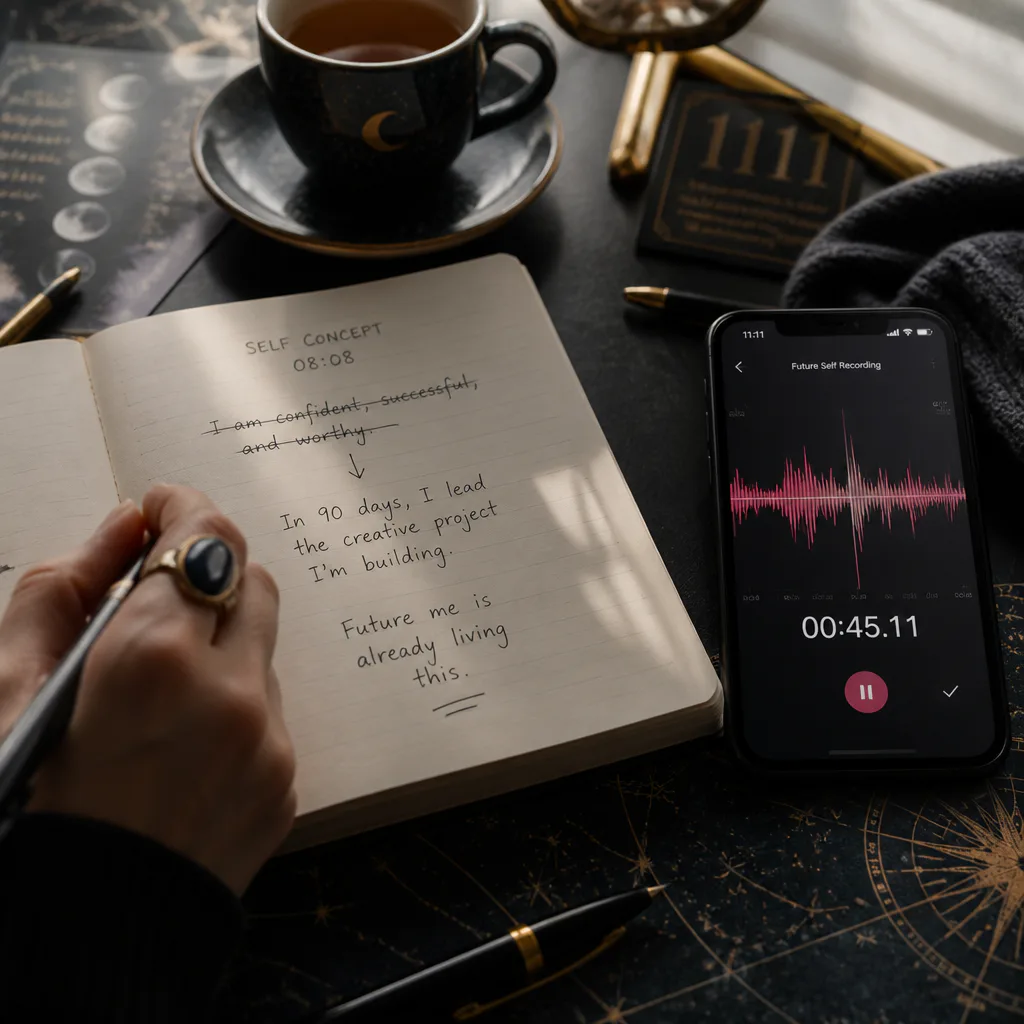
Which affirmations become stronger when spoken by your future self?
The strongest future-self affirmations are the ones that describe a pattern you can practice, not a fantasy you have to force.
Start with the places where you already leak attention. Money. Love. Work. Rest. Your body. Your voice. These areas are common because they touch threat and belonging. Pew Research Center reported in 2023 that 60% of U.S. adults said money was a major source of stress in their lives. It is hard for a broad money affirmation to land when the body is bracing. A future-self audio can make the statement smaller and safer.
Try choosing affirmations from these categories:
- Identity: I am the kind of person who keeps one promise to myself.
- Behavior: I send the message before I rehearse it twenty times.
- Receiving: I let care arrive without paying for it with overgiving.
- Boundaries: I answer after I have checked with myself.
- Rest: I stop before I am empty.
- Visibility: I let my work be seen before it feels perfect.
Each line becomes stronger when it is spoken as evidence. Not I am visible. Instead: I posted the work on Tuesday, then made dinner, and nothing terrible happened. Not I am worthy. Instead: I did not apologize for needing the afternoon.
Neville Goddard often taught from the idea of assuming the feeling of the wish fulfilled. You do not have to inherit every part of his philosophy to use the useful piece. The feeling needs a scene. Your mind responds better to a lived moment than a slogan floating above the day.
If you are building a wider practice, pair this with the Manifestation pillar, where desire is treated as something you relate to daily, not something you shout at. The quieter the affirmation, the more exact it can become.
One good future-self line usually contains three parts:
- A scene: where you are, and what is happening.
- A behavior: what you do differently.
- A felt signal: what changes in your breath, posture, or pace.
The sentence becomes usable when you can see yourself inside it.
How do you write affirmations that work as future-self audio?
You write them by turning a desired identity into a short scene your future self can speak without strain.
Take one plain affirmation. I am confident. Good. Now ask what confidence does at 9:40 on a Tuesday. Does it ask for the fee without shrinking? Does it say no to the call? Does it send the draft? The mind can argue with confidence as an abstract claim. It has a harder time arguing with a clear behavior.
Implementation intention research can help here. In 1999, psychologist Peter Gollwitzer found that if-then plans improved follow-through because they linked a cue to an action. An affirmation can borrow that structure without sounding mechanical. When I feel the urge to overexplain, I pause and answer in one clean sentence. That is not a mood. It is a map.
Use this small process:
- Name the old loop. I rush when I think someone is disappointed.
- Choose the new proof. I pause before answering.
- Set it in a scene. I see the message, put my feet on the floor, and breathe once.
- Speak from after. I do not rush my answer anymore. I let one breath come first.
- Keep it under 90 seconds. Short audio repeats more easily.
A useful recording does not need a perfect voice. It needs a true one. If you stumble, leave the stumble. If your voice sounds tired, let it be tired. Perfection can turn the practice into another place to fail.
You can also place one phrase on a Manifestation Board inside Aya, but let that visual stay in its right size. The board is a reminder. The daily affirmation can be a small written companion. The audio is the method. If you want to compare the language of belief with symbolic timing, Astrology and manifestation may help you notice rhythm without giving your agency away.
The best affirmation is not the one that impresses you. It is the one you can repeat on an ordinary day and still believe by one percent.
When should you listen so the practice actually stays?
You should listen at a cue you already have, because repetition needs less willpower when it borrows an existing rhythm.
Do not build the practice around a fantasy morning if your actual morning contains a child looking for socks, a kettle boiling over, and a nervous glance at your inbox. Use what is already there. The 2009 Lally habit study did not find that habits form by intensity. It found consistency matters, and that missing one day did not erase the pattern. That is mercy, and also science.
Good cues are small:
- after you brush your teeth
- while the kettle heats
- before opening your laptop
- after parking the car
- before sleep, with the screen dim
- during the first three minutes of a walk
You are not trying to create a ceremony that depends on a perfect mood. You are giving your attention a dependable doorway. The easier the doorway, the more likely you are to enter.
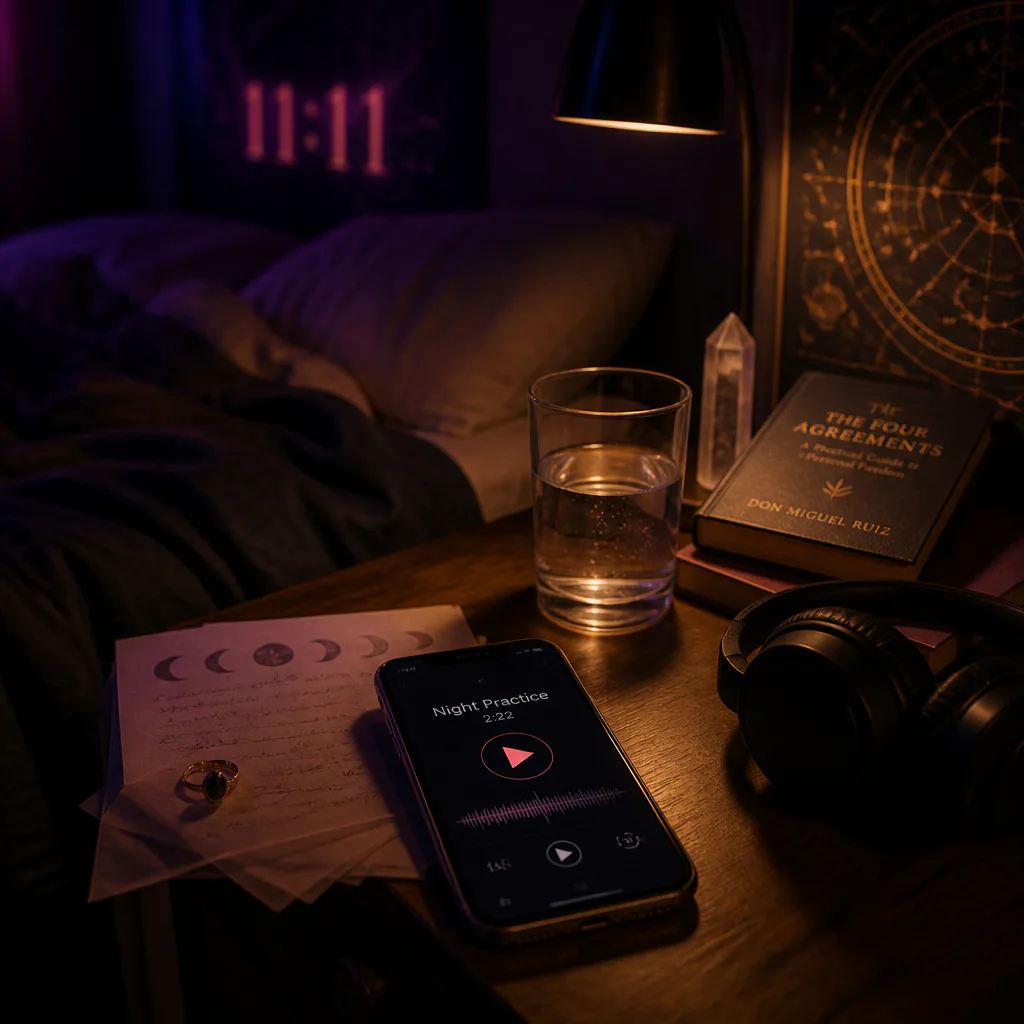
In behavioral design, BJ Fogg has written about tiny habits and the importance of attaching new actions to existing prompts. His model is simple: after I do this, I do that. Future-self audio fits well because it can be brief. A 60-second recording can live inside a day that has no spare hour.
If you miss a day, do not make the missed day the story. Listen the next time the cue returns. Shame is a poor teacher. Repetition teaches better when it is allowed to be human.
For many people, morning works because the mind has not been fully claimed yet. For others, night is softer because the performance of the day is over. Pick the time when you are least likely to negotiate with yourself. The practice does not need your most impressive self. It needs your returning self.
How can you tell if an affirmation audio is working?
You can tell it is working when your behavior begins to shift in small, repeated ways before your belief feels fully settled.
Do not wait for a grand inner certainty. Look for ordinary evidence. You pause before replying. You ask for the fee. You leave the party when your body says leave. You rest for ten minutes without earning it first. These are not fireworks. They are receipts.
A 2015 review in the Journal of Behavioral Medicine noted that self-affirmation interventions can support health behavior, though effects vary by context and design. That variation is important. Not every sentence will help every person. You are allowed to edit. You are allowed to make the audio quieter, more specific, less polished.
Track evidence for seven days, not forever. Write one line after listening:
| Day | Evidence I noticed |
|---|---|
| 1 | I paused before answering the message |
| 2 | I named my price without adding a discount |
| 3 | I went to bed before the second episode |
| 4 | I let the compliment land |
Seven days is long enough to see patterns and short enough not to become another self-improvement ledger. If nothing changes, adjust the sentence. Make it smaller. Move it closer to the body. Instead of I am fearless, try I can feel fear and still send the email.
If the practice brings up grief, that does not mean it is failing. Sometimes hearing a kinder future self shows you how long you have been speaking to yourself harshly. Go slowly. If old pain becomes too much, support from a therapist or trained practitioner matters. Audio is a practice, not a substitute for care.
For more language work, return to the Affirmations pillar. For the daily structure that holds the listening, return to the AYA Method. Let the evidence be modest. Modest evidence is still evidence.
What is a simple script for future-self affirmation audio?
A simple script begins with recognition, names the new pattern, and ends with one small piece of proof you can live today.
Keep the recording between 45 and 90 seconds at first. In audio learning, shorter repeated segments are often easier to retain than long recordings, especially when attention is divided. You are not making a lecture for yourself. You are leaving a note in your own voice from a steadier room.
Use this script:
- Open with now. I know where you are. You are standing in the kitchen, trying not to rush.
- Speak from after. I am you from the place where calm has become familiar.
- Name the changed behavior. We answer one thing at a time now.
- Add body proof. The jaw softens. The shoulders drop. The breath comes back.
- Give today one action. Before the first message, put both feet on the floor.
- Close gently. You do not have to become someone else. You are returning to yourself.
Here is a sample:
I know you are tired this morning. I know part of you wants to hurry so no one can be disappointed. I am you from the days when we stopped living ahead of ourselves. We answer slowly now. We let one breath come before the explanation. We trust the clean sentence. Today, before you reply, feel both feet on the floor. That is enough. I am here. You are not behind.
Notice how little the script tries to prove. It does not argue with fear. It gives fear a chair and continues. That is often what affirmations that work have in common. They do not shout over the body. They teach it a new order, one listen at a time.
You can keep refining the words as your life gives you new evidence. If the sentence becomes too easy, make it more honest. If it becomes too hard, make it smaller. The practice should meet you where you are and speak from where you are going.
Stay close enough to hear yourself.