lucid dreaming
Dream Journal for Lucid Dreaming: Turn Signs Into Audio
Use a dream journal for lucid dreaming to spot recurring dream signs, write cleaner notes, and turn them into audio cues you can rehearse daily.

A dream journal for lucid dreaming works best when it does two jobs: it records what happened, then converts recurring dream signs into cues you can rehearse. Write the fragment, tag the pattern, script it as audio, and listen often enough that the cue feels familiar when it arrives again at 3:33.
How does a dream journal for lucid dreaming actually work?
A dream journal works by improving recall first and recognition second.
Lucid dreaming depends on a small but decisive mental event: you notice that the dream is a dream while it is happening. Stephen LaBerge, the Stanford psychophysiologist who helped verify lucid dreaming in sleep labs in the 1980s, built much of his work around that moment of recognition. The dream journal gives that moment better odds because it teaches your waking mind what your sleeping mind keeps repeating.
Most people remember dreams unevenly. The American Academy of Sleep Medicine notes that REM sleep occurs in cycles across the night, with longer REM periods toward morning; that means a 6:10 a.m. fragment may be richer than a midnight impression. You do not need a full cinematic plot. You need the blue stairwell, the aunt who never speaks, the train station with no tracks. The sign is the gate.
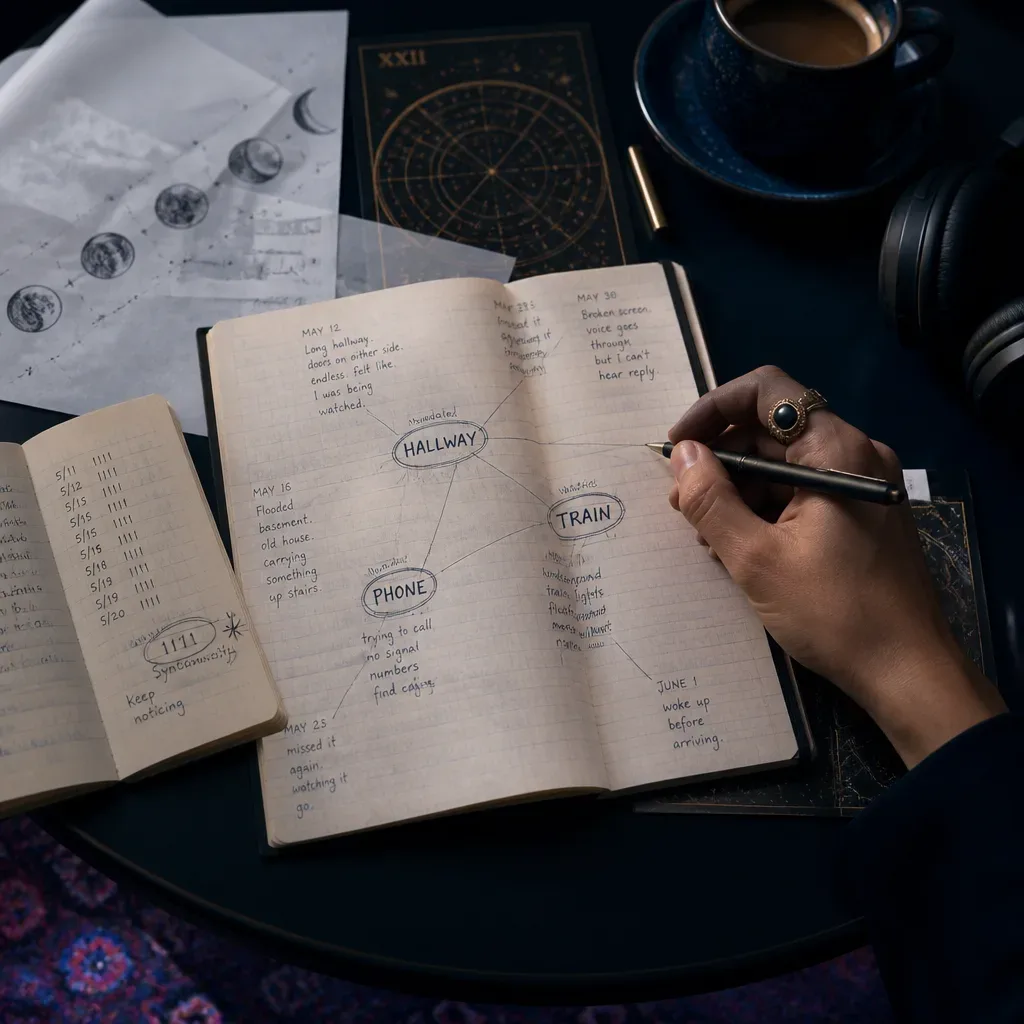
The journal is also a pattern machine. After 10 entries, you may notice water, elevators, dead phones, old apartments, or a specific feeling of being late. In lucid dreaming language, these are dream signs: repeated features that can trigger the question, “Am I dreaming?” In the Manifestation pillar, naming is treated as part of the work because attention changes the way a thing behaves in the room. Dreams are no different. What you name, you can meet again.
A useful journal is not a diary with better lighting. It is field notes from the border. Keep it plain, quick, and honest. One line written within 2 minutes of waking often beats 500 elegant words written after coffee.
The dream sign is not decoration. It is the handle on the door.
What should you write down the moment you wake?
Write the strongest fragment first, then add structure only after the memory is safe.
Dream memory is famously slippery. Sleep researcher Robert Stickgold has written about the unusual logic of dreaming and memory consolidation; the waking brain often loses dream material quickly because it was encoded in a different state. That is why the first 90 seconds matter. If you reach for messages, weather, or headlines first, the dial moves.
Use the smallest possible capture system. I like a notebook because it cannot seduce me into checking Berlin tram delays, but voice notes work if your hands are slow in the morning. Date the entry. Add the wake time if you know it. Then write the fragment exactly as it arrived, even if it is absurd.
A practical entry can follow this order:
- Title: “Green elevator,” “Hotel with no roof,” “11:11 ticket.”
- First image: the sharpest visual detail.
- Emotion: anxious, calm, watched, delighted, rushed.
- Setting: childhood kitchen, airport, dark ocean, office that was also a church.
- Characters: known people, strangers, animals, versions of yourself.
- Impossible detail: broken physics, changing rooms, dead people alive, unreadable text.
- Possible dream sign: one recurring element to tag.
The number 7 is arbitrary, but the constraint matters. A short checklist prevents perfectionism from dressing up as devotion. If you remember nothing, write “no recall” and one body sensation. After 14 days, even the blank mornings say something about sleep timing, stress, alcohol, screens, or the lunar mood you swear you do not track until you do.
Dream journaling becomes more effective when you stop asking for the whole dream and start asking for the signal.
How do you identify dream signs without over-reading everything?
You identify dream signs by counting repetition, not by forcing symbolism onto every object.
This is where the practice gets cleaner. A red bird once may be beautiful. A red bird five times in 3 weeks is a candidate. Doreen Virtue popularized angel numbers for a wide audience, especially sequences like 111 and 444, though many readers now hold that work with distance and discernment. The same principle applies here: repetition deserves attention, but attention is not the same as surrendering your common sense.
Review your journal every 7 entries. Use a pen, not a verdict. Circle anything that repeats across nights. If you are working digitally, tag entries with simple labels: water, school, ex, teeth, late, flying, phone. After 21 entries, sort the tags and count them. One specific number can save you from a very dramatic theory.
| Dream sign category | What to look for | Audio cue example |
|---|---|---|
| Place | old apartment, school, train station | “When I am back in that apartment, I pause.” |
| Person | former partner, teacher, dead relative | “When I see her, I check my hands.” |
| Object | broken phone, blue door, ticket | “When the ticket has no number, I know.” |
| Emotion | rushing, hiding, being watched | “When urgency floods the room, I question it.” |
| Physics | floating, changing text, impossible light | “When the light changes twice, I am dreaming.” |
The best dream sign is frequent, vivid, and easy to test. A general mood like “confusion” can work, but an object like a phone that will not dial is easier. LaBerge’s MILD technique, or Mnemonic Induction of Lucid Dreams, asks the dreamer to remember the intention to recognize dreaming. Dream signs give that memory a target.
If everything feels meaningful, choose the thing that appeared at least 3 times. If nothing repeats yet, keep writing. The mirror needs data before it gives you a clean reflection.
How do you turn dream signs into audio cues?
You turn a dream sign into audio by writing a short first-person cue that links the sign to recognition.
This is where a notebook becomes a recording. Choose one dream sign. Not nine. One. The sleeping mind is not a committee meeting; it responds better to a clean signal. If your repeated sign is “I cannot find my room,” the audio cue might be: “When I cannot find my room, I stop, look at my hands, and know I am dreaming.”
Keep the sentence under 15 seconds when spoken. Cognitive load matters. A 2012 review in Consciousness and Cognition discussed prospective memory as a key part of lucid dream induction; you are trying to remember to do something later, under unusual conditions. That is the same mental category as remembering to buy salt when you pass the shop, except the shop is underwater and your first-grade teacher is the cashier.
Here is the simple conversion:
- Name the sign: “When I see the blue hallway…”
- Name the pause: “…I stop and look closely…”
- Name the test: “…I check my hands or read the text twice…”
- Name the recognition: “…and I know I am dreaming.”
For readers already using the AYA Method, this audio logic will feel familiar. The AYA Method is a daily audio manifestation practice. Each day you listen to a short personalized recording — your Dream-Self Moment — narrated from the version of you who has already manifested the life you intend. Listening is the practice. Repetition is the work. The audio is the method.
Lucid dreaming audio is adjacent, not identical. The Dream-Self Moment holds identity and intention; the dream-sign cue trains recognition. They can sit in the same morning or evening rhythm, but do not confuse the complement with the spine. Audio works because it repeats the chosen signal until it starts to feel already known.
A cue becomes powerful when it is specific enough for the dream to recognize itself.
What should your lucid dreaming audio script sound like?
Your audio script should sound calm, concrete, and slightly already true.
The mistake is making it theatrical. You do not need thunder, a cathedral reverb, or a twelve-minute speech about cosmic power. You need a sentence the mind can carry across the threshold. Dr. Andrew Huberman often discusses repetition and state-dependent learning in the context of the nervous system; while lucid dreaming is its own specialty, the broader point holds: what you rehearse consistently becomes easier to access under pressure.
Use present tense. Use your actual dream signs. Speak slowly enough that one cue can land in the body. If you record three cues, leave 5 to 8 seconds of silence between them. Silence gives the image somewhere to appear.
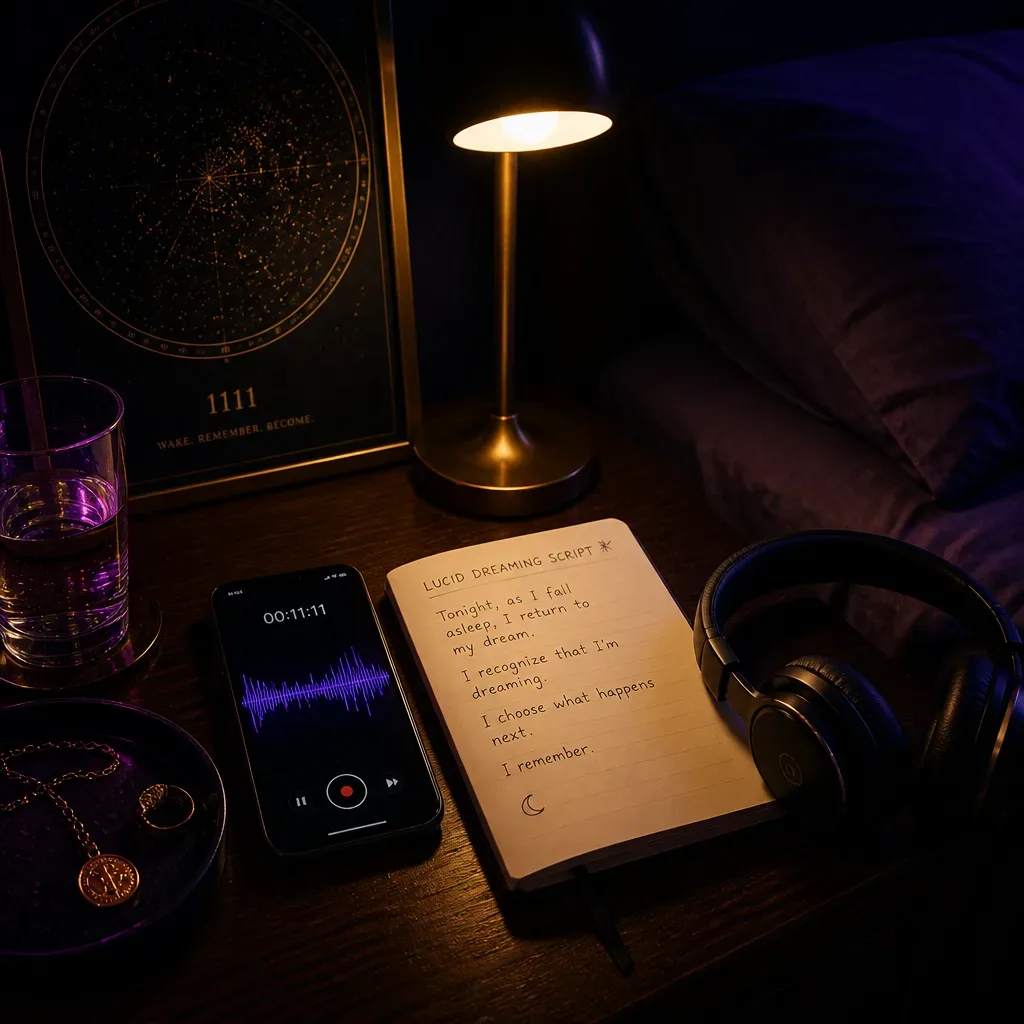
A clean 60-second script might look like this:
“Tonight I remember my dreams. When I see the blue hallway, I pause. I look at my hands. I read the nearest word twice. If the letters change, I know I am dreaming. When the phone will not work, I smile and check the room. I do not chase the dream. I witness it. I stay calm. I remember.”
Notice the lack of decoration. The audio is a set of instructions wrapped in a steady voice. If you use the Affirmations pillar as a reference, keep the affirmation precise rather than grand. “I recognize the blue hallway” is stronger than “I am a limitless dream master,” and also less embarrassing at 11:42 p.m.
Record it in your own voice first. If you prefer a generated or narrated version later, fine, but your voice carries a familiar authority. In small lucid dreaming communities, many practitioners report better consistency when cues are personal rather than generic. That is anecdotal, not a lab claim. Still, the mirror knows your accent.
When should you listen to the audio for best results?
Listen when your mind is close to sleep or close to waking, because those thresholds are already tilted toward dream recall.
The two obvious times are the last 10 minutes before sleep and the first 10 minutes after waking. Before sleep, the cue supports intention. After waking, it pairs with journaling and keeps the dream sign active. If you wake naturally during the night, especially after 4.5 to 6 hours of sleep, you may also use a short listen before returning to bed. Many lucid dreamers pair this with Wake Back to Bed, a method that takes advantage of longer REM periods near morning.
LaBerge’s research on MILD found that intention and recall mattered more than strain. Later lucid dreaming studies vary in design and sample size, but the pattern is consistent enough to be useful: techniques work better when they are repeated and remembered. A 2020 paper in Frontiers in Psychology noted that lucid dream induction results are mixed, with no single method working for everyone. Translation: use the cue, track the result, stay humble.
Here is a simple 12-minute routine:
- Minute 0-2: Wake or settle. Do not check your phone.
- Minute 2-5: Write dream fragments or review last night’s sign.
- Minute 5-7: Choose one cue for the day.
- Minute 7-9: Record or replay the cue.
- Minute 9-12: Sit quietly and picture the sign appearing.
If you follow Astrology and manifestation, you might notice dream intensity around a full moon or during a personal cycle. Treat that as timing, not proof. The moon can be a clock. It does not have to be an excuse.
What mistakes make a dream journal too heavy to keep?
A dream journal becomes too heavy when it turns into performance instead of recall.
I say this as a recovering perfectionist with a long history of making simple things ornate until they collapse. A dream journal does not need matching ink, a linen cover, and a theory of the soul by Tuesday. It needs contact. The National Sleep Foundation commonly recommends 7 to 9 hours of sleep for most adults; if your journal routine steals sleep, the method is eating its own tail.
Watch for these traps:
- Writing too late: breakfast memory is usually edited memory.
- Interpreting before recording: analysis can overwrite the raw sign.
- Tracking too many signs: five cues dilute the one that matters.
- Using vague audio: “I become aware” is less useful than “I check the broken phone.”
- Judging blank mornings: no recall is still data.
- Turning it into content: the dream does not need an audience to count.
There is a useful parallel with the Manifestation Board, when used well: it is a visual support, not the practice itself. In lucid dreaming, the journal is a support. The audio cue is rehearsal. Sleep is the field. If the support starts demanding more attention than the field, simplify.
The cleanest rule I know is this: never make the ritual more fragile than the life it has to fit inside. Three lines every morning for 30 days will teach you more than one magnificent entry followed by avoidance.
A practice kept imperfectly has more power than a perfect practice abandoned by February.
How do you know the audio cue is working?
You know the cue is working when it begins to appear in dreams, even before full lucidity arrives.
Do not measure only lucid dreams. Measure earlier signals. Did the blue hallway return? Did you notice your hands looked strange? Did you wake with the phrase “check the phone” in your mind? These are not failures. They are the dial moving one notch. In behavioral change research, intermediate cues often matter because they show the habit loop is forming before the final behavior stabilizes.
Use a weekly review with 4 numbers:
| Metric | What to count each week | Why it matters |
|---|---|---|
| Dream recall nights | 0-7 | Shows whether journaling is improving memory |
| Repeated sign appearances | Total count | Shows whether the cue has a real target |
| In-dream questioning | Total count | Shows awareness entering the dream |
| Lucid moments | Total count | Shows the full recognition event |
If your recall rises from 1 night to 4 nights in a week, that is movement. If you question reality once in a dream but wake immediately, that is movement. A 2016 meta-analysis in Dreaming estimated that about 55% of people have had at least one lucid dream in their lifetime, while frequent lucid dreaming is much rarer. The rarity is not a verdict. It is a reason to respect the repetitions.
You can also connect this work back to the broader lucid dreaming practice and the way the AYA Method uses daily listening as a steady spine. The journal notices. The audio rehearses. The dream answers when it answers.
Name the signal. Then sleep.