astrology manifestation
Full Moon Ritual: Release With 3-Minute Audio
A quiet full moon ritual for release using paper, breath, and a 3-minute Dream-Self audio so you can let the old story soften.

The glass of water is beside the bed. The notebook is open. A full moon ritual can be simple: name what has ended, listen to a 3-minute Dream-Self audio, and choose one small act that proves you’re no longer living from the old sentence.
What does a full moon ritual actually release?
A full moon ritual releases your repeated agreement with an old pattern, not the facts of your life.
The moon reaches fullness once every 29.5 days, according to NASA’s lunar cycle data, which makes it a useful monthly marker. Not magic in the dramatic sense. A marker. A soft bell. You look up, notice the light, and ask what has become too heavy to keep carrying.
Release is often misunderstood as forgetting. It isn’t. You may still remember the breakup, the burnout, the sentence your old boss said at 4:42 p.m., the way your body tightened before every meeting. The ritual doesn’t erase memory. It changes your rehearsal. In behavioral psychology, repetition is one way patterns stay available to the brain. A 2009 study in the European Journal of Social Psychology found habit formation took a median of 66 days, with wide variation from 18 to 254 days. The point is plain: what you repeat starts to feel like you.
A full moon ritual asks you to stop repeating one thing on purpose. One belief. One attachment. One small punishment you’ve mistaken for discipline.
Release is not a performance. It’s a private decision to stop feeding the old line.
For the astrology-minded, the full moon is often treated as a time of culmination. If you want the broader frame, Astrology and manifestation holds the connection between timing, attention, and intention without making the moon do all the work. The moon can mark the moment. You still choose the sentence you’re done living inside.
Use this ritual when you feel overfull. Not broken. Not behind. Overfull. Too many tabs open in the mind. Too many versions of yourself trying to be heard at once.
Why add a 3-minute Dream-Self audio to the ritual?
A 3-minute Dream-Self audio gives the release a new voice to follow.
The ritual needs more than subtraction. If you only write what you’re letting go, the old story may stay in the center. Audio changes the center. It lets you listen to the version of you who already knows how to live without that story. Three minutes is long enough to enter the body, and short enough to repeat on a tired night.
The AYA Method is a daily audio manifestation practice. Each day you listen to a short personalized recording, your Dream-Self Moment, narrated from the version of you who has already manifested the life you intend. Listening is the practice. Repetition is the work. The audio is the method.
That last sentence matters here. The audio is not decoration for the ritual. It’s the method. The candle, the water, the notebook, the moon at the window: these can support you. But the core practice is listening. Dr. Andrew Huberman has spoken often about neuroplasticity needing both attention and repetition. The exact mechanisms are complex, but the usable truth is simple: the nervous system learns from what you return to.
A full moon ritual with audio holds two truths at once:
- You can name what is complete.
- You can hear who you are becoming without the old script.
- You can keep the practice small enough to do again.
This is where manifestation becomes less like wishing and more like rehearsal. Not forcing. Rehearsal. A quiet choosing of the self you keep meeting.
| Ritual part | What it does | Time |
|---|---|---|
| Paper release | Names the old pattern | 3 minutes |
| Dream-Self audio | Gives the new self a voice | 3 minutes |
| Closing action | Makes tomorrow specific | 2 minutes |
How do you prepare without making it complicated?
You prepare by removing friction, not by gathering more objects.
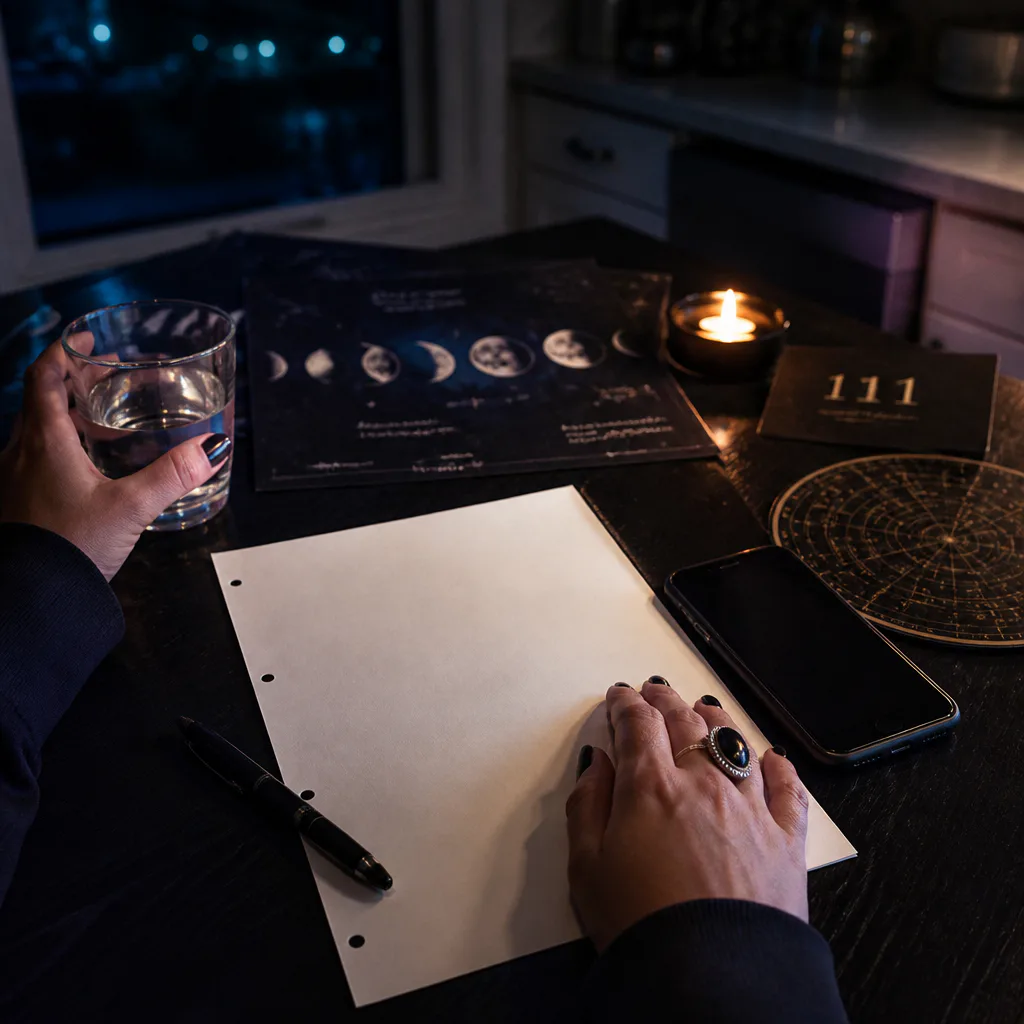
Set out five things: paper, pen, water, a place to sit, and your 3-minute Dream-Self audio. If you like a candle, light one. If you don’t, don’t. The American Psychological Association has noted that stress can narrow attention and increase rumination; when you’re already carrying too much, extra ritual steps can become another task you quietly resent.
Keep the room ordinary. A kitchen table counts. A bathroom floor counts. Your parked car counts, if it’s safe and still. Ritual is not proved by aesthetics. It’s proved by attention. I learned that the first month after I left my magazine job, when my apartment was mostly laundry and silence. My notebook was a receipt envelope. It still worked.
Before you begin, turn your phone face down except for the audio. If possible, set it to Do Not Disturb for 12 minutes. Pew Research Center reported in 2024 that 72% of U.S. teens say they often or sometimes feel peaceful without their smartphone, and adults know the same relief in their bodies even when no one has surveyed them at midnight. Fewer interruptions make the ritual easier to trust.
Use this simple setup:
- Pour a glass of water.
- Put one hand on the notebook.
- Take 6 slow breaths.
- Write the date and the moon phase.
- Ask, “What am I done rehearsing?”
Don’t search for the most dramatic answer. The true thing may be small. “I’m done checking if they noticed.” “I’m done calling exhaustion ambition.” “I’m done needing the plan to be perfect before I begin.”
What are the exact steps for the 12-minute ritual?
The ritual has five steps: arrive, name, listen, release, and choose tomorrow.
Start with arrival. Sit down. Feel both feet. Take 6 breaths, which usually takes about 45 to 60 seconds if you’re breathing slowly. A 2017 review in Frontiers in Human Neuroscience found that slow breathing practices are associated with changes in autonomic function and emotional control. You don’t need to make a project of it. You’re telling the body: here, now.
Then name what has completed. Write three sentences beginning with “I release my agreement with…” Keep the wording exact. Not “I release fear,” which is too large to hold. Try “I release my agreement with checking my email before I know how I feel.” Specific language gives the mind a handle.
Now listen. Play your 3-minute Dream-Self audio. Let your eyes close if that feels safe. Don’t analyze every line. Let the voice land. The daily affirmation inside the app can support the mood later, and the Manifestation Board can help you see the life you’re practicing toward, but here the audio leads. The listening is the practice.
After the audio, choose one sentence from the page. Tear it into four pieces, fold it away, or place it in recycling. Don’t burn paper unless you have a safe container and ventilation. Fire departments in the U.S. respond to an estimated 353,500 home structure fires per year, according to National Fire Protection Association data from 2017 to 2021. Safety is part of devotion to your future self.
Close with one action for tomorrow. One. Send the email. Delete the draft. Leave the meeting on time. Walk for 10 minutes. The action should be small enough that your body believes you.
A future self becomes believable when tomorrow has one honest instruction.
What should you say during the release?
Say the sentence that makes your shoulders drop, not the one that sounds impressive.
Words matter because they focus attention. In affirmations, the best phrases are not loud. They’re believable enough to repeat. A full moon release line works the same way. It should meet you where you are and point you one inch toward what’s true.
Use present-tense language when you can. “I’m allowed to stop proving I’m tired.” “I can leave what has already left me.” “I don’t need to chase a closed door.” If the sentence feels false, soften it. “I’m learning to stop proving I’m tired” may be more honest than “I never overwork.” Honesty keeps the practice from becoming theater.
Here are release lines you can borrow:
- I release my agreement with being available all the time.
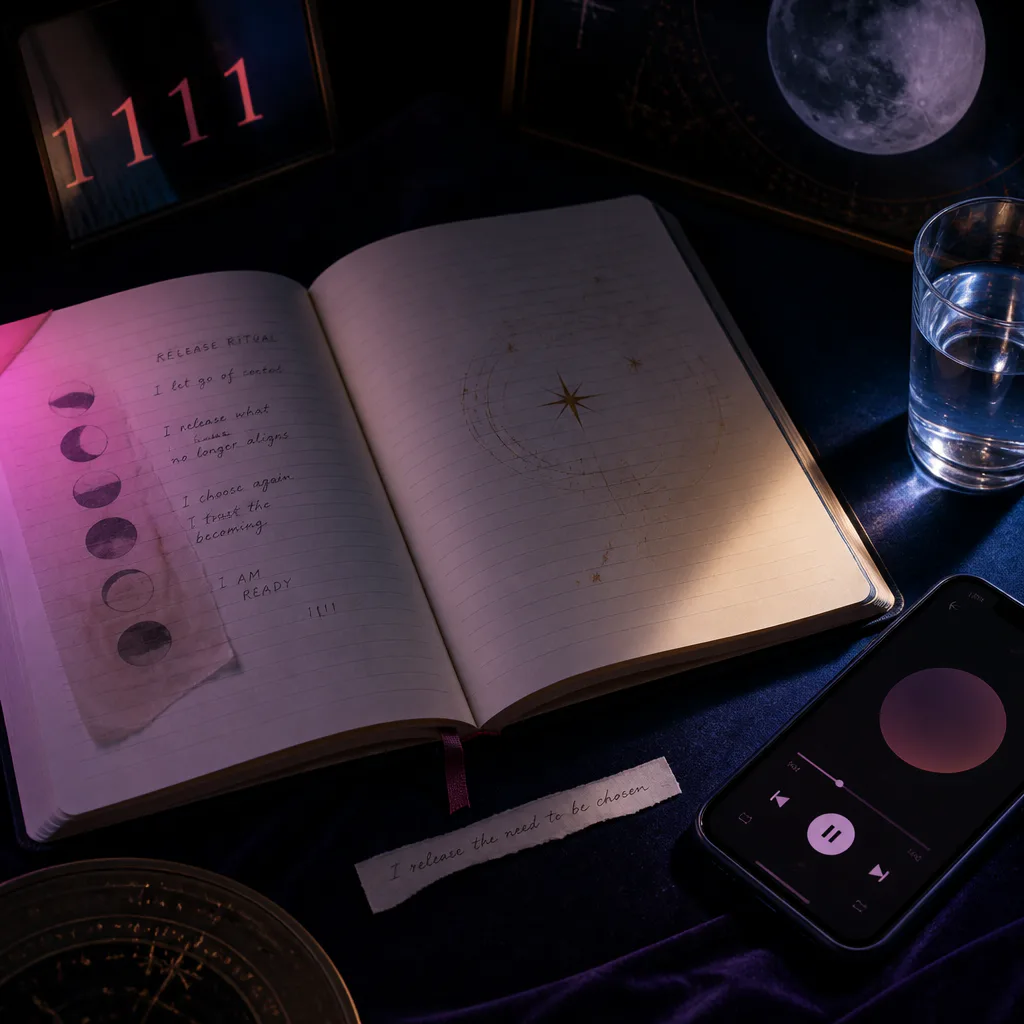
- I release the need to be chosen by people who don’t see me clearly.
- I release the old rule that rest must be earned.
- I release the habit of calling fear a plan.
- I release my attachment to the version of me who survived by shrinking.
- I release the pressure to know the whole future tonight.
Neville Goddard wrote often about assumption and inner speech, especially in The Power of Awareness in 1952. You don’t have to accept every metaphysical claim to use the practical insight: the phrases you live with shape what feels available. Your inner language becomes a room you spend time in.
If you want to connect this to moon timing, return to Astrology and manifestation after the ritual, not during it. During the ritual, stay close. One sentence. One breath. One listen.
How does this connect to manifestation without becoming wishful thinking?
It connects by pairing inner rehearsal with a visible next action.
Manifestation gets vague when it floats away from behavior. It becomes useful when it changes what you practice, say yes to, say no to, and notice. The full moon ritual is not a request sent outward. It’s a rehearsal brought inward. You listen to the Dream-Self Moment, then you choose one action that makes that self easier to believe.
Research on implementation intentions, led by psychologist Peter Gollwitzer, has shown across many studies that “if-then” plans can improve follow-through. The format is simple: if situation X happens, then I’ll do Y. After your ritual, write one. If I wake up and reach for my phone, then I’ll play my audio first. If I want to apologize for needing time, then I’ll pause before answering.
This is where the AYA Method fits naturally with manifestation. The Dream-Self audio gives you the felt image of the self you’re practicing. The full moon gives you a monthly clearing. The next action gives the practice a place to land.
You can also use a simple comparison to keep yourself honest:
| If the ritual becomes… | Return to… |
|---|---|
| Too elaborate | Three minutes of audio |
| Too abstract | One written release sentence |
| Too emotional to finish | One hand on the heart, 6 breaths |
| Too future-focused | One action tomorrow |
There is nothing weak about smallness. Small is how the nervous system agrees to begin.
When should you repeat the ritual, and what should you track?
Repeat the ritual monthly, then track the sentence you released and the action you took.
The full moon gives you a cadence. About 12 or 13 times a year, depending on the calendar, you get a built-in chance to ask what is complete. That number is forgiving. Not daily pressure. Not a once-a-year reinvention. A monthly return.
Keep a simple moon page in your notebook. Four lines are enough: date, release sentence, Dream-Self line that stayed with you, tomorrow’s action. After three months, look back. Patterns will show themselves. You may notice that the same old rule keeps appearing in different clothes. Or you may see that a sentence has lost its hold.
Princeton Engineering Anomalies Research, often called PEAR, ran studies for nearly three decades on intention and random systems. The findings remain debated, and they shouldn’t be treated as proof that thought controls matter. Still, the cultural interest around the research points to something human and old: people want to know whether focused attention matters. In this ritual, you don’t need a grand claim. You only need to notice that focused attention changes your next choice.
You can track gently:
- Did I listen to the audio?
- What did I release?
- What did I do the next day?
- Did the old sentence return?
- What felt even 5% lighter?
Five percent counts. In burnout recovery, five percent may be the first honest measure. It’s the difference between replying instantly and waiting 10 minutes. Between saying yes and asking for time. Between lying awake in the old story and playing the audio once.
For another moon-centered frame, keep Astrology and manifestation nearby. For the daily practice that continues when the moon is no longer full, return to the AYA Method. The moon marks the doorway. The listening helps you walk through it.
Leave the glass by the window until morning.