audio manifestation
Future Self Meditation in 3 Minutes: A Quiet Guide
Future self meditation can fit inside three quiet minutes. Learn the exact audio practice, timing, posture, and reflection that make it real.

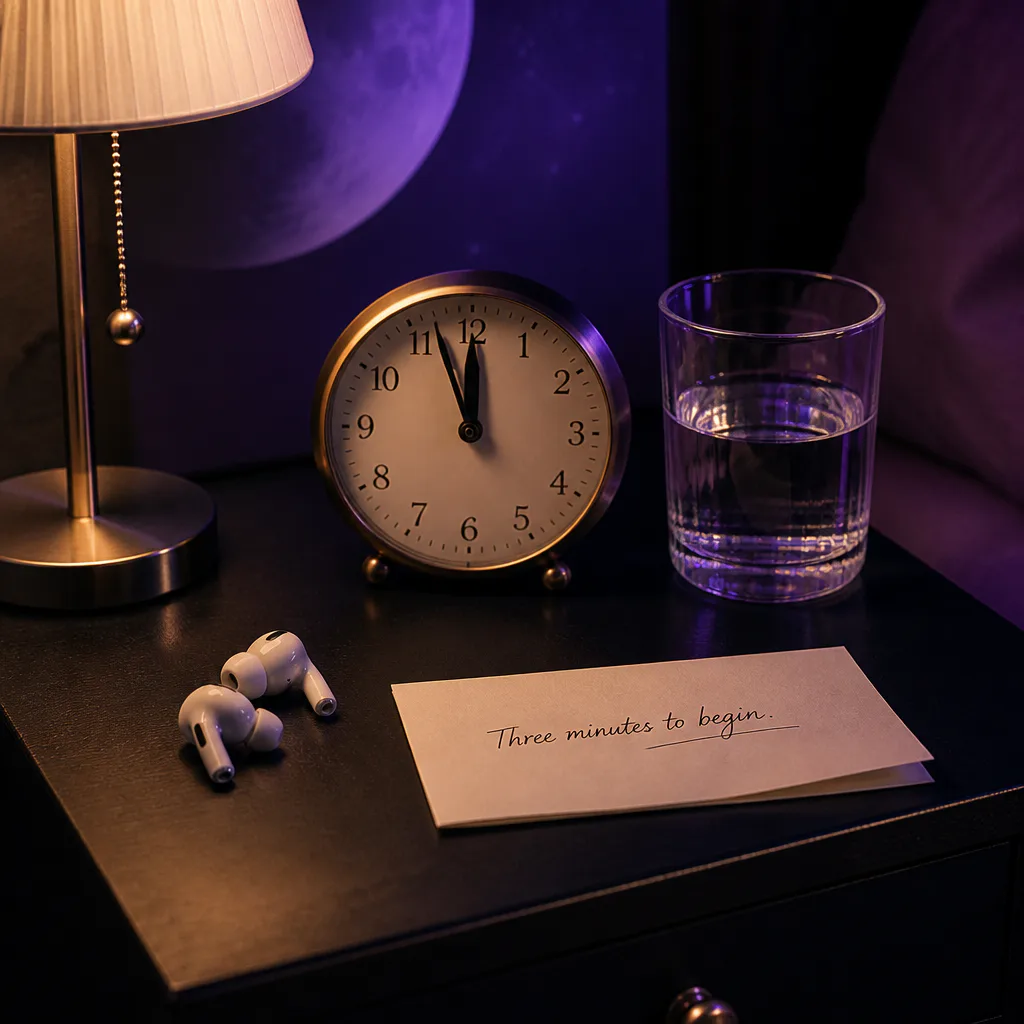
Your phone is on the counter. You have 3 minutes before the kettle clicks, the meeting starts, or the child calls your name. A future self meditation works in that small space when you listen to one short audio, receive one clear line, and take one next action.
What is a 3-minute future self meditation?
A 3-minute future self meditation is a short audio practice where you listen to the version of you who has already become the person you’re practicing toward.
The point is not to escape the room you’re in. The point is to hear a truer instruction while you’re still in it. In 180 seconds, you can let the body settle, hear one image of your future self, and choose one action that belongs to that self today. Small is not weak. Small is repeatable.
The AYA Method is a daily audio manifestation practice. Each day you listen to a short personalized recording, your Dream-Self Moment, narrated from the version of you who has already manifested the life you intend. Listening is the practice. Repetition is the work. The audio is the method.
Research gives this a plain spine. Hal Hershfield and colleagues found in 2011 that people who interacted with aged images of themselves allocated more money toward retirement than people who did not. The study was about saving, but the deeper idea is useful here: when the future self feels more real, present choices can change.
This is why a future self meditation is different from general relaxation. It has an identity target. It asks, who am I rehearsing being now? If you’re new to manifestation, this matters. Manifestation is not only wanting. It is the repeated practice of seeing, feeling, and choosing from the life you intend.
A 3-minute practice is also honest. Many people don’t have 30 quiet minutes. You may not have a candle, a clean desk, or a soft morning. You may only have the walk from the bedroom to the kitchen. Three minutes can still hold a full return.
The practice is not made real by its length. It is made real by your return.
How do you set it up in under 30 seconds?
You set it up by removing choice before the audio begins.
Most short practices fail because the first minute gets spent deciding. Where should I sit? Which recording should I use? Should I journal first? The 3-minute version has no room for negotiation. You choose one cue, one audio, and one posture. Then you begin.
Use this simple setup:
- Put the phone within reach before the cue happens.
- Open the same future-self audio each time.
- Sit or stand in one repeatable place.
- Take 3 slow breaths.
- Press play before you check anything else.
That is the whole doorway. In habit research, context matters. Wendy Wood’s work on habit formation has shown that repeated behavior in stable contexts becomes more automatic over time. One commonly cited 2009 study by Phillippa Lally and colleagues found that habit formation took a median of 66 days, with wide variation. You don’t need to obsess over the number. You do need a cue you can meet again.
Here is a quiet way to choose your cue:
| Cue | Why it works | What to avoid |
|---|---|---|
| After brushing teeth | Already repeated once or twice daily | Adding 5 extra tasks |
| Before opening email | Protects the mind before input | Checking notifications first |
| In the parked car | Clear pause before transition | Scrolling after the audio |
| Before sleep | Less competition from tasks | Using it as a way to judge the day |
The cue should feel almost too ordinary. That is good. A practice that needs a perfect mood will disappear on a hard Tuesday. A practice tied to a toothbrush, a car seat, or a closed laptop can survive.
What should you listen for inside the audio?
Listen for one detail that makes your future self feel specific, believable, and near.
A future-self audio can contain many things: a voice, a room, a sentence, a decision, a feeling in the body. In 3 minutes, don’t try to hold all of it. Let one detail choose you. It might be the way your future self speaks with less apology. It might be a sentence about money, love, health, or work. It might be the quiet sound of a home you haven’t lived in yet.
Mental imagery research supports this focus on specificity. A 1994 meta-analysis by Driskell, Copper, and Moran found that mental practice improved performance across many tasks, especially when paired with physical practice. The meditation is not the whole action. It is the rehearsal before the action.
If the audio includes words that sound like an affirmation, let them land, but don’t turn the practice into a recital. The affirmations can support the day. They can give you one line to remember. Still, in this method, the listening comes first. The daily affirmation is a complement. The recording is the practice.
Try listening in 3 passes, all within the same 180 seconds:
- First minute: hear the setting and let your breathing slow.
- Second minute: notice the line or image that feels most true.
- Third minute: ask what this version of you would do next.
This is not pretending. Pretending needs strain. A good future self meditation feels like recognition. Some part of you says, yes, I know this. Maybe not fully. Maybe not yet. But enough to move.
Your future self does not need to be dramatic to be real. Sometimes she simply answers the email without shrinking.
How do you stay with it when your mind wanders?
You stay with it by treating distraction as a return point, not a failure.
Your mind will leave. It will remember the invoice, the child permission slip, the meeting at 9:00, the strange text you didn’t answer. That is not proof the meditation failed. It is proof you have a working mind. The work is to notice, soften, and come back to the audio.
Attention studies often describe this loop as monitoring and returning. In meditation research, even brief training can change attentional control, though effects vary by study size and design. A 2014 review in JAMA Internal Medicine found moderate evidence that mindfulness programs can reduce anxiety, depression, and pain. That doesn’t mean every 3-minute audio will change your day. It means repeated attention practice has a measurable place in the literature.
Use one of these anchors when you drift:
- The narrator’s next sentence
- The feeling of headphones touching your ears
- One slow exhale
- The image of your future self’s hands
- The last word that felt true
The anchor should be simple enough to find while tired. Don’t punish yourself with a full reset. Come back at the next word. Come back halfway through the breath. Come back in the final 10 seconds if that’s what you have.
I learned this the hard way. I came to manifestation after years of spreadsheets, forecasts, and meetings where every number had to defend itself. My first instinct was to measure the practice while doing it. Did I feel something? Was it working? Was I doing it right? That made the audio smaller. Listening got better when I stopped grading it.
You can’t listen and audit yourself at the same time.

What do you do in the last 30 seconds?
You use the last 30 seconds to name one small action that matches the self you just heard.
This is where the practice touches the day. Not with a giant promise. With one next thing. Send the message. Drink the water. Open the document. Put the card away. Walk into the room slower. Say the cleaner sentence. Future self work becomes real when it changes the next ordinary choice.
Psychologist Gabriele Oettingen’s research on mental contrasting, including work summarized in her book Rethinking Positive Thinking, suggests that desired futures work better when paired with present obstacles and concrete plans. Peter Gollwitzer’s implementation-intention research is similarly plain: if-then plans help people act. If it’s 8:30, then I press play. If the audio ends, then I write one line.
Use this 30-second closing:
- Ask: What did I hear?
- Ask: What is one action that belongs to that version of me?
- Choose an action that takes under 5 minutes.
- Do it before you explain it to anyone.
You can write the answer down if that helps. One sentence is enough. Aya also includes a Manifestation Board, which can hold images and reminders, but it is not the center of the practice. The board helps you see. The audio helps you listen.
Some readers like timing their practice with personal cycles, moon dates, or birth-chart reflections. If that language is yours, you may find astrology and manifestation useful as a supporting lens. Keep the order clear, though. The audio comes first. The timing can decorate the doorway, but it doesn’t replace walking through it.
A future self is not proven by a mood. A future self is practiced by a choice.
How do you make 3 minutes feel enough?
You make 3 minutes feel enough by using the same practice daily instead of chasing a bigger version you won’t repeat.
There is a quiet kind of discipline that doesn’t look impressive. It doesn’t make a new plan every morning. It doesn’t need a special notebook. It returns to one recording, one cue, one breath, one action. That is why 3 minutes can work. The limit protects the practice from becoming another task you resent.
The American Psychological Association has reported for years that stress is a common part of daily life, and in its 2023 Stress in America report, many adults named money, health, and the future as major concerns. A future self meditation does not erase those concerns. It gives you 180 seconds of contact with the self who can meet them with less fear.
If you want the simplest structure, keep this:
- Same audio for at least 7 days
- Same cue whenever possible
- Same closing question
- One sentence after listening
- One action under 5 minutes
Seven days is not magic. It is just long enough to notice patterns. Maybe one line keeps returning. Maybe you resist the same action every morning. Maybe your body softens faster on day 4 than day 1. Those are useful signals. Don’t turn them into a performance review.
You can also reread the AYA Method when you forget what matters. The core stays simple: your Dream-Self Moment, repeated daily. Listening is the practice. Repetition is the work. The audio is the method.
The quiet test is not whether the meditation felt perfect. The quiet test is whether you can return tomorrow without making it heavier.
What if nothing seems to happen at first?
If nothing seems to happen, keep the practice small enough to repeat and look for changes in behavior before changes in feeling.
Many people expect a future self meditation to announce itself. Warmth in the chest. Tears. Certainty. Sometimes that happens. Often it doesn’t. Sometimes you listen, feel ordinary, and still make a better choice 20 minutes later. That counts.
Behavior change is often subtle before it is visible. In small studies of self-affirmation, results vary by context, and some research, including a 2009 paper by Wood, Perunovic, and Lee, suggests positive statements can backfire when they feel unbelievable to people with low self-esteem. This is one reason personalized audio matters. It should sound close enough to enter, not so distant that your mind rejects it.
Track plain evidence for 14 days:
| What to notice | Example |
|---|---|
| Faster return | You restart the audio after distraction |
| Cleaner action | You answer one email without overexplaining |
| Softer body | Your jaw releases by the second minute |
| Less delay | You begin the next task within 5 minutes |
| More honesty | You admit what you actually want |
Don’t demand fireworks from a practice built to be daily. Daily things are often quiet. Brushing teeth. Locking the door. Saying goodnight. Listening to your Dream-Self Moment belongs in that category. It doesn’t need to impress you to change the way you move.
If the audio keeps feeling wrong after 7 to 14 days, adjust it. Make the voice more yours. Make the scene more specific. Make the next action smaller. A future self meditation should stretch you, not split you.
Three minutes can be a room you return to.