manifestation for life areas
Manifest Dream Home With a 3-Minute Audio
Use manifest dream home scripting in a 3-minute Dream-Self audio practice that trains attention, choice, and daily action toward home.

To manifest dream home results with a 3-minute Dream-Self audio, script the home as already lived, listen daily, and take one practical action after each session. The audio trains attention. The action trains evidence. Together, they make the future address less abstract and more available.
Why does a 3-minute audio help you manifest dream home clarity?
A 3-minute audio helps because it gives the mind one repeated signal instead of 47 competing fantasies.
The brain is not short on pictures. It is short on priority. A dream home can start as a saved listing, a number seen on a clock, a floor plan pinned at 11:11, or a street you keep taking for no practical reason. Most people stop there. They collect signals and call that practice.
The useful move is to give the signal a daily container. In the AYA Method, the AYA Method is a daily audio manifestation practice. Each day you listen to a short personalized recording, your Dream-Self Moment, narrated from the version of you who has already manifested the life you intend. Listening is the practice. Repetition is the work. The audio is the method.
Three minutes matters because it is small enough to survive a normal morning. A 2021 Statista report put average daily audio listening in the United States above 90 minutes, but most people do not need more content. They need one better cue. A short recording can sit before the noise arrives.
Mental rehearsal also has a record outside manifestation circles. A classic 1994 meta-analysis by Driskell, Copper, and Moran reviewed 35 studies and found mental practice improved performance, especially when paired with physical practice. Not magic. Rehearsal plus behavior.
The audio is not a wand. It is a witness you return to.
When the subject is a home, this matters. A home is not only desire. It is credit, cash flow, timing, partnership, geography, maintenance, and the private courage to admit what no longer fits. The audio keeps the dial pointed while the practical variables move.
What should your Dream-Self Moment actually say?
Your Dream-Self Moment should sound like a calm field report from the version of you already living in the home.
Do not write like a brochure. Brochures say chef’s kitchen, vaulted ceilings, dream oasis. Your nervous system often responds better to evidence: the way the floor feels before sunrise, the mug on the left side of the sink, the mail key in the ceramic bowl, the fact that you no longer check listings with a tight jaw.
A strong script has 3 parts. First, it names the scene. Second, it names the identity. Third, it names the next behavior. That last part keeps the practice from floating off. Gollwitzer and Sheeran’s 2006 meta-analysis on implementation intentions reviewed 94 independent tests and found that if-then planning had a medium-to-large effect on goal attainment. Translation: the future likes a calendar.
Use this structure:
- Scene: I am standing in the morning light of my own kitchen.
- Identity: I am someone who chooses well before urgency chooses for me.
- Behavior: Today I take one clean step toward this home.
- Evidence: I notice options, numbers, names, and doors that match the life I am claiming.
Here is the difference between vague and usable:
| Weak line | Stronger Dream-Self line |
|---|---|
| I live in my perfect house. | I wake in a quiet home where my shoulders drop before my feet touch the floor. |
| Money comes easily. | I review the numbers without flinching and make one decision that supports the address. |
| I love my beautiful life. | I can hear the kettle, the street is still, and the room feels like it waited for me. |
A home script should be intimate, not inflated. The room has to believe you.
How do you prepare before listening each day?
Prepare by removing one distraction, naming the home signal, and choosing the action you will take after listening.
I like mornings because the day has not yet started negotiating. Dr. Andrew Huberman has often discussed the usefulness of early-day light exposure for circadian timing, and sleep researchers have shown that stable morning cues support better routines. You do not need a perfect sunrise. You need a repeatable gate.
Before pressing play, choose one home signal. Not five. One. It could be the blue front door, the walkable school route, the reading chair near a window, the paid-off credit card, or the feeling of not apologizing for wanting more space. A signal is a handle. Without a handle, desire gets slippery.
Then decide the action before you listen. The action can be small enough to look unimpressive. In housing, small is often what counts. The Federal Reserve’s 2022 Survey of Consumer Finances reported a median homeowner net worth of about $396,200 compared with about $10,400 for renters, a gap shaped by time, equity, and access. Big outcomes often sit on boring monthly decisions.
Try this 30-second preparation:
- Put the phone on Do Not Disturb.
- Sit or stand somewhere you will not be interrupted.
- Name the signal: morning light, safe street, clean numbers, right lease, enough space.
- Name the action: email, call, save, walk, ask, transfer, research.
- Press play once. No multitasking.
This is where Manifestation pillar work becomes practical. You are not bargaining with fate. You are training perception and behavior to stop contradicting the address you say you want.
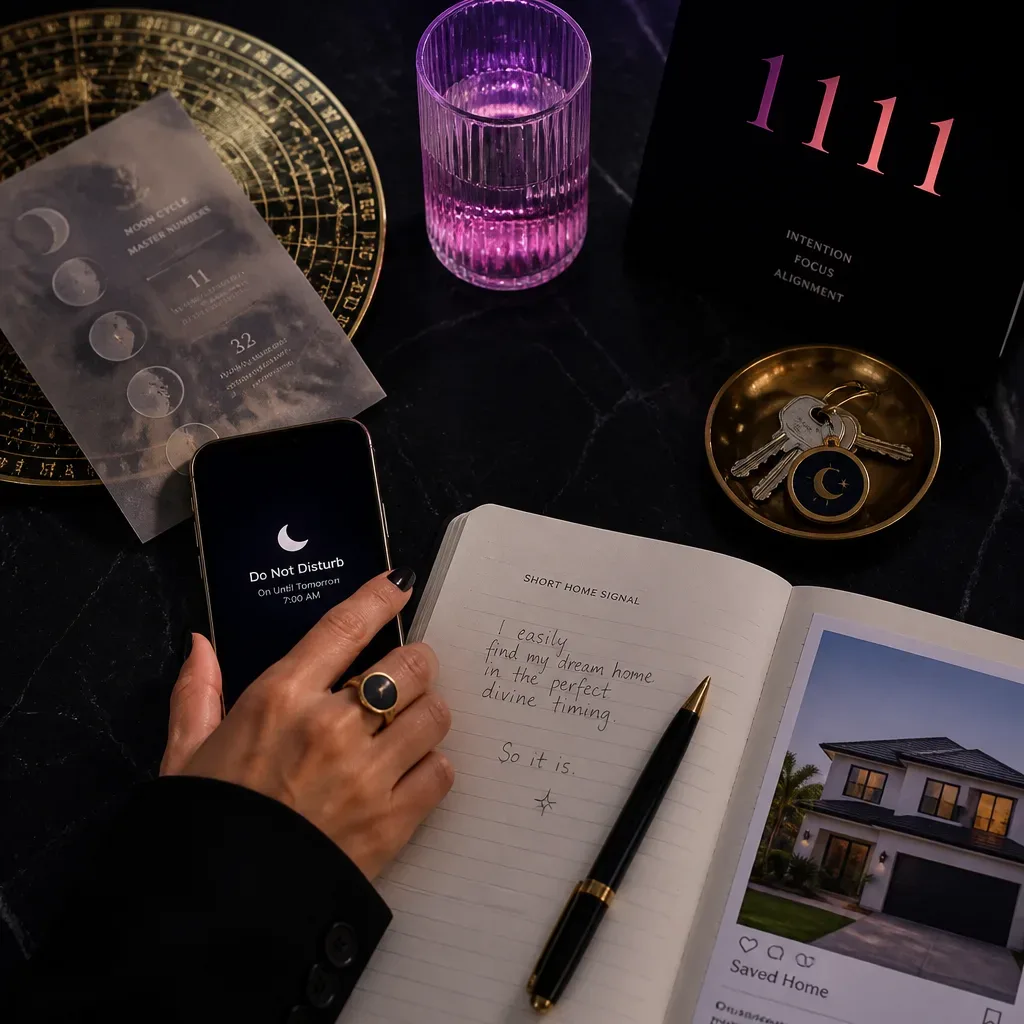
What is the exact 3-minute dream home audio routine?
The routine is one minute of arrival, one minute of identity, and one minute of action.
Minute 1 is arrival. You hear yourself inside the home. Not approaching it. Not earning it. Inside it. The front door has weight. The air has temperature. The room has a sound. If you are trying to claim a coastal place, let the gulls be real. If you want a city apartment, let the radiator knock. Details tell the mind this is not wallpaper.
Minute 2 is identity. This is where many scripts go soft. Do not say only that you have the home. Say who you became to hold it. I am the person who checks the numbers. I am the person who asks the direct question. I am the person who leaves the wrong room on time. Joe Dispenza often teaches mental rehearsal as a way of conditioning the body toward a chosen state; whether you take his metaphysics or leave them, the repetition principle is clear.
Minute 3 is action. The audio should end by naming today. Not someday. Today. One call. One listing. One transfer. One conversation. One walk through the neighborhood at 6 p.m., when the fantasy has to meet traffic.
A sample closing might sound like this:
I live here with steadiness. I choose from evidence, not panic. Today I take the next visible step, and I let the right doors become easier to recognize.
The whole routine takes less time than checking 12 listings you already know are wrong. Three minutes is not less serious. Three minutes is harder to avoid.
How do you act after listening without forcing the outcome?
Act by taking one clean, measurable step and refusing to confuse pressure with faith.
There is a specific kind of frantic browsing that looks like devotion and feels like punishment. I know it. I once ran finance teams, so I can make a spreadsheet look spiritual if left unsupervised. But checking mortgage calculators six times before lunch is not practice. It is anxiety with columns.
After the audio, take one action that leaves evidence. Evidence can be a sent email, a saved deposit, a scheduled viewing, a credit report checked, a conversation with your partner, or a boundary with a landlord. The Consumer Financial Protection Bureau recommends checking credit reports for errors because mistakes can affect lending options; that is not glamorous, but neither is a cracked foundation.
Use the one-step rule:
- If the step takes under 5 minutes, do it immediately.
- If it takes 5 to 30 minutes, schedule it today.
- If it takes more than 30 minutes, break it into the first visible piece.
- If it requires another person, send the message now.
You can also pair the audio with a single line from the Affirmations pillar, but keep the hierarchy clean. The daily affirmation is a complement. The Dream-Self audio carries the practice.
Pressure performs certainty. Practice builds it.
Forcing usually narrows the field. Clean action widens it. When you listen and then act once, you give the day a point of contact. The signal has somewhere to land.
How does Dream-Self audio compare with vision boards and scripting?
Dream-Self audio is best for daily repetition, while boards and written scripts work best as supporting cues.
A Manifestation Board can be powerful because the eye returns quickly. A written script can clarify what you actually mean. But audio enters differently. You can hear timing, tone, hesitation, authority. A future self who sounds calm can become more persuasive than a collage of marble countertops.
Research on self-talk and performance gives this some ground. A 2011 review by Hatzigeorgiadis and colleagues found instructional and motivational self-talk can improve sport performance, with effects varying by task. The home is not a tennis court, but the principle travels: language repeated in the right state changes what you notice and attempt.
Here is the clean comparison:
| Tool | Best use | Risk | Best role |
|---|---|---|---|
| Dream-Self audio | Daily identity rehearsal | Listening without action | Main practice |
| Manifestation Board | Visual memory and taste | Collecting images as avoidance | Complement |
| Daily affirmation | Short verbal cue | Repeating words you do not believe | Complement |
| Scripting | Clarifying desire | Writing novels instead of moving | Planning aid |
| Astrology timing | Naming cycles and windows | Outsourcing choice | Reflection tool |
The Astrology and manifestation lens can be useful if timing helps you pay attention. New moons, Saturn returns, and master numbers like 11 and 22 can mark a season. Still, the lease does not sign itself because Mercury changed direction.
Use symbols as clocks, not crutches.

What signals show the practice is working?
The practice is working when your attention, decisions, and emotional baseline shift before the external result arrives.
This is the part skeptics should protect. Do not call every feather a contract. Do not call every 11:11 a mortgage approval. Synchronicity is interesting because it sharpens attention, not because it excuses evidence. Carl Jung used the term synchronicity for meaningful coincidence in the 20th century; he did not mean that coincidence replaces action.
Look for grounded signals across 30 days. Thirty days is long enough to see patterns and short enough to keep the experiment honest. A 2009 study by Lally and colleagues found habit formation averaged 66 days, with wide variation, but noticeable automaticity began earlier for many participants. Your first month is not the whole house. It is the foundation inspection.
Track these markers:
- You stop saving homes that match old fear instead of current desire.
- You ask clearer money questions.
- You notice neighborhoods at the right times of day, not only in edited photos.
- You feel less shame about wanting a home that suits your actual life.
- You take one action most days without needing a dramatic mood.
- You recover faster when a door closes.
The strongest signal is often not a sign. It is a better decision made on an ordinary Tuesday.
If you want broader context for desire, evidence, and repetition, keep Manifestation pillar close. If you want to refine the exact sentence that follows the audio, revisit Affirmations pillar. The dial works better when each tool has its place.
What if doubt shows up while you listen?
Doubt is not a failure of the practice; it is information asking to be named.
If your audio says, I live in my dream home, and your body replies, absolutely not, do not paste glitter over the objection. Ask what the doubt knows. Maybe the numbers are not ready. Maybe the location is wrong. Maybe the dream belongs to a version of you from 8 years ago. Maybe you want quiet more than square footage.
Tara Brach’s RAIN practice, recognize, allow, investigate, nurture, has been widely used in mindfulness teaching because it makes difficult emotion workable. You can borrow the first 2 moves: recognize and allow. During the audio, you might say internally, doubt is here. Then keep listening.
Adjust the script if it is too far beyond belief. Not smaller, necessarily. Truer. Instead of I own the exact house by June, try I am becoming the person who recognizes, funds, and receives the right home in right timing. The second sentence leaves room for reality without surrendering the claim.
This is also where the AYA Method earns its keep. Daily audio does not demand that you feel certain every morning. It asks you to return. Repetition is a kind of vote. Some days it is a quiet vote, but it still counts.
A dream home is not proved by intensity. It is proved by the life you are willing to prepare for.
When the numbers, the room, and the inner signal start to agree, move carefully. Then move.
Keep the key where your future hand can find it.