manifestation for life areas
Manifesting Creativity With 3 Minutes of Audio
Manifesting creativity can be quiet and short. Use a 3-minute Dream-Self audio to meet the self who already makes, writes, cooks, and begins.
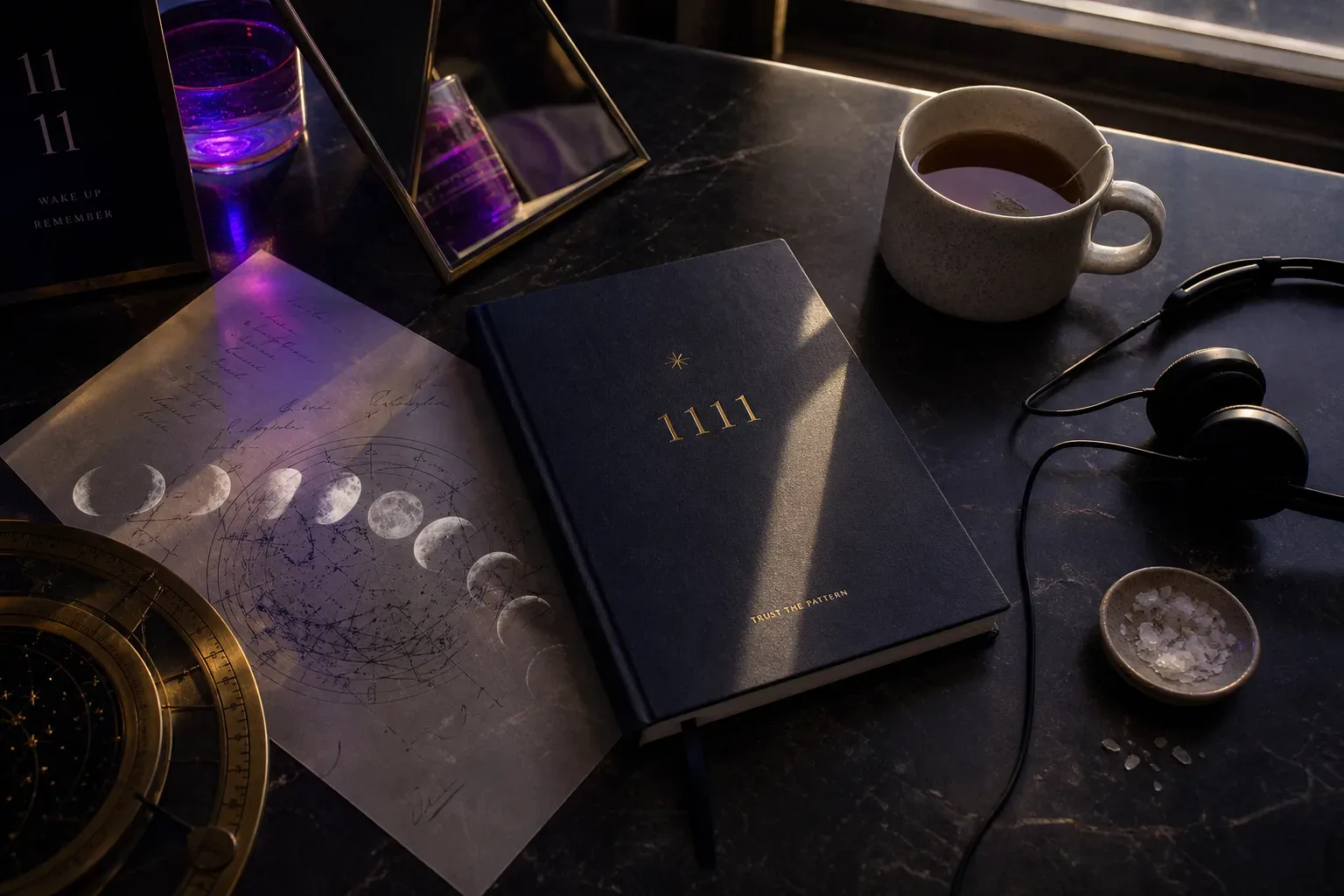
The kettle clicks off. Your notebook is still closed. Manifesting creativity means listening, for 3 minutes, to the self who already makes, then taking one small creative action before doubt gets loud. The audio gives your attention a shape. The first mark makes it real.
What does manifesting creativity actually mean?
Manifesting creativity means practicing the identity, attention, and first action of a person who creates regularly.
It doesn’t mean waiting for a rare mood. It doesn’t mean forcing beauty out of a tired body. It means you give your mind a clear picture of who you are becoming, then you meet that picture with one act small enough to do today. Teresa Amabile’s work on creativity at Harvard, first published in Creativity in Context in 1996, names three conditions that matter: skill, motivation, and a social or inner setting that allows ideas to move.
A 3-minute Dream-Self audio works because it speaks to the inner setting. It says, softly: this is the kind of person you are. Not someday. Now. A 2015 review in Neuroscience & Biobehavioral Reviews found that mental imagery and simulation can recruit some of the same neural systems used in perception and action. The brain doesn’t confuse a voice note for a finished poem. But it can rehearse access.
I know this from the kitchen, too. Before a mole is a sauce, it’s a decision to toast the chiles. Before a book is a book, it’s one sentence that doesn’t run away. Creativity often begins with the smallest possible proof.
Creativity doesn’t need a thunderclap. It needs a door you can open again tomorrow.
If you already read about manifestation, you know the practice asks for desire, attention, and repetition. Creativity is one life area where repetition becomes especially tender. The page remembers whether you came back.
Why use a 3-minute Dream-Self audio instead of waiting for inspiration?
Use a 3-minute Dream-Self audio because inspiration is unreliable, while a cue can be repeated.
Three minutes is short enough to fit into a real day. It can sit beside coffee, after school drop-off, before a studio hour, or while the rice rests for 10 minutes under a towel. In habit research, BJ Fogg’s Tiny Habits model emphasizes making the behavior so small it can be done even on low-motivation days. The size is not a flaw. The size is the mercy.
The AYA Method is a daily audio manifestation practice. Each day you listen to a short personalized recording — your Dream-Self Moment — narrated from the version of you who has already manifested the life you intend. Listening is the practice. Repetition is the work. The audio is the method.
For manifesting creativity, that Dream-Self Moment might sound like you after the book proposal is sent, after the ceramics shelf is full, after you’ve cooked the menu enough times to trust your hand. The voice is not begging. It’s remembering. Neville Goddard called imagination the act of assuming the fulfilled state; his language was mystical, but the useful part is simple: you rehearse being the one who has already begun.
A 2020 paper in Psychology of Aesthetics, Creativity, and the Arts noted that creative self-efficacy, the belief that you can produce creative outcomes, predicts creative behavior across multiple settings. Audio can help because belief often needs a body cue. Headphones on. Breath lower. The same first sentence.
How do you prepare the audio so it sounds true?
Prepare the audio by choosing one creative identity, one real scene, and one first action.
Don’t make the scene too grand. Your mind may resist it. Choose something close enough to feel possible. A poem open beside the sink. A voice memo after walking 12 minutes. A design file named clearly. A bowl of masa covered with a damp cloth because you’re coming back. Specificity makes the future less theatrical and more useful.
Use this simple structure:
- Name the identity. “I’m the woman who writes before checking messages.”
- Name the scene. “The page is open. The room is quiet. My hand is moving.”
- Name the feeling. “I don’t need to prove it all today. I only need to return.”
- Name the action. “After I listen, I write six lines.”
- Name the proof. “The draft exists because I touched it again.”
Psychologist Peter Gollwitzer’s research on implementation intentions, published across the 1990s and 2000s, found that if-then plans increase follow-through by tying action to a cue. Your audio can hold that cue. “After I listen, I open the file.” That line is plain. Plain lines often save us.
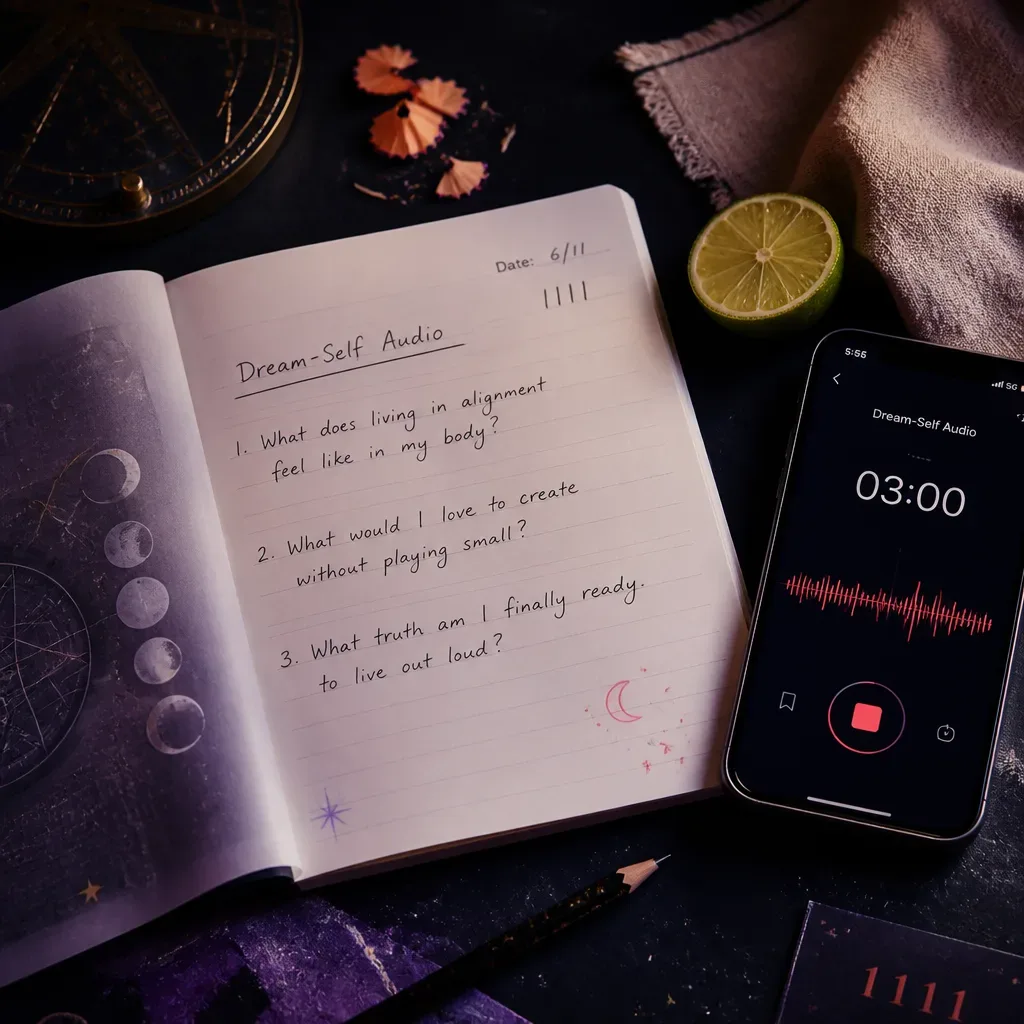
Here is a small table I use when a creative wish feels too cloudy:
| Creative wish | Dream-Self scene | First action after audio |
|---|---|---|
| Write essays | A document with one honest paragraph | Write 6 sentences |
| Cook publicly | A tested recipe card on the counter | Photograph one plate |
| Paint again | Brushes rinsed and laid flat | Mix 2 colors |
| Make music | A saved rough track | Record 30 seconds |
| Start a shop | Product notes in one folder | Name 3 items |
The point isn’t to make the future impressive. The point is to make it reachable. If you use affirmations, keep one line beside the audio, not as a second center of gravity. Something like: “I return to the work before I judge it.” One sentence. That’s enough.
What should you do during the 3 minutes?
During the 3 minutes, listen without multitasking and let the future self be more familiar than the fear.
Sit, stand, or walk slowly. You don’t need a candle, but you may light one. You don’t need silence, but you may want it. Dr. Andrew Huberman has often discussed the role of visual focus and breathing in shifting nervous system state; the simple version is this: a slower exhale and reduced distraction can make the body more available for action. Try 5 breaths before pressing play.
During the audio, don’t argue with every sentence. Let it pass through. If one line feels false, notice it and keep listening. In clinical settings, repetition and exposure are often used to make unfamiliar states less threatening. This is not therapy. Still, the principle is gentle and useful: what you meet often can become less strange.
A 3-minute practice can follow this rhythm:
- Minute 1: arrive in the body, hands unclenched, eyes soft.
- Minute 2: hear the Dream-Self Moment as a scene already lived.
- Minute 3: receive the first action and see yourself doing it.
The audio doesn’t create for you. It makes the first creative act easier to recognize.
This matters because creative fear often wears practical clothes. It says you need a better pen, another class, a cleaner kitchen, 2 free hours. Sometimes you do need support. Often you need one beginning. According to the U.S. Bureau of Labor Statistics, many people have less than 5 hours of leisure on an average workday, and much of that is fragmented. Three minutes respects the life you actually have.
What happens right after the audio ends?
Right after the audio ends, do one visible creative action before you check anything else.
The moment after listening is delicate. Don’t fill it with messages. Don’t ask the room for permission. Do the action you named. If you’re writing, write six lines. If you’re cooking, pull one ingredient from the shelf. If you’re painting, uncap the brush pen. If you’re planning a business, open the note and write the first offer in ugly language.
James Clear popularized the idea that identity-based habits grow through repeated votes. The phrase is useful here. Every small action is a vote for the maker you are practicing. Not a dramatic vote. A small one. A vote that fits in the palm.
In the AYA app, the Manifestation Board can support this moment by holding a visual reminder of what you’re making. It is a complement. The audio remains the method. You may also like reading about astrology and manifestation if timing helps you begin, but don’t let timing become another way to wait.
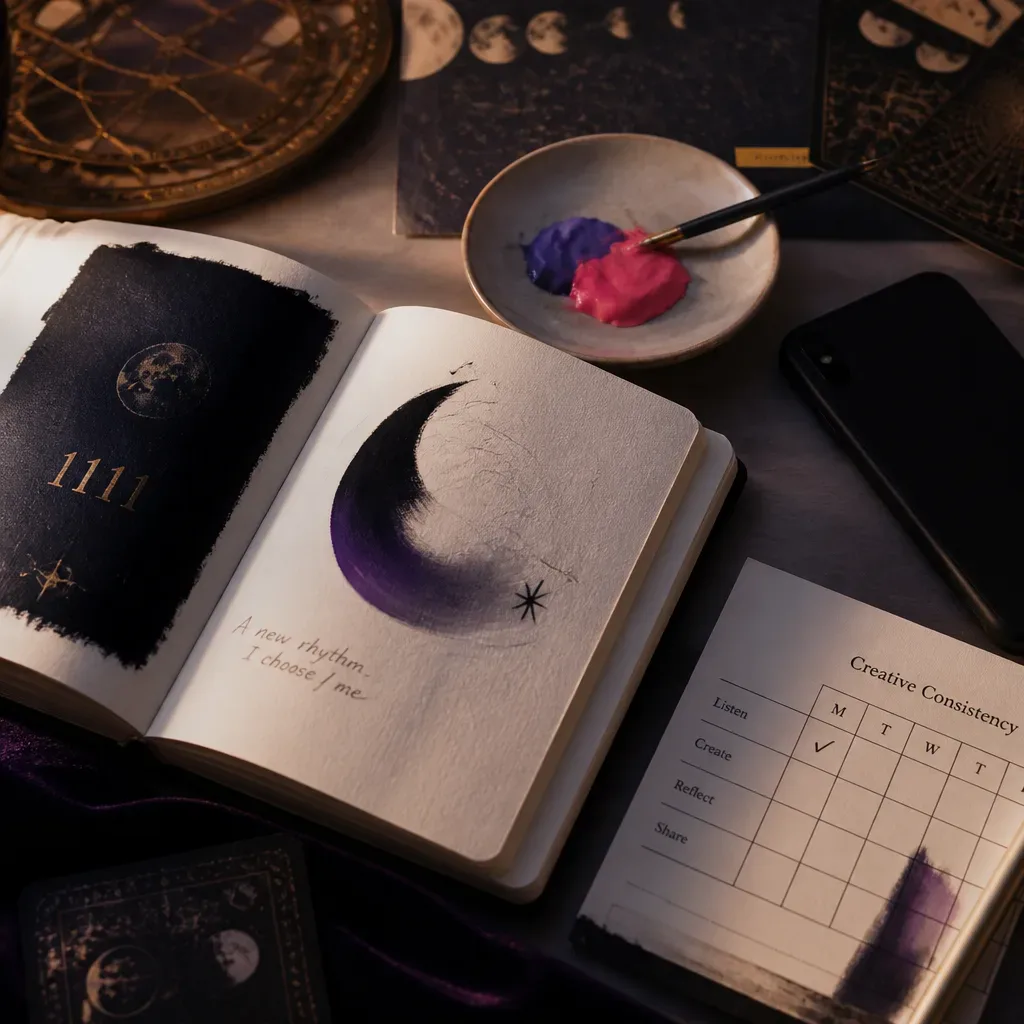
Use this after-audio rule for 7 days:
- Listen to the same Dream-Self Moment.
- Do the same first action.
- Stop while the action still feels possible.
- Mark the day with a small check.
- Leave the next step visible.
A 2009 study in the European Journal of Social Psychology found that habit formation took an average of 66 days, with wide variation from 18 to 254 days. Seven days won’t build a whole creative life. It will show you whether the door is placed well.
How do you keep it from becoming another thing to fail at?
Keep it kind, measurable, and small enough that missing one day doesn’t become a verdict.
Creative people are often cruel to the part of them that begins. You don’t need that cruelty. You need a structure that can survive a bad night of sleep, a sick child, a shift that runs long, a sink full of bowls. In small studies on self-compassion, including work by Kristin Neff and colleagues, people who respond to setbacks with less self-attack often show more willingness to try again.
So set a minimum. Not a fantasy minimum. A true one. Three minutes of listening. One small mark. That is the floor. You may do more, but you don’t build the practice on more. You build it on return.
Watch for these signs that the practice is too heavy:
- You keep rewriting the audio instead of listening.
- You require a perfect mood before you begin.
- You turn the first action into a full project.
- You punish yourself for missing one day.
- You compare your private beginning to someone else’s finished work.
A practice that requires your perfect life will not meet your real one.
If you miss a day, don’t repair it with drama. Listen the next day. In food, you learn this quickly. One burned tortilla doesn’t ruin the meal. You warm another. You keep your hands near the heat.
You can also read the broader manifestation pillar when you want the bigger frame, or return to the AYA Method when you want the audio practice itself. For creativity, keep the center simple. Listen. Make one mark. Return.
How will you know the practice is working?
You’ll know it’s working when beginning feels less dramatic and evidence starts to gather.
Look for quiet measures. Not fame. Not applause. Count returns. Count pages touched. Count meals tested. Count sketches dated. Count the number of times you began before asking whether the work was good. In creativity research, output volume matters. Dean Keith Simonton’s studies of creative productivity across artists and scientists suggest that more attempts tend to increase the chance of notable work.
Use a 14-day evidence list. It can live in your notes app or on paper beside salt, coffee, or whatever small object tells you the day has started. Make 3 columns: date, listened, first action. That’s all. If you want, add one line called “proof.” Proof might be “I opened the draft” or “I made the soup again and changed the lime.”
The practice is also working if your self-talk changes. You may hear less “Who am I to make this?” and more “I know the next small thing.” That shift matters. Albert Bandura’s theory of self-efficacy, developed in the 1970s, names mastery evidence as one of the main sources of belief. You believe because you see yourself doing.
There is no need to make the practice ornate. Affirmations can give you a line. A board can give you an image. The Dream-Self audio gives you the remembered self in your ear. Then the work asks for your hand.
The room is still here, and so are you.