affirmations
Positive Affirmations for Teens as Future-Self Audio
Positive affirmations for teens work best when they become short future-self audio cues: believable, repeated, private, and easy to keep.
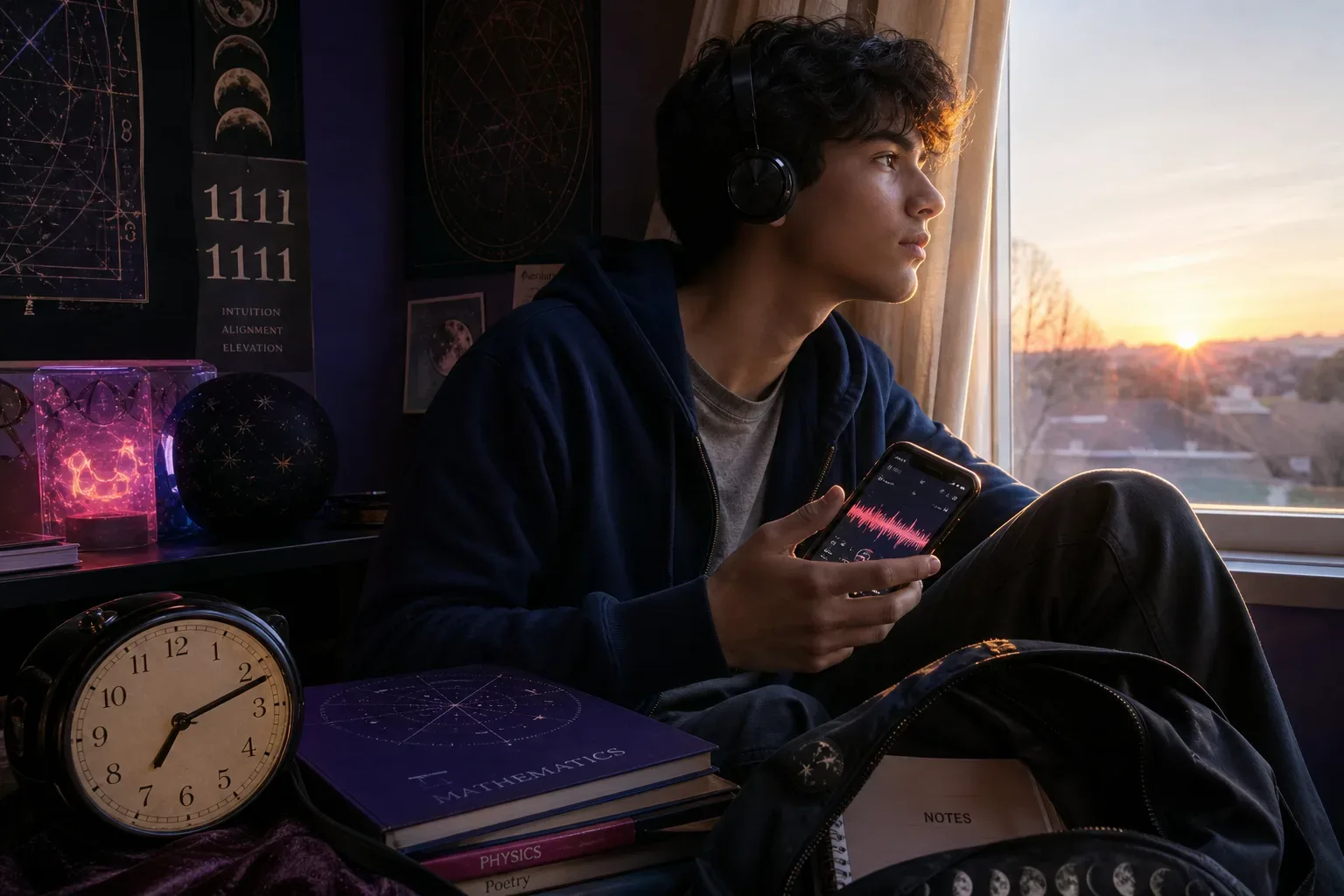
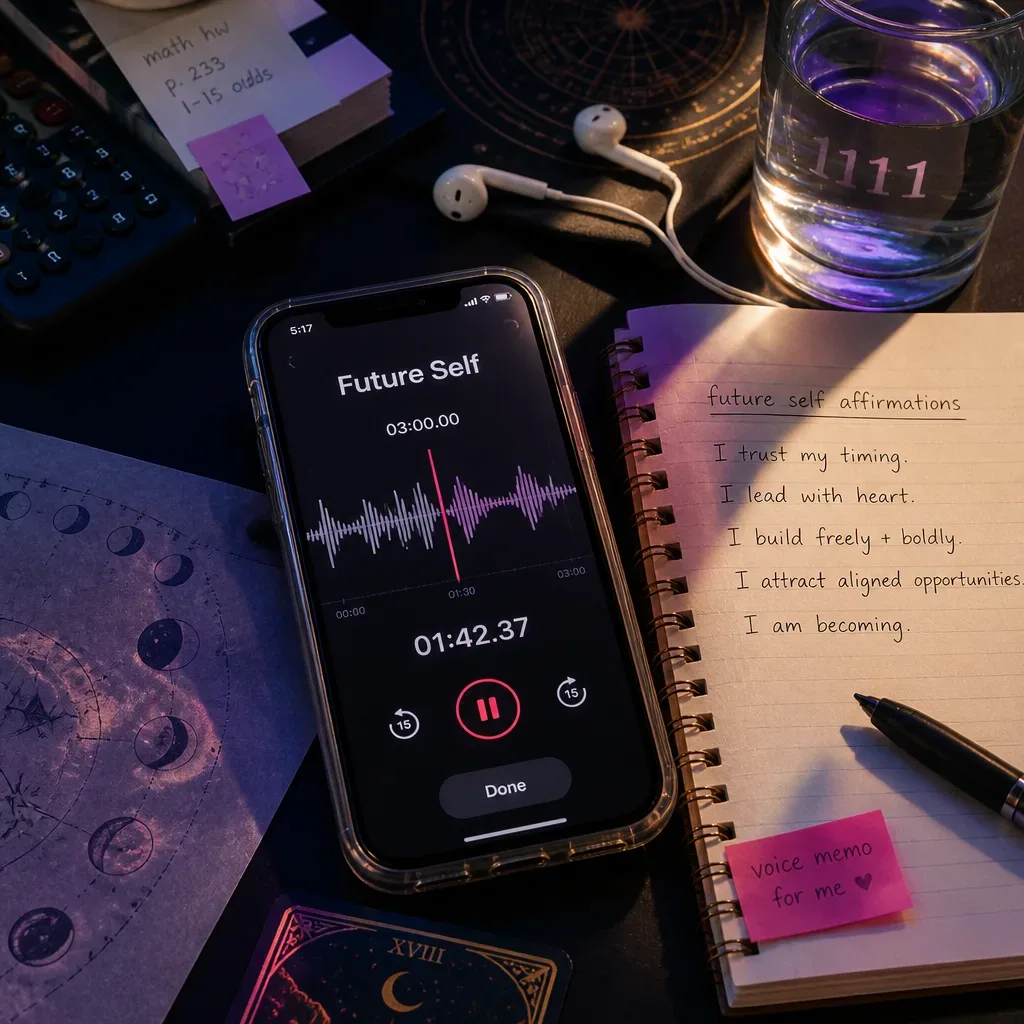
Positive affirmations for teens work best when they are short, believable, and heard in their own voice or a trusted future-self voice. A 3-minute audio turns a slogan into a cue: listen, breathe, name the next version of yourself, then take one small action on cue.
At 7:11 on a school morning, the house already has two competing weather systems: the alarm that failed and the group chat that did not. This is where teen affirmations either become useful or theatrical. Useful wins.
What makes positive affirmations for teens work better as audio?
Audio works because it meets teens where their attention already lives: in sound, repetition, and private cues.
Written affirmations have their place, especially inside the Affirmations pillar, but teens often need less ceremony and more access. A 3-minute recording can be played while brushing teeth, walking to the bus, or waiting outside room 204 before a test. Common Sense Media reported in 2023 that U.S. teens used social media for an average of 4.8 hours a day, not counting schoolwork or entertainment video. Attention is already being trained by audio, video, and notification loops. The practice has to be just as easy to reach.
The difference is tone. A typed line can feel like homework. A recording can feel like a signal. When the words are spoken slowly, with breath built in, the body gets more than a concept. It gets timing. Dr. Andrew Huberman often describes the nervous system through state shifts: alert, stressed, focused, relaxed. Audio can become a repeatable gate into a different state, especially when it begins the same way every time.
The AYA frame is precise here. The AYA Method is a daily audio manifestation practice. Each day you listen to a short personalized recording, your Dream-Self Moment, narrated from the version of you who has already manifested the life you intend. Listening is the practice. Repetition is the work. The audio is the method. A daily affirmation can complement that. A Manifestation Board can complement that. But the audio holds the room.
A teen does not need a louder pep talk; they need a believable signal repeated at the same gate.
Which teen affirmations are worth recording first?
The best affirmations for teens name one real pressure and one believable response.
This is where most lists get too shiny. “I am unstoppable” may look good on a lock screen, but if the teen is exhausted, bullied, overstimulated, or failing algebra, the line can backfire. In a 2009 study in Psychological Science, Joanne Wood and colleagues found that positive self-statements could make people with low self-esteem feel worse when the statements felt unbelievable. The mirror knows when it is being sold something.
Start with language that can survive a Tuesday.
- “I can feel nervous and still begin.”
- “I do not have to solve the whole year today.”
- “My body is allowed to calm down before I answer.”
- “I can ask one clear question.”
- “I return to myself before I react.”
- “I can make one honest repair.”
- “The next three minutes count.”
These work because they are not pretending. They are directional. Carol Dweck’s work on growth mindset, first widely discussed in 2006, became popular because it shifted attention from fixed identity to adaptable behavior. The strongest affirmation does the same thing. It does not say, “I am perfect.” It says, “I can practice this.”
For teens who like the cosmic dial, you can use numbers without making the number do all the work. Three breaths. Eleven words. A 22-day streak. Master numbers 11, 22, and 33 carry symbolic weight in numerology, but the practical value is pattern recognition. The number becomes a witness. The action still belongs to the teen.
Use this quick filter before recording any line:
| Affirmation test | Keep it if the answer is yes |
|---|---|
| Is it believable on a hard day? | The teen could say it without rolling their eyes |
| Is it specific? | It points to school, friendship, body, focus, or repair |
| Is it active? | It includes a next move, not just a mood |
| Is it kind? | It does not shame the current self |
The best teen affirmation is not a costume for confidence. It is a bridge back to choice.
How do you turn affirmations into a 3-minute future-self script?
A strong 3-minute script has four parts: arrival, identity, evidence, and one next action.
Three minutes is not a compromise. It is a design choice. A 2022 review in Nature Reviews Psychology noted that brief interventions can matter when they are targeted, repeated, and timed to a real context. Teens do not need a forty-minute ritual before first period. They need a script that can land before the bell.
Use this structure:
- Arrival, 20 to 30 seconds. Name the body. “Your feet are here. Your jaw can loosen. You are not late to yourself.”
- Future-self voice, 60 to 75 seconds. Speak from the teen who has already handled this season. “I know what it feels like to walk into the room and not shrink.”
- Evidence, 45 to 60 seconds. Mention proof from real life. “You did the presentation. You sent the apology. You studied for 18 minutes when you wanted to quit.”
- Next action, 20 to 30 seconds. Give one cue. “Open the notebook. Write the first line. Ask the teacher after class.”
The future-self voice matters because it avoids the brittle grammar of command. Neville Goddard wrote often about assuming the feeling of the wish fulfilled, but for teens, the phrase needs grounding. We are not asking them to deny the day. We are asking them to rehearse a steadier relationship with it. Joe Dispenza uses future-self language in a different teaching tradition, often linking mental rehearsal to emotional state. You do not need to swallow every claim to use one clean idea: repeated inner rehearsal changes what feels familiar.
Here is a sample opening:
“Hey. It is me, later. Not a fantasy version. The one who learned how to breathe before answering. The one who stopped treating every mistake like a verdict. Put one hand on your ribs. You are still here. That counts.”
That is the tone. Not syrup. Not conquest. A signal.
When should a teen listen so it actually sticks?
The best listening time is the moment that already repeats: morning, commute, pre-practice, post-conflict, or before sleep.
Habits attach more easily to existing cues. In a 2009 study from University College London, Phillippa Lally and colleagues found that habit formation took a median of 66 days, with wide variation depending on the behavior. That number is useful because it lowers the drama. A teen does not need to feel changed by day 3. The dial may take longer to line up.
Pick one anchor, not five. The audio should arrive where the day already has a hinge.
- Before school: best for identity, social courage, and test steadiness.
- After school: best for decompression and repair.
- Before practice or rehearsal: best for focus and body confidence.
- Before sleep: best for emotional closure, but keep it gentle.
- After conflict: best only if the script is calming, not corrective.
The CDC’s 2023 Youth Risk Behavior Survey reported that 40% of high school students felt persistently sad or hopeless during the previous year. That number should make adults more careful, not more controlling. If a teen is in crisis, audio is not enough; professional support matters. But for the ordinary daily pileup, a 3-minute recording can create a private pause before the next demand.
Pair the audio with a tiny physical cue. Same earbuds. Same seat on the bus. Same hand on the chest. The brain likes a pattern. In Manifestation pillar terms, repetition turns intention from decoration into practice. In parenting terms, it means the teen can do it without being watched.
A practice that requires a perfect morning will not survive adolescence.
What should parents avoid when offering affirmations to teens?
Parents should avoid turning affirmations into performance, surveillance, or another way to correct a teen.
A teen can smell agenda at 30 paces. If the affirmation is secretly a lecture, the room closes. “You are responsible and organized” may sound supportive, but if it arrives five minutes after a missing assignment fight, it is not an affirmation. It is a costume. The American Psychological Association’s 2023 Stress in America reporting continued to flag high stress among younger people, with school safety, social life, and future uncertainty in the mix. They do not need adults laundering pressure through inspirational language.
Offer the tool, then give privacy. You might say: “I can help you record something for mornings, or you can record it alone. It should sound like you.” That last sentence matters. Teens are forming identity in real time. Erik Erikson described adolescence as a central period for identity formation decades ago, and the point still lands. The voice should not erase the teen. It should help them hear themselves more clearly.
Avoid these lines:
- “I am always happy.”
- “Nothing bothers me.”
- “I am better than everyone.”
- “I never procrastinate.”
- “I attract only perfect friends.”
Try these instead:
- “I can tell the truth without attacking myself.”
- “I can pause before I post.”
- “I can be left out and still belong to myself.”
- “I can study for 10 minutes and build from there.”
- “I can choose one friend who feels safe.”
If you use the Astrology and manifestation lens, keep it respectful. A Mercury retrograde joke may help a teen laugh at a misread text. It should not become fatalism. The chart is a mirror, not a verdict.
How do numbers, timing, and synchronicity support the habit?
Numbers help when they make the practice memorable, not when they replace the practice.
Manifest 11 readers tend to notice the clock. 11:11. 2:22. The same locker number three days running. Most people call it coincidence and move on. Sometimes that is correct. Sometimes the pattern becomes a useful cue. Psychologist Carl Jung used the word synchronicity for meaningful coincidence, though modern psychology would also point to attention, salience, and pattern detection. Both can be true enough for a teen trying to remember who they are before chemistry.
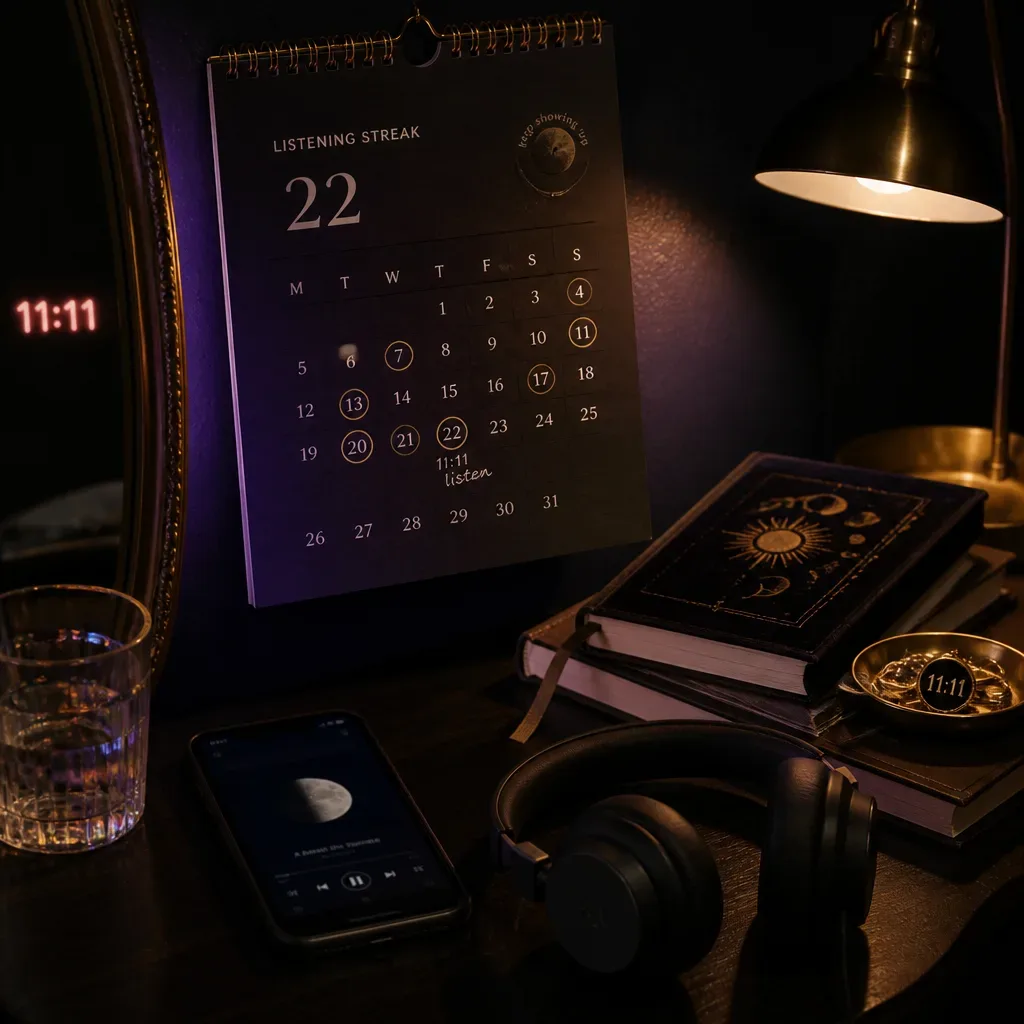
The trick is to keep the number humble. If 11:11 appears, listen for three minutes. If the date is the 22nd, renew the script. If the teen is drawn to 33, use 33 days as a streak container. Numerology calls 11, 22, and 33 master numbers; practice calls them reminders. The difference matters.
Here is a simple 22-day format:
| Day range | Focus | Audio line to emphasize |
|---|---|---|
| Days 1–7 | Calm the body | “I can return to my breath first.” |
| Days 8–14 | Name the identity | “I am becoming someone who begins.” |
| Days 15–22 | Take the action | “One honest step is enough for today.” |
Princeton’s former Global Consciousness Project reported exploratory findings around random event generators and collective attention, but its interpretation remains debated. That is a useful caution. We can be enchanted without becoming sloppy. A number can open the gate. It cannot do the homework, send the apology, or ask the counselor for help.
Synchronicity is most useful when it points you back to the thing you can actually practice.
How can teens track whether affirmations are helping?
Track the smallest observable shifts: faster recovery, clearer choices, fewer spirals, and more honest action.
Feelings matter, but they are noisy. A teen may listen for five days and still feel anxious before a quiz. That does not mean the practice failed. The better question is behavioral: did they begin studying 10 minutes earlier, ask for help sooner, or stop one text before it became a fire? In clinical and educational research, self-monitoring is often used because measured behavior gives the brain feedback. Even a simple 1-to-5 rating can show change over 14 days.
Use a low-pressure tracker. No gold stars. No parental audit.
- Before listening: stress level, 1 to 5.
- After listening: body level, 1 to 5.
- One action taken: write the actual step.
- One line that worked: keep or revise the phrase.
- One line that felt fake: remove it without drama.
This is where the Affirmations pillar and the audio practice meet cleanly. Affirmations are not magic sentences. They are repeated agreements with a future behavior. If the behavior never changes, revise the sentence. If the sentence creates shame, retire it. If the sentence helps the teen return 8% faster after a hard moment, keep it. Eight percent is not glamorous. It is also not nothing.
For teens who already use the AYA Method, the tracking can stay light: listen to the Dream-Self Moment, use one daily affirmation as a complement, then put one visual cue on a Manifestation Board if that helps. The board is not the spine. The affirmation is not the spine. The listening is the spine.
A teen’s inner voice is being trained somewhere. Better that it be trained by something honest.
The next cue can be quiet and still count.