reality shifting
Raven Method Shifting With 3-Minute Dream-Self Audio
Raven method shifting can feel steadier with a 3-minute Dream-Self audio. Learn the exact setup, script cues, counting pattern, and safety notes.
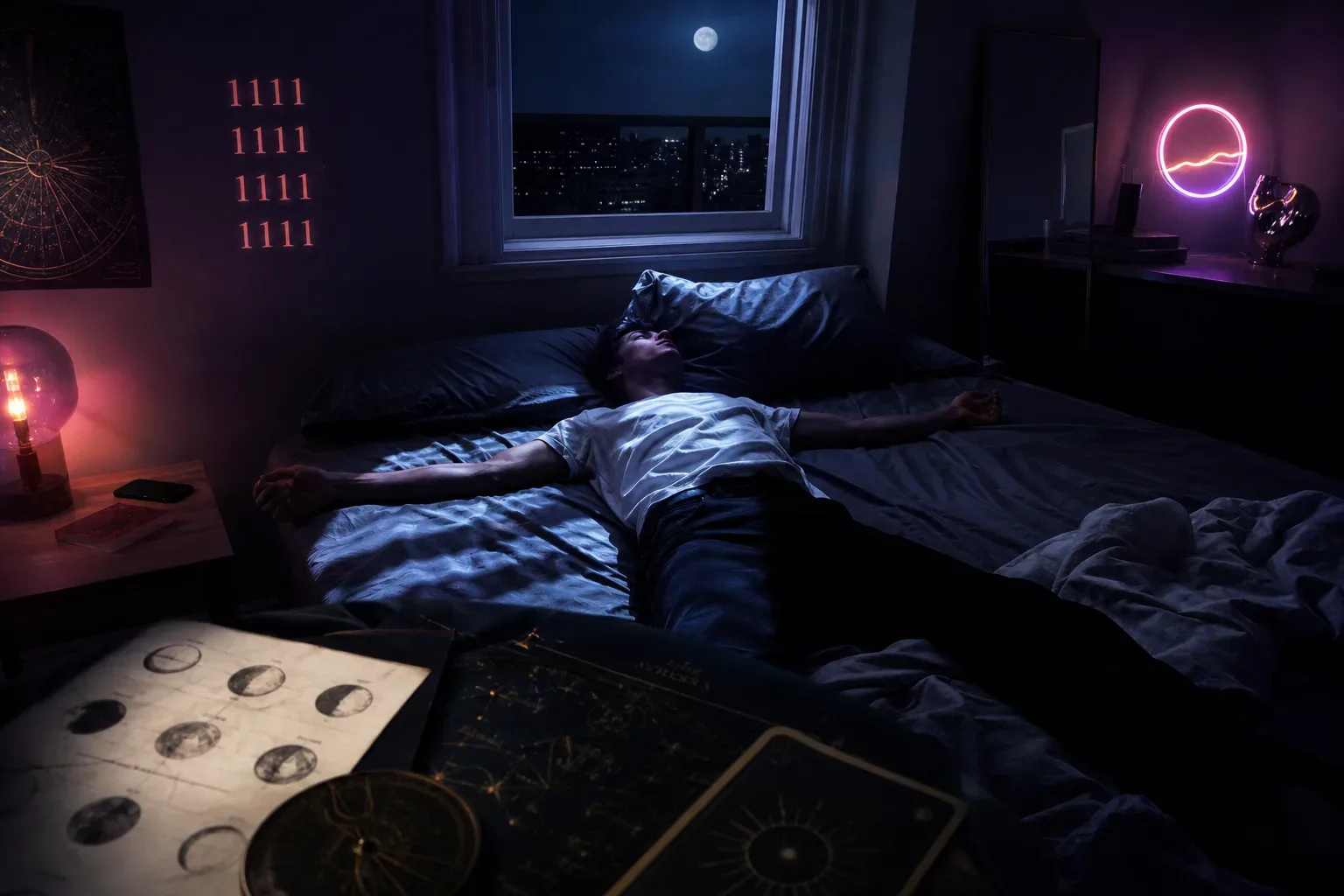
Raven method shifting works best when the body is still, the intention is specific, and the mind has one clear signal to follow. A 3-minute Dream-Self audio can become that signal: listen first, lie down, count from 1 to 100, and let the audio carry the identity before the method asks you to hold it.
What is the Raven Method, exactly?
The Raven Method is a reality-shifting practice that combines stillness, counting, and identity-based statements to focus attention on a desired reality.
The classic version is simple enough to travel by screenshot. Lie on your back. Spread the arms and legs slightly, like a starfish. Count from 1 to 100. Between numbers, repeat a line such as, “I am in my desired reality,” or, more grounded, “I am rehearsing the self I intend to meet.” The form is spare. The effect comes from repetition.
Reality shifting became widely visible through online communities in 2020 and 2021, especially among teenagers and young adults. A 2021 BBC report described shifting communities on TikTok and YouTube as large, highly organized, and script-driven. That matters because the Raven Method is not just a relaxation pose. It is a ritual with a script, a number sequence, and a shared mythos. The room knows when a ritual has a shape.
Still, keep the claims clean. Raven method shifting is best treated as a focused imaginative practice, not as proof of physical relocation. Lucid dreaming research offers a useful neighbor: a 2016 meta-analysis in Consciousness and Cognition estimated that about 55% of people have experienced at least one lucid dream, while 23% report lucid dreams monthly or more. Altered attention is common. Certainty about what it means is where people tend to overreach.
The method works because it narrows the field. At 11:11, the number is not magic by itself. The number becomes a gate because you notice it, name it, and return to it on cue.
Why add a 3-minute Dream-Self audio before counting?
A 3-minute Dream-Self audio gives the Raven Method a stable identity cue before the counting begins.
The problem with many shifting attempts is not lack of desire. It is too many signals. You start counting, then wonder whether the affirmation is right, whether your script is detailed enough, whether the tingling means something, whether you should start over because you swallowed at 37. The dial gets crowded.
This is where the AYA Method fits cleanly. The AYA Method is a daily audio manifestation practice. Each day you listen to a short personalized recording, your Dream-Self Moment, narrated from the version of you who has already manifested the life you intend. Listening is the practice. Repetition is the work. The audio is the method.
For Raven Method use, the audio should come first. Three minutes is long enough to create atmosphere and short enough not to steal the whole ritual. In attention research, even brief auditory cues can shape task readiness. Dr. Andrew Huberman has often discussed the role of visual focus and breathing in state regulation; audio works differently, but it can serve the same principle: reduce options, increase signal.
Use the audio as the opening bell, not background noise for the entire count. The Dream-Self voice names the room you are entering. The Raven count gives you 100 steps across the floor.
A tight setup looks like this:
- Sit or lie down and play the 3-minute Dream-Self audio once.
- Let the final sentence become your entry phrase.
- Move into the starfish position.
- Count from 1 to 100, slowly.
- Repeat one short present-tense line after each number.
- Rest for 60 seconds before moving.
A practice does not become stronger because it becomes more complicated. A practice becomes stronger when it becomes repeatable.
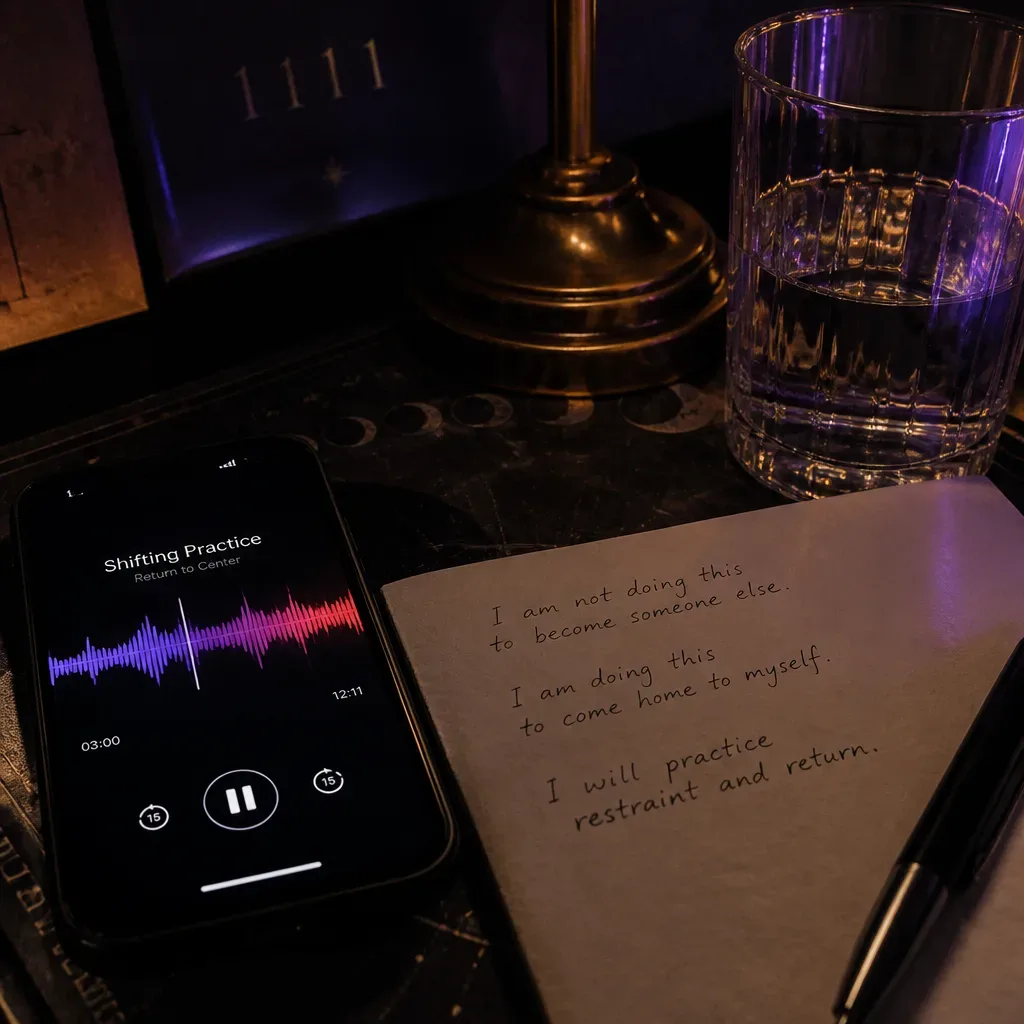
How do you prepare the script, room, and body?
You prepare by removing friction before the practice starts, because half-asleep minds do not negotiate well.
The script is not a novel. It is a set of cues. Many online shifting scripts run for pages, with names, rooms, rules, relationships, and entire school schedules. That can be creative, but for Raven method shifting with audio, you want a condensed version. Choose 3 details that matter: who you are, where you wake, and what proves you have arrived.
A useful script might be: “I wake in a quiet apartment with morning light on the floor. I feel rested, known, and unhurried. My phone shows 11:11, and I remember that I chose this.” Notice the number. Notice the witness. The sign is not there to impress anyone. It is there so your mind has a handle.
The room should be boring in the best way. The National Sleep Foundation has long recommended a cool, dark, quiet room for sleep, often around 60 to 67 degrees Fahrenheit for many adults. You do not need perfect sleep lab conditions, but you do need fewer interruptions than usual. Put the phone on Do Not Disturb. If you use the audio from the same phone, start it, place the device face down, and refuse the little blue shrine of notifications.
Prepare the body with less theater than the internet suggests. Starfish position means open and symmetrical, not strained. If your shoulders ache, bend the elbows. If your lower back protests, put a pillow under the knees. The body is not a prop. It is the instrument.
Use this quick table before you begin:
| Element | Keep it simple | Avoid |
|---|---|---|
| Script | 3 core details | A 12-page dossier at bedtime |
| Audio | 3 minutes once | Looping until you feel numb |
| Position | Comfortable starfish | Pain as proof of devotion |
| Count | 1 to 100 | Restarting after every tiny distraction |
| Sign | One repeated cue | Hunting for 22 symbols at once |
If you already work with manifestation, think of this as a narrower practice inside the larger field. Manifestation names direction. The Raven Method supplies a specific nightly gate.
What should the 3-minute Dream-Self audio say?
The audio should speak from the identity you are practicing, using sensory detail, present-tense certainty, and one clean emotional signal.
The strongest Dream-Self audio does not beg. It does not plead with the universe, and it does not lecture you for wanting something. It speaks as if the desired identity has already become ordinary. That is the voltage. Not fireworks. Familiarity.
Three minutes usually allows 350 to 450 spoken words, depending on pace. Many narration guides place calm voiceover around 120 to 150 words per minute. Stay closer to 120. The nervous system hears pace before it hears poetry.
Here is a simple structure:
- First 30 seconds: name the body and the room. “Your shoulders soften. The room is dark. Nothing needs to be solved tonight.”
- Next 60 seconds: speak from the Dream Self. “I wake with the certainty of someone who belongs here.”
- Next 60 seconds: include 2 or 3 sensory anchors. Light, temperature, sound, texture.
- Final 30 seconds: give the Raven cue. “When I begin counting, every number returns me to this self.”
This is also where affirmations can help, as long as they remain precise. The affirmation is not the method. In this setup, the daily affirmation is a complement to the audio and the count. If the line is too grand, your mind will argue. If it is too weak, your mind will wander.
Try lines like:
- “I know this room.”
- “I recognize this version of me.”
- “Every number steadies the signal.”
- “I do not chase the door. I stand at it.”
Neville Goddard called this kind of inner rehearsal “assuming the feeling of the wish fulfilled.” Whether you take Goddard literally or psychologically, the instruction is useful: do not only picture the scene. Practice the feeling-tone of being the person who belongs in it.
The future self should not sound like a motivational poster. She should sound like someone who has already put the kettle on.
How do you do Raven Method shifting step by step?
You do the Raven Method by listening once, lying still, counting slowly, repeating one intention line, and closing the practice without grabbing for proof.
Set aside 15 minutes. The first 3 minutes are the Dream-Self audio. The next 8 to 10 minutes are the count, depending on pace. The final 1 to 2 minutes are for stillness and notes. A 2020 paper in Frontiers in Psychology noted that brief mindfulness practices can affect attention and mood, but consistency matters more than a single dramatic session. Same room. Same cue. Same count. The signal strengthens by return.
Follow this sequence:
- Choose the time. Night works well because the threshold state is close, but a late afternoon rest can work if bedtime makes you anxious.
- Play the 3-minute Dream-Self audio. Listen without multitasking. No scrolling. No editing the script in your head.
- Move into starfish. Arms and legs slightly apart. Jaw loose. Tongue resting. Eyes closed.
- Begin counting. Say the number internally, then the line. “One, I recognize this room. Two, I recognize this room.”
- Let sensations pass. Tingling, heaviness, floating, swallowing, and random images are common relaxation effects. They do not require applause.
- Reach 100. If you fall asleep, fine. If you stay awake, rest for 60 seconds.
- Write the signal. Record any repeated image, word, number, or feeling. Keep it factual.
Do not restart because you lost count once. Pick up at the last number you remember, or choose the nearest clean number, like 40 or 50. The point is not purity. The point is return.
How do you read signs without losing the plot?
You read signs as reflective cues, not as commands, because a signal is useful only when it keeps you sane.
Raven method shifting has a strong relationship with numbers. The count itself is a ladder of 100. People often notice 111, 222, 333, or the master numbers 11, 22, and 33 around practice periods. Numerology gives those numbers symbolic weight: 11 is often read as intuition, 22 as building, 33 as teaching or service. Treat that as language, not law.
There is a cognitive reason signs seem to multiply. The Baader-Meinhof phenomenon, often called frequency illusion, describes the way something appears more often after you first notice it. Cognitive scientists have discussed this for decades; your attention tags an object, then finds it again. That does not make the sign fake. It makes your attention involved.
Astrology and manifestation can work the same way when used well. A lunar cycle gives you dates. A transit gives you a frame. A master number gives you a mark on the wall. None of them should take over the practice. The audio is the method. The numbers are punctuation.
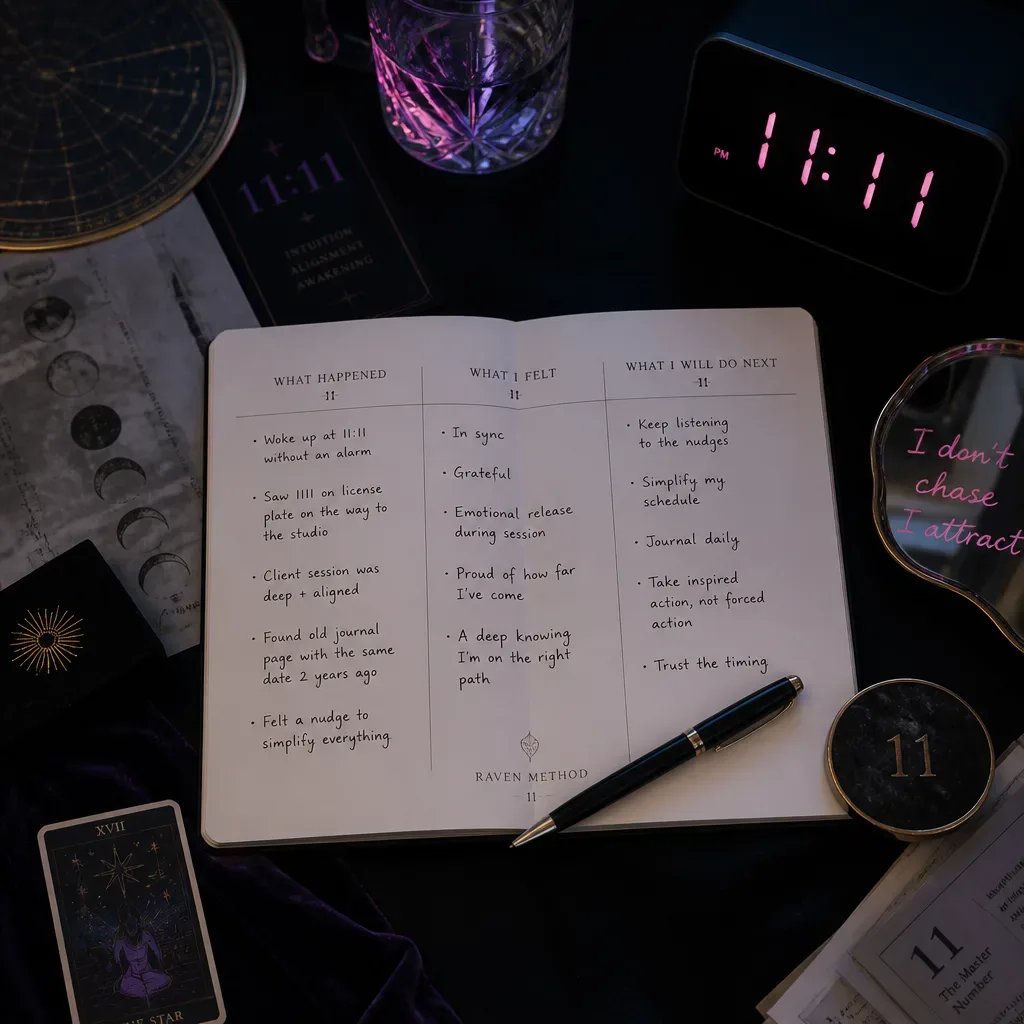
Use a three-column note after each session:
| What happened | What I felt | What I will do next |
|---|---|---|
| Saw 11:11 after practice | Calm, slightly startled | Repeat same audio tomorrow |
| Lost count near 62 | Frustrated | Count slower next time |
| Dreamed of blue hallway | Curious | Add hallway detail only if it returns |
This is the editor’s rule: one appearance is a detail, two is a pattern, three deserves a name. I learned that at a features desk long before I learned it in ritual. The story rarely begins where the teller starts it. Watch the slow lead-up.
For broader context on the practice category, keep one foot in the reality shifting frame and one foot in ordinary life. Pay your bills. Text back. Drink water. A gate that makes you abandon the room you are standing in is not a gate worth trusting.
What should you do if it does not work the first night?
If it does not work the first night, repeat the same setup for 7 nights before changing the method.
Most people change the ritual too quickly. Night 1 is Raven. Night 2 is pillow method. Night 3 is Julia method. Night 4 is a subliminal with rain, thunder, and a comment section full of strangers insisting they shifted in 4 minutes. The mind never gets a clean pattern. It gets a costume rack.
Give the audio-and-count version one week. Seven days is not sacred, but it is long enough to notice friction. In habit research, Phillippa Lally and colleagues at University College London found in 2009 that habit formation varied widely, with an average of 66 days for automaticity in one study. You do not need 66 days to test a shifting method, but the finding is a useful correction: repetition is slower than excitement.
If nothing happens, troubleshoot in this order:
- Too much pressure: make the desired scene more ordinary.
- Too much detail: reduce the script to 3 cues.
- Too much stimulation: move the practice earlier or dim the screen 30 minutes before.
- Too much fear: stop night practice and try a daytime version.
- Too much performance: stop reporting every attempt to other people.
Joe Dispenza often talks about rehearsing a future self until the body begins to recognize the state. Tara Brach, from a very different tradition, teaches the power of kind attention toward present experience. Put those together carefully: rehearse the future, but do not reject the body on the bed.
If the practice increases panic, derealization, or distress, pause. Grounding is not failure. It is how the nervous system says, “Stay with me.” For mental health concerns, a licensed professional outranks every method on the internet, including this one.
The cleanest version is still the simplest: 3 minutes of Dream-Self audio, 100 counts, one line, one note afterward. No spectacle. No bargaining.
Count softly. Let the room answer.