morning rituals
Shower Manifestation Routine With Dream-Self Audio
A quiet shower manifestation routine using Dream-Self audio while you wash, dress, and return to the version of you already living what you intend.

The water is warm. Your phone stays dry on the counter. A shower manifestation routine works by pairing a short Dream-Self audio with something you already do each morning, so listening becomes repeatable. Five to twelve minutes is enough. The point is not more effort. It is a truer inner rehearsal.
What is a shower manifestation routine, really?
A shower manifestation routine is a short listening practice you attach to washing, drying, and getting ready.
It does not ask you to wake earlier. It does not ask you to sit cross-legged while someone needs breakfast or the dog is staring at the door. It uses the time already there. The U.S. Environmental Protection Agency has estimated the average shower lasts about 8 minutes and uses roughly 17 gallons of water. That is already a container. You are simply choosing what your mind rehearses inside it.
In the AYA Method, the practice has a clear center: The AYA Method is a daily audio manifestation practice. Each day you listen to a short personalized recording — your Dream-Self Moment — narrated from the version of you who has already manifested the life you intend. Listening is the practice. Repetition is the work. The audio is the method.
That matters because the shower can make vague advice too easy. You can think about money, love, work, your body, the message you have not answered. Your mind can scatter in 30 directions before the conditioner is out. Audio gives the mind a track to follow. A routine is not a demand. It is a place you return to before the day gets loud.
If you are new to manifestation, think of this less as asking and more as rehearsing identity. You are practicing the felt normal of being someone who chooses differently. Neville Goddard wrote often about living from the fulfilled wish, not staring at it from far away. In a shower, that can become very ordinary: the way you stand, the way you breathe, the sentence you let be true for 8 minutes.
The bathroom can become a threshold without becoming a ceremony.
Why does Dream-Self audio fit so well while you get ready?
Dream-Self audio fits the shower because your hands are busy and your attention is gently available.
Most people already pair sound with getting ready: a playlist, a podcast, a news clip, a voice memo. Edison Research reported in 2024 that 47 percent of Americans age 12 and older had listened to a podcast in the past month. Audio is not a strange morning behavior. It is already how many people keep themselves company.
The difference is intention. A podcast gives you someone else’s thoughts. A Dream-Self Moment gives you a rehearsal of your own future self. That distinction is small and important. Your mind is still waking. Cortisol naturally rises in the first 30 to 45 minutes after waking, a pattern often called the cortisol awakening response in psychoneuroendocrinology research. You do not need to flood that window with urgency.
A soft audio script can become a cleaner first input. It lets you hear how the version of you who has what you intend speaks about ordinary things. Not in slogans. In details. She answers the email. She does not over-explain the boundary. She orders the cheaper coffee and still feels held by her own life. Specificity calms the mind because it gives it something to practice.
Here is the difference:
| Morning sound | What it trains | Best use |
|---|---|---|
| News clip | Alertness and scanning | Later, when you are ready for the outer world |
| Random playlist | Mood association | Good, but often inconsistent |
| Podcast | Learning and distraction | Useful when you can listen fully |
| Dream-Self audio | Identity rehearsal | Best for a short manifestation practice |
If you use timing from lunar cycles or personal astrology, astrology and manifestation can be a gentle layer. Still, the audio remains the method. The stars may give the morning a date. Listening gives it a practice.
A good ritual should make the true thing easier to repeat.
How do you set up the routine in twelve minutes?
You set it up by making the audio safe, short, and impossible to negotiate with.
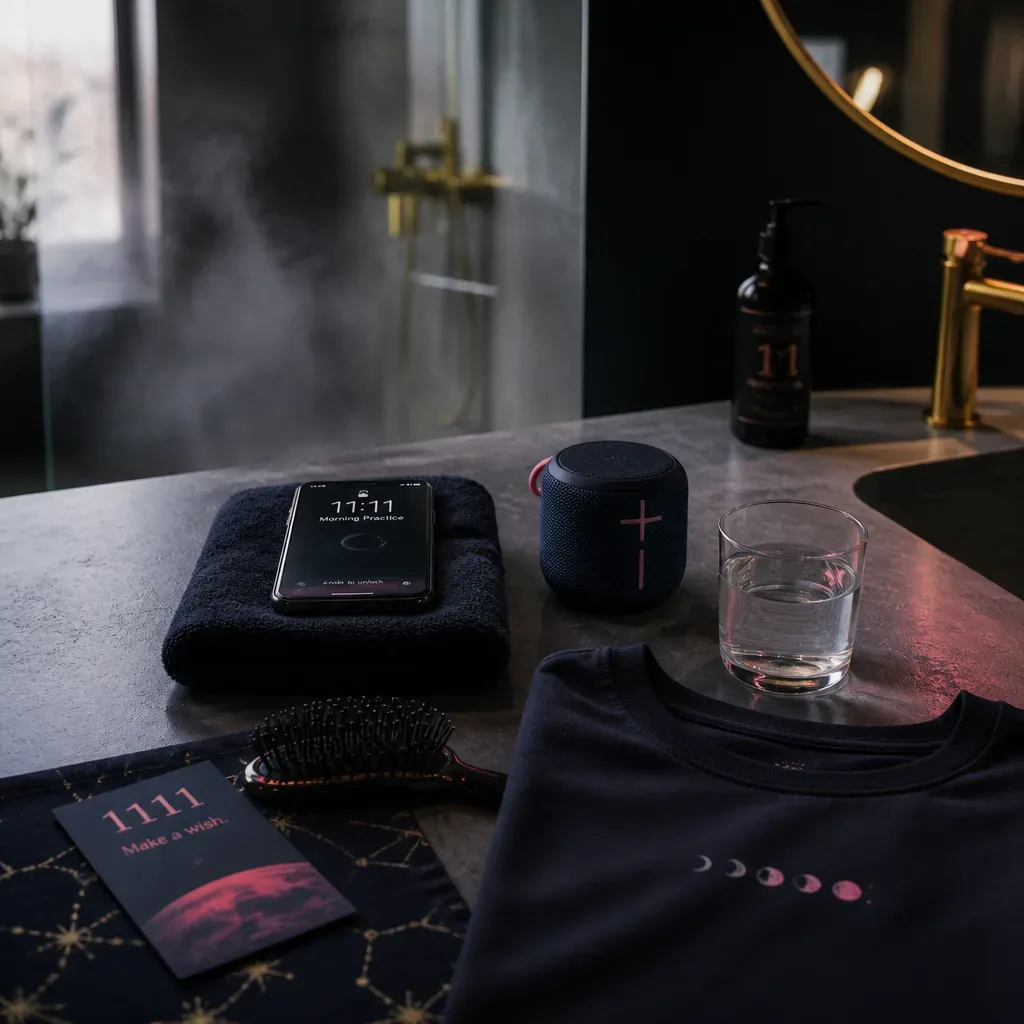
Before water is involved, decide where the sound lives. Put your phone on a dry counter, a high shelf, or outside the bathroom door with the volume turned up just enough. If you use a waterproof speaker, keep it away from the direct spray. Do not plug in a device near water. The U.S. Consumer Product Safety Commission has warned for years about electrical risk around water, and no ritual is worth ignoring that.
Use this twelve-minute version when the morning is normal, not perfect:
- Minute 0 to 1: place the audio. Open your Dream-Self Moment before you start undressing. This removes the decision point.
- Minute 1 to 2: let the first line land. Stand outside the water for one breath. Hear the voice before you move.
- Minute 2 to 8: shower and listen. Wash as usual. When your mind wanders, return to the next sentence.
- Minute 8 to 10: dry off with one line. Choose one phrase. Not the prettiest one. The truest one.
- Minute 10 to 12: dress from that line. Make one small choice that matches it.
Small matters. In a 2009 study in the European Journal of Social Psychology, Phillippa Lally and colleagues found that habit automaticity took a median of 66 days, with wide variation from 18 to 254 days. The takeaway is not that you must count perfectly. It is that repetition changes what feels normal over time.
You can also make the routine smaller:
- Two-minute version: press play while brushing your teeth after the shower.
- Five-minute version: listen only while washing your face and hair.
- No-shower version: play the audio while getting dressed.
- Child-at-the-door version: use one earbud after you are dry and dressed.
The right routine is the one you can repeat on a Tuesday.
What should you listen for in the Dream-Self Moment?
Listen for one ordinary proof that the future version of you is already available in behavior.
Many people listen for a feeling first. That can create pressure. Feelings shift with sleep, hormones, blood sugar, grief, and the way a meeting went yesterday. The Centers for Disease Control and Prevention reports that about 1 in 3 U.S. adults do not get enough sleep. A tired nervous system may not produce a cinematic response at 7:12 a.m. That does not mean the practice failed.
Listen instead for cues. A cue is something you can use. Maybe your Dream-Self audio says you answer with clarity. Maybe it says you no longer apologize for needing time. Maybe it says your home feels quieter because you stopped filling every gap with proving. Choose the cue that can become visible today.
This is where manifestation becomes less foggy. A manifestation practice is not only about picturing an outcome. It is about practicing the identity that can live there. Joe Dispenza often teaches rehearsal of a future state through repeated mental and emotional practice. You do not have to follow every part of his work to see the practical point: rehearsal changes what your brain expects to do next.
Try this after the audio ends:
- Ask: what did I hear that I can live by noon?
- Name one behavior: send it, ask it, decline it, start it, rest.
- Keep the behavior small enough to complete.
- Do not make a public announcement about it.
- Let the day show you where the sentence belongs.
One true sentence carried into action is worth more than ten beautiful sentences left in the steam.
Can affirmations and a Manifestation Board support the shower practice?
Yes, affirmations and a Manifestation Board can support the routine, as long as they do not replace the audio.
The audio is the method. The daily affirmation and Manifestation Board are complements. This is a quiet distinction, but it protects the practice from becoming too crowded. If you add too many parts, the routine becomes another morning task. If you keep the audio central, the other pieces can act like small reminders.
Use affirmations carefully here. In a 2009 Psychological Science paper, Joanne Wood and colleagues found that very positive self-statements could make some people with low self-esteem feel worse. That does not mean affirmations are bad. It means the sentence has to be believable enough for your system to let it in. I am safe to take the next clear step may work better than I always get everything I want.
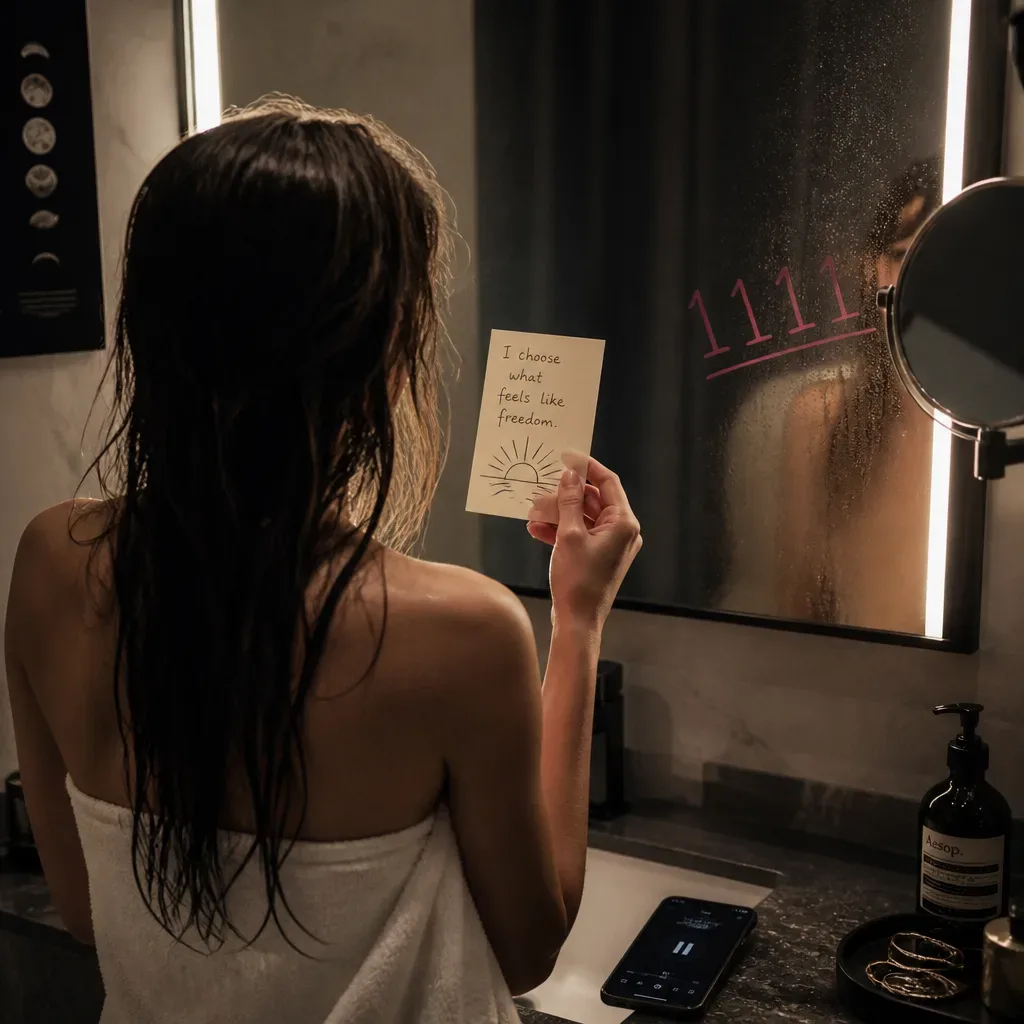
A Manifestation Board can help after the shower, not during it. You might glance at one image while you put on lotion or choose clothes. Keep it simple. One image. One sentence. One action. The board gives the eye a place to rest. The Dream-Self audio gives the mind a voice to follow.
Here is a simple support map:
| Complement | When to use it | How to keep it quiet |
|---|---|---|
| Daily affirmation | After the audio | Repeat one believable line |
| Manifestation Board | While dressing | Look at one image, not the whole board |
| Journal note | After breakfast | Write one sentence only |
| Calendar reminder | Midday | Name the behavior you chose |
If you like lunar timing, astrology and manifestation can help you choose a theme for the week. But do not let timing become a reason to postpone practice. Water, a dry phone, and the audio are enough.
The complement should serve the practice, not compete with it.
How do you keep the routine safe, private, and real?
You keep it safe by lowering the stakes and respecting the room you are actually in.
Start with volume. The World Health Organization has noted that prolonged exposure to sound above 85 decibels can increase risk of hearing damage. Your Dream-Self audio does not need to fill the house. It needs to be audible enough to guide you. If other people are asleep, place the speaker close to the door or use the audio after you are dry with one earbud.
Privacy matters too. Not because the practice is shameful. Because some things grow better before they are explained. If you live with a partner, roommates, children, or family, you can make the routine discreet. Name it as a short morning audio if you need to. You do not owe everyone a full theology of your inner life before 8 a.m.
Real also means flexible. Some mornings you will miss the whole recording. Some mornings the toddler will open the door. Some mornings you will press play and then think about laundry for 6 minutes. This is normal. In mindfulness research, returning attention is often treated as part of the practice, not a failure of it. The same applies here. Return when you notice. Return without drama.
A few grounded rules help:
- Keep devices dry and unplugged.
- Use a volume that protects your hearing.
- Choose one line, not a whole new personality.
- Let missed mornings stay small.
- Do not measure the practice by instant mood.
- Do not turn privacy into secrecy if someone needs basic context.
The practice becomes real when it survives ordinary interruption.
What changes after seven days of shower listening?
After seven days, the biggest change is familiarity: the future-self voice starts to feel less like a visitor and more like yours.
Seven days is not a magic number. It is a clean first measure. Clinical and behavioral studies often use one-week periods because they are long enough to show adherence patterns and short enough to remember clearly. You can ask a simple question on day seven: did this fit inside my actual life?
Track only three things. More tracking can turn the practice into performance. Use a note in your phone, a paper square, or one line in a journal:
- Did I listen today?
- What sentence stayed with me?
- What small behavior matched it?
That is enough data. If you listened 5 out of 7 days, you have evidence of fit. If you listened 1 out of 7, the routine may need to move. Try after the shower, during skincare, or while making coffee. The practice should meet your life without making your life feel scolded.
By the end of a week, you may also notice what your mind resists. Maybe the audio names rest and you keep rushing. Maybe it names receiving help and you keep doing everything alone. That information is useful. A 2014 review in the Journal of Behavioral Medicine linked self-affirmation practices with improved receptivity to health messages in several studies, suggesting that identity-based reflection can change what people are willing to consider.
You are not trying to become someone else in the shower. You are letting the truer version of you sound familiar before the world asks for the old one.
Let the water run, and let the new thought become familiar.