evening rituals
Sleep Manifestation Audio: 5-Minute Bedtime Practice
Use sleep manifestation audio as a quiet 5-minute bedtime practice: listen to your future self, soften the day, and repeat it nightly.

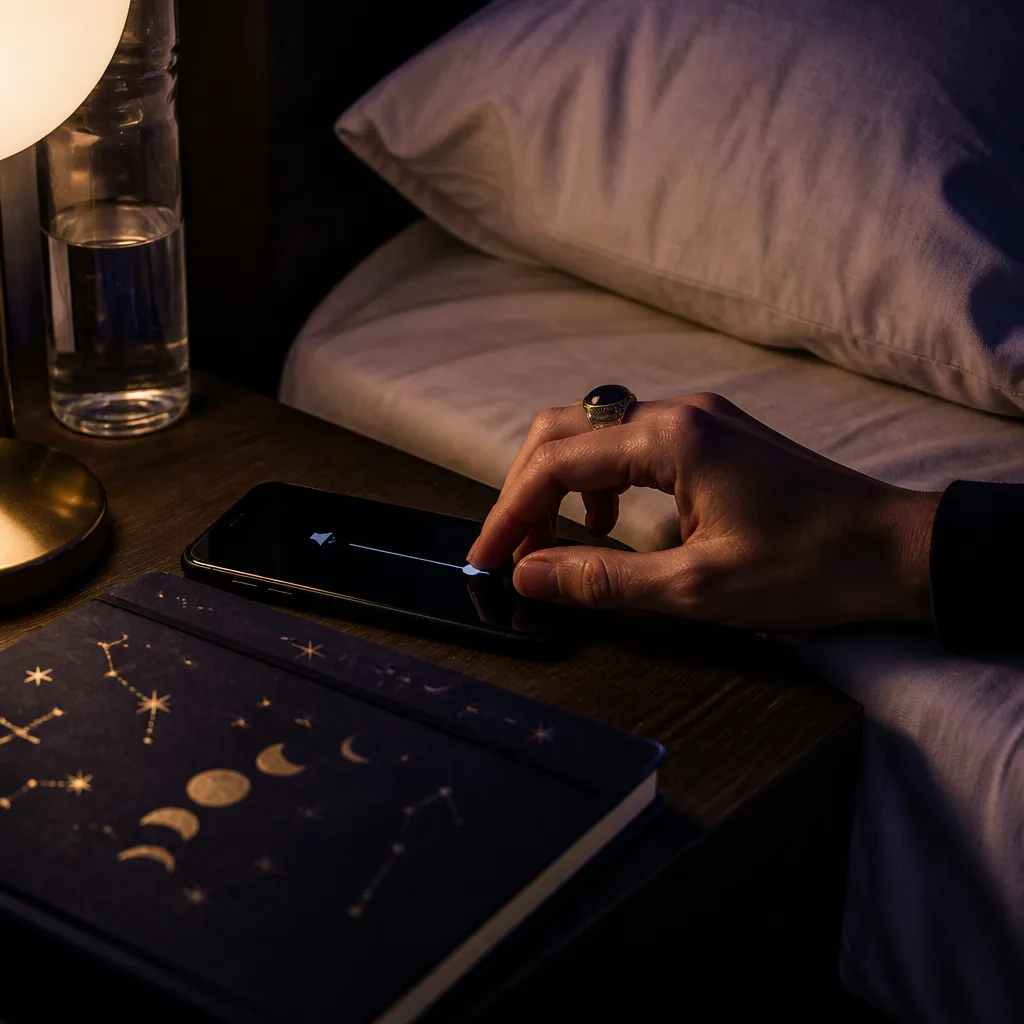
The lamp is already off. Your phone is face down. Sleep manifestation audio is a short bedtime recording that lets you hear the self you’re practicing becoming before sleep. Five minutes is enough: choose one recording, listen once, let the body soften, and leave the rest to repetition.
What is sleep manifestation audio?
Sleep manifestation audio is a brief bedtime listening practice that gives your mind one clear self-image before rest.
It isn’t a lecture. It isn’t background noise for hours. The useful version is small, specific, and repeatable. You hear language that describes you as already steady, already living from the choice you’re practicing. Then you stop. The nervous system tends to learn through repetition, and the American Academy of Sleep Medicine recommends adults get at least 7 hours of sleep because restoration depends on enough time, not more striving.
In the AYA Method, the definition is exact: The AYA Method is a daily audio manifestation practice. Each day you listen to a short personalized recording — your Dream-Self Moment — narrated from the version of you who has already manifested the life you intend. Listening is the practice. Repetition is the work. The audio is the method.
That matters at bedtime because sleep is already a threshold. Dr. Andrew Huberman has often pointed to consistent evening cues, lower light, and reduced stimulation as supports for sleep timing. You don’t need to turn that into a 14-step routine. You need a signal your body can recognize.
The best bedtime practice is the one your tired self can still do.
Manifestation can become too mental when it’s done late. You start negotiating with the future. You start checking whether you believe enough. Audio helps because it asks less of you. You listen. You receive the words. You let the same inner picture become familiar. For the wider frame, you can keep Manifestation pillar close, but tonight only asks for 5 minutes.
How do you do the 5-minute practice?
You do it by making the practice too simple to avoid.
The Sleep Foundation often recommends a consistent wind-down period of 30 to 60 minutes, but the audio itself can stay short. Think of the 5 minutes as the final cue, not the whole evening. Brush your teeth. Plug in the phone. Turn down the room. Then choose one recording before you lie down, so you don’t scroll while half-asleep.
Here is the whole practice:
- Set the room for listening. Dim the light and put the phone on night mode. If you share a bed, use one earbud at low volume or play it softly from the nightstand.
- Choose one desired state. Not ten outcomes. One state. Calm authority. Safe rest. Clear work tomorrow. A softer heart.
- Play the audio once. Don’t restart it to make it perfect. Perfection wakes the mind up.
- Notice one body signal. A slower exhale counts. A softened jaw counts. Nothing dramatic is required.
- Stop adding instructions. When the recording ends, let the room be quiet.
A 2010 review in Sleep Medicine Reviews connected pre-sleep cognitive arousal with poorer sleep. That means bedtime isn’t the best time to solve your life. It’s a better time to give the mind one clean track and stop feeding it new questions.
| Minute | What you do | What to avoid |
|---|---|---|
| 0:00-1:00 | Settle the body and press play | Checking messages |
| 1:00-3:30 | Listen for the future-self narration | Testing whether you believe it |
| 3:30-5:00 | Let one phrase land | Replaying the audio again and again |
A bedtime ritual should not need a second bedtime ritual to recover from it.
If you use Aya, your Dream-Self Moment can be the recording. The app also includes a daily affirmation and Manifestation Board, but those are complements. At night, audio stays at the center because tired minds need fewer objects, not more.
What should you listen for as you fall asleep?
Listen for recognition, not proof.
A good sleep manifestation audio doesn’t need to convince you with big claims. It should help you hear a version of yourself that feels specific enough to be yours. Maybe the recording says you answer emails without shrinking. Maybe it says you wake without bargaining with the day. Maybe it says you speak honestly in the room where you used to go silent.
Neville Goddard taught the use of a short imagined scene before sleep, often called entering the state akin to sleep. You don’t have to accept every metaphysical claim to use the practical point: the mind is suggestible when the body is quiet. Cognitive behavioral sleep research also treats bedtime thoughts seriously because repeated mental patterns can raise or lower arousal.
Three things are worth hearing for:
- A scene you can see. One room. One gesture. One ordinary sign that something has changed.
- A voice that sounds like you. Not inflated. Not theatrical. True enough to return to.
- A body response. Less gripping. Less rehearsing. More here.
This is where Affirmations pillar can help as context. An affirmation may be one sentence. Audio gives that sentence a place to live. But don’t turn the listening into a quiz. Your job isn’t to force belief before sleep.
Belief often arrives after the body has heard the same true sentence enough times.
If a line feels false, soften it. “I am fearless” may make your mind argue. “I meet tomorrow with steadier breath” may be easier to receive. In small studies on self-affirmation, researchers have found changes in stress response and self-processing, including work by Creswell and colleagues. The point is not magic certainty. The point is repeated contact with a self you can practice.
How is this different from affirmations or a vision board?
Sleep manifestation audio is different because listening is the active practice, while affirmations and visual boards support it from the side.
This distinction protects the practice from becoming crowded. A daily affirmation is useful when you need one line to carry. A Manifestation Board is useful when you need to see what you’re choosing. But at bedtime, too many tools can become stimulation. The National Sleep Foundation has long advised keeping the bedroom connected with sleep and calm, not late-night tasking.
| Practice | Best time | Main sense | Bedtime role |
|---|---|---|---|
| Sleep manifestation audio | Last 5 minutes before rest | Hearing | Core practice |
| Daily affirmation | Morning or a pause in the day | Speech or reading | Optional support |
| Manifestation Board | Daytime review | Sight | Keep outside the bed if it wakes the mind |
| Journaling | Earlier evening | Writing | Good if it ends before the audio |
The distinction also keeps the AYA Method clean. Audio is the method. The Dream-Self Moment is the center. The other features can help you remember, but they don’t replace the listening.
Some people like timing their evening practices with moon phases or personal charts. If that speaks to you, Astrology and manifestation can give you a wider language for timing. Still, don’t let timing become another reason to delay. Tuesday at 10:42 p.m. with a tired face is allowed.
The practice becomes real when it fits inside an ordinary night.
If you only have capacity for one thing, choose the audio. Not because the other tools are wrong. Because bedtime asks for fewer choices. One recording. One listen. One quiet return.
What if your mind keeps talking?
If your mind keeps talking, lower the standard and give it one small job.
You may lie there and think about rent, work, the thing you said too sharply, the message you didn’t answer. That doesn’t mean the practice failed. It means you’re human at night. According to the CDC, more than 1 in 3 adults in the United States report getting less than the recommended amount of sleep. A noisy mind is not rare.
Try this instead of arguing with it: choose one phrase from the audio and let it become the only phrase you return to. Not all 5 minutes. One line. “I can rest without solving this.” “I know what matters tomorrow.” “I am safe enough to stop rehearsing.”

If worry is loud, keep a paper beside the bed. Write one sentence only: “Tomorrow, I will look at this at 9:00.” Research on worry scheduling and cognitive behavioral therapy for insomnia often uses containment like this because the mind calms when it trusts a concern won’t be lost. The page holds the thought. The audio holds the state.
You can also reduce the sensory load:
- Set volume at the lowest clear level.
- Use a 5-minute sleep timer.
- Keep the screen face down.
- Avoid choosing a new recording in bed.
- Don’t chase a special feeling.
The goal isn’t to silence thought by force. Force is stimulating. The goal is to stop giving every thought a microphone. When you notice you’ve wandered, come back to the voice. Again. Quietly. This is why repetition matters. One night is a cue. Seven nights begin to become a pattern.
How do you keep it honest over 7 nights?
You keep it honest by tracking the practice, not trying to control the outcome.
A 7-night test is long enough to notice your relationship with the audio, and short enough that you won’t turn it into a life audit. Behavior researchers often use simple adherence measures because what gets repeated has a better chance of becoming automatic. One 2009 study by Lally and colleagues found habit formation varied widely, with an average of 66 days, but early repetition still mattered.
Use a plain note. No score for worthiness. No dramatic interpretation. Just enough data to see what’s real.
| Night | Did I listen once? | One phrase I remember | Body after listening |
|---|---|---|---|
| 1 | Yes / No | 3 to 8 words | Tight, softer, sleepy, alert |
| 2 | Yes / No | 3 to 8 words | Tight, softer, sleepy, alert |
| 3 | Yes / No | 3 to 8 words | Tight, softer, sleepy, alert |
| 4-7 | Yes / No | 3 to 8 words | Tight, softer, sleepy, alert |
After 7 nights, ask three questions:
- Did I resist the practice less by the end of the week?
- Did one phrase start to feel more familiar?
- Did bedtime become even 5 percent simpler?
Five percent counts. The Journal of Behavioral Medicine has published many studies connecting stress practices, self-regulation, and health behavior, but your home evidence is still important. If the practice makes you more alert, move it earlier. If the words feel false, edit the intention. If you keep skipping, make the setup easier.
For broader reading, keep the main manifestation guide close, and use affirmation practice when you want a daytime sentence to match the nighttime recording. But don’t ask the night to hold everything. Let the audio do its one job.
The room is dark, and the voice is already yours.