love manifestation
Avoidant Attachment Affirmations as Future-Self Audio
Avoidant attachment affirmations work best as future-self audio: short, repeated phrases that make closeness feel chosen, safe, and specific.

Avoidant attachment affirmations work when they do not bully you into intimacy. Use them as short future-self audio: specific, believable sentences spoken from the version of you who can stay connected without disappearing. The point is not to perform openness. The point is to rehearse safe closeness until your body recognizes it.
What are avoidant attachment affirmations actually trying to change?
They are trying to change the reflex that reads closeness as a threat to autonomy.
Avoidant attachment is not a lack of feeling. That is the lazy reading. It is often a fast, polished strategy for staying safe: pull back, explain less, need nobody, keep the exit visible. John Bowlby’s attachment theory began with children and caregivers in the 1950s and 1960s, but adult attachment research has been circling the same signal for decades: early patterns become expectations about what closeness costs.
Cindy Hazan and Phillip Shaver’s 1987 adult attachment study surveyed 620 people and helped bring attachment language into adult romantic relationships. Their work did not say every avoidant person is doomed to leave the room. It suggested that many adults carry working models of love, comfort, and dependence. Avoidant attachment affirmations are useful only when they speak to those working models, not when they paste glitter over them.
A bad affirmation says, I love being vulnerable all the time. Your nervous system hears fraud. A better one says, I can answer one honest question and still belong to myself. That sentence has a gate in it. It lets the body enter without setting off every alarm.
An affirmation that denies your defense will be rejected by the part of you that built the defense.
The future-self frame matters because avoidant patterns often live in anticipation. Before the date, before the text, before the serious talk, the dial starts turning. Future-self audio gives that anticipatory mind a new scene to rehearse. In The AYA Method, manifestation is not treated as wishful decoration; it is practiced through a daily recording heard again and again. Repetition is how a sentence earns a room in the body.
The aim is small and exact. You are not trying to become constantly available. You are practicing the moment before disappearance.
Why does future-self audio fit avoidant attachment better than written lines?
Future-self audio works because avoidant strategies often hide inside thought, while the voice brings the practice back into the body.
Many avoidant people are fluent in analysis. They can explain the pattern, footnote the childhood, name the ex who activated it, and still go cold at 9:42 p.m. when someone asks, Are we okay? Insight is useful, but it is not the whole ceremony. A 2015 review in social neuroscience literature noted that self-referential processing involves midline brain regions; put plainly, the brain treats stories about the self as serious material. Audio makes that story harder to keep at arm’s length.
This is why I like future-self audio for attachment work. Your own voice, or a voice written specifically for you, carries timing. A pause can say, You do not have to run. A slower sentence can lower the temperature. Dr. Andrew Huberman has often spoken about respiration and physiological state on his neuroscience podcast; while attachment repair is not a breathing hack, state matters. A sentence received while braced is not the same sentence received while settled.
Here is the distinction that keeps the practice honest:
| Format | What it does well | Where avoidant attachment may resist |
|---|---|---|
| Written affirmation | Clear, portable, easy to edit | Can stay intellectual and distant |
| Mirror work | Adds eye contact and immediacy | Can feel exposing too quickly |
| Future-self audio | Adds tone, pacing, repetition, body cue | Requires hearing yourself receive care |
| Journaling | Reveals the pattern in detail | Can become analysis without action |
The AYA Method is a daily audio manifestation practice. Each day you listen to a short personalized recording, your Dream-Self Moment, narrated from the version of you who has already manifested the life you intend. Listening is the practice. Repetition is the work. The audio is the method.
For avoidant attachment affirmations, that definition matters. The affirmation is not the pillar. The audio holds the work. A daily affirmation can sit beside it, and a Manifestation Board can witness the larger season, but the listening is where the nervous system gets its cue.
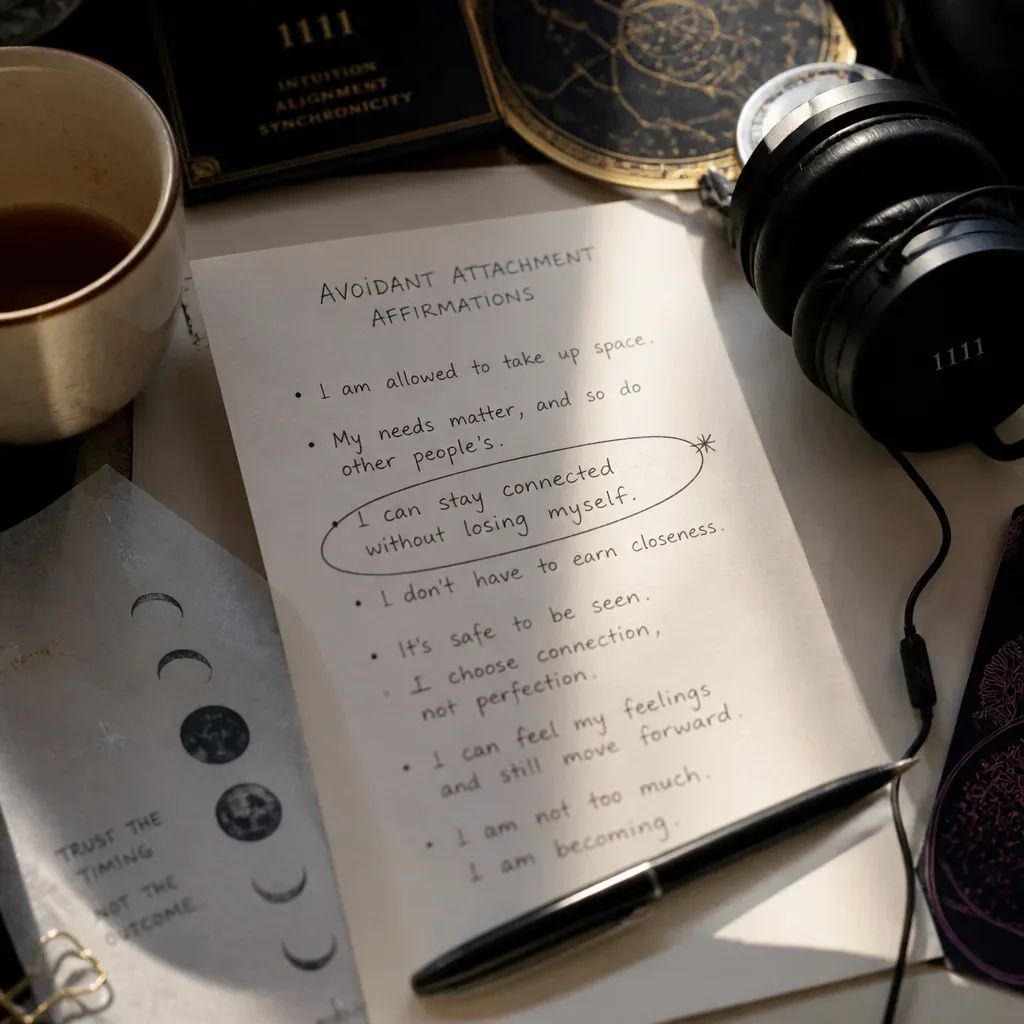
How do you write avoidant attachment affirmations that your body believes?
Write them as secure permissions, not romantic commands.
The first rule is simple: never write a sentence your body has to fight. If the affirmation creates a private eye-roll, it is too far from the current pattern. Claude Steele’s self-affirmation theory, first outlined in 1988, focused on how affirming core values can reduce defensiveness. That is the signal here. The line should lower defensiveness, not stage a coup.
Start with the avoidant reflex you actually use. Do you delay replying for 17 hours because the thread feels needy? Do you suddenly become busy after a good date? Do you mistake calm commitment for a trap? Name the move without making yourself a villain. Attachment patterns are adaptations before they are problems.
Then write one sentence that protects two truths at once: I can have space, and I can remain connected. Secure attachment is not constant closeness. Mary Ainsworth’s Strange Situation studies in the 1970s observed that secure children explored and returned. That rhythm matters. The point is not clinging. The point is return.
Use this 5-step drafting sequence:
- Name the trigger in plain language: When someone wants reassurance, I tense.
- Name the old protection: I disappear so I do not feel claimed.
- Name the secure option: I can answer briefly and choose space kindly.
- Put it in first person: I can stay honest without surrendering myself.
- Test it out loud: If your chest tightens hard, soften the sentence.
Examples that tend to land:
- I can pause before I pull away.
- I can let care reach me without owing my whole self.
- I can ask for space without making the other person feel punished.
- I can stay in the conversation for one more honest sentence.
- I can be loved and still have edges.
The best attachment affirmation does not force the door open. It turns on a lamp inside the room.
If you want a wider frame for the practice, the Affirmations pillar is a useful companion. Just keep the order clean: the audio is the method, the affirmation is the sentence inside it.
How do you turn the affirmation into a Dream-Self Moment?
Place the affirmation inside a specific scene where your future self chooses connection and keeps their boundaries.
Avoidant attachment is often triggered by vague emotional demand. So do not record vague audio. Specificity is the medicine. Instead of saying, I am open to love, create a scene: It is Thursday night. A message arrives. My body wants to go silent. I put one hand on the table, breathe for 6 slow counts, and reply with kindness.
Joe Dispenza often teaches mental rehearsal as a way to practice a future state before it appears in external life. You do not need to accept every metaphysical claim to use the practical point. Athletes have used imagery rehearsal for decades; a 1994 review by Driskell, Copper, and Moran found mental practice had a positive effect on performance across 35 studies, especially when paired with physical practice. Attachment is relational, not a free throw, but rehearsal still matters.
A Dream-Self Moment for avoidant attachment should include 4 parts:
- A real trigger: a text, a request, a plan, a conflict, a morning-after feeling.
- A body cue: shoulders soften, jaw unclenches, feet on the floor.
- A secure action: reply, ask, repair, stay, or request space cleanly.
- A future-self sentence: I can remain myself and remain here.
Here is a sample script:
I am in my kitchen after a good date. I notice the old urge to create distance. I do not obey it on cue. I take one slow breath and let myself remember: closeness is not a contract to disappear. I send one honest message. I keep my evening. I stay connected and intact.Keep it short. Three to seven minutes is enough. The nervous system respects repetition more than drama. If you are practicing through the AYA Method, your Dream-Self Moment becomes the daily signal. The Manifestation pillar gives the larger architecture, but this particular gate is intimate: a voice, a sentence, a choice you can repeat.
When should you listen, and what should you notice afterward?
Listen once a day at a predictable cue, then watch for the first pause before your usual withdrawal.
Morning works for many people because the day has not started collecting noise. Evening works if your attachment pattern shows up after dates, messages, or conflict. The time is less important than the cue. James Clear popularized habit stacking for a reason; behavior research often finds that context cues support repetition. In one 2009 study by Phillippa Lally and colleagues, habit formation took a median of 66 days, with wide variation from 18 to 254 days. Attachment practice deserves that kind of patience.
Do not measure success by whether you feel instantly secure. That is too theatrical. Measure the smaller signal: Did I notice the urge? Did I wait 10 seconds before going distant? Did I ask for space instead of vanishing? Did I send one clean sentence instead of a beautiful essay three days late?
The first sign of change is often not a new feeling. It is a tiny delay before the old performance begins.
Use a simple tracking note after listening. Keep it almost embarrassingly plain:
| Day | Cue used | Body response | Real-life signal |
|---|---|---|---|
| 1 | Walk home | Tight chest, calmer by minute 4 | Replied instead of waiting overnight |
| 7 | Coffee | Less resistance | Asked for Saturday alone without apology |
| 21 | After therapy | Sad, steady | Stayed present during a hard question |
If astrology is part of how you mark timing, use it as punctuation, not proof. A Venus retrograde, a new moon, or a repeated 11:11 can help you notice the season you are in. The practice still has to be lived in the text thread. Our piece on Astrology and manifestation says this plainly: symbols are signals, not substitutes.

The daily affirmation can be written beside your bed. A Manifestation Board can hold the wider picture of love, home, friendship, and repair. But when it is time to practice the relational reflex, press play. Let the voice arrive before the old exit does.
What mistakes make avoidant attachment affirmations backfire?
They backfire when they shame independence, move too fast, or confuse secure attachment with constant access.
Avoidant attachment has a dignity to it. That may be an inconvenient sentence, but it is true. The strategy often formed around privacy, competence, and not becoming too much for anyone. If your affirmation insults that history, the whole system will reject it. Mikulincer and Shaver’s attachment research, summarized across multiple books and papers, repeatedly shows that attachment systems are activated under threat. Shame is a threat. So is forced intimacy.
The most common mistake is writing anxious-person affirmations for an avoidant-person body. I am available at all times is not secure. It is surveillance with a scented candle. I never need space is false. I share everything is not maturity if your system hears it as invasion. Secure love includes separateness.
Better replacements look like this:
- Instead of I never pull away, use I can notice the pull and choose my next move.
- Instead of I am completely open, use I can be honest in one clear sentence.
- Instead of I do not need walls, use I can have boundaries without disappearing.
- Instead of Love is always safe, use I can learn the difference between danger and closeness.
Another mistake is using audio only after a rupture. That trains your brain to associate the practice with emergency. Listen on ordinary days too. The Princeton Engineering Anomalies Research program is often cited in manifestation circles for mind-matter experiments, though its conclusions remain debated and should be held carefully. Attachment repair does not need paranormal certainty. It needs repeated cues, observable choices, and enough honesty to notice when something is not working.
If a phrase makes you numb, irritated, or oddly superior, listen to that. The body may be saying, Too much, too soon. Scale down. One honest text. One kind boundary. One repair within 24 hours. That is not small work. That is the hinge.
For love-specific practice, you can place this audio beside a broader love manifestation intention, but keep the relational behavior measurable. A signal without action becomes décor.
How do you know the practice is working in real relationships?
You know it is working when your behavior gains one more option between closeness and escape.
The metric is not whether you become soft-focus and permanently available. Please do not do that to yourself. The metric is choice. Avoidant attachment narrows the field: leave, minimize, delay, detach, intellectualize. Secure practice widens it: pause, answer, ask for space, repair, receive, return. A 2020 paper in the Journal of Social and Personal Relationships discussed how perceived partner responsiveness is linked with relationship satisfaction. People do not need perfect access to you. They need signals they can read.
Look for these concrete signs over 4 to 8 weeks:
- You name your need for space before disappearing.
- You recover from closeness without punishing the person who offered it.
- You send simpler messages sooner.
- You can hear disappointment without treating it as control.
- You repair within a day or two instead of waiting until the room goes cold.
There is a master number quality to this work, very 11:11 in the unglamorous sense. Two ones standing beside two ones. Self and other. Autonomy and bond. Not merged. Not estranged. Aligned enough to be seen.
Secure love is not the absence of distance. It is the presence of return.
Keep listening until the sentence stops sounding like a performance and starts sounding like a remembered route. If you use angel numbers as timing markers, fine. A repeated 222 may remind you to soften, and a repeated 111 may remind you to choose the next thought carefully. But the real sign is still behavioral. Did you stay for one more breath? Did you tell the truth without burning the bridge?
That is why future-self audio fits this work so cleanly. It gives the avoidant system a preview of closeness that does not require self-erasure. It lets tomorrow’s steadier self speak into today’s reflex. On cue, the dial moves.
Let the safer sentence arrive on cue.