love manifestation
Manifest Emotionally Available Partner With Audio
To manifest emotionally available partner love, use future-self audio to rehearse safety, choose steady behavior, and leave old patterns quietly.

The phone is face down on the table. You can manifest emotionally available partner love by rehearsing the self who receives steady care, then choosing from that place. Future-self audio won’t control another person. It trains your attention toward consistency, repair, honesty, and peace you can actually live with.
What are you really asking to manifest?
You’re asking for a relationship where care is visible, repeatable, and safe enough to trust.
Emotionally available doesn’t mean someone texts every hour or never feels afraid. It means they can stay present when closeness asks for truth. They can name feelings. They can repair. They don’t make you earn tenderness by becoming smaller.
Attachment research gives language to what many people already know in their bodies. In a classic 1987 paper, Cindy Hazan and Phillip Shaver connected adult romantic patterns to attachment styles first studied in children. Later studies have found that secure attachment is linked with higher relationship satisfaction and better conflict repair. That matters here. You’re not trying to manifest a perfect person. You’re learning to recognize secure behavior while it’s still quiet.
A helpful first question is not, “Do they like me?” It is, “Can I be myself without turning into a detective?” Attraction can be loud. Availability is often plain. It returns calls. It tells the truth. It follows through on Tuesday, not only at midnight.
Before you record anything, write what availability looks like in behavior. Use nouns and verbs, not glow. For example:
- They answer direct questions without punishment.
- They make plans and keep them.
- They can apologize without making you manage their shame.
- They ask about your inner life and remember what you said.
- They don’t disappear when the conversation becomes real.
The love you can live inside has a rhythm your nervous system can learn.
Pew Research Center reported in 2020 that 3 in 10 U.S. adults had used a dating site or app. More choice doesn’t always create more clarity. So your practice begins by making the signal simpler. You name what safe love does.
Why does future-self audio help you choose differently?
Future-self audio helps because the brain learns through repeated mental rehearsal, not only through advice.
When you hear yourself narrated from a steadier future, you give your attention a route to follow. This is why the audio matters. The AYA Method is a daily audio manifestation practice. Each day you listen to a short personalized recording — your Dream-Self Moment — narrated from the version of you who has already manifested the life you intend. Listening is the practice. Repetition is the work. The audio is the method.
The app also includes a daily affirmation and a Manifestation Board, but those are complements. For this work, the center is the Dream-Self Moment. You listen to the self who no longer mistakes distance for depth. You listen until her choices become easier to find.
Neuroscientist Dr. Andrew Huberman has often discussed how repetition, visualization, and emotional salience can shape learning through attention and plasticity. The claim here is modest. A 3-minute recording won’t fix attachment history by itself. But daily listening can interrupt the moment when old longing grabs the steering wheel.
Gabriele Oettingen’s research on mental contrasting, summarized in her 2014 book Rethinking Positive Thinking, also matters. Fantasizing alone can lower effort. Pairing a desired future with the obstacle in front of you can increase useful action. So your audio should include both the calm love and the way you now behave when fear appears.
Here is the small math of the practice:
| Old pattern | Future-self cue | New action |
|---|---|---|
| Chasing after silence | ”I don’t audition for care” | Wait, then ask directly |
| Calling chaos chemistry | ”Calm is allowed to feel new” | Keep seeing the steady person |
| Hiding needs | ”My needs are information” | Name one need simply |
| Overreading texts | ”I trust behavior over signs” | Watch consistency over time |
For more on the wider practice, keep the manifestation pillar close. Manifestation is not pretending. It’s attention plus repetition plus chosen action.
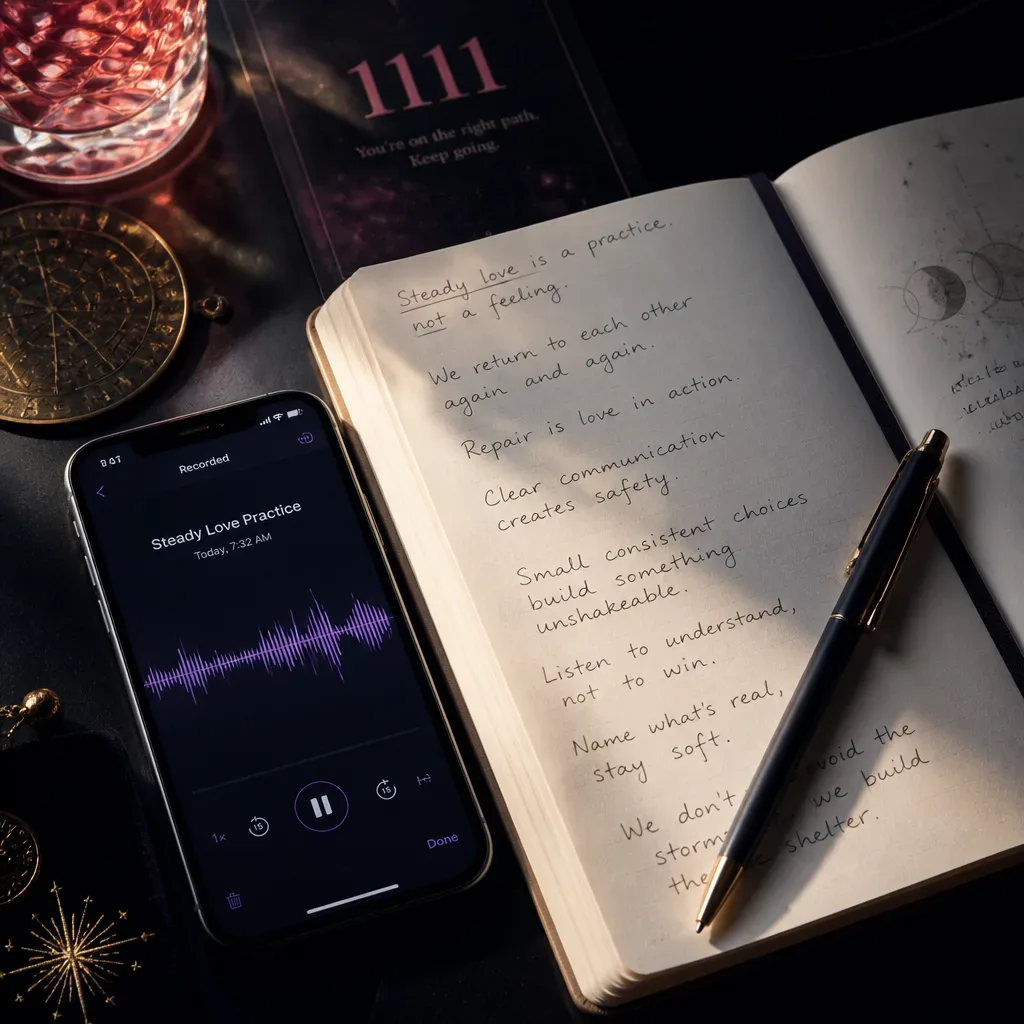
How do you write the Dream-Self Moment for love?
You write it as a scene from the relationship you can actually inhabit, not a catalog of traits.
Start with one ordinary moment. The morning after a hard conversation. A walk home after dinner. A Sunday where no one is performing. The smaller the scene, the truer it tends to be. Neville Goddard called this kind of practice an imaginal act, often recommending a short scene that implies the wish fulfilled. The word “implies” is useful. You don’t need to script a wedding. You need a moment that proves emotional availability is already normal in your life.
A good Dream-Self Moment includes 5 parts:
- Time and place. Put yourself somewhere plain: kitchen, train, doorway, bed.
- A body signal. Describe relaxed shoulders, easy breath, warm hands, unclenched jaw.
- A partner behavior. Let them listen, follow through, repair, or ask a real question.
- Your new response. You receive without testing. You speak without shrinking.
- One sentence of knowing. End with a line your future self can say without force.
The recording can be 90 seconds to 4 minutes. Many guided imagery studies use brief sessions, sometimes 5 to 15 minutes, but consistency matters more than length for this daily practice. Short enough to repeat is better than beautiful enough to avoid.
Try language like this:
I wake up rested. There is no panic in my chest. Last night, I told the truth, and love stayed. My partner listened. They didn’t rush me. They didn’t vanish. This morning, they make tea and ask how my heart is. I answer plainly. I don’t decorate my needs to make them acceptable. I know what steady care feels like now. I let it be here.
That is not a spell over another person. It’s a rehearsal of your capacity to stay with steadiness. If you use affirmations, let them be small supports. The affirmations pillar can help you choose one sentence, such as, “I receive love that can speak and stay.” One sentence. Then back to the audio.
What daily practice actually changes your pattern?
The practice changes when you listen every day and pair the listening with one honest dating behavior.
Do it at the same time if you can. Before opening an app. Before leaving for a date. Before replying to someone who has been inconsistent. Habit researchers Phillippa Lally and colleagues published a 2009 study in the European Journal of Social Psychology finding that automaticity took 18 to 254 days, with an average of 66 days. That range is kind. It reminds you that change can be uneven and still be real.
Use this 12-minute practice:
- Minute 0 to 2: settle. Put one hand on your chest or cheek. Notice the room. No performance.
- Minute 2 to 6: listen. Play your future-self audio once. Don’t multitask.
- Minute 6 to 8: name the obstacle. Write one old pattern that may appear today.
- Minute 8 to 10: choose one action. Ask clearly, pause before chasing, or tell the truth.
- Minute 10 to 12: close. Read one line aloud and return to the day.
A daily practice should be small enough to survive your life. If it requires a perfect morning, it will abandon you on the first hard week. If it fits beside your coffee, your train ride, or the two minutes before you get out of the car, it can stay.
Joe Dispenza often speaks about rehearsing a future state until the body begins to recognize it. You don’t have to accept every claim made in that world to use the ordinary principle: repetition teaches familiarity. In small behavioral studies, repeated cue-and-response practice can reduce hesitation because the next action has already been rehearsed.
You don’t rise to the love you fantasize about. You return to the love you’ve practiced receiving.
If you like timing your practice with the moon or Venus cycles, hold it lightly. Astrology and manifestation can give ritual texture, but the audio remains the method. The sky can mark the evening. You still have to listen.
How do you test availability without turning love into a checklist?
You test availability by observing behavior over time, while staying human and honest yourself.
A checklist can become another wall. It can keep you safe from chaos, but it can also keep you from being touched by real care. The point is not to grade someone. The point is to stop explaining away what hurts you.
Relationship researcher John Gottman has written for decades about bids for connection, those small moments when one person reaches and the other turns toward, away, or against. In Gottman’s public summaries of lab research, couples who turned toward bids more often tended to have stronger outcomes over time. That gives you a plain test: when you reach in a reasonable way, what happens next?
Use these 4 availability checks:
- Consistency: Do their words and actions match across several weeks, not just one date?
- Repair: When something goes wrong, can they discuss it without contempt or withdrawal?
- Curiosity: Do they ask real questions and remember your answers?
- Capacity: Do they have room for love in their actual life, not only in their longing?
The number matters. One beautiful date is data, not proof. Three kept plans mean more. A kind repair after a misunderstanding means more still. If someone says they want intimacy but disappears every time it asks for presence, believe the behavior.
Your part is also visible. Future-self audio isn’t only for receiving. It teaches you to stop testing people in secret. Instead of waiting to see if they guess your need, you can say, “I like steady communication. What does that look like for you?” Directness is not neediness. It is mercy for both people.
For a broader base on choosing from intention rather than panic, return to love manifestation and the larger manifestation pillar. Keep the practice close to the body. Your body often knows the difference between calm and collapse before your story catches up.

What if fear shows up after someone steady arrives?
Fear after steadiness arrives doesn’t mean the love is wrong; it may mean your system is meeting something unfamiliar.
This is the part people don’t say enough. Emotionally available love can feel almost suspicious if you’ve spent years bonding through pursuit. You may miss the spike. You may call calm boring. You may search for a problem because peace leaves too much room to feel.
Attachment researchers have found that anxious and avoidant strategies can persist even when a partner behaves kindly. That isn’t a moral failure. It’s learned protection. The work is to pause before you obey the alarm. Ask: “Is there a present problem, or is my body remembering an old one?” The answer may take more than one breath.
When fear appears, use a 3-line repair with yourself:
- Name it: “I’m scared because this is steady.”
- Locate it: “I feel it in my chest and jaw.”
- Choose it: “I can move slowly and still stay open.”
Then listen again that night. Not to erase fear. To remind yourself of the self who can feel fear without handing it the pen.
A 2018 review in Frontiers in Psychology described self-compassion as linked with lower anxiety and greater emotional resilience across multiple studies. That belongs here. You will not shame yourself into receiving better love. You will practice returning.
Some days the action is not texting. Some days it is asking for clarity. Some days it is ending something cleanly because the pattern is old and the behavior is plain. The Manifestation Board can hold images of the life you’re building, and an affirmation can steady one sentence. But when you can only do one thing, listen to the Dream-Self Moment.
The available partner is not only someone you find. It is someone your steadier self can recognize.
The room is still, and you’re allowed to choose what stays.