love manifestation
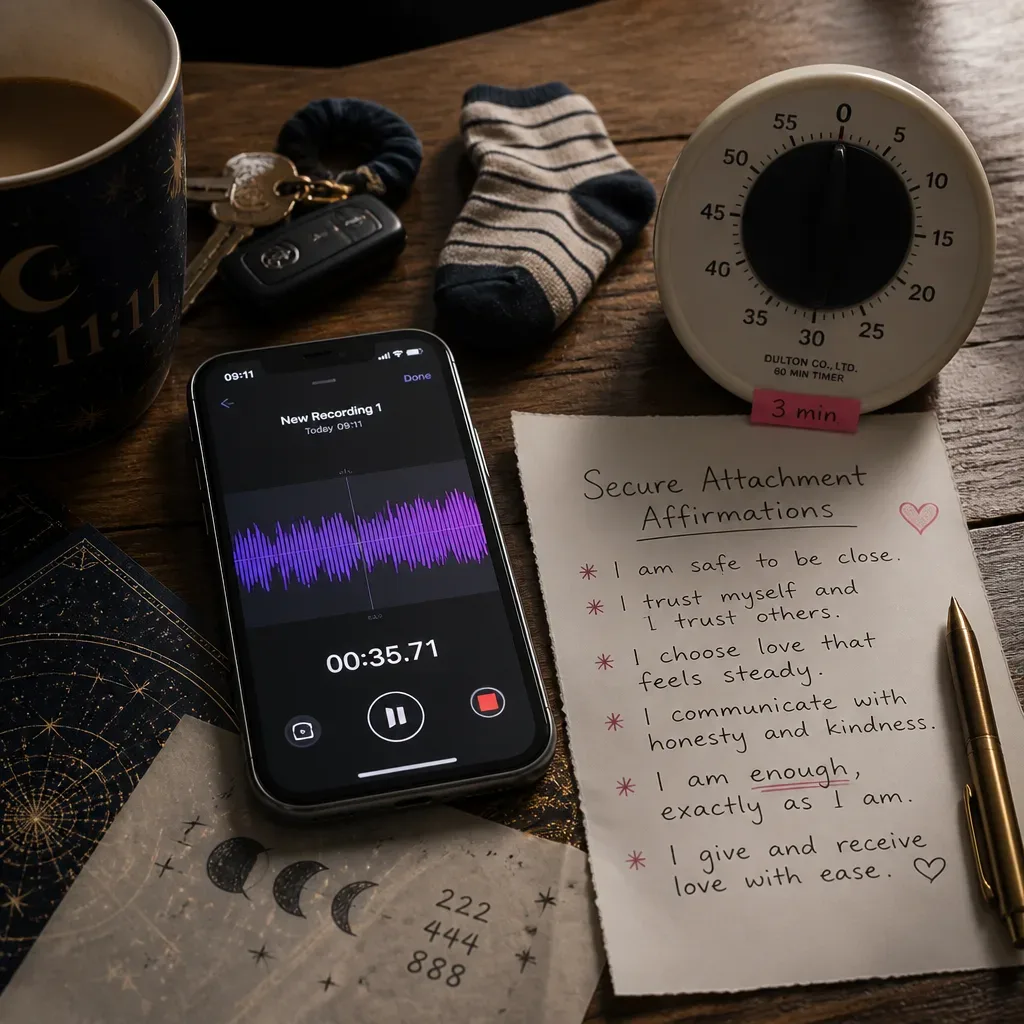
Secure Attachment Affirmations in 3-Minute Audio
Secure attachment affirmations become stronger as 3-minute future-self audio: a practical daily script for calmer love, repair, and receiving care.

At 7:11 this morning, the house was already negotiating with me. One child wanted socks. One pan wanted washing. Secure attachment affirmations work best when they become a 3-minute future-self audio: specific, repeated daily, and spoken from the version of you who already trusts love without gripping it.
What are secure attachment affirmations really training?
Secure attachment affirmations train your nervous system to expect steadiness, repair, and mutual care instead of scanning every pause as a verdict.
Attachment theory began with John Bowlby in the 1950s and 1960s, then Mary Ainsworth’s Strange Situation research in the 1970s gave the field its now-familiar categories: secure, anxious, avoidant, and disorganized. The language has gone mainstream, sometimes too neatly. Still, the signal underneath is useful. A secure system has learned that connection can bend without breaking.
That is what these affirmations are for. Not pretending. Not painting a nervous pattern with gold leaf. You are rehearsing a different response to a known cue. If delayed replies make your chest tighten, your affirmation should not be vague. It should meet the exact moment: I can feel uncertainty without abandoning myself. I can ask clearly. I can wait without creating a whole courtroom in my head.
In adult attachment research, Cindy Hazan and Phillip Shaver’s 1987 paper connected romantic bonds with early attachment patterns. Later studies by researchers such as R. Chris Fraley showed that attachment is relatively stable but not fixed. That sentence matters. Stable is not permanent. A dial can hold its place and still be moved.
A secure system does not need fireworks; it needs evidence.
Useful secure attachment affirmations tend to include four elements:
- Safety: I can be close without losing myself.
- Consistency: Love can be steady, not dramatic.
- Repair: Conflict is information, not an ending.
- Receiving: I allow care to arrive without auditing it first.
If you want the wider frame, start with the Affirmations pillar and the Manifestation pillar. Then bring it down to one sentence you can believe at 11:11, or in the school pickup queue with the engine off.
Why does a 3-minute future-self audio work better than a long script?
A 3-minute audio works because it is short enough to repeat daily and long enough to change the emotional weather.
Three minutes is not a symbolic number pulled from a glittery hat. It is practical. In behavior design, BJ Fogg’s research at Stanford has emphasized tiny habits because small actions face less resistance. A 3-minute recording can fit before a meeting, after washing bottles, or while sitting in the car because you arrived 4 minutes early and refuse to scroll yourself into comparison.
The future-self angle gives the script a point of view. You are not begging for love from the old wound. You are listening to the version of you who has already learned to stay. That is the same direction used in the AYA Method: The AYA Method is a daily audio manifestation practice. Each day you listen to a short personalized recording, your Dream-Self Moment, narrated from the version of you who has already manifested the life you intend. Listening is the practice. Repetition is the work. The audio is the method.
Notice the spine: audio first. A daily affirmation can support it. A Manifestation Board can give the eyes something to witness. But the audio carries the practice because the voice arrives in time. It enters the room.
Neuroscientist Dr. Andrew Huberman often points to repetition, attention, and emotional salience as key conditions for neuroplastic change. The exact mechanisms are complex, and no one should claim one recording rewires an attachment system overnight. But repeated listening can make a new response more available. That is already a lot.
Repetition is not the enemy of feeling. Repetition is how feeling learns the route home.
How do you write secure attachment affirmations that sound believable?
You write believable secure attachment affirmations by naming the trigger, choosing the secure response, and keeping the language close to real life.
Do not write like a moonlit billboard. Write like someone who has paid rent, missed a call, sent the awkward apology, and lived. If your body does not believe I am perfectly safe in every relationship, do not use it. The body is not impressed by theater. It prefers accuracy.
A 2022 review in the journal Current Opinion in Psychology described self-talk as most useful when it is task-specific and emotionally regulated. That tracks with attachment work. The sentence I am chosen forever may feel nice for 9 seconds, but it may collapse the moment a partner is tired. Better: I can notice distance without making it mean rejection. Specific language gives the mind a handle.
Use this simple writing sequence:
- Name the trigger. When a message is late, my body tries to predict loss.
- Name the old move. I used to chase, test, withdraw, or go cold.
- Name the secure move. I pause, breathe, and choose one clean request.
- Name the future-self truth. I am someone who can receive steady love.
- Name repair. If something is unclear, I can ask without accusation.
Here is a compact comparison table:
| Weak affirmation | Secure attachment version |
|---|---|
| I never feel anxious again. | I can feel anxiety and still act from steadiness. |
| They always text me back fast. | I do not measure my worth by response time. |
| Love never hurts me. | I choose relationships where repair is possible. |
| I am wanted by everyone. | I am available for mutual, honest care. |
Neville Goddard taught assumption as an inner state, not just a sentence. Joe Dispenza speaks often about rehearsing the future with emotion. Take what is useful and keep your feet on the tile. In love, the cleanest assumption is not that someone else behaves perfectly. It is that you meet yourself with enough steadiness to choose well.
The attachment dial moves when your daily language stops insulting your actual nervous system.
How do you record the 3-minute audio without making it awkward?
You record it like a voice note from your steadier self, slowly, with pauses, and with no performance voice.
I played bass on tour for 10 years. The glamorous secret is that most practice is unglamorous. You play the same line until your fingers stop asking permission. A future-self audio is similar. The first recording may sound stiff. Fine. So did the first take of many songs people now pretend arrived fully dressed.
Set a timer for 3 minutes. Most people speak around 130 to 160 words per minute in ordinary conversation, so your script should be roughly 330 to 420 words if you read slowly with pauses. If you write 900 words, you are not making a practice. You are making a podcast episode for one tired listener.
Use this structure:
- 0:00 to 0:30: Arrive. Breathe. Say your name.
- 0:30 to 1:15: Name the old attachment pattern kindly.
- 1:15 to 2:20: Speak the secure future-self affirmations.
- 2:20 to 2:50: Picture one real-life moment handled differently.
- 2:50 to 3:00: Close with one sentence you can carry.
Example opening:
I know the silence used to make you reach for proof. I know your body learned to listen for leaving. But we are not living only from that alarm now. We can ask. We can wait. We can choose people who return.
Keep the recording human. If your child bangs a spoon in the background, decide whether it ruins the take or blesses it with evidence. Life is rarely silent when it is telling the truth.
The Journal of Behavioral Medicine has published multiple studies on mindfulness and self-regulation across decades, with brief daily practices often showing measurable stress benefits. Your attachment audio is not the same as a clinical mindfulness protocol, but it shares a principle: the body learns through repeated cues.
A groove is just a promise kept at tempo.
When should you listen so the practice actually sticks?
Listen at the same daily cue, because attachment security grows through consistency rather than intensity.
The best time is the time you can repeat without bargaining. Morning works for some people because the mind has not yet collected 47 tabs. Night works for others because attachment fears often get loud when the room goes quiet. Parents may need a third gate: parked car, bathroom floor, washing dishes, stroller walk, school pickup line. Sacred is good. Repeatable is better.
Research on habit formation by Phillippa Lally and colleagues at University College London found that habits took an average of 66 days to become automatic, with wide variation from 18 to 254 days. That is a useful correction to the popular 21-day myth. If your secure attachment practice still feels deliberate after 2 weeks, nothing has gone wrong.
Try a 7-day rhythm first:
- Day 1: Record the audio and listen once.
- Day 2: Notice resistance without editing.
- Day 3: Listen before one relational risk.
- Day 4: Write down one calmer choice.
- Day 5: Add one line about repair.
- Day 6: Listen without multitasking.
- Day 7: Decide what sentence feels true enough to keep.
There is also a cosmic reason people like a daily cue. Numbers help the mind mark the gate. Seeing 11:11 does not have to mean the ceiling opened. It can simply remind you: return to the chosen script. Master number 11 has long been associated in numerology with intuition and signal, while 22 is often tied to building and structure. I like that pairing. Listen at 11:11 if it helps. Then do the dishes.
For relationship timing, you can also read Astrology and manifestation, especially if lunar cycles help you name the season you are in. Just do not let the moon do the work you are avoiding.

How do you know the affirmations are changing your attachment pattern?
You know the practice is working when your behavior shifts before your mood fully agrees.
Do not wait for a permanent calm glow. Secure attachment often looks ordinary. You pause before sending the third text. You say, I need reassurance, without turning it into a trial. You notice attraction to inconsistency and do not make it sacred. You receive care without immediately checking the exits.
Track behavior, not just feeling. In small psychotherapy outcome studies, progress is often measured by concrete changes: fewer symptoms, improved functioning, better relational choices. You can borrow that seriousness for your own practice without pretending to be a lab. Choose 3 markers and watch them for 14 days.
| Marker | What to observe for 14 days |
|---|---|
| Protest behavior | Fewer tests, threats, or dramatic exits |
| Repair | Faster, cleaner apologies and requests |
| Receiving | Less suspicion when care arrives |
| Selection | More interest in consistent people |
If the audio makes you cry, that may be meaningful, but tears are not the only receipt. Sometimes the first sign is boring. You sleep. You eat. You do not turn a 12-minute delay into a prophecy. The mirror stops exaggerating the room.
Tara Brach often teaches the pause as a place where choice returns. Attachment work needs that pause. Between signal and story, there is a small gate. Your 3-minute audio trains you to notice it.
Secure love is not the absence of need. It is the ability to bring need into the room without setting the room on fire.
If your history includes trauma, abuse, coercive control, or panic that overwhelms daily life, bring in professional support. Audio can accompany therapy, not replace it. A secure future self does not refuse help to prove a point.
What should your first secure attachment audio say?
Your first audio should speak to one real pattern, one secure response, and one future-self identity you can practice for 7 days.
Here is a 3-minute script you can adapt. Keep what lands. Cut what performs. Record it in your own voice or a voice that feels calm enough to trust.
I am here. I am not in trouble for wanting closeness. My need for love is not the problem. The old alarm is trying to protect me, and I can thank it without letting it drive.
When a message is late, I do not turn silence into a sentence. When someone needs space, I do not disappear from myself. When I need reassurance, I can ask plainly. I do not have to test love to see if it survives.
I am becoming someone who can receive consistent care. I notice people who return, repair, and tell the truth. I do not confuse intensity with intimacy. I do not confuse distance with depth. My body is learning the difference.
If conflict arrives, I stay close to myself. I can say what hurt. I can listen. I can repair when I miss the mark. Love is allowed to be human and still be safe.
I choose relationships where my nervous system can exhale. I choose words that make contact. I choose patience without self-erasure. I choose honesty without threat.
Today, I practice one secure move. One breath before the story. One clear request. One moment of receiving care without pushing it away. I do not need to become someone else to be loved. I am learning to be here.
That is enough for the first recording. If you want a fuller practice container, use the AYA Method for the daily audio spine, then let secure attachment affirmations support the specific love pattern you are naming. The Manifestation pillar can help you place that desire in a wider frame, and the Affirmations pillar can sharpen the wording.
Doreen Virtue popularized angel numbers for a mass audience before publicly distancing herself from that work; it is worth holding such sources with discernment. A number can be a witness without becoming a command. The same is true of an affirmation. Let it point. Then practice.
At the right hour, the right sentence gets quiet enough to enter.