love manifestation
Manifest Marriage Without Timeline Panic: 3-Minute Audio
Manifest marriage without spiraling over dates, age, or anniversaries with a 3-minute audio practice that trains calm selection daily.

To manifest marriage without timeline panic, use a three-minute daily audio practice that puts your nervous system inside the lived reality of partnership before your calendar starts bargaining with fear. The point is not to force a date. It is to rehearse devotion until your choices stop chasing and start selecting.
Why does timeline panic make marriage feel farther away?
Timeline panic makes marriage feel farther away because it turns desire into threat, and threat narrows perception.
You know the scene. It is 11:11 on the phone, then 2:22 on the receipt, then another engagement post before breakfast. The dial lines up, but instead of a signal, your body hears a siren. Marriage stops feeling like a life you are allowed to choose. It becomes a race against age, family comments, fertility math, and everyone else’s matching linens.
The numbers are not imaginary. The U.S. Census Bureau reported the median age at first marriage in 2023 at about 28.4 for women and 30.2 for men, nearly 7 years later than in 1970. That shift gives people more time, but it also gives anxiety more room to count. A delayed cultural timeline can feel like a personal verdict if you let the calendar become the judge.
Stress changes the room. In a widely cited 2013 Carnegie Mellon study, self-affirmation improved problem-solving performance under stress, suggesting that identity-based cues can protect executive function. That matters in love. When you are panicked, you do not read people better. You read them faster, harsher, and through old alarms.
Marriage is not claimed by gripping the date until it bruises. Marriage is claimed by becoming the kind of person who can recognize steadiness when it arrives.
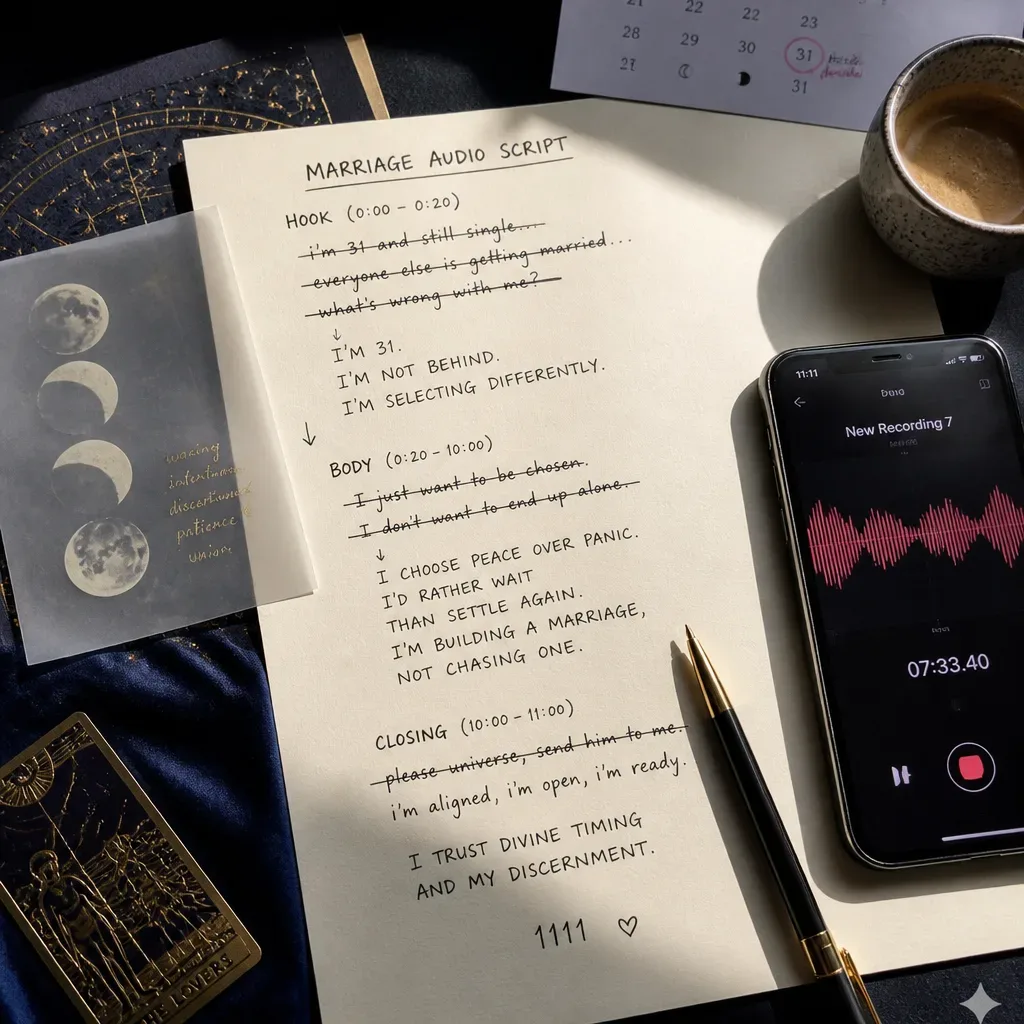
This is where the AYA Method becomes useful. The AYA Method is a daily audio manifestation practice. Each day you listen to a short personalized recording, your Dream-Self Moment, narrated from the version of you who has already manifested the life you intend. Listening is the practice. Repetition is the work. The audio is the method.
What should a 3-minute audio practice actually do?
A three-minute audio practice should regulate your body, specify the marriage reality, and create one repeatable cue for aligned action.
Three minutes is not a loophole. It is a container. Dr. Andrew Huberman has often discussed the power of brief physiological practices, including cyclic sighing research published in Cell Reports Medicine in 2023, where five minutes daily improved mood and reduced physiological arousal more than mindfulness meditation in that small trial. The principle is clean: short practices can matter when they are specific and repeated.
For manifest marriage work, the audio should not sound like begging. It should sound like evidence from the future. You are not pleading to be chosen. You are hearing from the version of you who already knows what mutual commitment feels like on a Tuesday night, with dishes in the sink and no performance required.
Use this structure:
- Opening signal, 20 seconds: breathe, arrive, and let the body know the gate is open.
- Dream-Self narration, 2 minutes: hear yourself describe a steady marriage as already lived.
- Selection cue, 30 seconds: name the quality you will choose today.
- Action close, 10 seconds: decide the next non-panicked move.
The audio should include sensory details, not fantasy fog. A wedding can appear, but the marriage matters more. Mention the morning light, the respectful disagreement, the shared calendar, the way your body does not brace when their name appears on your phone. The nervous system learns through repetition and specificity; generic desire is a weak signal.
If you want broader grounding before narrowing into love, read the Manifestation pillar. It explains why attention, identity, and repeated inner rehearsal work better when they are tied to behavior.
How do you write a marriage script that does not beg?
You write a marriage script that does not beg by speaking from the version of you who is already safely loved, not the version auditioning for proof.
The difference is not cosmetic. A begging script asks, when, who, why not me. A marriage script names the room after arrival. Neville Goddard called this living in the end; his language is old-school, but the psychological move is still sharp. You rehearse the state that would naturally produce different choices.
Here is the editorial test: if the script would make you check your phone harder afterward, rewrite it. If it makes you breathe lower, stand taller, or delete the message you were about to send from panic, the dial is closer.
Use this table before recording:
| Panic line | Marriage-state line |
|---|---|
| I need to know if this is my person now. | I recognize consistency without forcing a verdict. |
| Everyone is getting married before me. | My timing is private, and my standards are alive. |
| If they leave, I am behind again. | I do not bargain with unavailable love. |
| I have to be perfect to be chosen. | I am chosen in a life where honesty has room. |
Specific language matters. In 1999, psychologist Peter Gollwitzer’s implementation-intention research found that if-then planning improved goal follow-through across multiple domains. Your script can borrow that precision: if I feel timeline panic after a date, then I listen once before interpreting the silence.
A strong script has three parts:
- Identity: I am someone who is safe with real commitment.
- Evidence: My marriage includes repair, laughter, attraction, and shared responsibility.
- Boundary: I no longer confuse intensity with devotion.
Affirmations can support this, especially when you need a one-line return during the day. The Affirmations pillar is useful for that complement. Still, keep the hierarchy clear: the daily audio holds the practice; the affirmation is a pocket-sized witness.
How do you stop checking the calendar after every date?
You stop checking the calendar by replacing countdown behavior with signal behavior.
Countdown behavior asks, how many months until engagement, how many dates until certainty, how many birthdays until I should worry. Signal behavior asks, did I feel respected, did they follow through, did my body soften, did I stay honest. One keeps you trapped in an imagined deadline. The other returns you to data.
Relationship researchers John and Julie Gottman have studied couples for decades, including observations from the Love Lab beginning in the 1980s. Their work repeatedly points toward small patterns, repair attempts, bids for connection, and contempt, rather than grand romantic declarations, as predictors of relational health. Marriage is not proven by intensity. It is revealed by repeated behavior.
After your three-minute audio, do this tiny audit:
- Did I act from selection or alarm today?
- Did I honor one boundary without performing detachment?
- Did I make room for love in my schedule, not just in my fantasy?
- Did I confuse chemistry with capacity?
- Did I let one good signal be enough for one day?
This is not about becoming cold. It is about becoming legible to yourself. Timeline panic makes every interaction a referendum. A calm practice makes each interaction a piece of information.
There is also a cultural piece here. Pew Research Center reported in 2019 that marriage rates in the U.S. had declined over decades, while cohabitation and later marriage became more common. If your parents married at 24 and your peers are doing it at 34, the old map will misread the current road. That does not mean your desire is outdated. It means the timing field changed.
Use astrology if it helps you track cycles, not if it gives panic better stationery. New moons, Venus returns, and 11-day personal rituals can be beautiful containers. The point is observation, not outsourcing. For that lens, Astrology and manifestation offers a grounded way to read timing without surrendering your agency.
What actions should follow the audio if you are dating?
The action after the audio should be small, concrete, and consistent with the marriage you are claiming.
Listening is the method, but listening is not hiding. If the Dream-Self Moment shows a steady marriage, your next action should have the same temperature. Not dramatic. Not manipulative. Not a seven-paragraph text sent at 12:12 because the number felt like permission.
In dating, aligned action often looks almost boring:
- update one profile sentence so it names commitment clearly
- ask one direct question instead of decoding hints for 3 days
- stop replying to someone who disappears and returns on cue
- schedule dates when you are rested enough to be yourself
- tell the truth sooner, kindly, without auditioning
The Journal of Social and Personal Relationships has published many studies on responsiveness, a partner’s perceived understanding, validation, and care, as a key component of intimacy. The practical translation is simple: do not only ask whether someone is attractive. Ask whether responsiveness is present in a repeatable pattern.
Here is the three-minute routine as a how-to:
- Minute 1: regulate. Sit still, soften the jaw, and let the first lines of the audio slow your breathing.
- Minute 2: receive. Hear the Dream-Self narration as if it is a memo from the life already arranged around mutual devotion.
- Minute 3: select. Choose one action that matches marriage, not panic.
If you are not dating, the action may be different. Clear one Saturday morning each month for social life. Tell a friend you are open to introductions. Remove the emotional placeholder who consumes the room without building anything in it. The love manifestation guide can help you separate desire from fixation when the signal gets noisy.
The action does not need to impress anyone. It needs to prove to your body that your future has a vote today.
How can affirmations and a Manifestation Board help without taking over?
Affirmations and a Manifestation Board help when they support the audio practice rather than replace it.
This distinction matters. The daily audio is the method. The affirmation is a line you can carry. The Manifestation Board is a visual witness. If you make all three equal, the practice can become busywork with better fonts. I say that as a former advertising writer who has sold many feelings in tidy sentences. A promise is not a practice.
A useful affirmation for manifest marriage is not sugary. It should be clean enough to survive a hard day. Try one of these after listening:
- I choose the love that can choose me back.
- My timing does not need public approval.
- I am available for devotion, not performance.
- I can desire marriage without turning my body into a clock.
Self-affirmation research by Claude Steele, and later studies such as Creswell’s work on stress and self-integrity, suggests that values-based statements can reduce defensiveness under pressure. That is the point here. Not magic wording. Less bracing. More choice.
A Manifestation Board can hold the same line visually. Choose images of daily partnership, not only ceremony: two mugs, a shared key hook, a table with room for both laptops, a hand on a shoulder during ordinary weather. According to The Knot’s 2023 Real Weddings Study, the average U.S. wedding cost was reported around $35,000, which is exactly why ceremony imagery can hijack the deeper desire. You are practicing marriage, not only event production.
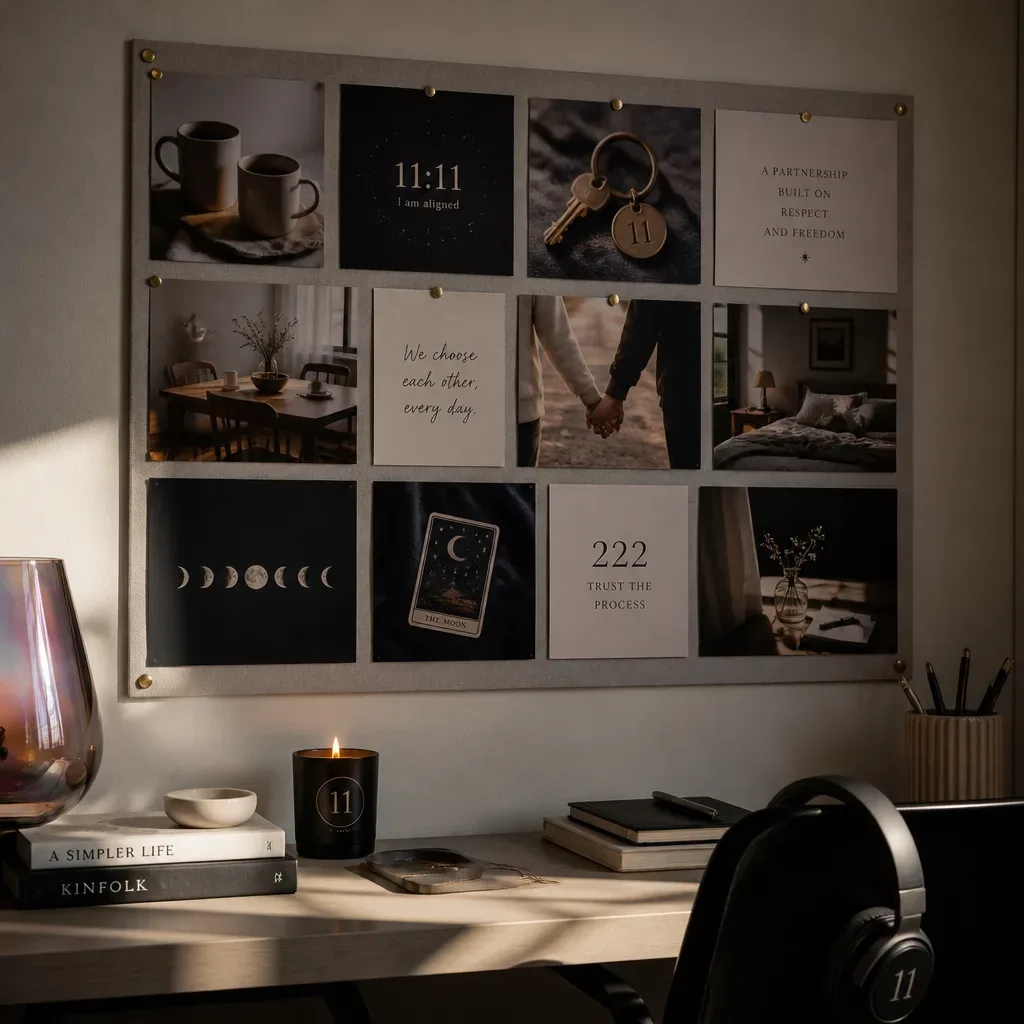
Keep your board edited. Eleven images are enough. Master number 11 is often read as intuition and signal in numerology; whether you treat that symbolically or aesthetically, the restraint helps. Too many images can turn longing into noise.
What should you do when panic returns anyway?
When panic returns, treat it as a weather event, not a prophecy.
Panic will return because you are human, not because the practice failed. Someone will announce an engagement. A relative will ask the question with the precision of a paper cut. A promising person will take 26 hours to reply. Your body may reach for the old verdict before your wiser mind arrives.
Use the 90-second rule as a practical mercy. Neuroscientist Jill Bolte Taylor has popularized the idea that the chemical surge of an emotion can move through the body in about 90 seconds if we do not keep feeding it with story. The exact timing varies by person and context, but the principle is useful: pause before you crown the feeling king.
When panic hits, do this:
- Put one hand on your sternum.
- Say, this is timeline panic, not instruction.
- Play the first minute of your audio if three minutes feels too much.
- Drink water or walk for 5 minutes.
- Take no romantic action until your body is less loud.
This is not passivity. It is governance. The part of you that wants marriage deserves leadership, not surveillance.
If grief, fertility pressure, religious expectations, or past betrayal sit underneath the panic, bring in support. Therapy, medical guidance, community care, or a wise elder can all belong in the room. Manifestation is not a substitute for care. It is a practice that helps you meet care without abandoning your center.
You can also mark cycles without obeying them. Try 11 days of the three-minute audio, then review your behavior rather than your results. Did you text differently? Choose differently? Rest sooner? Tell the truth with less theatre? Those are not small receipts. They are the first architecture of a different love pattern.
The ring is not the only sign. Sometimes the first sign is that you stop negotiating with almost.
Let the bell ring once, then live the day.