love manifestation
No Contact Manifestation: 3-Minute Audio Instead of Checking
Use no contact manifestation without spiraling: a 3-minute audio practice for the moment you want to check, text, stalk, or reopen the wound.
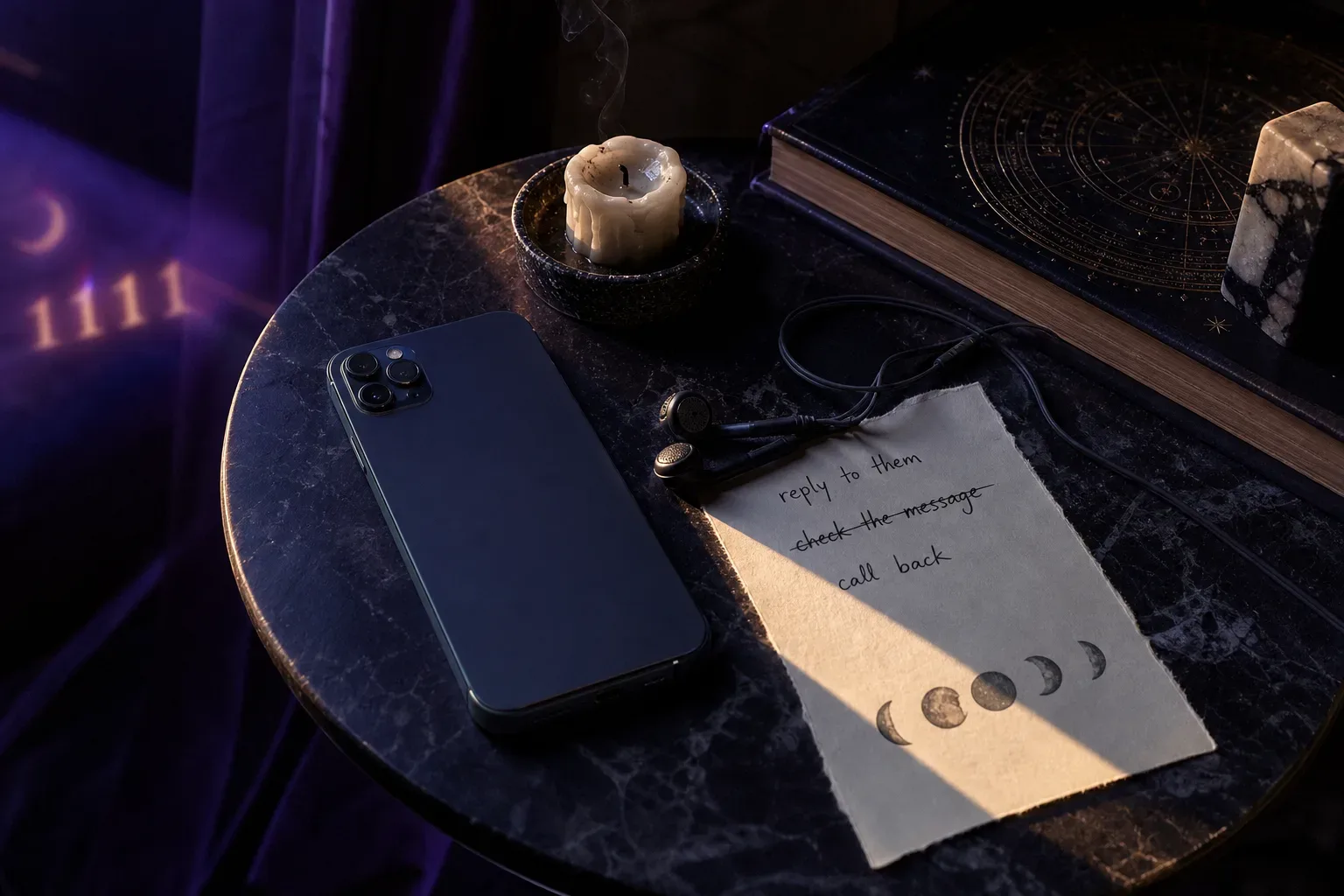
No contact manifestation works best when it gives your checking urge somewhere else to go. Instead of opening their profile, rereading the thread, or watching the last-seen dot like weather, you play a 3-minute audio that rehearses your steadier self. The practice is not avoidance. It is choosing the signal over the loop.
What is no contact manifestation, really?
No contact manifestation is holding an intention while refusing to use checking as emotional evidence.
The phrase gets messy because people use it for everything from dignified silence to strategic disappearance. I mean something cleaner. You are not texting. You are not checking their stories. You are not asking the mutual friend with suspicious casualness whether they seemed fine at dinner. You are practicing the state you said you wanted to live from.
That distinction matters. In 2024, Pew Research Center reported that 90% of U.S. adults owned a smartphone, which means the object of longing now lives in the same rectangle as your bank app, your map, your music, and your 2:17 a.m. mistake. No contact used to require not calling. Now it requires not conducting a forensic audit of someone’s online presence.
Checking feels like action because the body gets a hit of possible information. It is not the same as movement. A notification can change your mood in 2 seconds and still tell you nothing true about your future. That is the tiny gate this practice is built for.
The manifestation part is not about forcing another person to return. If you want a fuller frame for intention, start with the Manifestation pillar, where the work is named as attention plus repeated identity, not wishful staring. No contact manifestation asks: who are you when nobody is feeding you evidence?
The check is not neutral when your peace is paying for it.
Why does checking make the desire feel farther away?
Checking makes desire feel farther away because it trains your nervous system to treat uncertainty as an emergency.
There is a reason the same profile can feel like a slot machine with better lighting. B. F. Skinner’s work on variable rewards in the 1950s showed that unpredictable reinforcement can make behavior unusually persistent. The reward does not have to arrive every time. The maybe is enough to keep the hand moving.
Modern phones sharpen that pattern. In a 2015 study in the Journal of Computer-Mediated Communication, researchers found that iPhone separation increased anxiety and impaired cognitive performance during a task. That study was not about romance, but anyone who has placed a phone across the room during no contact knows the body does not care about the category. It reads absence as unfinished business.
No contact is also vulnerable to false signals. They watched your story. They posted at 11:11. They liked a song you once played in the car. I respect synchronicity; this whole room has a clock in it. Still, not every number is a command. In numerology, 11 is a master number associated with intuition and heightened perception, but heightened perception without discipline can become surveillance with incense.
This is where Astrology and manifestation can be useful if you keep it as a timing mirror, not a legal document. A Venus retrograde can name a season of review. It cannot excuse refreshing someone’s page 22 times before breakfast.
A useful rule: if the sign costs your self-respect, it is not a sign yet. It is a symptom.
How do you replace checking with a 3-minute audio?
You replace checking by making the audio the first response, not the reward after you have already spiraled.
The move has to be small because the urge is fast. App-opening is often a one-thumb decision. A 2022 DataReportal analysis estimated that the average internet user spent nearly 7 hours online per day globally; attention is not merely distracted, it is trained. Your practice has to be reachable inside that training.
Here is the 3-minute protocol I give people on my podcast when the story is complicated and the phone is too close:
- Minute 0:00 to 0:20: Turn the phone face down. Not across the city. Just face down. Make one physical vote for your future self.
- Minute 0:20 to 1:00: Press play before negotiating. Do not ask if you deserve to check first. The urge will always vote yes.
- Minute 1:00 to 2:20: Listen as the steadier version of you speaks. Let the words describe your body, your choices, your calm, and the way you stop auditioning for reassurance.
- Minute 2:20 to 3:00: Choose one ordinary next action. Water. Shower. Walk. Work email. Something visible, boring, and real.
This is where the AYA Method fits cleanly. The AYA Method is a daily audio manifestation practice. Each day you listen to a short personalized recording, your Dream-Self Moment, narrated from the version of you who has already manifested the life you intend. Listening is the practice. Repetition is the work. The audio is the method.
The daily affirmation and Manifestation Board can support the practice, especially after the urge has passed. But in the hot moment, audio wins because it occupies the same attention channel the checking loop wanted to hijack. It gives your mind something to follow when your hand wants the app.

What should your no contact audio actually say?
Your audio should speak from the identity you are practicing, not from the panic you are trying to hide.
A no contact recording is not a plea disguised as confidence. It should not say, they are obsessed with me, they regret everything, they cannot sleep. That may feel powerful for 11 seconds, then the body notices you are still orbiting them. The better script returns the camera to you.
Self-affirmation research gives this some ground. A 2014 paper in the Journal of Experimental Social Psychology found that self-affirmation can buffer stress responses and improve problem-solving under pressure. The point is not magic language. The point is reducing threat so the brain can stop treating the silence as proof of abandonment.
Use present-tense identity language, but keep it believable enough that your body does not roll its eyes. If you need support writing lines, the Affirmations pillar is useful, especially if you tend to write sentences that sound like a billboard trying too hard.
| Checking thought | Audio replacement |
|---|---|
| If they cared, they would text. | I do not use silence to measure my worth. |
| I need to know if they moved on. | I return to my life before I collect evidence. |
| One look will calm me down. | One look restarts the loop. I choose the pause. |
| What if no contact makes them forget me? | I am not kept by being constantly available. |
| The sign means I should reach out. | A signal can be witnessed without being obeyed. |
A strong 3-minute audio includes four parts:
- One sentence that names the urge without shame.
- Two or three sentences from your future self.
- One body cue, such as unclenching your jaw or lowering your shoulders.
- One final instruction that returns you to the day.
Try this line: I can miss someone without making myself available to the version of them that could not meet me. It is a full sentence. It does not need a court case.
What do you do when the urge to text gets physical?
When the urge to text gets physical, treat it like a wave in the body before you treat it like a decision.
You know the moment. Heat behind the ribs. A sentence forming. The moral brilliance of the message is suddenly undeniable. You are not spiraling, you tell yourself; you are clarifying. Every person who has ever sent a bad paragraph at 12:41 a.m. has called it clarifying.
Jill Bolte Taylor popularized the idea that the physiological life of an emotion can move through the body in about 90 seconds when we do not keep feeding it with thought. The exact timing is debated, but the instruction is useful. Give the body one full minute before you crown the urge as truth.
Use this emergency version:
- Put both feet on the floor.
- Start the 3-minute audio.
- During the first 90 seconds, do not interpret anything.
- At 2 minutes, write the text in notes if you must.
- At 3 minutes, wait 24 hours before sending.
The 24-hour rule is not dramatic. It is data collection. In one 2019 study in Emotion, affect labeling, the act of naming feelings, was associated with reduced emotional reactivity in some contexts. Writing the text in notes lets you name the charge without making another person responsible for regulating it.
If the message still feels clean after 24 hours, and if no contact is not tied to safety, manipulation, or a stated boundary, you can decide from a calmer room. But the audio comes first. Desire should not have to sprint past your discernment to be heard.
How do you read signs without turning them into surveillance?
You read signs by recording them after you return to yourself, not while you are hunting for permission.
I like signs. I notice dates. I notice repeated songs. I once interviewed a woman who saw 222 on the receipt from the cafe where she decided not to send the message. The number did not make the decision for her. It witnessed the decision she had already made.
That is the difference. Angel numbers and master numbers can act like punctuation. They are not the paragraph. Doreen Virtue helped popularize angel numbers in the early 2000s, though she later distanced herself from that work; the cultural imprint remains. People still see 111, 222, 333 and feel the dial turn. Fine. Let the number ring. Then ask what your body did next.
A Manifestation Board can help here, not as a shrine to the other person, but as a witness board for your own pattern. Put on it the life that no contact is protecting: the apartment with morning light, the calmer nervous system, the friends who do not need the edited version of the story. Vision boards work best when they make your standards visible.
For love-specific context, pair this with the wider Manifestation pillar and, if timing keeps appearing, the guide to Astrology and manifestation. Just keep the order clean: practice first, interpretation second.
Use a simple signal log for 7 days:
| Day | Trigger | Sign noticed | Audio played? | What I did after |
|---|---|---|---|---|
| 1 | Wanted to check stories | 11:11 | Yes | Walked outside |
| 2 | Dreamed of them | Same song | Yes | Made breakfast |
| 3 | Mutual friend mentioned them | 222 receipt | No | Checked, then reset |
The point is not to become cold. The point is to stop confusing intensity with instruction.

What changes after seven days of the 3-minute practice?
After seven days, the biggest change is usually not the relationship; it is the shrinking gap between urge and choice.
Seven days is not a sacred number, though numerology gives 7 a long reputation for reflection and inner knowledge. It is also just long enough to reveal your pattern. Maybe the urge arrives after work. Maybe it spikes when you feel overlooked. Maybe Sunday nights are the gate. The number matters less than the witness.
Habit research by Phillippa Lally and colleagues, published in the European Journal of Social Psychology in 2009, found that habit formation ranged from 18 to 254 days, with an average of 66 days. That study is often flattened into a neat rule, but the messier finding is more useful: automaticity takes different lengths depending on the behavior and the person. No contact is not one habit. It is several.
By day 7, look for these markers:
- You checked fewer times, even if the number is not zero.
- You played the audio before at least one spiral.
- You can name your most common trigger.
- You feel the urge in your body sooner.
- You have one ordinary action that reliably returns you to the day.
If you want structure, repeat the same audio for 21 days. Joe Dispenza often speaks about rehearsing a future self until the body recognizes it as familiar; you do not need to adopt every claim to use the practical insight. Repetition changes what feels reachable.
This is also where the broader AYA Method rhythm matters. A 3-minute emergency audio is useful, but daily listening makes the steadier identity less theoretical. The morning practice sets the dial before the first trigger appears.
No contact manifestation is not proven by whether they text on day 3, day 7, or at the exact minute you stop caring. The cleaner metric is whether you are still abandoning yourself at the first sign of silence. When that changes, the room changes.
Leave the phone face down a little longer.