dream symbolism
Dreams About Teeth Falling Out: Meaning + Audio Reset
Dreams about teeth falling out often point to stress, transition, or voice. Learn the meaning, common variations, and a simple audio reset.

Dreams about teeth falling out usually mean your mind is processing stress, loss of control, self-image, communication, or a life transition. They are common stress dreams, not automatic omens. The reset is simple: name the feeling, check the body, then listen to a steady audio practice before the day takes over.
What do dreams about teeth falling out usually mean?
Dreams about teeth falling out usually mean something in waking life feels exposed, unstable, or hard to say.
The image lands hard because teeth are not decorative. They are tools. They bite, speak, smile, defend, seduce, nourish. When they fall out in a dream, the psyche uses a very physical symbol for a very human fear: something essential is not where it should be. Most people would call it bizarre. I call it the mind choosing good theater.
Dream researchers have treated teeth dreams as a common motif for decades. In a 2018 study published in Frontiers in Psychology, researchers found that teeth dreams may be linked to dental irritation during sleep more than some traditional symbolic theories suggest. That does not cancel symbolism. It just adds a practical gate: the body may be speaking before the oracle gets involved.
Still, dream meaning is rarely one dial. A woman who dreams her teeth crumble before a presentation may be processing fear around voice. Someone who dreams of spitting teeth into a sink after a breakup may be naming grief, embarrassment, or the cost of change. The same symbol can arrive with different weather.
A useful first reading looks like this:
| Dream detail | Possible waking-life signal |
|---|---|
| Teeth crumble slowly | Gradual stress or erosion of confidence |
| Teeth fall out in public | Fear of judgment or exposure |
| Pulling teeth out yourself | Control, self-sabotage, or release |
| Blood with the teeth | A painful ending or embodied anxiety |
| No pain, only surprise | Change that is unsettling but not harmful |
A dream symbol is not a verdict. It is a witness statement from the night mind.
For a wider frame on how symbols become practice, the Manifestation pillar is useful because it treats attention as something you place, not something that happens to you.
Why does this dream feel so disturbing when it is not real?
This dream feels disturbing because teeth sit at the crossroads of survival, beauty, speech, and control.
You can forget a dream about a hallway by lunch. Teeth are harder to dismiss. The mouth is intimate territory. It is where appetite, language, and family ritual all meet. I grew up in an Oaxaca kitchen where no one stirred a pot angry, because the mouth would know. That may not be a clinical statement, but it is precise in the way family rules often are.
The nervous system also prefers vivid symbols under pressure. The American Psychological Association has repeatedly reported stress as a significant factor in sleep disruption, with recent Stress in America reports showing money, health, and the future as recurring pressure points for adults. When the body is tense, the dream may borrow the body’s most vulnerable stage.
There is also a social layer. Teeth are visible markers. In a 2022 survey from the American Association of Orthodontists, many adults reported that smile confidence affected social and professional life. So when teeth fall out in a dream, the image can carry a fear of being seen incorrectly. Not unseen. Seen wrong.
The dream can also arrive during a season of identity change: a new role, an ending, a move, a diagnosis, a birthday with teeth in it. Numerology people notice master numbers like 11, 22, and 33 because they mark intensity, structure, and teaching. Whether you take that literally or poetically, the principle holds: some moments feel numbered.
If the dream returns, ask what part of your life currently feels bite-sized but is actually asking for a full plate.
Could teeth dreams be about stress, health, or the body?
Yes, teeth dreams can be symbolic and physical at the same time.
This is where the mystic has to wash her hands and check the sink. If you wake with jaw soreness, headaches, tooth sensitivity, or a tight neck, the dream may have a body trigger. Bruxism, or teeth grinding, often increases with stress. The American Dental Association notes that grinding can happen during sleep and may be connected to anxiety, alcohol use, caffeine, medications, or sleep disorders.
The 2018 Frontiers in Psychology study on teeth dreams found a relationship between teeth dreams and dental irritation upon waking. The sample was not a prophecy machine, and no single study gets the whole room, but it is enough to keep us honest. Before you assign cosmic meaning, notice whether your jaw has been working the night shift.
Here is the 3-part body check I use before coffee:
- Jaw: Is it tight, sore, or clicking?
- Mouth: Any gum tenderness, dryness, or tooth pain?
- Breath: Did you wake anxious, shallow, or already braced?
If the answer is yes to any of those for more than 7 days, schedule dental or medical care. Symbol work should never replace basic care. A message loses its glamour when a mouthguard would solve half of it.
There is no shame in a practical explanation. The body is not less sacred because it has enamel.
What do different versions of the teeth falling out dream mean?
Different versions point to different emotional gates, so the details matter more than the headline.
A dream where one tooth loosens is not the same as a mouthful of teeth falling into your hands. One may point to a specific worry. The other may suggest overwhelm. In dreamwork, specificity is the gold. Carl Jung wrote about symbols as living images rather than fixed codes, and that remains useful here: the symbol has a history with you.
Common variations include:
- Loose teeth: uncertainty, waiting, something not yet decided.
- Teeth breaking: pressure, depletion, or too much force applied for too long.
- Teeth falling out in front of others: shame, exposure, performance fear.
- Swallowing teeth: words held back, grief taken inward, silence with weight.
- New teeth growing in: renewal after loss, maturity, a changed voice.
- Rotten teeth: neglect, resentment, or a truth that has sat too long.
A 2014 review in Sleep Medicine Reviews noted that nightmares and distressing dreams are associated with stress, trauma symptoms, and emotional regulation. That does not mean every teeth dream is trauma. It means the night mind often sorts intense feeling through intense image.
Context is the dial. If you dream your teeth fall out the night before resigning from a job, the symbol may be about voice and consequence. If it happens after scrolling through old photos, it may point to aging or comparison. If it happens during a family conflict, the mouth is no accident.
The most accurate interpretation is often the one your body recognizes before your mind starts performing intelligence.
For readers who track timing, the Astrology and manifestation guide can help you notice lunar cycles, retrogrades, and personal timing without handing your authority to the sky.
How should you interpret the dream without spiraling?
Interpret it by recording the facts first, then naming one feeling and one next action.
The mistake is treating the dream like a court summons. It is not. It is data with mood lighting. You do not need a 40-tab search session at 3:17 a.m., and yes, 3:17 has its own suspicious little rhythm. You need a clean note and a calmer nervous system.
Use this 5-minute dream note:
- Write the scene in 3 lines. No analysis yet.
- Name the strongest feeling. Fear, shame, relief, disgust, grief, surprise.
- Circle the mouth-related theme. Voice, appetite, appearance, truth, money, age.
- Find the waking echo. What happened in the last 24 to 72 hours?
- Choose one next action. Apologize, rest, book the dentist, speak plainly, stop checking the message thread.
Sleep researchers often ask participants to use dream diaries because recall fades quickly. Many people lose dream detail within minutes of waking, according to classic sleep-lab findings from researchers like Ernest Hartmann and later dream recall studies. The sooner you write, the less the mind edits.
Do not over-interpret every symbol. The point is not to become obedient to dreams. The point is to become literate in your own signals.
If the dream points to a sentence you have not said, say it cleanly. If it points to exhaustion, sleep before you spiritualize. If it points to a pattern, name the pattern and stop feeding it after midnight.
The dream is loud because something quieter has been ignored.
What is the audio reset after a teeth falling out dream?
The audio reset is a short listening practice that steadies the body and returns attention to the self you are choosing to rehearse.
This is where the AYA Method enters the room. The AYA Method is a daily audio manifestation practice. Each day you listen to a short personalized recording, your Dream-Self Moment, narrated from the version of you who has already manifested the life you intend. Listening is the practice. Repetition is the work. The audio is the method.
After a teeth dream, you do not need to argue with the symbol. You need to reset the inner narration. Joe Dispenza often speaks about mental rehearsal and the body learning a future state before it arrives. Neuroscience researcher Dr. Andrew Huberman has also discussed how breath, attention, and repeated cues can shift state through the nervous system. Different schools, same useful hinge: repetition trains response.
Here is the reset I recommend before the phone starts making demands:
| Minute | Action | Why it works |
|---|---|---|
| 0:00-0:30 | Sit up, feet on floor, hand on jaw | Brings the dream back into the body |
| 0:30-1:30 | Exhale longer than you inhale | Signals downshift through breath |
| 1:30-2:30 | Write one sentence: The dream felt like… | Names the charge without obeying it |
| 2:30-5:00 | Listen to your Dream-Self Moment | Rehearses the identity you are practicing |
A daily affirmation can support this, and the Affirmations pillar has language for that. But the affirmation is a complement. The audio holds the practice. The Manifestation Board can also help you place the image somewhere visible, but again, the board is not the spine.
The reset is not denial. It is a refusal to let one night image write the whole day.

When should you take a recurring teeth dream seriously?
Take it seriously when it repeats, intensifies, affects your waking mood, or comes with physical symptoms.
A single teeth dream after a stressful week may be nothing more than the mind clearing the kitchen after a crowded dinner. A recurring dream is different. Repetition is the psyche knocking with a pattern. If the same dream appears 3 or more times in a month, track it. If it arrives with panic attacks, insomnia, grief, trauma memories, or jaw pain, get support.
The National Sleep Foundation has reported that adults generally need 7 to 9 hours of sleep, and disrupted sleep can affect mood, cognition, and stress tolerance. Dreams are not separate from that system. If fear of the dream makes you avoid sleep, the problem has moved from symbol to health.
Consider support when:
- You wake distressed more than once a week.
- You grind your teeth or wake with jaw pain.
- The dream follows a traumatic event.
- You feel afraid to sleep.
- The dream keeps pointing to a real conversation you are avoiding.
- You use alcohol, scrolling, or overwork to avoid the feeling.
A therapist, dentist, physician, or sleep specialist may be the right witness, depending on the pattern. Tara Brach often teaches the value of naming what is present with compassion. That is not softness for its own sake. Accurate naming lowers the drama so the truth can be handled.
If you like a symbolic frame, compare the dream with your Manifestation pillar practice: what identity are you rehearsing by day, and what fear is rehearsing itself by night? If the two are in conflict, the dream may be showing you where the practice needs honesty.
And if the timing keeps arriving on cue, 11:11 on the oven clock, 22 unread messages, the same dream after every family call, do not panic. Notice the pattern. Patterns are not commands. They are invitations to pay better attention.
What should you do the morning after the dream?
The morning after, care for the body first, then turn the dream into one clear signal and one grounded action.
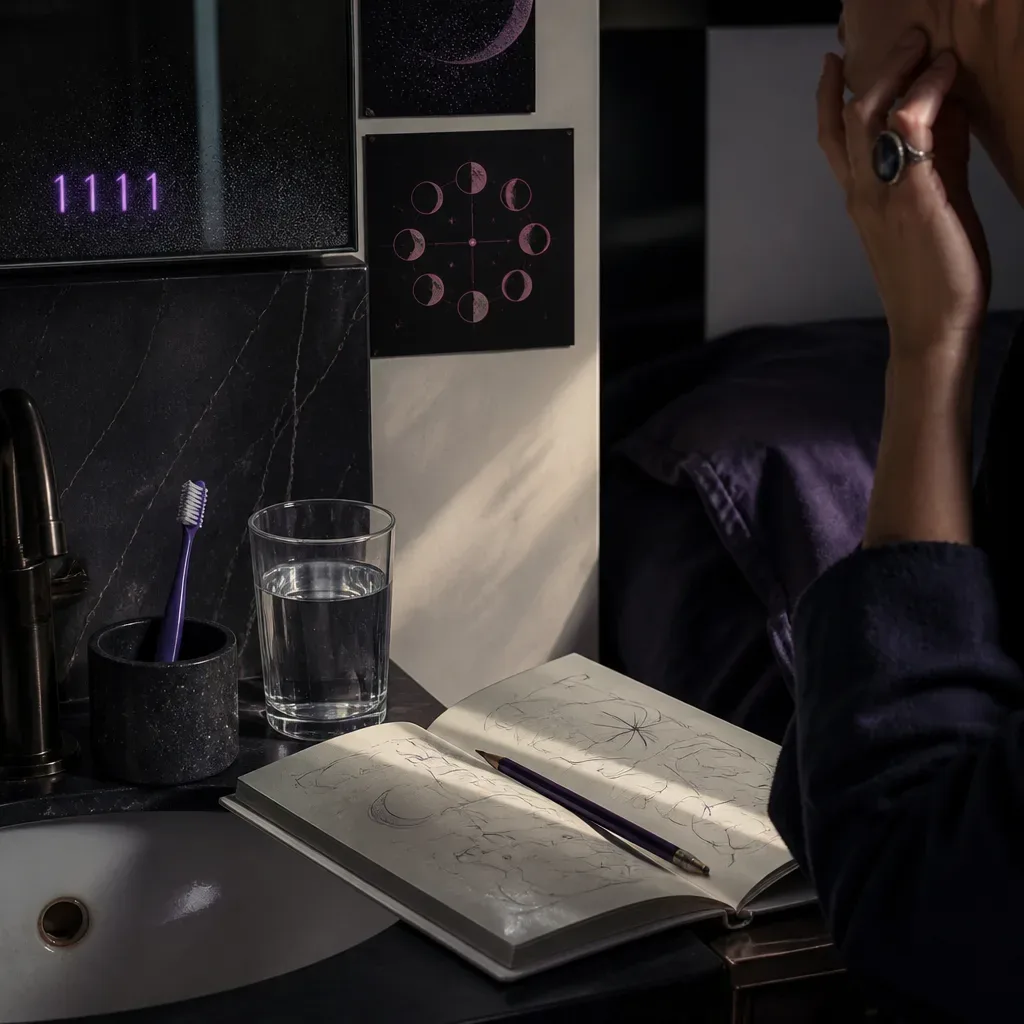
Do not begin with interpretation. Begin with water. Begin with your jaw. Begin with the unglamorous intelligence of the body. In my kitchen, I put salt near the notebook, not because salt explains the dream, but because ritual works better when the hand has something to do.
Here is the simple order:
- Drink water before reading anything online.
- Check your jaw, mouth, and shoulders.
- Write the dream in 3 lines.
- Name the feeling in 1 word.
- Listen to your audio practice.
- Choose 1 action that fits the signal.
- Leave the dream alone for at least 11 minutes.
That final number is partly practical, partly theatrical. Eleven is the master number associated with intuition in modern numerology, popularized through 20th-century numerology traditions rather than clinical science. You do not have to believe the number is magic. You can use it as a gate. A timer can be sacred if you keep the appointment.
If your one action is a conversation, keep it plain. If your one action is rest, actually rest. If your one action is dental care, book the appointment before your mind turns the dream into a myth. The most grounded practice is the one that changes the next ordinary hour.
For broader symbol work, you can pair this with the Astrology and manifestation guide when timing feels loud, or return to the AYA Method when you need the daily audio to hold the line. The dream may be strange. Your response can be precise.
Some mornings, the signal is not a warning. It is the room asking you to speak with your whole mouth.