dream symbolism
Recurring Dreams Meaning: A 3-Minute Audio Reset
Recurring dreams meaning often points to unfinished emotion. Use this 3-minute audio reset to listen, name the pattern, and sleep cleaner.

Recurring dreams meaning is usually simple at the center: your mind is repeating an image because something emotional has not been fully named. The dream may be symbolic, stress-related, or trauma-linked. A 3-minute audio reset helps by moving you from startled interpretation into steady witnessing, where the pattern can finally change.
What does a recurring dream usually mean?
A recurring dream usually means the psyche is circling an unresolved emotional pattern rather than predicting a fixed event.
The number is not small. Dream researchers Tore Nielsen and Antonio Zadra have often noted that recurring dreams are common, with studies suggesting a majority of adults have experienced at least one across their lives. The exact percentage varies by sample, but 60% to 75% is frequently cited in dream literature. That makes the repeating staircase, the missing exam, the loose tooth, the locked door: not strange. Common, actually. The strange part is how personally it arrives.
A recurring dream is not a prophecy; it is a rehearsal the psyche has not finished.
The meaning usually sits at the meeting point of symbol and state. A house may point to identity. A train may point to timing. A phone that will not dial may point to contact, expression, or the old terror of not being heard. Carl Jung treated dreams as symbolic material from the unconscious; modern sleep researchers are more cautious, but many agree that dreams can reflect waking concerns. Both camps would recognize the same practical truth: repetition is data.
Look less at the object and more at the role you play. Are you late, hiding, searching, falling, failing, waiting? That verb matters. In the Manifestation pillar, desire is treated as a direction that needs a clear signal. Dreams work similarly. The image gets dramatic because the message has not yet been received in plain language.
Here is the cleaner read:
| Dream repeats as | Possible waking pattern | Better question |
|---|---|---|
| Missed train or flight | Fear of losing a season | Where do I believe the gate has closed? |
| Old school exam | Performance pressure | Who is still grading me? |
| Childhood home | Old identity rules | Which room am I still living in? |
| Teeth falling out | Loss of control or exposure | What truth feels unsafe to say? |
| Being chased | Avoided emotion or decision | What stops when I turn around? |
The symbol is the costume. The feeling is the plot.
Why does the same dream come back at night?
The same dream comes back because sleep keeps processing what waking attention keeps skipping.
REM sleep tends to arrive in cycles about every 90 minutes, with longer REM periods in the second half of the night. That is one reason a dream at 3:11 a.m. can feel cinematic, almost overlit. The brain is active, the body is still, and emotional memory has the room. The dial lines up while the day is finally quiet.
Stress is a known amplifier. The American Psychological Association has repeatedly reported that stress affects sleep quality for many adults, and sleep disruption can intensify emotional reactivity the next day. That loop matters. If the waking pattern stays charged, the sleeping mind may keep staging it. Same cast. Same hallway. Same cue.
Dream scholar G. William Domhoff argued that dreams often reflect the continuity of waking life: our concerns, relationships, threats, and desires. Not a mystical loophole. A continuity. The office appears because the office still owns a piece of the nervous system. The ex appears because the body has not finished its exit interview. The wave appears because something is arriving faster than your prepared self can meet it.
This is where synchronicity gets interesting but must stay honest. If you wake three nights in a row at 3:33 after the same dream, you may notice the master-number charge around 33, often associated in numerology with teaching, service, and spiritual maturity. Fine. Notice it. But do not outsource your agency to the clock. A number can be punctuation without becoming the author.
The dream returns on cue because some part of you is asking for a witness.
How does a 3-minute audio reset help after a recurring dream?
A 3-minute audio reset helps by giving the nervous system a short, repeatable script for safety, attention, and future orientation.
This is not about forcing meaning at 4 a.m. The half-awake mind is suggestible, tender, and often inaccurate. Dr. Andrew Huberman has discussed how physiological arousal changes perception and decision-making; anyone who has sent a 2:17 a.m. message already knows the field evidence. After a recurring dream, the first task is not analysis. It is return.
The reset works because repetition teaches. The AYA Method is a daily audio manifestation practice. Each day you listen to a short personalized recording, your Dream-Self Moment, narrated from the version of you who has already manifested the life you intend. Listening is the practice. Repetition is the work. The audio is the method. You can read the full practice here: the AYA Method.
For a dream reset, use the same principle in miniature. Three minutes is enough to change state without turning the night into a research project. In clinical sleep work, imagery rehearsal therapy for nightmares often involves rewriting and rehearsing a new version of the dream while awake; the American Academy of Sleep Medicine has recognized it as a treatment option for nightmare disorder. Your reset is not therapy, but it borrows one useful idea: the waking mind can interrupt the old ending.
Try this sequence:
- Minute 1: Orient. Say your name, the date, and one true sentence: “I am awake in my room.”
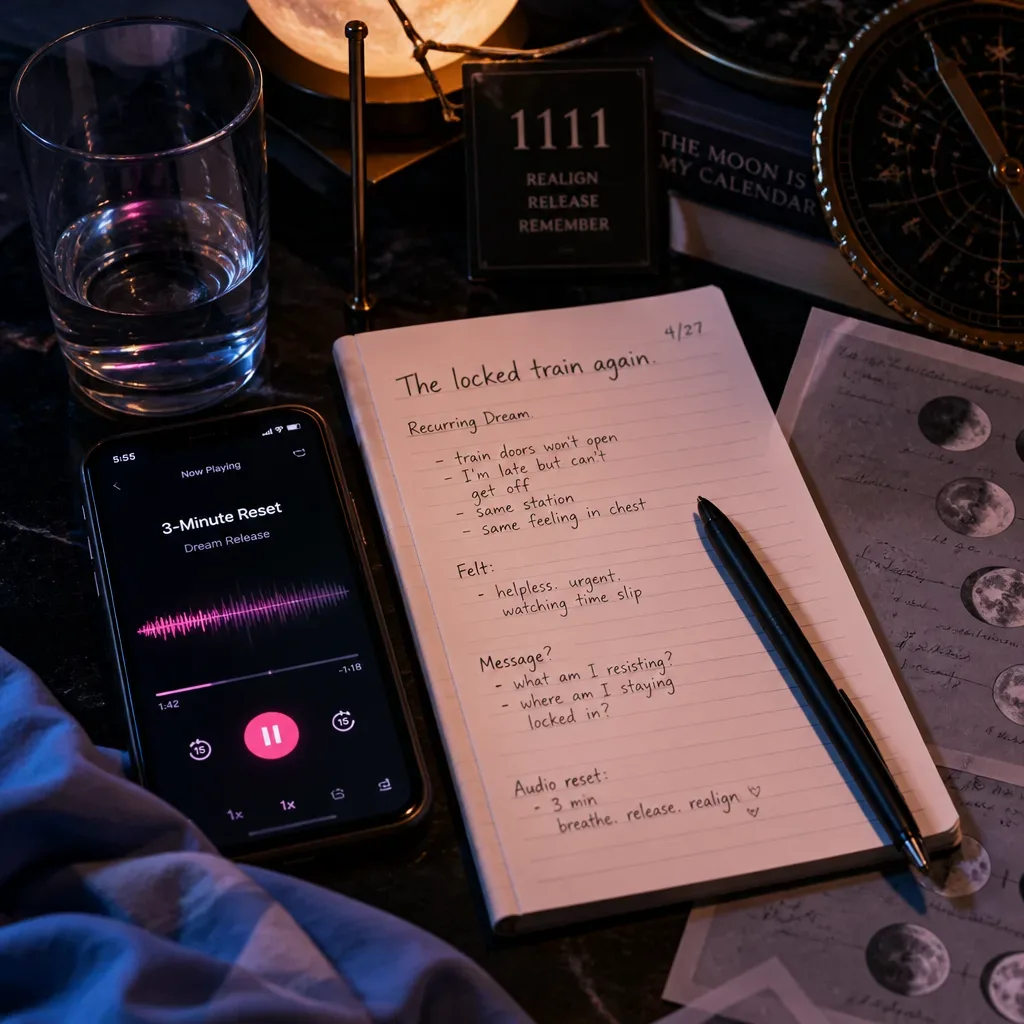
- Minute 2: Name the dream. Give it a title in five words or fewer: “The locked train again.”
- Minute 3: Hear the future self. Listen to a calm line from your Dream-Self Moment, or record one sentence that answers the dream from a steadier season.
Do not negotiate with the nightmare. Change the room it finds you in.
What should you write down before you interpret it?
Write down the repeat, the feeling, and the moment of no-choice before you decide what the dream means.
Dream journals get useful when they stop becoming decorative. You do not need five pages. You need a clean record. In sleep research, dream recall fades quickly after waking; many people lose details within minutes unless they record them. Keep the note short enough that you will actually do it at 3:11 a.m.
Use the 11-line record if the number pleases you. Manifest 11 is allowed its little gates.
- Time you woke
- Dream title
- Main location
- Main figure or object
- Strongest feeling
- Body sensation
- Choice you could not make
- Line you heard or thought
- Waking-life echo from the last 48 hours
- One thing the dream may be protecting
- One thing your future self would do differently
That last line matters. The Affirmations pillar is useful here, but only if the affirmation is precise. “I am safe” may be true and still too broad. “I can answer the door and stay myself” is sharper if the dream keeps placing you behind a locked door. Language is a dial. Turn it until the sentence catches.
Neville Goddard wrote often about living from the end, and Joe Dispenza teaches mental rehearsal as a way to condition the body toward a future state. You do not have to accept every metaphysical claim to use the practical overlap: the mind responds to repeated inner scenes. If your dream repeats an old scene, your waking practice can rehearse a new response.
Interpretation should make you more honest, not more theatrical.
When is a recurring dream a sign to get support?
A recurring dream is a sign to get support when it disrupts sleep, repeats after trauma, or leaves you distressed during the day.
Nightmares are not rare, but frequency and impact change the category. The International Classification of Sleep Disorders describes nightmare disorder as repeated disturbing dreams that cause distress or impairment after waking. If you avoid sleep, wake in panic, or replay the dream through your workday, the signal has crossed from symbolic curiosity into care. Take that seriously.
Trauma dreams deserve particular respect. After traumatic events, recurrent nightmares can appear as part of post-traumatic stress symptoms. The U.S. Department of Veterans Affairs notes that nightmares are common in PTSD, and treatments such as imagery rehearsal therapy, cognitive behavioral therapy for insomnia, and trauma-focused therapies may help. This is not a failure of your manifestation practice. It is the body asking for a wider circle.
Use spiritual language carefully here. A dream can be meaningful without being assigned cosmic authority. It can be a signal and still need a clinician. Tara Brach often teaches the practice of naming what is present with compassion; that is a beautiful first step. It is not the only step when the nervous system is living in alarm.
Get support if any of these are true:
- The dream repeats weekly or more for a month.
- You dread sleep or delay bedtime.
- You wake with panic, sweating, or a racing heart.
- The dream connects to a known trauma.
- You feel detached, unsafe, or unable to function the next day.
The bravest interpretation is sometimes an appointment.

How do numbers, astrology, and timing fit into recurring dreams?
Numbers, astrology, and timing can add context, but they should not replace the emotional evidence of the dream.
If you keep waking at 11:11 after the same dream, yes, notice it. Master number 11 is often read in numerology as intuition, sensitivity, and a threshold between inner knowing and outer action. In editorial terms, it is a headline: pay attention. But the article is still the dream itself. What happened? Who were you? What did you refuse to see?
Lunar timing can be useful because sleep and mood are both sensitive to routine, light, and expectation. Some studies on lunar cycles and sleep have found small effects; others have not replicated them strongly. That mixed evidence is the point. If a full moon seems to coincide with your recurring dream, track it for three cycles before you crown it a law.
For readers who work with charts, Astrology and manifestation can be a helpful lens. Saturn themes may echo responsibility. Neptune themes may echo fog, longing, or porous boundaries. Mars themes may echo pursuit, anger, or the chase dream that keeps arriving in red shoes. Still, the chart is a mirror, not a verdict.
Here is the hierarchy I trust:
- Body response: What did you feel when you woke?
- Dream pattern: What image or action repeated?
- Waking echo: Where did that pattern appear in the last 7 days?
- Symbolic layer: What do numbers, astrology, or archetypes add?
- Practice response: What will you listen to, write, or change today?
Synchronicity is most useful when it sends you back to your own evidence.
What if the recurring dream changes after you start listening?
If the recurring dream changes, it often means your relationship to the pattern has changed first.
This is the part people miss. The dream may not vanish on the first night. It may shift. The train arrives but you do not board. The door opens into a different room. The person chasing you slows down. In small clinical studies of imagery rehearsal therapy, reduced nightmare frequency often comes after the dreamer practices a revised script while awake. The sleeping mind can learn new choreography.
The same principle appears in daily audio practice. When you listen to the AYA Method, the future-self voice is not there to decorate your morning. It is there to make a new state familiar through repetition. The daily affirmation and Manifestation Board can support that, especially for language and visual cues, but they are complements. The audio carries the practice.
A changed recurring dream is worth documenting with almost annoying precision. Date it. Title it. Note the one difference. If the old dream was “I cannot find the room” and the new version is “I find the room but it is empty,” that matters. The psyche has moved from exclusion to uncertainty. Different gate. Different work.
For a fuller symbolic map, keep the dream beside your broader practice with Manifestation pillar notes and focused language from the Affirmations pillar. Not to overbuild the ritual. To catch the quiet turn when it happens.
The dream changes when the witness changes.
Listen once. Name the signal. Let the night stand down.