manifestation 101
Future Self Letter: Make It a 3-Minute Audio
Turn a future self letter into a focused 3-minute audio practice with a simple edit, recording structure, and daily listening rhythm.

A future self letter becomes a 3-minute audio by cutting it to 390 to 450 spoken words, rewriting it in present tense, and recording it as a message from the version of you who has already arrived. The point is not drama. The point is a repeatable signal your mind can recognize daily.
What should a future self letter become when it becomes audio?
A future self letter should become a short, believable recording that lets your future identity speak before your current doubt gets the microphone.
The written letter can wander. That is part of its charm. It spills, circles, confesses, revises. Audio is less forgiving. At an average speaking pace of 130 to 150 words per minute, 3 minutes gives you roughly 390 to 450 words, which is enough for one clean scene and one clear instruction. Anything longer starts asking too much from the listener, especially when the listener is you at 7:11 a.m. with a half-lit kitchen and three tabs already open in your head.
A good future self letter audio is not a diary entry with a soundtrack. It is a dispatch from the version of you who crossed the gate. Neville Goddard called this living from the end in his 1948 lectures, and the phrase still has bite because it is practical. You are not begging the future to arrive. You are rehearsing the interior posture of the person who can meet it.
This is where the AYA Method gives the practice a spine: The AYA Method is a daily audio manifestation practice. Each day you listen to a short personalized recording, your Dream-Self Moment, narrated from the version of you who has already manifested the life you intend. Listening is the practice. Repetition is the work. The audio is the method.
Your letter can feed that same direction. The daily affirmation and the Manifestation Board may help you name the symbols, but the recording is where the voice enters the room. A sentence on paper can be admired. A sentence in your own ear can interrupt a pattern.
The future self is not a fantasy character. She is an editorial standard.
How do you edit the letter without flattening the signal?
You edit a future self letter by keeping the sentences that feel arrived and cutting the sentences that are still auditioning for permission.
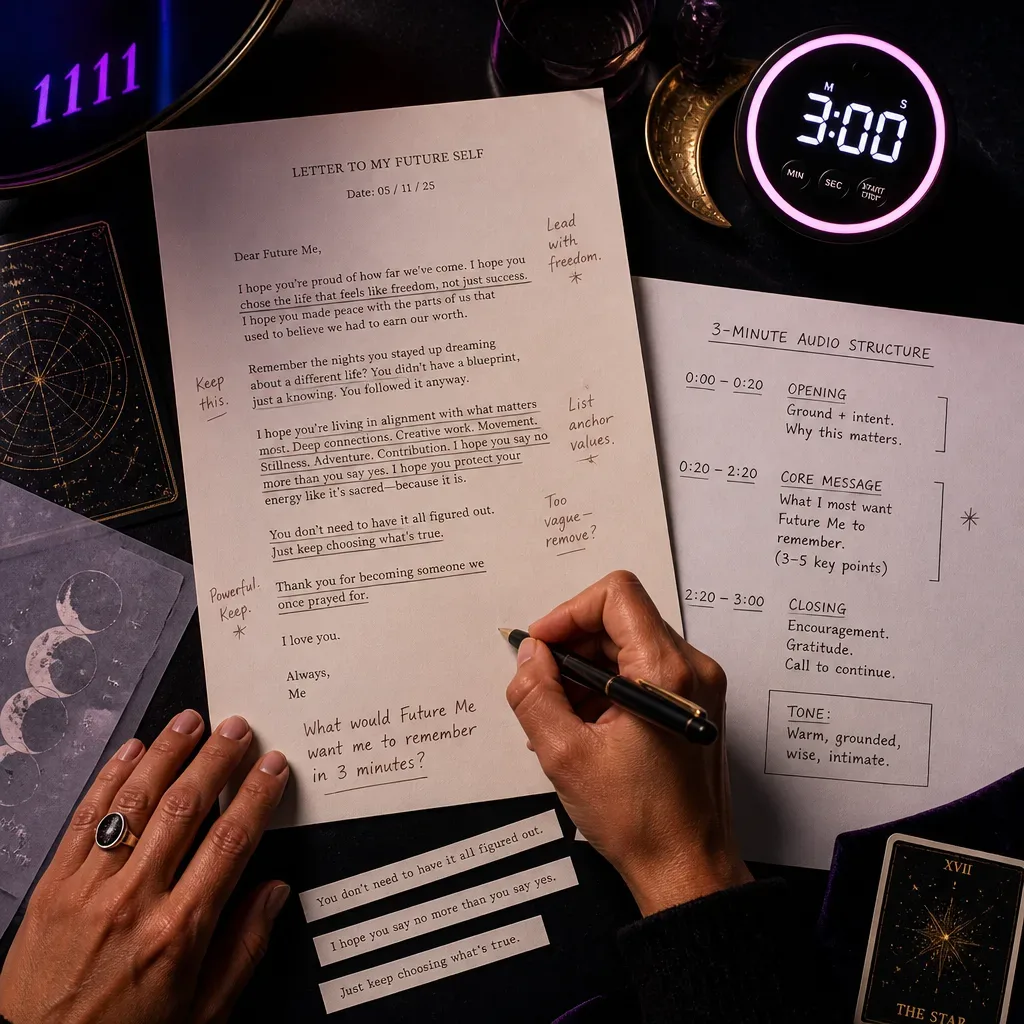
Print the letter or paste it into a clean document. Underline every line that carries evidence. Evidence sounds like this: I sleep through the night now. I send the proposal before noon. I no longer negotiate with the old panic. It does not sound like this: I hope I will maybe become someone who can try. Hope has its place, but in audio it often arrives wearing too many coats.
Expressive writing research gives the first clue. In the original Pennebaker and Beall study published in 1986, participants wrote about emotional experiences for 15 minutes across 4 days, and later studies linked structured writing with changes in health visits and emotional processing. The lesson is not that every sentence belongs in the final script. The lesson is that writing reveals the material. Editing chooses the signal.
Use this 4-pass edit:
- Circle the date. Choose one future date, ideally 6 to 12 months ahead.
- Underline proof. Keep concrete evidence: rooms, habits, conversations, numbers.
- Cut the pleading. Remove any line that asks the future to rescue you.
- Turn it toward your ear. Rewrite as if your future self is speaking directly to you.
If the letter is 1,200 words, do not panic. That is three audios pretending to be one. A 2023 Microsoft attention study reported that workers often switch tasks dozens of times per day; whether your number is 30 or 300, the implication is plain. Your practice should be easy to return to. The cleaner the script, the more likely it survives the week.
Keep the strange line if it feels true. Cut the polished line if it feels rented. The room can tell.
What is the 3-minute structure that actually holds attention?
The best 3-minute future self audio uses a simple arc: a timestamped opening, three pieces of future evidence, and one instruction for today.
Think of the script as a small editorial package. It needs a headline, a scene, and a close. The listener should know where she is within the first 15 seconds. The first line might be: It is September 2, 2027, and I am writing from the quiet desk I used to think I had to earn. That single sentence gives date, place, tone, and arrival.
Use this structure:
| Audio section | Time | Word count | Job |
|---|---|---|---|
| Arrival line | 0:00 to 0:25 | 50 to 65 | Name the future date and room |
| Evidence 1 | 0:25 to 1:05 | 85 to 100 | Show one changed daily habit |
| Evidence 2 | 1:05 to 1:45 | 85 to 100 | Show one changed relationship or boundary |
| Evidence 3 | 1:45 to 2:25 | 85 to 100 | Show one material sign: money, work, body, home |
| Instruction | 2:25 to 3:00 | 70 to 85 | Give today one calm action |
Specificity matters because the brain does better with cues than fog. In future-self research, Hal Hershfield and colleagues reported in 2011 that people who saw age-progressed images of themselves allocated more money toward retirement in experimental settings. The point was not magic; it was continuity. When the future self feels less abstract, present behavior can tilt.
Here is the difference between vague and useful:
- Vague: I am finally happy and everything worked out.
- Useful: I wake at 6:40 without checking messages, drink water before coffee, and open the proposal file before the room gets loud.
- Vague: I trust myself completely.
- Useful: I answer the client in one paragraph instead of writing the anxious essay.
A future self letter works when it stops performing inspiration and starts giving evidence.
If you need a broader frame for this work, the Manifestation pillar names the difference between wishing and practicing. This audio belongs on the practicing side of the line.
How do you record it so your nervous system believes you?
You record it in a steady, intimate voice, because the body reads tone before it debates content.
Use your phone. Use a closet if the room echoes. Put the microphone 6 to 8 inches from your mouth. Read slower than feels natural. Most people rush when they hear themselves, and rushing gives the future self the tempo of a sales pitch. That is not the dial. You want the tone of someone who already knows the door is open.
Neuroscience is careful about big claims, but repetition and attention are not decorative. Dr. Andrew Huberman has often discussed neuroplasticity as requiring focus, repetition, and rest; those are broad principles, not a guarantee that one recording changes a life. Still, your nervous system learns from repeated cues. A 3-minute daily audio for 11 days gives you 33 minutes of exposure. Master number people will notice the 11 and 33. Skeptics can still respect the math.
Before you press record, do three small things:
- Drink water, because mouth noise becomes strangely theatrical on playback.
- Read the script once silently, then once aloud.
- Mark two pauses with a slash where the listener needs space.
Do not add music on the first version. Music can make weak writing seem cinematic for one listen and unbearable by the fifth. If you add sound later, keep it lower than the voice. The voice is the signal. The track is only the room around it.
There is a reason contemplative teachers, from Tara Brach to secular mindfulness clinicians, return to the voice. Guided audio reduces the burden of deciding what to think next. In an 8-week mindfulness-based stress reduction format, participants often practice with recordings between sessions; the repetition is not glamorous, but it is the mechanism.
Your future self does not need a stage voice. She needs a voice you can bear to hear every morning.
How should you listen each day without turning it into pressure?
You should listen once daily at the same natural hinge in your day, then take one ordinary action that matches the recording.
Pick a hinge, not a fantasy schedule. Morning works if you already touch your phone before coffee. Night works if your mind softens after the lights go low. A commute works if it is safe and not competing with navigation. Habit researchers often point to cue-based repetition; BJ Fogg popularized the idea of anchoring tiny behaviors to existing routines, and the useful number here is one. One anchor beats five noble intentions.
For 11 days, do not revise the recording unless something is factually wrong. Let it become familiar. The first listen may feel theatrical. The third may irritate you. The seventh may suddenly land in the body. That pattern is normal. In meditation studies, adherence often matters as much as technique; a 2014 JAMA Internal Medicine review found moderate evidence for mindfulness meditation improving anxiety, depression, and pain, but the programs depended on repeated practice, not one perfect session.
A clean listening rhythm looks like this:
- Cue: I put on the kettle.
- Audio: I listen to the 3-minute future self letter.
- Action: I do one matching move within 10 minutes.
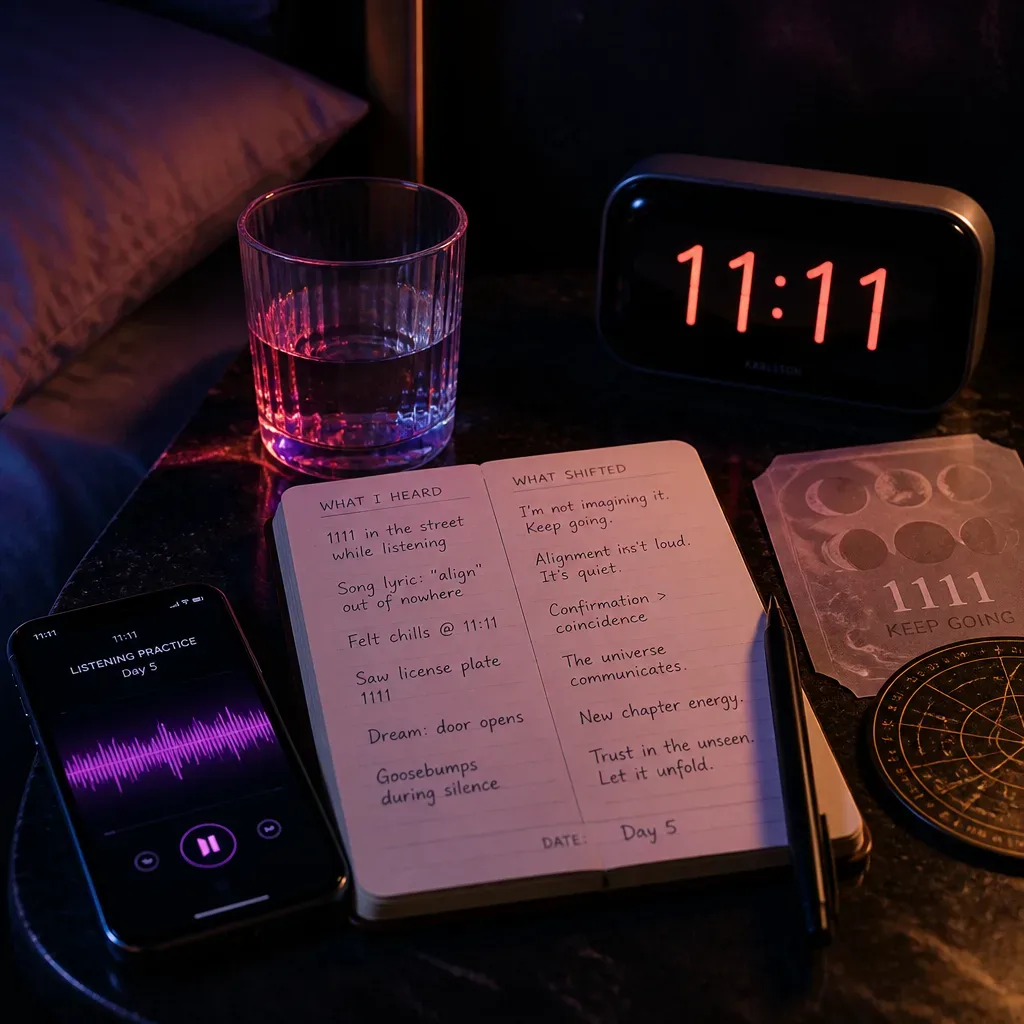
- Witness: I note one sentence in a journal or notes app.
If affirmations help, use one after the audio, not instead of it. The Affirmations pillar is useful for tightening language into a single line. Your future self audio does a different job. It gives the line a body, a room, and a timestamp.
The action after listening should be small enough to do on a bad day. Send the email. Open the file for 5 minutes. Put the shoes by the door. Transfer 11 dollars. If the recording describes a future identity, the action is the receipt.
What do you do after the recording starts working on you?
You track the subtle returns, then update the audio only when your life has outgrown the old script.
This is the part people skip because it is quiet. The audio starts changing what you notice. You hear a sentence in the morning, then at 2:22 p.m. you choose the cleaner reply. You catch yourself not apologizing. You stop feeding the old story its regular snack. Most people would call it nothing. I would call it the dial lining up.
Keep a 2-column witness log for 14 days:
| Date | What I noticed after listening |
|---|---|
| Day 1 | The line about the proposal annoyed me, which means it is alive. |
| Day 4 | I opened the file before checking messages. 6 minutes, but real. |
| Day 9 | I did not explain my boundary twice. |
| Day 14 | The future room feels less decorative and more operational. |
Measurement does not make the practice cold. It keeps you honest. In cognitive behavioral approaches, tracking thoughts and behaviors is a standard tool because memory is a biased witness. A written log gives you a record when the old mood claims nothing is changing.
Synchronicity can belong here too, if you keep it grounded. Seeing 11:11 after recording your letter does not prove the cosmos signed a contract. It may prove that your attention has been tuned to a symbol, and symbols can be useful gates. If timing, lunar cycles, or angel numbers help you mark seasons, Astrology and manifestation can give that pattern a cleaner container.
Revise after 21 or 30 days, not every time your mood changes. Joe Dispenza often teaches mental rehearsal as a way to pair elevated emotional states with future identity; take the useful part and stay sober about it. Rehearsal is not escape. It is practice under chosen conditions.
When you revise, ask three questions:
- Which line has become true enough to retire?
- Which line still feels like costume?
- What is the next honest edge?
Then record version two. Keep the first file somewhere. The old audio becomes a time capsule, proof that the self you are now was once the future speaking back.
For the larger map of the practice, return to manifestation basics when you need language, and return to the audio when you need contact. The page can teach you the theory. The recording meets you in the moment.
Leave the voice where morning can find it.