manifestation 101
Robotic Affirming vs Dream-Self Audio: What to Repeat
Robotic affirming can steady attention, but Dream-Self audio gives repetition a scene, voice, and future self to rehearse daily.
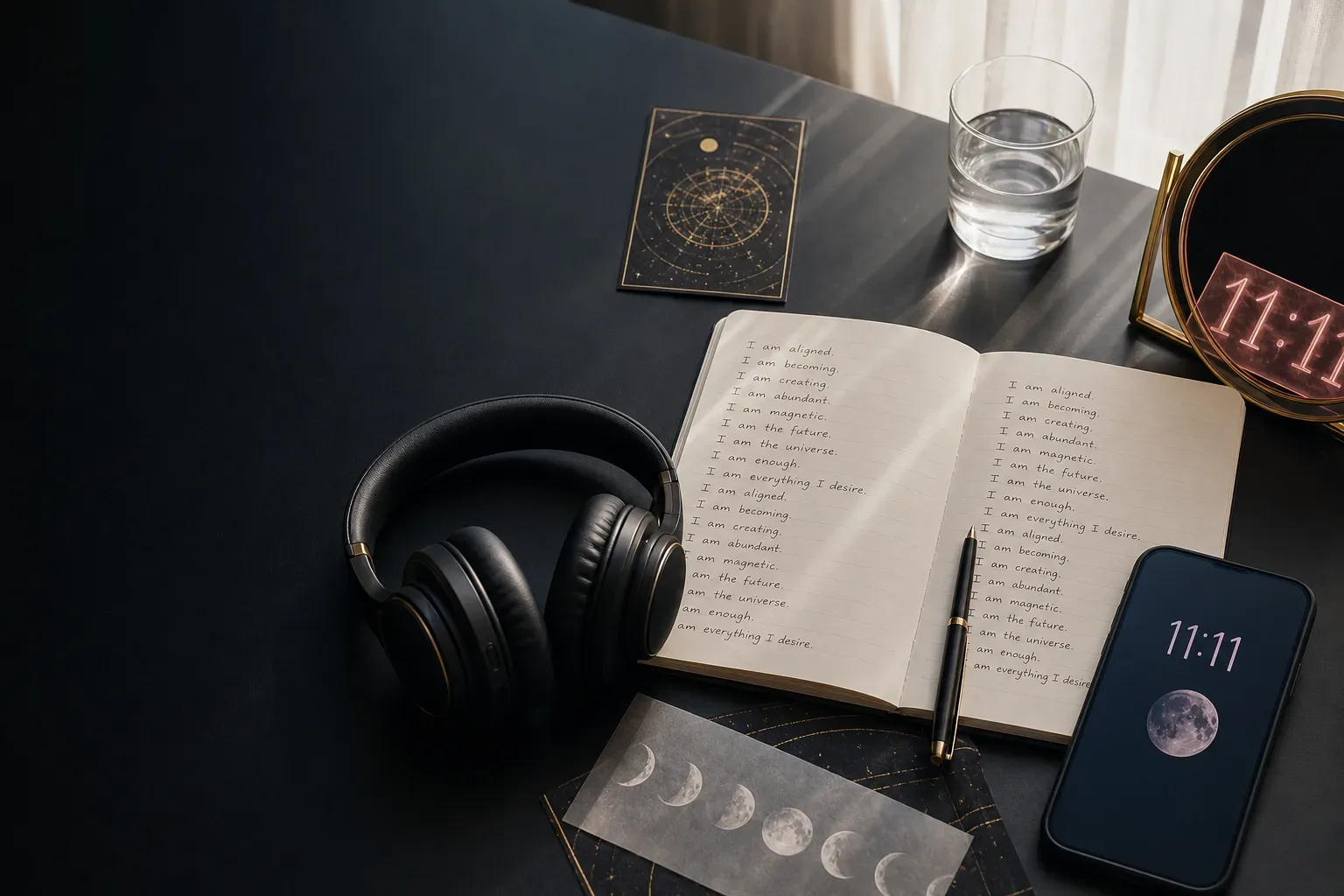
Robotic affirming is the better tool for quick mental interruption; Dream-Self audio is the better daily practice when you want repetition to carry identity, emotion, and direction. One repeats a sentence. The other rehearses a self. If your question is what to repeat daily, choose the form your body will believe enough to return to.
At 11:11, the phrase looks powerful. At 11:12, it has to live in your actual calendar.
That is where the comparison gets honest.
What is robotic affirming, really?
Robotic affirming is the repeated recitation of one chosen statement, usually without trying to feel it first.
The point is not poetry. It is saturation. People repeat a sentence such as I am chosen, money comes easily, or everything is working out, sometimes for 10 minutes, sometimes 100 times, sometimes whenever anxiety starts knocking on the glass. The word robotic is not an insult in the community. It means mechanical on purpose.
The method borrows from older affirmation traditions, New Thought language, and the modern internet’s obsession with volume. Neville Goddard taught that assumption matters more than outer evidence, and his 1948 lectures still circulate because they are blunt about inner speech. Cognitive psychology has its own adjacent evidence: a 2014 paper by Ethan Kross and colleagues found that distanced self-talk can improve emotional regulation under stress. The phrase you repeat does not need incense around it. It needs a job.
Robotic affirming can be useful because it reduces choice. The mind spirals. You give it one track. That is not mystical; it is attentional training. Dr. Andrew Huberman often frames attention as a limited resource, and most working adults feel that limit before breakfast. A repeated phrase can become a small gate: this thought, not that one.
But there is a catch. A 2009 study in Psychological Science by Joanne Wood, Elaine Perunovic, and John Lee found that positive self-statements could make people with low self-esteem feel worse when the statements clashed with self-belief. That does not cancel affirmations. It does make the dial more precise. If the sentence is too far from the nervous system’s current setting, repetition can become friction.
A sentence repeated without relationship becomes noise; a sentence repeated with timing becomes a signal.
Robotic affirming is best understood as a cue, not a whole cosmology. It can steady the hand. It should not have to carry the entire future alone.
What is Dream-Self audio in the AYA Method?
Dream-Self audio is a short personalized recording that lets you hear from the version of you who has already arrived.
In the AYA Method, the daily practice is specific: The AYA Method is a daily audio manifestation practice. Each day you listen to a short personalized recording — your Dream-Self Moment — narrated from the version of you who has already manifested the life you intend. Listening is the practice. Repetition is the work. The audio is the method.
That definition matters because it keeps the hierarchy clean. The audio is the method. A daily affirmation can complement it. A Manifestation Board can help you name images and symbols. But the spine is listening. You are not collecting tools like charms in a drawer. You are returning to one embodied rehearsal.
There is research logic behind the format, even if manifestation itself sits outside conventional lab measurement. Mental rehearsal has been studied for decades in sport and performance psychology. A 1994 meta-analysis by Driskell, Copper, and Moran reviewed 35 studies and found mental practice had a positive effect on performance, especially when tasks had cognitive components. The mind rehearses before the room changes. Anyone who has practiced a hard conversation in the shower already knows this.
Audio also adds intimacy. A written affirmation asks you to generate tone. A recording gives tone back to you. That changes the demand. When my child is asking for toast and I have 7 minutes before a client call, I do not want a blank page asking me to become devotional. I want a voice to meet me where I am and point the dial.
The Dream-Self Moment works because it makes repetition less lonely. Instead of repeating one sentence into the air, you are witnessed by a future self with details: the calmer inbox, the cleaner boundary, the different room, the week that no longer requires panic as proof of ambition.
If you need the wider frame, the Manifestation pillar lays out the larger practice without pretending desire alone is a strategy. Dream-Self audio belongs there because it turns desire into a daily appointment.
How do they compare when your mind is loud?
Robotic affirming interrupts mental noise quickly, while Dream-Self audio gives the noise somewhere more coherent to settle.
There are days when you do not need a full ceremony. You need one line and a door. Robotic affirming is built for that moment. You can repeat I am safe to choose differently while washing a bottle, waiting for the train, or sitting in the parking lot after a meeting that left your jaw tight. It costs 30 seconds. That matters.
Dream-Self audio asks for a slightly larger container, usually a few minutes. That sounds small until the day arrives with teeth. Still, the advantage is depth. Audio can carry pacing, scene, and emotional order. It can remind you not only what you are claiming, but who is doing the claiming. In habit research, Phillippa Lally and colleagues at University College London found in 2009 that automaticity took a median of 66 days to form, with wide variation from 18 to 254 days. The daily return is not decorative. It is the mechanism.
Here is the clean comparison:
| Practice | Best use | Main strength | Main risk |
|---|---|---|---|
| Robotic affirming | Short bursts during the day | Fast attention redirection | Can feel hollow if the phrase is too extreme |
| Dream-Self audio | Daily seated or walking practice | Identity rehearsal with voice and scene | Requires a few uninterrupted minutes |
| Written affirmations | Journaling or reflection | Clarifies language | Can become over-edited |
| Manifestation Board | Visual cueing | Makes symbols visible | Can become passive decoration |
Robotic affirming is a matchstick. Dream-Self audio is a lamp.
Neither is morally superior. The question is not which one looks more spiritual from the outside. The question is which one survives Tuesday. Pew Research reported in 2023 that 42% of U.S. adults use meditation at least sometimes, yet consistency remains the fragile part of most contemplative habits. A practice that fits your actual day has an unfair advantage.

The loud mind needs repetition, yes. But it also needs proportion. A phrase can stop the spiral. A voice can give the next minute a shape.
Which practice changes identity faster?
Dream-Self audio usually changes identity more completely because it rehearses context, not only language.
Identity is not a slogan. It is a set of repeated cues, behaviors, memories, and permissions. Robotic affirming can influence that system, especially if the line is believable and used consistently. But one sentence has a narrow bandwidth. Audio can include the sentence, the room, the body posture, the decision you make at 4:40 p.m., and the way you stop explaining yourself to people committed to misunderstanding you.
Joe Dispenza often speaks about rehearsing a future state until the body begins to recognize it. You do not have to accept every metaphysical claim to see the practical point: repeated inner rehearsal changes what feels familiar. Neuroscience would phrase it more cautiously. Neuroplasticity is experience-dependent, and repeated patterns can strengthen pathways. The National Institute of Mental Health notes that the brain continues changing through learning and repeated experience across the lifespan. The mirror is not fixed.
Robotic affirming may work faster for very specific targets. If your mind keeps returning to one fear, a single line can be efficient. I do not chase; I choose. I am allowed to be seen. The cleaner the sentence, the better it behaves. In numerology circles, people like 11, 22, and 33 because master numbers imply amplification. Fine. Use the number if it helps you return. Just do not confuse counting with becoming.
A useful sequence looks like this:
- Listen to your Dream-Self audio once daily, ideally at the same time.
- Pull one sentence from it as your robotic affirmation.
- Repeat that sentence during friction points, not all day as punishment.
- Notice which behaviors shift within 7 days.
- Revise the sentence if your body keeps rejecting it.
The Affirmations pillar is helpful here because affirmations do their best work when they are precise, not theatrical. A sentence should feel like a key cut for a real lock.
Identity changes when repetition stops auditioning and starts becoming ordinary.
That is the quiet power of Dream-Self audio. It makes the future self less like a poster and more like a person you recognize on cue.
When should you use robotic affirming instead?
Use robotic affirming when the moment is too small, too public, or too urgent for audio.
This is where robotic affirming earns its place. You cannot always put in headphones. You may be in line at school pickup, walking into a performance review, checking a bank notification, or reading a message that tilts your whole chest. A short phrase can meet the moment without announcing itself.
The best robotic affirmations are brief enough to survive interruption. Five to nine words is a good working range. Cognitive load research has long challenged the old seven-items rule, but George Miller’s 1956 paper on working memory is still culturally sticky for a reason: short units are easier to hold. A phrase you can remember under pressure is more useful than a paragraph you admire when calm.
Good robotic affirming sounds like this:
- I return to the chosen version.
- This is evidence catching up.
- I can act from the new pattern.
- The answer can arrive cleanly.
- I am not available for the old loop.
Notice what is missing. No begging. No frantic volume. No sentence that requires you to deny the room you are standing in. Robotic affirming should not be emotional taxidermy. It should be a clean redirect.
There is also a timing question. Some people repeat first thing in the morning, often for 3 to 10 minutes. Others use it as needed. If you are already listening to Dream-Self audio daily, I prefer the second option. Let the audio set the season. Let the phrase handle the weather.
Robotic affirming is also useful during astrological or symbolic timing if that language helps you witness patterns. A new moon, a Saturn return, or a repeated 11:11 can act as a cue, not a command. The piece on Astrology and manifestation makes that distinction cleanly: timing is information, not a substitute for practice.
The danger is using robotic affirming as a way to outrun feeling. Tara Brach’s work on radical acceptance is useful here. Naming what is present often softens the grip. If a phrase becomes a lid on grief, anger, or exhaustion, it is not discipline. It is avoidance with nicer typography.
When should Dream-Self audio be the daily repeat?
Dream-Self audio should be the daily repeat when you want a stable practice that holds desire, identity, and nervous-system pacing together.
Daily means the practice has a chair in your life. It does not need a throne. In my own calendar, that often means headphones before the house fully wakes or a parked car before daycare pickup. Ninety seconds still counts when the alternative is disappearing for a week and calling it fate.
Audio has one advantage that busy people underestimate: it reduces authorship fatigue. You do not have to generate the perfect sentence every morning. You listen. The voice carries the structure. That matters when decision fatigue is already high. The American Psychological Association has reported that chronic stress remains a common issue for adults, with work, money, and family responsibilities among recurring pressure points in Stress in America surveys. A practice that removes decisions has teeth.

Dream-Self audio also protects against affirmation inflation. When people only use robotic affirming, they sometimes keep making the sentence bigger because they do not feel enough yet. Bigger salary. Bigger love. Bigger proof. Bigger claim. The line starts wearing platform shoes. Audio can return the desire to lived detail: how you answer email, how you sleep, how you walk into the kitchen without rehearsing dread.
This is why the AYA Method guide keeps the method centered on listening. Repetition is not filler. Repetition is how the future stops sounding foreign. The daily affirmation and Manifestation Board can support the signal, but they do not replace the recording.
A simple daily rhythm can look like this:
- Put on headphones before input from messages or feeds.
- Listen to the Dream-Self Moment once.
- Choose one sentence that feels usable today.
- Repeat that sentence during one predictable friction point.
- Record one small action you took from the new identity.
Small actions matter because manifestation without behavior becomes theater. The Manifestation pillar is clear on this: attention, belief, and action need to share a room. The audio sets the room. Your day shows whether you entered it.
The practice is not proven by intensity. It is proven by return.
That line has saved me more than any perfect streak.
What should you repeat daily if you want results?
Repeat Dream-Self audio daily, then use one robotic affirmation as a daytime cue.
That pairing gives each method the right job. Audio handles the deeper rehearsal. The phrase handles the interruption. One is the room. One is the match struck in the hallway. When people make robotic affirming do everything, they often burn out on their own sentence. When people only listen passively, they may miss the chance to carry the signal into the day.
A strong daily repeat has 3 qualities: it is specific, believable enough, and attached to time. Specificity prevents fog. Believability prevents backlash. Time prevents negotiation. The 66-day habit figure from Lally’s research is not a promise; it is a reminder that repetition needs a runway. Seven days can reveal a shift. Sixty-six can reveal a pattern. Two hundred fifty-four, the upper range in that study, reminds the impatient part of us to sit down.
Here is my comparison in plain terms:
| If your main issue is… | Repeat this daily | Add this during the day |
|---|---|---|
| Anxiety loops | Dream-Self audio | One calming robotic affirmation |
| Low self-trust | Dream-Self audio | Evidence log with 1 action |
| Scattered desire | Dream-Self audio | Manifestation Board check-in |
| Specific trigger | Robotic affirmation | Audio when you can listen |
| Skepticism | Believable Dream-Self audio | Softer bridge phrase |
Bridge phrases are underrated. Instead of I am wealthy when your bank account is flashing red, try I can make the next clean money decision. Instead of I am adored when your body is braced for rejection, try I can receive steadiness without performing. The bridge is not smaller. It is smarter.
For readers who want a broader map of belief language, Affirmations and manifestation is worth keeping open beside your notes. For timing patterns, Astrology and manifestation can help you mark cycles without handing your agency to a chart.
Robotic affirming is not childish. Dream-Self audio is not superior because it is prettier. The choice is architectural. What structure will hold when the day forgets to be convenient?
The future self does not need you to shout. She needs you to return on cue.
Repeat the audio. Carry the sentence. Watch what starts arriving without applause.
The dial is already moving.