manifestation 101
Cinnamon Manifestation Ritual With Dream-Self Audio
A grounded cinnamon manifestation ritual using scent, intention, and Dream-Self audio so the signal lands in the body and the day.
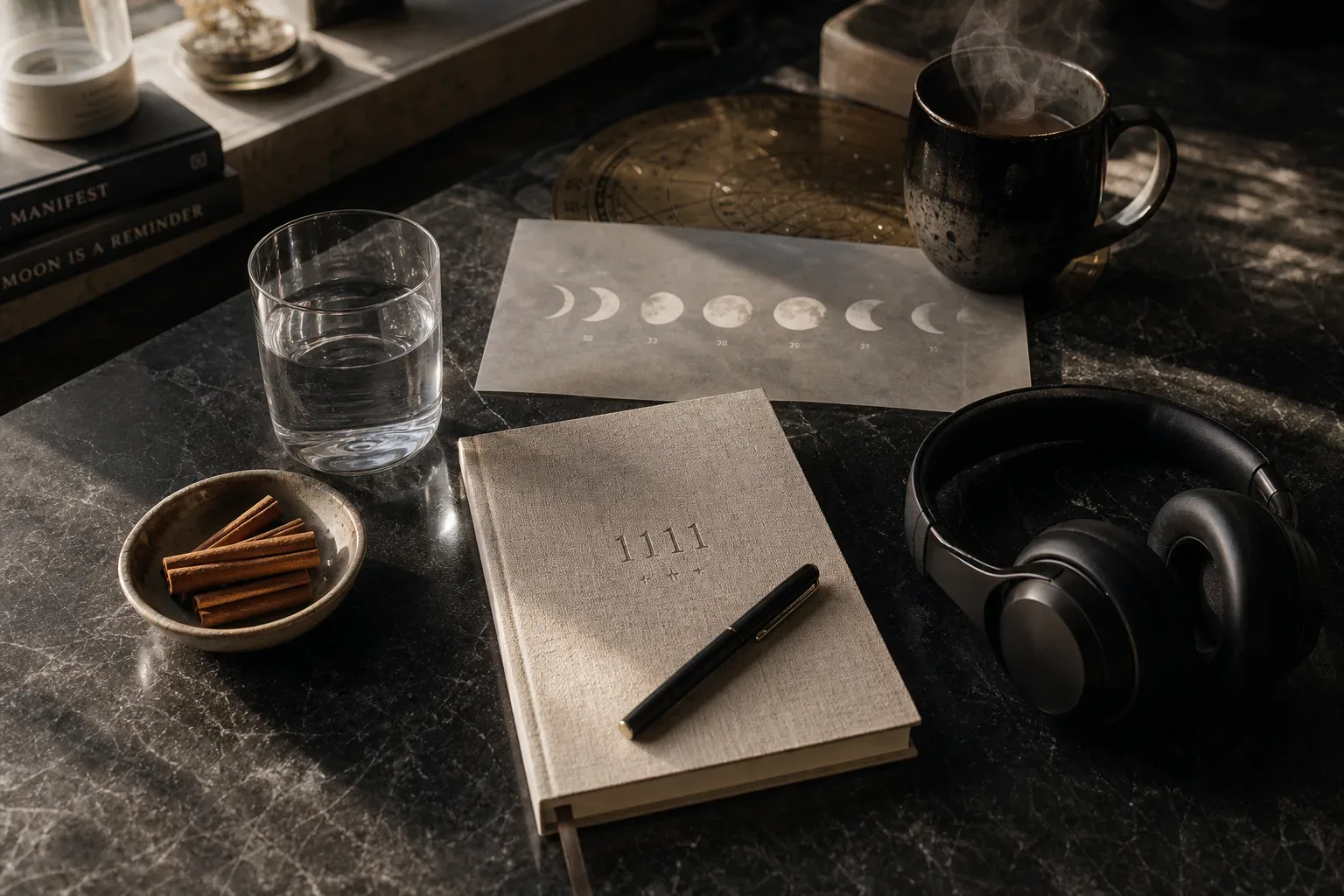
A cinnamon manifestation ritual works best when cinnamon becomes the sensory signal, not the whole spell. Place the spice near you, listen to your Dream-Self audio, write one present-tense intention, then take one action within 24 hours. The scent marks the gate. The repetition makes it real.
What is a cinnamon manifestation ritual with Dream-Self audio?
A cinnamon manifestation ritual with Dream-Self audio is a sensory intention practice that pairs the warm cue of cinnamon with a personalized future-self recording.
Cinnamon has always known how to enter a room. In my grandmother’s kitchen, it arrived before the rice pudding did. One stick in hot milk and everyone understood the assignment: soften, gather, wait. The ritual version is not so different. You use cinnamon to tell the body, this moment is different from the rest of the day.
The audio gives the moment its spine. The AYA Method is a daily audio manifestation practice. Each day you listen to a short personalized recording — your Dream-Self Moment — narrated from the version of you who has already manifested the life you intend. Listening is the practice. Repetition is the work. The audio is the method.
That distinction matters. A pinch of cinnamon can feel beautiful and still leave you unchanged by noon. Audio repeats identity into the nervous system with structure. In a 2009 study in the European Journal of Social Psychology, Phillippa Lally and colleagues found that habit formation took an average of 66 days, with wide variation from 18 to 254 days. The number is useful because it humbles the drama. One ritual is a bell. Repetition is the temple.
This practice also belongs inside the wider grammar of manifestation: attention, identity, emotion, and action. Cinnamon does not bribe fate. It helps you witness the moment when you choose who gets to run the day.
A ritual is not a performance for the sky. It is a room you build inside your attention.
What do you need before you begin?
You need cinnamon, your Dream-Self audio, a small writing surface, water, and one clear intention that can survive contact with ordinary life.
Keep it simple. The kitchen already taught us this. Too many ingredients and the sauce loses its line. For this ritual, I use one cinnamon stick, a glass of water, headphones, a notebook, and a pen. If all you have is ground cinnamon in a jar with a faded label, good. Precision does not require ornament.
The scent is the cue. In cognitive science, cues matter because behavior often follows context before it follows willpower. A widely cited 2006 Duke University paper by Wendy Wood and colleagues estimated that about 45% of daily behaviors are repeated in the same context. The dial turns because the room reminds us who we usually are there. Your ritual changes the cue on purpose.
Set your surface like this:
| Item | Purpose | Keep it grounded |
|---|---|---|
| Cinnamon stick or powder | Sensory signal | Do not overuse it; a small amount is enough |
| Dream-Self audio | Core practice | Listen once with full attention |
| Notebook | Witness | Write one line, not a page of pleading |
| Water | Return to the body | Drink after the audio |
| One action | Proof | Complete it within 24 hours |
If you work with angel numbers or master numbers, you may choose 11 minutes because 11 is traditionally read as a gate number: two columns, one threshold. Numerology is not a substitute for action, but symbols can help the mind take attendance. The point is not that 11 forces the outcome. The point is that 11 helps you arrive on cue.
How do you do the cinnamon manifestation ritual step by step?
Do the ritual by setting the space, placing cinnamon, listening to your Dream-Self audio, writing one present-tense sentence, and taking one same-day action.
Here is the 11-minute version I use when the morning is honest but crowded. No candles required. No theatrical whispering. Just the spice, the audio, the page, and the next move.
- Clean one small surface for 60 seconds. Wipe the table, counter, or desk. This tells the body the ritual has a boundary. In family kitchens, the clean counter is the first prayer.
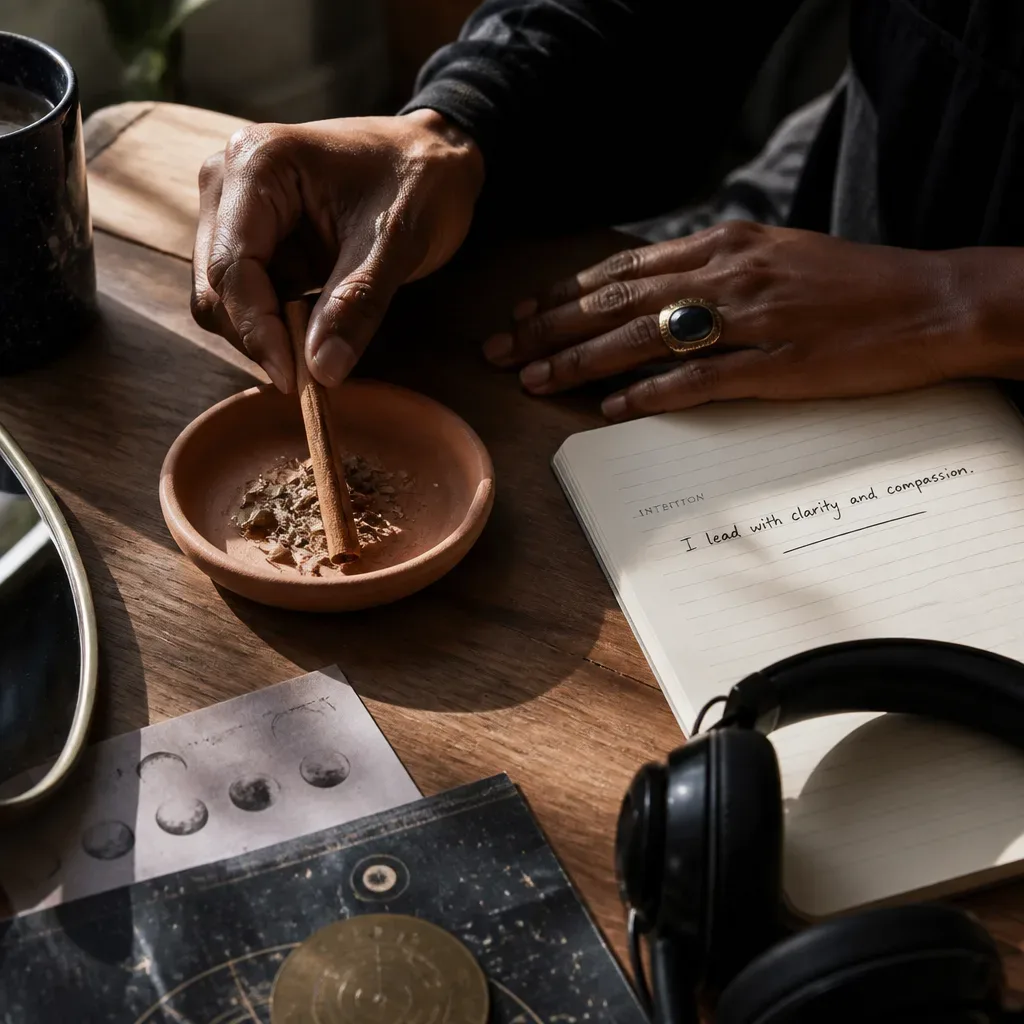
- Place cinnamon in a dish for 30 seconds. Use one stick or a small pinch. Smell it once without forcing meaning. Let the signal arrive.
- Play your Dream-Self Moment for 3 to 5 minutes. Use headphones if possible. Do not scroll. Do not answer the room unless the stove is actually on fire.
- Write one sentence in present tense for 2 minutes. Try: “I move through money conversations with clarity and clean timing,” or “My work is received by the right people and answered with respect.”
- Choose one action for 2 minutes. Make it visible and boring. Send the proposal. Update the document. Put the walking shoes by the door. Ritual without action becomes perfume.
- Drink water and sit for 30 seconds. Let the body mark the close. The day can begin after that.
Joe Dispenza often speaks about rehearsing a future state until the body begins to recognize it as familiar. You do not have to accept every metaphysical claim to use the practical part: repeated emotional rehearsal can change what feels available. In sports psychology, mental imagery has been studied for decades; a 2017 meta-analysis in Frontiers in Psychology found that imagery can support performance when paired with physical practice. That last phrase is the hinge: paired with practice.
If you are new to intention language, read the Affirmations pillar and keep your line specific. “I am chosen for aligned work” is stronger than “Everything is perfect.” The first gives the day a direction. The second gives it fog.
Why does cinnamon work as a sensory signal?
Cinnamon works because scent has a direct relationship with memory, emotion, and state change.
The olfactory system is unusually intimate with the brain’s emotional and memory centers. Unlike visual or auditory information, smell has close pathways to the amygdala and hippocampus, regions associated with emotional salience and memory. That is why one kitchen scent can return you to a year, a person, a table, a grief, or a holiday with almost no warning.
This is not decoration. It is design. When you pair the same scent with the same audio practice, the body begins to recognize the opening note. Dr. Andrew Huberman has often discussed the role of cues and state regulation in behavior change, especially the way repeated context can support nervous system predictability. The ritual uses that principle gently: cinnamon marks the state; audio gives the state language.
Cinnamon also carries cultural charge. It has been traded for thousands of years, noted in ancient Egyptian embalming practices and in classical trade routes. In many contemporary folk practices, people blow cinnamon near the doorway on the first day of the month as a sign of welcome, prosperity, and fresh motion. We can respect that lineage without pretending every tradition says the same thing.
The key is to avoid superstition that makes you passive. The cinnamon is not doing your work while you check out. It is standing at the door like a witness. The signal is sacred because you answer it.
A strong sensory cue also reduces decision fatigue. The American Psychological Association has reported for years that stress affects attention, sleep, and decision-making; a 2022 APA survey found that 76% of adults reported health impacts due to stress in the prior month. A small ritual will not solve structural pressure. It can, however, give your attention a clean place to stand.
When should you do the ritual for the clearest signal?
Do the ritual in the morning, at the start of a month, or whenever you can repeat it consistently without making the practice too precious.
The first day of the month has obvious symbolic value. The calendar turns. The page changes. The rent may be due, which keeps the mysticism honest. Many cinnamon practices happen on the 1st because beginnings help the mind sort time into cycles. Behavioral researchers call these “fresh start” moments; a 2014 paper by Hengchen Dai, Katherine Milkman, and Jason Riis found that temporal landmarks can increase aspirational behavior by making a new mental accounting period feel available.
Morning is useful because it sets the first tone before the day gets crowded. You do not need to wake up earlier if that makes you resent the practice. Place the cinnamon and headphones where your coffee already happens. I listen with the phone face-down on the counter while the kettle clicks. My grandmother would have called that multitasking. I call it keeping the gate small enough to use.
You can also use lunar timing if it helps you notice cycles. New moons are commonly associated with beginning and intention in contemporary astrology. Full moons are associated with release, visibility, and completion. If that language speaks to you, the astrology and manifestation guide gives a wider frame without handing your agency to the sky.
Try this timing map:
- First day of the month: choose a financial, home, or work intention.
- Monday morning: choose a discipline or schedule intention.
- New moon: choose a beginning that needs privacy.
- Full moon: choose a truth that needs to be named.
- 11:11: pause for one breath and return to the sentence you wrote.
The best timing is the one you will actually keep. A ritual that survives Tuesday is more powerful than a ritual that only looks cinematic on the 1st.
What should you say during the ritual?
Say one present-tense sentence that names the state you are practicing and the behavior that will prove it.
Language is seasoning. Too little and the dish goes flat. Too much and nobody can taste the beans. Your ritual sentence should be short enough to remember and concrete enough to test. Neville Goddard taught the use of fulfilled-state imagination, often phrased as living from the wish fulfilled. The useful part is not pretending. It is choosing the inner posture from which your next action will come.
Avoid sentences that beg. Avoid sentences that outsource your life. “Please let someone save me” puts the power outside the room. “I meet the right support with clarity and I answer it when it arrives” gives you a role. The future self is not louder than you. She is more specific.
Use this formula:
- Name the area: work, love, money, health, home, creativity.
- Name the state: clear, steady, received, disciplined, discerning, protected.
- Name the proof: the call, the invoice, the boundary, the walk, the page, the application.
Examples:
- “I handle money with clean timing, and today I send the invoice before noon.”
- “I receive aligned work, and today I update the proposal with my real rate.”
- “I protect my body’s rhythm, and today I take the 20-minute walk.”
- “I speak plainly in love, and today I ask the question I keep circling.”
Implementation-intention research supports this kind of phrasing. Psychologist Peter Gollwitzer’s work, including a 1999 review in American Psychologist, found that “if-then” planning can increase goal follow-through by linking a cue to a behavior. Your cinnamon ritual is the cue. Your sentence names the behavior. Your Dream-Self audio supplies identity-level rehearsal.
For a deeper base, the Manifestation pillar explains how intention and action belong in the same room. The sentence is not a wish tossed into weather. It is a direction you can obey.
How do you close the ritual and carry it into the day?
Close the ritual by drinking water, putting the cinnamon away, and completing one action before the day can dilute the signal.
Closure matters. Open loops leak attention. When you finish the audio, do not rush straight into messages. Drink water. Put the cinnamon back in its jar or leave the stick in a small dish if you will repeat the practice tomorrow. Close the notebook. Let the body know the ritual has ended and the living part has begun.
Then do the action. Not later in the mythic afternoon. Within 24 hours. BJ Fogg’s behavior design work at Stanford emphasizes making actions tiny enough to complete and attaching them to existing routines. That principle keeps the ritual from floating. If your intention is financial clarity, the action may be opening the banking app for 3 minutes. If your intention is creative visibility, the action may be sending one email. Small does not mean weak. Small means the gate actually opens.
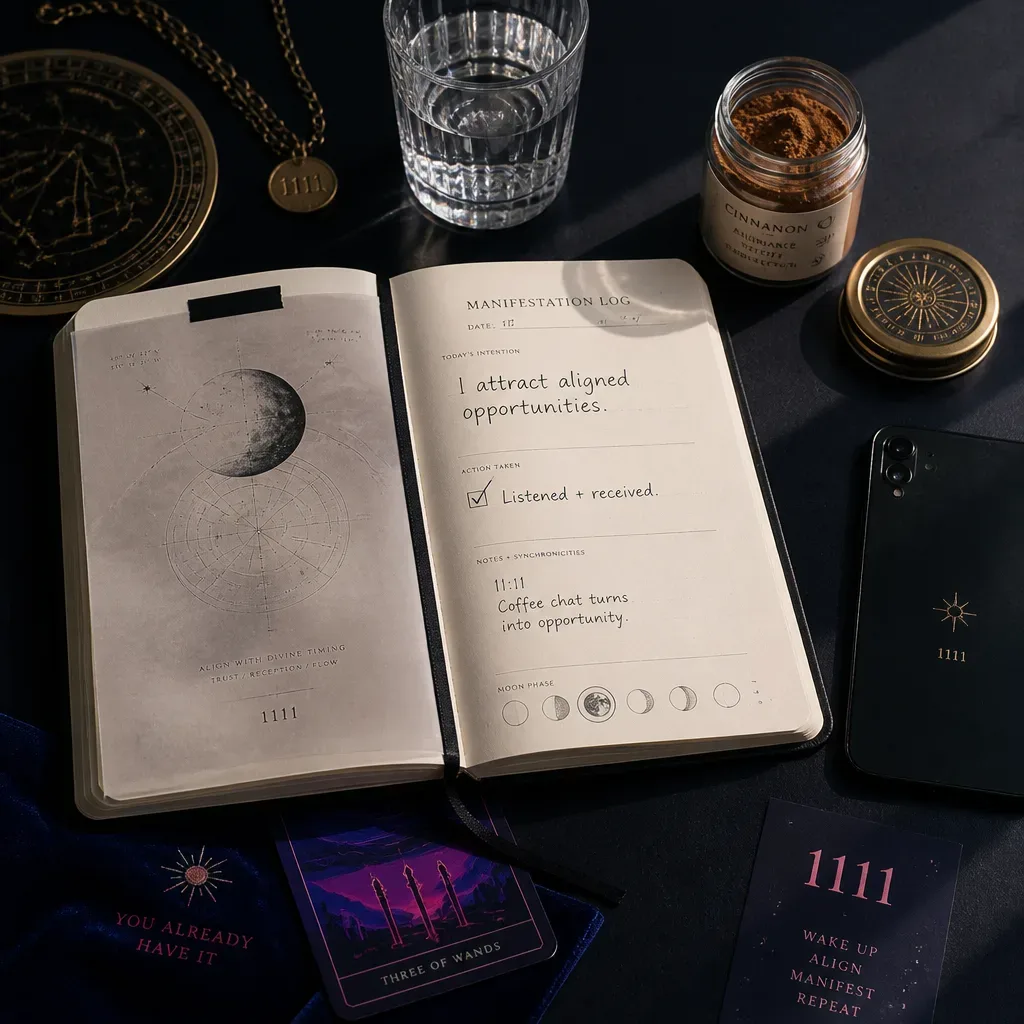
You may want to track the practice for 11 days. Not forever. Just long enough to notice patterns. Write the date, the sentence, the action, and one signal you noticed. A signal can be external, like a reply arriving. It can also be internal, like less avoidance. Synchronicity is not only the world winking at you. Sometimes it is you finally noticing what you usually ignore.
Keep these boundaries:
- Do not ingest large amounts of cinnamon. Cassia cinnamon can contain coumarin, which may be harmful in excess; the European Food Safety Authority has set a tolerable daily intake for coumarin at 0.1 mg per kilogram of body weight.
- Do not use ritual as a replacement for medical, legal, or financial advice.
- Do not turn a missed day into a verdict.
- Do not keep asking the same question after the answer has arrived.
The daily affirmation and the Manifestation Board can support this practice, especially if your sentence needs visual or verbal reinforcement. They are complements. The audio remains the method. If you want the daily structure, return to the AYA Method and let the Dream-Self Moment hold the center.
The cinnamon is only a spark. Your attention is the flame.
Leave the jar where morning can find it.