manifestation 101
How to Manifest Overnight: 3-Minute Sleep Audio
Learn how to manifest overnight without spiraling by using a 3-minute sleep audio, a clear request, and a nervous-system-friendly ritual.
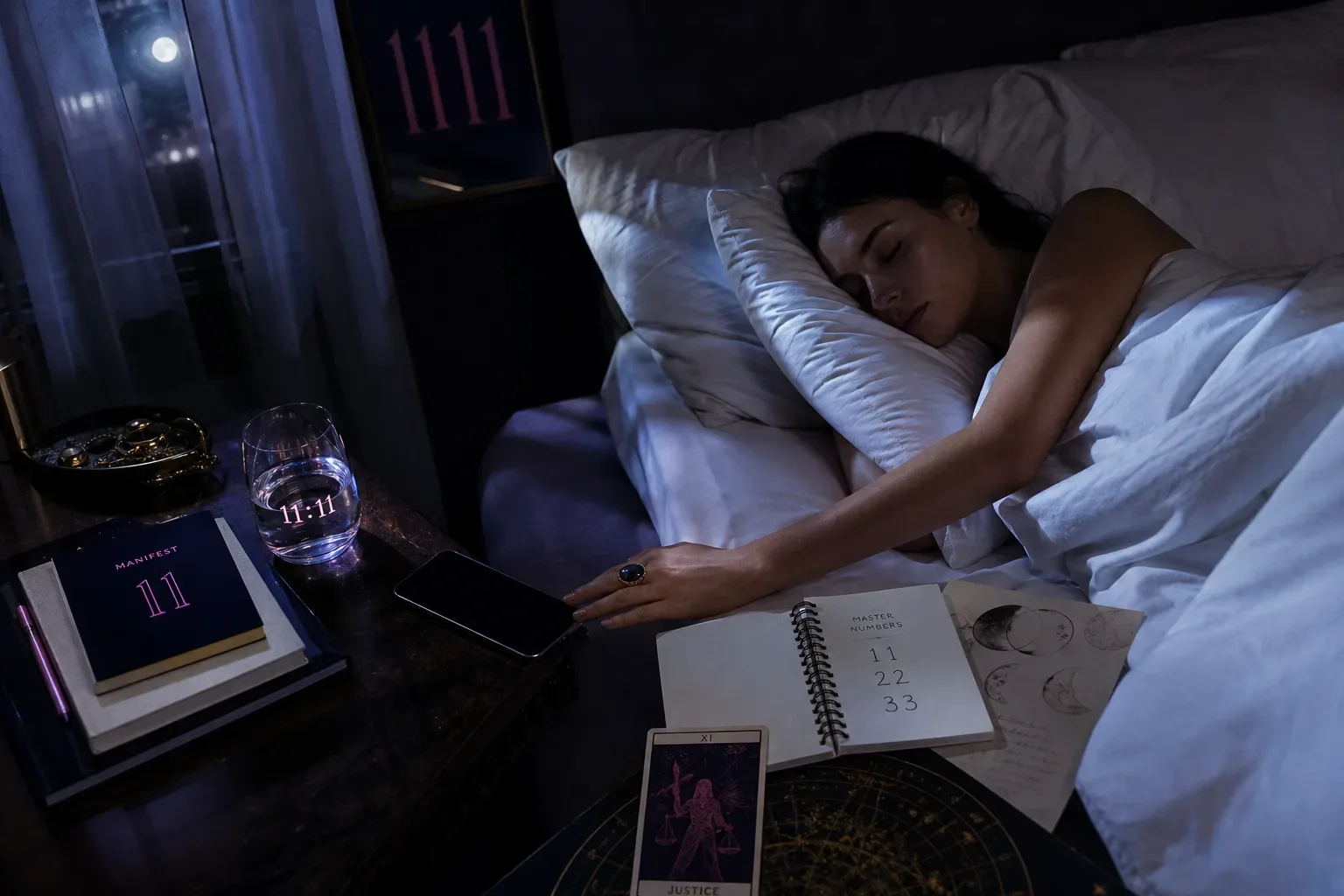
To learn how to manifest overnight, use one clear request, one 3-minute sleep audio, and one morning evidence check. The aim is not to force reality while exhausted. The aim is to give your attention a signal before sleep, then stop feeding the spiral that makes the signal harder to hear.
At 11:11, the phone lights up. Again. You were not looking for it, which is why it lands harder. The number does not do the work for you. It marks the gate. What you do before sleep is the part that counts.
Can you manifest overnight without making yourself anxious?
Yes, if the overnight practice is small enough to calm the body and specific enough to direct attention.
The mistake is treating midnight like a courtroom. You lie there trying to prove your worthiness, repeating the same sentence until it curdles. That is not devotion. That is nervous-system overtime. The National Sleep Foundation has long reported that adults generally need 7 to 9 hours of sleep; using the last hour of the day to negotiate with fear is an expensive use of biology.
A better overnight practice has three parts: a request, a state, and a stop point. The request tells your attention what to notice. The state tells your body what to rehearse. The stop point keeps the practice from becoming rumination. In clinical psychology, rumination is strongly associated with anxiety and poor sleep quality; a 2018 review in Clinical Psychology Review linked repetitive negative thinking with multiple emotional disorders.
Manifestation at night works best when it respects sleep as a collaborator. Memory consolidation, emotional processing, and threat calibration all shift during sleep, especially across REM cycles that tend to lengthen later in the night. A typical sleep cycle runs about 90 minutes, according to sleep medicine references from the Cleveland Clinic and similar institutions.
A night practice should feel like placing a letter on the right desk, not banging on the door until dawn.
If you are new to this, start with a desire that can show movement by morning. Not a complete life revision in 8 hours. A reply. A calmer decision. A dream with a clue. A changed appetite for the thing you thought you wanted. The dial can move one clean degree and still be on cue.
What is the 3-minute sleep audio method?
The 3-minute sleep audio method is a short pre-sleep listening ritual that places your desired state in the ear before the mind goes offline.
In the AYA Method, the audio is not decoration. It is the practice. The formal definition matters here: The AYA Method is a daily audio manifestation practice. Each day you listen to a short personalized recording, your Dream-Self Moment, narrated from the version of you who has already manifested the life you intend. Listening is the practice. Repetition is the work. The audio is the method.
Three minutes is not random. It is short enough to finish before the mind begins editing, objecting, and building a spreadsheet of doubt. It is long enough to include sensory detail, identity, and one clean emotional note. Dr. Andrew Huberman has often discussed how breath and auditory inputs can influence arousal states; while a manifestation audio is not a medical tool, sound before sleep can become a reliable cue for downshifting.
Your sleep audio should not sound like a commercial. I say this as someone who spent 12 years writing commercials. The body knows when it is being sold to. It softens faster when it is being witnessed.
Use this structure:
- Opening cue, 10 seconds: Name the body settling into bed.
- Fulfilled scene, 90 seconds: Describe one ordinary moment from the desired outcome.
- Identity line, 30 seconds: Speak as the person who can receive this without panic.
- Release, 40 seconds: Let the timing leave your grip.
- Stop, 10 seconds: End before the mind asks for more proof.
For background on the wider practice, keep the Manifestation pillar close. Overnight work is not a loophole. It is a concentrated version of the same principle: attention, repetition, state, action.
| Element | Too much | Just enough |
|---|---|---|
| Request | “Fix my entire life tonight” | “Show me the next clear step by morning” |
| Audio length | 30 minutes of pressure | 3 minutes of direction |
| Emotion | Desperate certainty | Calm recognition |
| Morning check | Hunting for miracles | Recording evidence |
How do you choose the right overnight request?
Choose a request that is specific, emotionally believable, and able to reveal evidence within 24 hours.
This is where people get theatrical. They ask for the whole season when the night is built for one signal. A useful overnight request has a tight frame: one person, one decision, one opening, one feeling, one sign. The brain’s attentional systems are selective by design; research on selective attention, including the famous 1999 Simons and Chabris “invisible gorilla” study, showed how easily humans miss what they are not primed to see.
That is the practical magic of specificity. You are not commanding the room. You are telling your attention which door to notice when it opens.
Good overnight requests sound like this:
- “By morning, I receive the next clear signal about the job.”
- “I wake with a calmer body and one honest answer.”
- “The conversation moves in a way I can recognize.”
- “I am shown whether to wait, ask, or release.”
- “I remember the idea that wants to arrive.”
Less useful requests sound like a panic disguised as faith: “Everything changes tonight,” “They finally understand my worth,” or “I wake up with no problems.” The nervous system hears those and braces. In The Journal of Behavioral Medicine, studies on stress and coping repeatedly show that perceived control affects physiological stress responses. A request that requires total control can increase pressure instead of reducing it.
The sweet spot is a request with room for timing. Neville Goddard taught the imaginal act as a completed inner scene, not a frantic demand shouted into the ceiling. Joe Dispenza’s work also emphasizes rehearsing a future state until the body begins to recognize it. You do not have to agree with every claim from either teacher to use the core discipline: rehearse the state cleanly, then stop interfering.
The right request does not beg the future to arrive. It gives the future a place to land.
What should the audio actually say?
Your audio should describe one fulfilled scene in plain language, spoken from the future self who is already steady inside the result.
Do not stuff the audio with 22 wishes because 22 is a master number. Master numbers can be beautiful markers, especially 11, 22, and 33 in numerology traditions, but the recording still needs a spine. One scene. One state. One ask. The number is punctuation, not architecture.
Here is a simple 3-minute script you can adapt:
“My body knows it is safe to sleep now. The day is complete. I am already in the version of my life where the next signal has arrived. I wake with the answer that belongs to me. I notice it easily. It may come as a message, a dream, a sentence, a shift in my chest, or a clean next step. I do not chase it. I recognize it. The part of me that used to spiral can rest. By morning, I receive what I need to know, and I meet it calmly.”
That is enough. The script does not overpromise. It gives the mind several acceptable channels: message, dream, sentence, body shift, next step. This matters because expectation can become too narrow. In cognitive science, prediction shapes perception; studies on placebo and expectancy, including work discussed in medical journals like The Lancet, show that what people expect can influence what they notice and feel.
If you use affirmations, keep them as complements. The Affirmations pillar is useful for wording, but do not turn the night into an affirmation marathon. One line after the audio is plenty. Try: “I can receive the signal without chasing it.”
For the recording itself, use your own voice if you can bear it. If not, use a voice that feels neutral and calm. Keep the volume low. Put the phone face down. The ritual should end, not expand.
How do you do the 3-minute practice tonight?
Do the practice in one clean sequence: prepare the body, listen once, seal the request, and sleep.
Here is the exact sequence I use when the day has teeth and I have very little patience left. It takes 3 minutes, not counting brushing teeth, because the ritual begins when you are already in bed. A 2023 Gallup report found that many adults report wanting more sleep, and the American Psychological Association has repeatedly linked stress with sleep disruption. So we are not adding a second job to the night. We are replacing the spiral.
The 3-minute overnight sequence
- Minute 0:00 to 0:30: Set the gate. Put the phone on Do Not Disturb. Say the request once: “By morning, show me the next clear signal about ___.”
- Minute 0:30 to 2:40: Listen to the audio. Let the Dream-Self Moment play once. Do not mouth along. Do not evaluate.
- Minute 2:40 to 3:00: Seal it. Place one hand on the chest or stomach and say, “I will recognize what arrives.”
- After 3:00: Stop. No more searching. No checking. No asking whether it worked.
This is where the AYA Method earns its keep. On a clean morning, I listen with tea. On a chaotic night, I listen like a person placing a pin on a map before the lights go out. The daily practice holds the pattern, so the overnight version does not have to carry your entire belief system by itself.
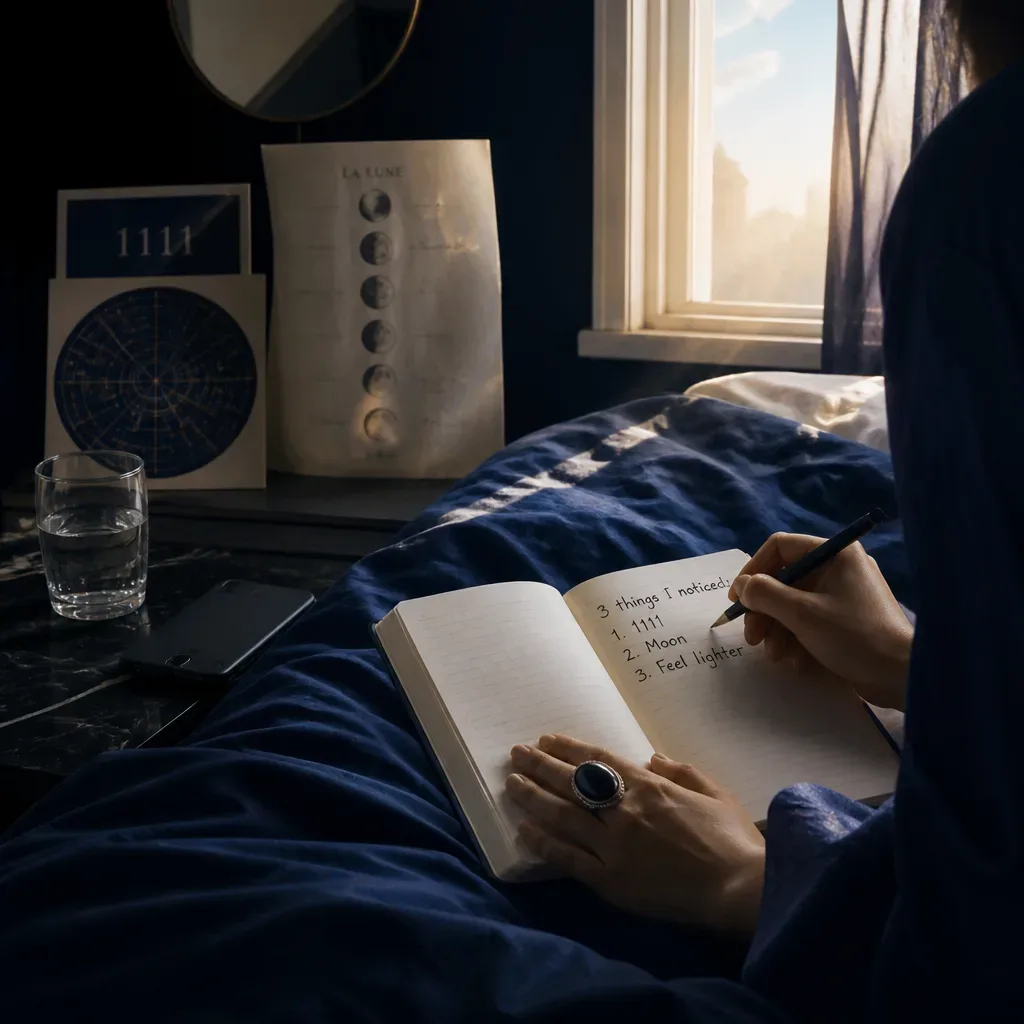
If astrology is part of your timing language, you can pair the practice with lunar phases or transits, but do not outsource your agency to the sky. Astrology and manifestation can help you name a season. The audio still asks you to participate.
The ritual works because it is repeatable on an ordinary night, not because the night is perfect.
What do you do if you start spiraling after the audio?
If you start spiraling, shrink the practice to nervous-system safety and stop trying to intensify belief.
Spiraling usually sounds spiritual at first. “Maybe I need to say it again.” “Maybe I did not feel it enough.” “Maybe the wording was wrong.” Then, 37 minutes later, you are editing a sentence in the dark as if the cosmos runs on legal copy. It does not. The body is now learning that desire equals danger.
Use a reset instead. Tara Brach’s RAIN practice, widely taught in mindfulness settings, begins with recognizing what is happening rather than wrestling it into a prettier shape. You can borrow that spirit without turning the night into a workshop.
Try this 4-step reset:
- Name it: “This is spiraling.”
- Locate it: “It is in my throat, chest, stomach, or jaw.”
- Reduce it: Exhale longer than you inhale for 5 breaths. Slow exhalation is often used in breathwork to support parasympathetic activity.
- Close it: “The request is placed. I do not need to keep proving it.”
This is not giving up. It is refusing to make anxiety the priestess of the ritual. In sleep research, pre-sleep cognitive arousal is a known contributor to insomnia symptoms; the more mentally activated you are in bed, the harder sleep becomes. Your manifestation practice should not mimic the exact pattern you are trying to leave.
You can also make the request smaller. Change “I receive the job offer by morning” to “I wake with the next clean action about this job.” Smaller does not mean weaker. Smaller often means truer.
If spiraling is frequent, do the audio earlier, perhaps 20 minutes before bed, then read something plain. Not every nervous system likes intensity at the pillow. Some need a softer runway.
How do you read the morning evidence without forcing it?
Read the morning evidence by recording what changed before you decide whether it “worked.”
This is the part most people skip. They wake up, check the phone, see no dramatic message, and call the whole thing a failure by 7:04. Too fast. Evidence has more forms than a notification. It can be a dream fragment, a sentence in your head, a softer body, a sudden lack of appetite for the old pattern, or a practical idea that was not there last night.
Use a 2-minute morning note. Keep it boring enough to repeat:
- What did I dream, even vaguely?
- What is the first emotional weather in my body?
- Did any message, memory, or idea arrive?
- What is the next clean action?
- What am I no longer willing to chase?
A 2018 study in the Journal of Experimental Psychology: General found that writing a specific to-do list before bed helped participants fall asleep faster than journaling about completed tasks. That is not the same as manifestation, but it supports the practical point: the mind rests better when it has a place to put unfinished material.
Your morning evidence log trains pattern recognition. Not fantasy. Pattern. Princeton Engineering Anomalies Research, often called PEAR, spent decades studying mind-matter questions and remains debated; whatever one makes of that research, the useful editorial stance is sober: notice carefully, record cleanly, and do not inflate the data.
For more grounding, return to the Manifestation pillar when you need the larger frame. For language, use Affirmations pillar. For timing, use Astrology and manifestation. But at night, keep the room simple.
Synchronicity gets louder when you stop demanding that it perform on command.
The signal does not need a spotlight to arrive.