manifestation for life areas
Health Manifestation Without Fixing Yourself
Health manifestation can support your body without shame. Try a 3-minute audio practice that helps you listen, repeat, and return gently.

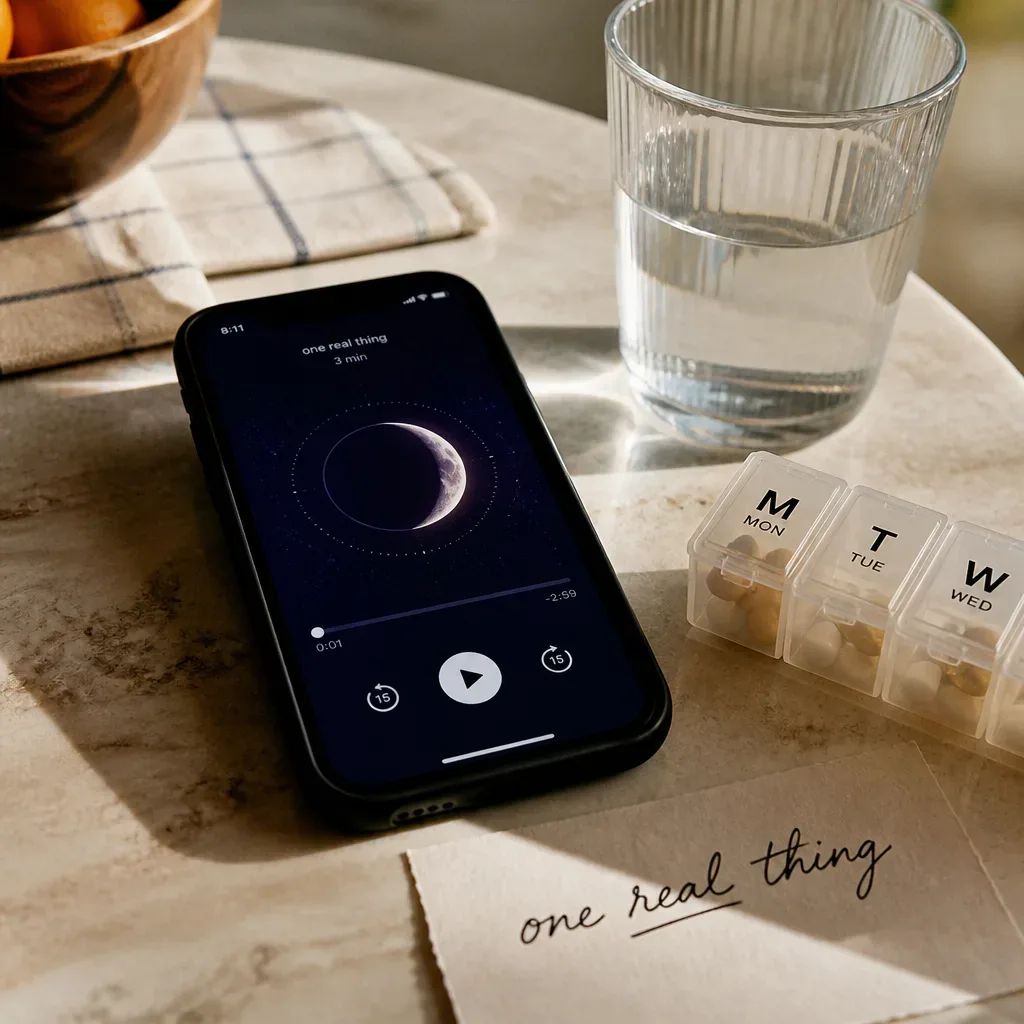
Your headphones are on the table. Three minutes is enough for health manifestation when the practice is not trying to fix you. Listen to a short audio from the self who already treats the body with care. Then do one small real thing. The point is not control. The point is return.
What does health manifestation mean when you’re not trying to fix yourself?
Health manifestation means practicing a kinder relationship with your body while still taking real care of it.
This matters because many wellness practices begin with a hidden insult: something is wrong with you, and the practice is proof that you’re finally doing something about it. That may create action for a week. It rarely creates trust. The Centers for Disease Control and Prevention reports that 6 in 10 adults in the United States live with at least one chronic disease. A body can need care without being a problem to solve.
A quieter definition is better. Health manifestation is the daily rehearsal of being someone who listens to the body, asks for help, rests without bargaining, and keeps promises that are small enough to keep. It can sit beside medication. It can sit beside physical therapy. It can sit beside grief. It does not ask you to deny pain or call symptoms imaginary.
The World Health Organization’s 1948 constitution described health as more than the absence of disease. That sentence has been debated for decades, but it still points to something useful: health is not only a lab result. It is also how safe you feel inside your own day. A practice can help with that part, even when the body is still healing.
You are not a project. You are a person with a body.
If you want the wider frame, Aya’s guide to manifestation explains the practice as attention, repetition, and lived identity. In health, that identity is not the person who never has symptoms. It is the person who no longer uses symptoms as proof of failure.
Why make it only 3 minutes?
Three minutes works because a health practice has to be easy enough for the days when you feel unwell.
Long routines often look good on paper. Then the body has a flare, the calendar fills, sleep breaks, or the mind feels loud. A 2010 study by Lally and colleagues in the European Journal of Social Psychology found that habit formation varied widely, from 18 to 254 days, with an average of 66 days. The lesson is not that you need 66 perfect days. The lesson is that repeatable beats impressive.
Three minutes also lowers the cost of starting. A body under stress does not always need more instructions. It may need one cue, one voice, and one next action. Dr. Andrew Huberman has often spoken about brief breathing or rest practices as ways to shift state, and Stanford’s public education on stress physiology points to the same practical truth: small nervous system inputs can matter when repeated.
Here is the shape:
- Put on headphones or turn the volume low.
- Sit, lie down, or stand still.
- Listen to your health audio for 3 minutes.
- Take one body-honoring action.
- Stop before the practice becomes performance.
Short is not shallow. Short is how you keep the door open.
This is especially true when health is tender. If you are managing pain, fatigue, anxiety, fertility questions, body changes, or recovery, you may not have a spare hour. You may not even have a spare 10 minutes. Three minutes says: start where your real life is.
How do you make the audio without shaming your body?
You make the audio from the voice of care, not from the voice of correction.
The words matter. Research on self-compassion by Kristin Neff and colleagues has linked self-compassion with lower anxiety and depression in multiple studies, including a 2012 meta-analysis in Clinical Psychology Review that reviewed 20 studies. Shame may get attention, but it does not reliably create steadiness. A health manifestation audio should not sound like a trainer who is disappointed in you. It should sound like someone who knows you are already worthy of care.
Use present-tense language, but do not lie to yourself. If you are in pain, you do not need to say, my body is perfect. Try: I listen sooner now. I speak to my body with respect. I take the next true step. I let care count even when progress is slow.
The Affirmations pillar can help you choose language that feels clean rather than forced. Affirmations are useful here as supporting lines, but in Aya they are not the main method. The audio is the method. The daily affirmation can echo what the audio is teaching your attention to remember.
A simple script can follow this table:
| Part of the audio | What it does | Example line |
|---|---|---|
| Body truth | Names what is real | I know you’ve been tired lately. |
| Future-self voice | Speaks from steadiness | I don’t punish my body to earn care. |
| Identity cue | Rehearses who you are | I’m someone who listens early. |
| Small action | Brings it into the day | I drink water, make the call, or rest. |
Do not include threats. Do not bargain with illness. Do not promise perfect outcomes. The most honest health audio leaves room for mystery and still asks you to be gentle now.
Where does the AYA Method fit in this practice?
The AYA Method fits by making the health practice something you listen to each day, not something you have to think your way through.
The AYA Method is a daily audio manifestation practice. Each day you listen to a short personalized recording, your Dream-Self Moment, narrated from the version of you who has already manifested the life you intend. Listening is the practice. Repetition is the work. The audio is the method.
For health manifestation, the Dream-Self Moment is not a fantasy of never needing help. It is a short visit with the self who no longer abandons the body. That self books the appointment. That self eats before the crash. That self stops calling rest lazy. That self takes prescribed medication without turning it into a moral story.
This matters because the brain learns through repetition and salience. In 1998, a well-known review by psychologist Shelley Taylor and colleagues in Psychological Bulletin described positive illusions as complex: sometimes helpful for motivation, sometimes risky when detached from reality. Aya’s approach is not detached from reality. It is practice with reality. You hear the future self, then you take the next grounded action.
If you use a Manifestation Board in the app, let it be a complement. Add an image that means steadiness, not perfection. A glass of water. A clinic door. A pair of shoes by the bed. If you use the daily affirmation, keep it close to the audio. One line is enough.
The body believes what you repeat and prove, not what you shout once.
What should you do right after the audio ends?
After the audio ends, take one small action that tells the body the words were real.
This is where many manifestation practices get vague. They ask you to feel better, then leave you alone with the same day. Health needs contact. In behavioral medicine, implementation intentions have strong support; Peter Gollwitzer’s work from the 1990s showed that if-then plans can improve follow-through across many behaviors. The idea is simple: if this cue happens, then I do this action.
After your 3-minute audio, choose one action from a short menu:
- Drink a full glass of water.
- Take medication or supplements as directed by a clinician.
- Send the message you’ve been avoiding.
- Schedule the test, session, or follow-up.
- Step outside for 2 minutes of light.
- Lie down with no phone for 5 minutes.
- Put one real meal on a plate.
The action should be small enough that your body does not brace against it. If you finish the audio and create a 12-step repair plan, you have left the practice. Come back. One action. One proof. One quiet vote for care.
A 2022 review in Nature Reviews Psychology noted that behavior change is more likely when interventions fit the context of daily life. That is the standard here. A health manifestation practice that only works on your best day is not your practice yet.
If you also work with astrology and manifestation, you can use timing as a soft cue, such as a moon phase or a personal transit. Let it remind you to listen. Do not let it replace care.

What if you don’t believe the words yet?
You do not need full belief; you need enough willingness to listen again tomorrow.
Skepticism is not a failure. I came to manifestation with a finance brain, and I still trust receipts. For health, this is useful. You are allowed to ask: What changes when I hear kinder words every day for 30 days? What changes when I pair those words with one real action? That is testable in your own life.
Placebo research is often misunderstood, but it gives one grounded clue: meaning and expectation can affect symptoms for some people. A 2015 review in The New England Journal of Medicine by Kaptchuk and Miller described placebo effects as psychobiological events linked to context, learning, and expectation. That does not mean thought cures disease. It means the body is not separate from the meanings around care.
So let belief be measured by behavior, not mood. Did you listen? Did you soften your tone by 5 percent? Did you do one thing you said you would do? Did you stop calling yourself broken for one afternoon? These are not tiny things. They are the way trust becomes visible.
You can also use the broader manifestation practice to name the identity underneath health: I am someone who responds to my body. I am someone who asks earlier. I am someone who lets support be normal. If an affirmation helps, borrow from Aya’s affirmation guidance, but keep the audio first.
If the words feel false, lower the pressure. Change I am healed to I am learning to care for my body today. Change I never feel fear to I can feel fear and still be kind. Truth is easier to repeat.
How do you keep health manifestation safe and grounded?
You keep it safe by treating manifestation as support, never as a substitute for medical care.
This is the boundary. If you have symptoms that worry you, seek professional care. If you are in crisis, contact local emergency services or a crisis line. If you are changing medication, speak with the clinician who prescribed it. Health manifestation can help your relationship with the body, but it should not be asked to do the work of diagnosis, treatment, or urgent care.
The National Center for Complementary and Integrative Health often uses a clear frame: complementary approaches are used alongside conventional care, not instead of it. That is the frame here. Audio can support attention. Repetition can support identity. A small next action can support follow-through. None of that replaces a blood test, imaging, therapy, surgery, rest, or a good doctor who listens.
A grounded 3-minute practice looks like this:
- Name what is true today.
- Listen to your Dream-Self Moment.
- Notice one body signal without judging it.
- Take one appropriate care action.
- Record one sentence, if you want: I listened today.
If you miss a day, do not make it a story. Start again. If the audio starts to make you anxious, rewrite it softer. If the practice becomes another way to monitor yourself, make it shorter. The nervous system does not need surveillance. It needs safety.
Health manifestation is not proving that you can control everything. It is remembering that you can be with yourself while you care for what is here.
You don’t have to earn care before you receive it.