mindset
Imposter Syndrome Manifestation: 3-Minute Audio
Imposter syndrome manifestation can be a 3-minute future-self audio practice: hear the calm you before the meeting, then take one real step.

Your phone is face down beside the notebook. Imposter syndrome manifestation means using a short future-self audio to rehearse the version of you who already belongs in the room. In 3 minutes, you listen, breathe, and take one real step before doubt has time to become the whole weather.
What is imposter syndrome manifestation really asking you to practice?
It asks you to practice belonging before your evidence has caught up.
Imposter syndrome was first named by psychologists Pauline Clance and Suzanne Imes in 1978, in a paper on high-achieving women who could not internalize their success. Later research widened the picture. A 2020 systematic review by Bravata and colleagues in the Journal of General Internal Medicine found reported prevalence rates from 9% to 82%, depending on the group and measure used. That wide range matters. It means the feeling is common, but not simple.
The manifestation part is often misunderstood. It is not a demand that you deny fear. It is not a sticky note pretending you are fine. Manifestation is most useful here when it becomes a rehearsal of identity plus action. You hear the self who sends the email. You hear the self who raises her hand. You hear the self who does not shrink when praise arrives.
Imposter syndrome is not proof that you are false. It is proof that your nervous system has not updated its file.
A 3-minute future-self audio gives the mind one small, repeatable update. Three minutes is short enough to use before a call. It is also long enough to name the scene, the fear, the chosen behavior, and the feeling after. In habit research, repetition matters more than length. A 2009 study by Phillippa Lally and colleagues found new habits took a median of 66 days to become automatic, with huge variation. You do not need 66 days to begin. You need one repeatable cue.
The cue is this: I listen, then I act.
Why does future-self audio work better than arguing with the doubt?
Future-self audio works because it gives your attention a scene to inhabit, not an argument to win.
Arguing with imposter thoughts can become another meeting with the same old committee. You say, I am qualified. The mind replies, prove it. You list your degrees, clients, wins, or years of practice. The mind asks why it still feels hard. This is why many people feel tired after trying to think their way out of self-doubt. The debate keeps doubt at the center.
Audio changes the center. Hearing a voice, especially your own or a calm narrator, can create a more embodied cue than reading text alone. Neuroscience does not need to be dressed up here. Auditory cues are used in memory, language learning, sport rehearsal, and therapy-adjacent tools because rhythm and repetition help the brain recognize what comes next. Dr. Andrew Huberman has spoken often about mental rehearsal and the need to pair visualization with action. The quiet part is the pairing.
The AYA Method is a daily audio manifestation practice. Each day you listen to a short personalized recording — your Dream-Self Moment — narrated from the version of you who has already manifested the life you intend. Listening is the practice. Repetition is the work. The audio is the method. You can read more about the AYA Method if you want the full frame.
There is also a useful caution. In a 2009 Psychological Science study, Joanne Wood and colleagues found that broad positive self-statements could make some people with low self-esteem feel worse. That does not mean affirming language is bad. It means the sentence has to be believable enough to enter. For imposter syndrome, I am the greatest may bounce off. I can ask one clean question in this meeting may get in.
A future-self recording does not shout over fear. It speaks from beyond the next small action.
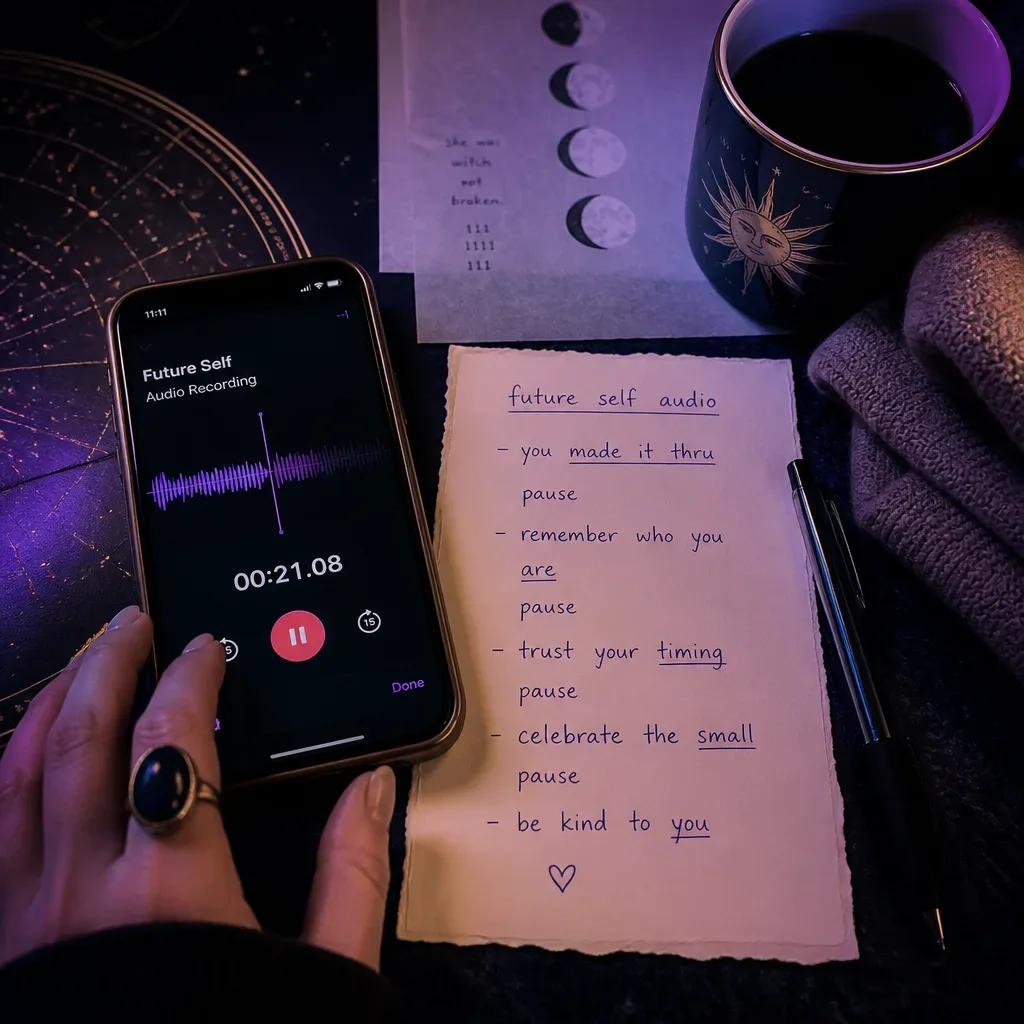
How do you make a 3-minute future-self recording that feels true?
You make it true by writing one specific scene, one honest fear, and one chosen behavior.
Set a timer for 10 minutes to write, then record for 3. Do not make a life manifesto. Imposter syndrome loves scale because scale gives it places to hide. Choose one scene: the interview, the client call, the first day of class, the post you are about to publish. A 2018 review in Frontiers in Psychology on self-related future thinking notes that imagining future events can influence present choices when the future feels connected to the current self. Specificity builds that bridge.
Use this simple structure:
- Name the room. Say where you are and what is happening.
- Name the old signal. Say what doubt usually does in your body.
- Name the future self. Speak as the version of you who has already done this.
- Name the behavior. Choose one thing you will do in the real scene.
- Name the after. Let the body hear what it feels like to remain intact.
Here is a small script shape:
| Minute | What to say | Example |
|---|---|---|
| 0:00-0:45 | The scene | I am opening the meeting notes. My hands are a little cold. |
| 0:45-1:30 | The old doubt | The old thought says I got here by accident. I let it pass. |
| 1:30-2:30 | The future self | I speak in a steady voice. I know the work because I did the work. |
| 2:30-3:00 | The next action | I ask one clear question. I stay present after I speak. |
Keep the language plain. Neville Goddard wrote often about living from the end, but the useful part here is not theatrical certainty. It is familiarity. Joe Dispenza also writes about mentally rehearsing a future state. You do not have to adopt anyone’s full philosophy to use the practical insight: the mind repeats what it knows.
If you already use affirmations, let them become narrower here. Instead of I am successful, try: I can be new in this room and still be prepared. One sentence. One room. One breath.
What should you listen for in the first week?
Listen for a small pause between the old thought and your next move.
The first week is not about feeling cured. It is about creating a gap. Cognitive behavioral therapy often works with the space between thought, feeling, and behavior. In daily life, that space can be tiny. Half a breath. A hand not withdrawing from the keyboard. A sentence sent before the inner courtroom opens. If your audio gives you 5 seconds of choice, that is not nothing.
Try a seven-day test. Listen once a day, preferably before one known trigger. The American Psychological Association has reported that stress can narrow attention and increase threat scanning. Imposter syndrome uses that narrowing well. A short recording gives attention a known path back.
Track only 3 things after each listen:
- What was the imposter thought?
- What did the audio ask me to do?
- What action did I take within 10 minutes?
Do not score the feeling. Feelings are weather, and some weather stays. Score the behavior. Did you send the message? Did you speak once? Did you stop apologizing before the point? In a meta-analysis of implementation intentions, Peter Gollwitzer and Paschal Sheeran found medium-to-large effects across 94 studies. The format was simple: if situation X happens, I will do Y. Your audio can carry the same logic in a softer form.
There is a reason the app also includes a Manifestation Board. A board can help you see what the future self is moving toward. But for this practice, keep the hierarchy clear. The audio leads. The board supports. The daily affirmation supports. Listening is the center.
How can you use it at work without making a performance of it?
Use it privately, briefly, and close to the moment you need to act.
You do not need a candle, a perfect morning, or a dramatic reinvention in the bathroom mirror. You need 3 minutes before the meeting link opens. You need one earbud on a walk around the block. You need the parked car before the presentation. In workplace studies, imposter feelings often rise in evaluative settings: medical training, academia, leadership, creative work, and first-generation professional spaces show up often in the literature. The room changes, but the fear sounds familiar.
Use the practice like this:
- Before a meeting: listen, then write the one sentence you will say.
- Before sending work: listen, then press send without adding one more apology.
- Before asking for money: listen, then state the number once.
- Before publishing: listen, then let the piece be seen for 24 hours before judging it.
- After praise: listen later, then write the compliment down as data.
The last one matters. People with imposter feelings often discount praise and overcount mistakes. Clance described this pattern in the original work: success gets attributed to luck, charm, timing, or extra effort, not ability. So your future-self audio should include receiving, not only performing. Let it say: I let the good sentence land. I do not rush to explain it away.
If you use timing, keep it exact. Three minutes of listening. Ten minutes to act. One line of tracking. That is 14 minutes total. You can do that between calendar blocks. You can do that before the child wakes. You can do that without announcing a new identity to anyone.
Astrology and manifestation can give some people a symbolic calendar for timing, but the work still comes back to the next behavior. The stars may make a beautiful clock. You still have to send the email.

What if the voice in your head says this is fake?
Let it say that, then make the recording more honest.
Resistance is not a sign that the practice is wrong. It may be a sign that the script is too far away from what you can believe today. This is where many manifestation practices lose people. The sentence leaps too high. The body declines the invitation. A better sentence is closer, quieter, and harder to dismiss.
Compare these lines:
| Too far | More believable |
|---|---|
| Everyone knows I am brilliant. | I can let one prepared point be heard. |
| I never doubt myself. | Doubt can come with me while I act. |
| I own every room. | I can stay in the room without shrinking. |
| Success is guaranteed. | My next step is mine to take. |
A 2014 study by Ethan Kross and colleagues found that using your own name or second-person self-talk helped people regulate distress before stressful tasks. That is interesting for audio because you can choose the address. Some days first person works: I am here. Some days second person is kinder: Selma, you know this work. It is not childish. It is a way to create distance from the thought without abandoning yourself.
If the recording feels fake, edit one line. Not the whole thing. One line. Replace certainty with steadiness. Replace grand claims with sensory truth. Your feet are on the floor. Your notes are in front of you. You prepared for 40 minutes. You can ask the first question.
The practice becomes trustworthy when it stops trying to impress you.
For a wider frame, the manifestation guide can help separate wishful thinking from repeated attention and action. If you keep a visual board too, this piece on a Manifestation Board may help you keep images specific rather than decorative.
How do you keep the practice small enough to repeat?
Make the practice too small to admire and too clear to avoid.
The temptation is to build a whole ceremony. I say this with affection, as someone who has made vision boards since sixteen and once cut out a magazine picture of a kitchen I could not afford, then somehow ended up with almost the same sink. I respect the collage. Still, imposter syndrome does not need more objects. It needs a repeatable cue before action.
Use this 3-minute daily frame for 7 days:
- Put the phone somewhere easy to reach.
- Play the same future-self audio once.
- Put one hand on the desk, wall, or your own knee.
- Take the named action within 10 minutes.
- Mark the action with one plain sentence.
That is it. No extra scoring. No performance. No proof for anyone else. In behavior design, BJ Fogg has written about tiny habits and the value of making actions small enough to repeat. The same principle applies here. Small is not weak. Small is how the practice survives Tuesday.
If you miss a day, do not start a trial. Start the audio again. If you freeze in the meeting, listen after and record what happened without insult. If the script stops fitting, revise it on day 4. Research on habit formation shows context cues matter, so pair the audio with a stable moment: kettle boiling, laptop opening, shoes on, meeting reminder at 10 minutes.
The daily affirmation can be a complement after listening. One line, written or spoken. The Manifestation Board can be a complement when you need to see the larger direction. But the method here is not the board. It is not the prettiest sentence. It is the audio you return to until the future self sounds less like a stranger.
You were never waiting to become real.
Stay near the voice that knows you.