mindset
Scarcity Mindset Reset With 3-Minute Audio
Reset a scarcity mindset with a 3-minute Dream-Self audio practice that calms threat, names enough, and trains better choices daily.

A scarcity mindset reset works when it interrupts the body’s threat story and gives the mind a more accurate script. A 3-minute Dream-Self audio does that by rehearsing enoughness, choice, and present-tense identity before your day starts spending attention on fear.
What is a scarcity mindset really doing to the brain?
A scarcity mindset narrows attention until shortage becomes the only signal in the room.
The phrase sounds soft until you watch it work. You check the account twice in 11 minutes. You answer a message too quickly because opportunity feels perishable. You turn down rest because time has started acting like a creditor. Scarcity is not just wanting more money. It is the habit of seeing the next decision through the smallest possible window.
Behavioral economists Sendhil Mullainathan and Eldar Shafir gave this pattern a hard edge in their book Scarcity and in a 2013 Science study. Indian sugarcane farmers performed worse on cognitive tests before harvest, when money was tight, than after harvest, when the same farmers had been paid. The reported drop was roughly equivalent to 13 IQ points. Same people. Different bandwidth.
That matters because a reset should not shame the person experiencing scarcity. If your brain is rationing attention, moral lectures will not help. A better practice gives the brain a cue it can repeat. Three minutes is not magic. Three minutes is short enough to survive a real morning.
Scarcity is a dial, not a verdict. When the dial is turned up, the whole room sounds like not enough.
A scarcity mindset also has good intentions. It is trying to protect you from loss. Daniel Kahneman and Amos Tversky’s 1979 prospect theory showed that losses often weigh heavier than gains in human decision-making. Later summaries commonly describe loss aversion as roughly twice as strong as the pleasure of a comparable gain. That is why a $50 bill can feel louder than a $50 win.
The work is not to pretend risk is gone. The work is to stop letting risk become your only narrator. If you want the wider frame on this site, start with the Manifestation pillar, then come back to this smaller gate: one recording, one morning, one better decision.
Why use 3-minute Dream-Self audio instead of another mindset exercise?
Three minutes works because it is brief enough to repeat and intimate enough to change the first signal your nervous system receives.
I came to audio practice like an ex-finance person, which is to say with suspicion and a spreadsheet. Thirty days. Notes. No enthusiasm permitted. What I noticed was not dramatic. On listening mornings, I made slightly cleaner choices before noon: fewer reactive purchases, better email boundaries, less checking. Slightly better compounded is the only kind of better I trust.
Audio has a different authority than reading. The auditory system is always tied to timing; rhythm, tone, and repetition tell the body what matters. Dr. Andrew Huberman has often discussed the role of repeated cues and state shifts in behavior, especially when paired with attention. You do not need to worship neuroscience to use the point: a familiar cue can become a gate.
This is where the AYA Method is precise. The AYA Method is a daily audio manifestation practice. Each day you listen to a short personalized recording, your Dream-Self Moment, narrated from the version of you who has already manifested the life you intend. Listening is the practice. Repetition is the work. The audio is the method.
That last sentence matters. The audio is not decoration. It is the daily contact point. A written line can help. A board can remind you. But the listening does the central work because it lets the future self arrive as a voice, not a concept.
There is also a compliance advantage. BJ Fogg’s behavior design research at Stanford emphasizes making habits tiny enough to do even on bad days. A 3-minute practice is 180 seconds. That is less time than many people spend checking one price, one comment thread, or one account balance loop.
A ritual that only works on perfect mornings is not a ritual. It is a performance with good lighting.
How do you prepare before pressing play?
Prepare by naming the exact shortage, choosing one ordinary future scene, and removing one source of noise.
Start with the shortage. Do not write scarcity mindset in general. Write the sentence that actually runs you. Mine used to be: if I slow down, I will fall behind. For someone else it might be: if I ask for more, they will leave. For money, the sentence might be: if I spend on the right thing, the wrong bill will arrive on cue.
The Federal Reserve’s 2023 report on household economic well-being found that 37 percent of adults said they would cover a $400 emergency expense with cash or its equivalent only with difficulty or not at all, depending on the exact measure used in reporting. That number explains why scarcity language sticks. Many people are not inventing stress. They are living close to the edge.
Preparation should respect that. Do not record a fantasy where bills vanish and you float above reality. Record a future self who checks the number, breathes, chooses the next move, and does not hand the whole day to panic. Accuracy is more useful than sparkle.
Use this quick preparation list:
- Name one shortage: money, time, attention, options, approval.
- Name one trigger: email, bank app, calendar, social media, family text.
- Name one better action: pause, ask, calculate, decline, wait, request.
- Choose one listening cue: after brushing teeth, before coffee, before opening the laptop.
- Remove one input: no news, no feed, no account checking until after the audio.
The American Psychological Association’s 2023 Stress in America reporting found money and the economy remained major stressors for a large share of adults. That is not a personal defect. It is a signal that your practice has to meet pressure directly.
When you prepare, you are not trying to become fearless. You are making fear less interesting than the next accurate action.
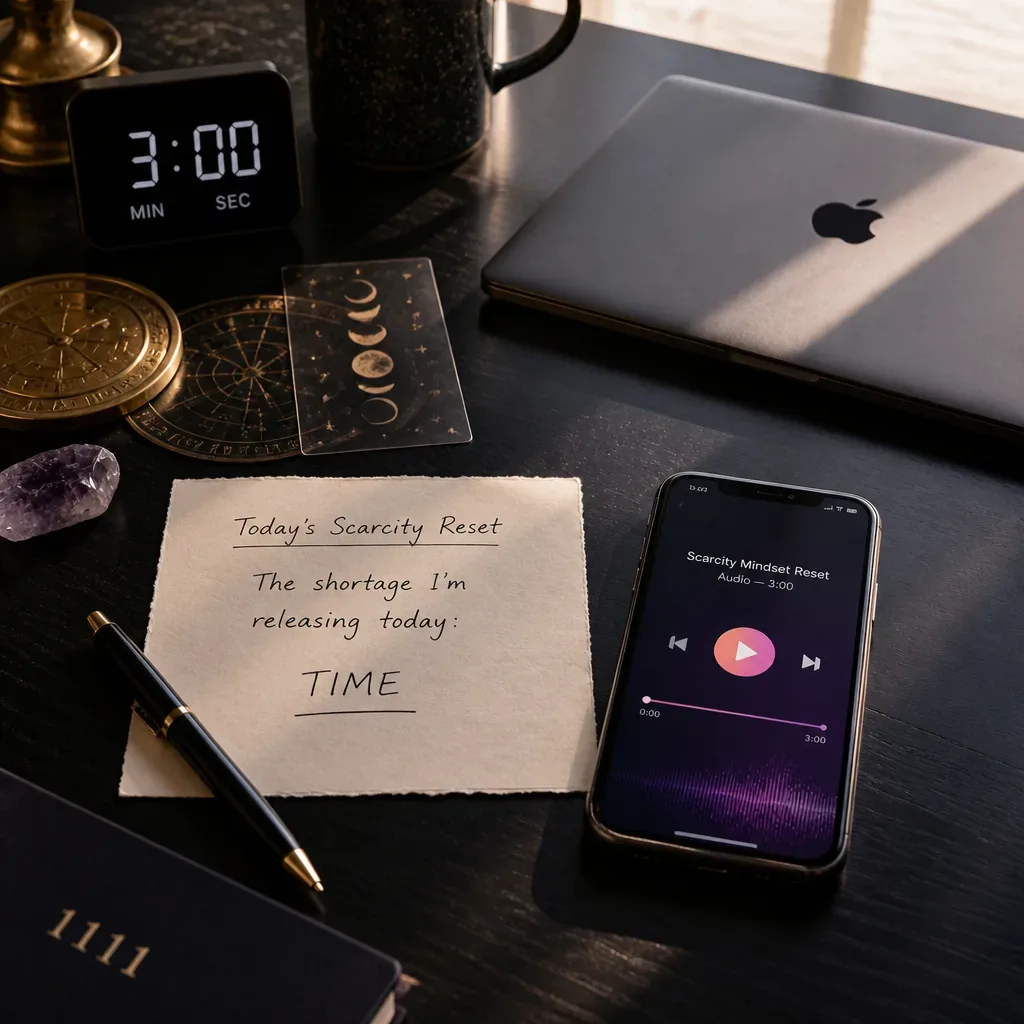
How do you do the 3-minute scarcity mindset reset step by step?
Do the reset by listening to one short Dream-Self recording before outside input and then taking one visible action that proves the new frame is in charge.
Here is the 3-minute sequence I use and teach. Keep it plain. The more dramatic it becomes, the less likely you are to repeat it on a Tuesday with bad sleep.
- First 30 seconds: name the present pressure. Say, silently or aloud, what is active. Example: I am worried there will not be enough time to do this well. Labeling emotion has research behind it; UCLA psychologist Matthew Lieberman’s work has shown that putting feelings into words can reduce amygdala activity in some contexts.
- Next 120 seconds: listen to the Dream-Self audio. Sit or stand still. No multitasking. Let the future self speak in a calm present tense. If your mind argues, fine. Let it argue while the audio continues. The point is exposure, not instant agreement.
- Final 30 seconds: choose one proof action. Send the invoice. Close the shopping tab. Ask for the fee. Open the calendar and remove one false obligation. Scarcity loses authority when the body performs a different vote.
The whole reset is 180 seconds. That number is important because the mind cannot easily negotiate with it. A 30-minute routine gives scarcity something to bargain against. Three minutes can slip past the internal committee.
This is also why I do not recommend changing the audio every day. Lally and colleagues, in a 2009 European Journal of Social Psychology study, found habit automaticity took a median of 66 days, with wide variation. Repetition is not a lack of creativity. Repetition is how the nervous system learns the route.
If you miss a day, do not stage a trial. Start again the next morning. The wave does not care what you intended yesterday. It only meets your position now.
What should the Dream-Self audio actually say?
The audio should sound like your future self calmly describing how you now handle shortage, choice, and enough.
Use present tense, but keep it believable. A scarcity mindset often rejects grand claims because the body can tell when language is trying too hard. If your bank account is under pressure, I am endlessly rich will probably create static. A cleaner line is: I look at the number without flinching, and I choose the next honest move.
Claude Steele’s self-affirmation research, beginning in the 1980s, suggests that people can handle threats better when connected to valued identity. Later studies are mixed by context, which is useful to know. The point is not that every sentence works. The point is that identity-based language can reduce defensiveness when it is grounded.
Try this structure for your recording:
| Audio part | Time | Example line |
|---|---|---|
| Arrival | 20 seconds | I am here, and I do not have to rush to be safe. |
| Identity | 45 seconds | I am someone who reads the numbers clearly and acts with respect for my future. |
| Behavior | 75 seconds | I pause before comparison. I ask for fair terms. I finish one valuable task before checking the room. |
| Evidence | 25 seconds | I have handled tight seasons before, and I am more skilled now. |
| Cue | 15 seconds | Today, enough begins with the next clean decision. |
A good Dream-Self audio is not a speech. It is a witness statement from the version of you who stopped negotiating with fear.
You can also bring in one line from the Affirmations pillar if it is specific enough to hold weight. The daily affirmation is a complement. It can become the sentence you carry after the audio ends. But do not mistake the line for the whole practice. In this method, listening remains the spine.
Neville Goddard called imagination the creative act, but his useful instruction was often practical: assume the state. In audio form, assumption becomes rehearsal. You are not begging the future to approve you. You are practicing the posture of the person who already knows what to do next.
How do affirmations, boards, and timing support the reset?
Use affirmations, visual boards, and timing as supports, not substitutes for the audio.
The daily affirmation can act like a pocket version of the Dream-Self recording. If the audio says, I handle the number without panic, the affirmation can be: I read the number and choose the next honest move. Short. Specific. Testable. If you cannot point to the behavior it names, tighten the sentence.
The Manifestation Board can help by giving the mind visual evidence of the life you are rehearsing. But again, it is not the method. The board is the mirror. The audio is the practice. That distinction keeps the work from becoming a wall of pretty images with no behavioral cost.
There is research support for implementation intentions too. Psychologist Peter Gollwitzer’s work shows that if-then plans can improve follow-through across many domains. Pair your audio with one: if I feel behind at 10:30, then I listen again for 3 minutes before making a money or time decision. One sentence. One gate.
Timing can also become meaningful without getting sloppy. Some people like listening at 11:11 because the master number 11 has long been associated with intuition and signal in numerology circles. Others use the new moon as a monthly review point. If you track cycles, Astrology and manifestation can give that timing a cleaner frame.
Use symbols as punctuation, not proof. The number on the clock can remind you to return. It cannot do the practice for you.

For a scarcity mindset reset, the best support stack is small:
- Audio: 3 minutes daily, before input.
- Affirmation: one sentence you can remember under pressure.
- Board: one visual that points to a real behavior.
- Timing: one recurring cue, such as morning, 11:11, or a weekly money review.
A signal is useful only if it changes what you do next.
How do you know the scarcity mindset is actually shifting?
You know it is shifting when your behavior changes before your feelings fully agree.
Do not wait to feel permanently calm. That is not the first marker. The first marker is a small delay between trigger and reaction. You see the sale and do not buy for 24 hours. You open the bank app once, not six times. You ask for the rate instead of accepting the first offer. The room has not changed, but your position in the room has.
Track observable evidence for 14 days. Two weeks is long enough to see patterns and short enough to avoid turning the practice into another self-improvement debt. In mindfulness research, even brief programs over 2 weeks have shown changes in attention and mind wandering in some studies, including work by Mrazek and colleagues in 2013. Small windows can matter when the repetition is clean.
Use this scorecard at the end of each day:
| Question | Score 0-2 |
|---|---|
| Did I listen before outside input? | 0, 1, or 2 |
| Did I pause during one scarcity trigger? | 0, 1, or 2 |
| Did I make one cleaner money, time, or attention choice? | 0, 1, or 2 |
| Did I avoid punishment after a miss? | 0, 1, or 2 |
A perfect score is not the point. A visible pattern is the point. In finance, a trend line beats a dramatic anecdote. In practice, the same rule holds.
If you want a wider frame for the metaphysics and the mechanics, read the Manifestation pillar after you have 7 days of notes. Theory lands differently when the body has receipts. If language is your main doorway, revisit the Affirmations pillar and refine the one sentence that follows the audio.
The cleanest sign is not that fear disappears. The cleanest sign is that fear stops getting the first vote.
What should you do when scarcity comes back hard?
When scarcity comes back hard, reduce the practice to the next 3 minutes and one honest action.
There will be days when the audio feels thin against the facts. A bill arrives. A client stalls. Someone else posts the win you wanted. On those days, do not decorate the pressure. Return to the smallest gate: listen, breathe, act once. Tara Brach often teaches the power of naming and allowing difficult states rather than fusing with them. That approach pairs well with this reset.
Use a fallback script when the usual recording feels too polished:
- This is scarcity speaking.
- It is loud because it is trying to protect me.
- I can listen to protection without obeying panic.
- I choose one accurate action now.
That script is under 30 words. It will not solve the economy, repair every account, or make a hard season soft. Good. We are not looking for theatrical certainty. We are looking for enough agency to move one inch in the right direction.
You can also return to the AYA Method when you need the practice held in a fuller container. The daily audio keeps the work from becoming abstract. The Dream-Self Moment gives the future self a voice. The repetition gives that voice a chance to become familiar.
Scarcity will probably return. Most old dials do. But each time you answer it with the same small practice, you teach the mind a new order of operations: signal, pause, listen, choose.
Listen again when the dial returns.