astrology manifestation
Last Quarter Moon Ritual With Dream-Self Audio
A simple last quarter moon ritual using 3-minute Dream-Self audio to release what is done, name the signal, and reset for the next cycle.
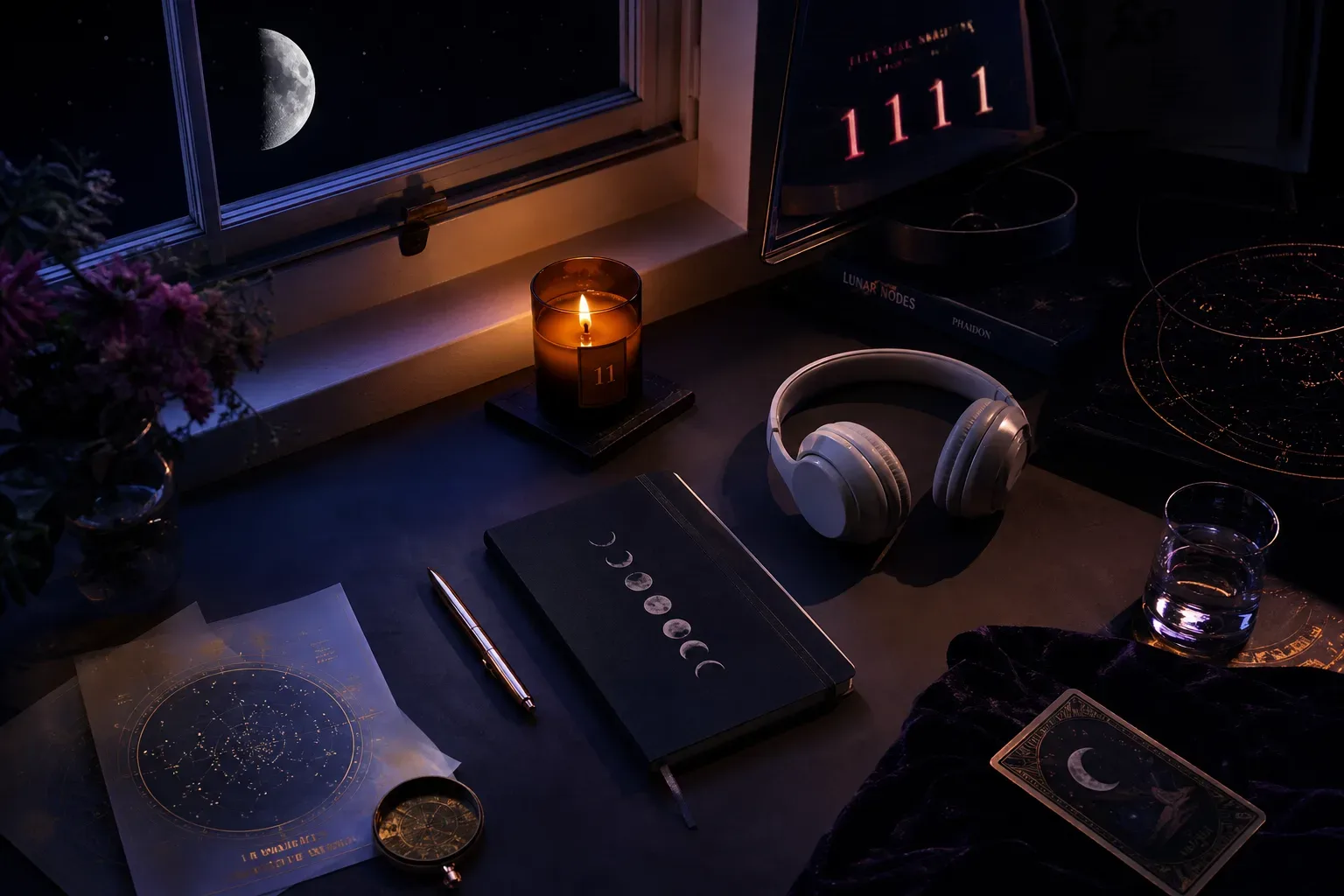
A last quarter moon ritual is a release practice for the waning half-moon: review the current cycle, stop feeding what is complete, and listen to a 3-minute Dream-Self audio as your signal for what stays. Keep it brief. The gate is narrow on purpose.
What is a last quarter moon ritual?
A last quarter moon ritual is a structured pause for review, release, and course correction in the final week of the lunar cycle.
The last quarter moon arrives when the moon is about 50% illuminated and waning, roughly 21 to 22 days after the new moon in a 29.5-day lunar cycle, according to NASA’s basic lunar phase timing. It looks like half a decision. Not empty. Not full. A clean hinge.
That hinge is why this phase has always suited subtraction. The full moon gets the drama, the photos, the balcony confession. The last quarter moon is quieter. It asks what you are still carrying because you forgot to put it down. The signal is not spectacle. The signal is friction.
In astrology, the last quarter square is often described as a crisis of consciousness, a phrase popularized in modern lunar phase work through astrologers like Dane Rudhyar. The word crisis can sound theatrical, but the practice is plain: something you believed at the new moon has met reality. Now you decide what to keep.
A last quarter moon ritual does not need smoke, seven crystals, or a perfectly poetic journal entry. It needs one honest inventory. A cycle can teach you in 28 days what your ambition tried to avoid for 2 years.
Use this ritual when you notice one of these signals:
- You are repeating a conversation in your head after it ended.
- You are clinging to a plan because you announced it publicly.
- You are tired in the same place every week.
- You received the answer, but not the one you wanted.
- You keep seeing the same number, name, or timing pattern and cannot ignore it.
If you want the wider map, keep Astrology and manifestation open beside this practice. The moon gives timing. Your attention gives consent.
Why use a 3-minute Dream-Self audio at this moon phase?
A 3-minute Dream-Self audio gives the last quarter moon ritual a future-facing witness instead of turning release into rumination.
The AYA definition matters here: the AYA Method is a daily audio manifestation practice. Each day you listen to a short personalized recording, your Dream-Self Moment, narrated from the version of you who has already manifested the life you intend. Listening is the practice. Repetition is the work. The audio is the method.
The last quarter moon can pull people into analysis. What failed? What did they mean? Why did I do that again? Useful questions, until they become a small courtroom. Audio interrupts the trial. For 3 minutes, you hear from the self who is not negotiating with the old pattern.
There is behavioral science under the elegance. A 2009 study in the European Journal of Social Psychology found habit formation averaged 66 days, with a wide range from 18 to 254 days depending on the behavior. Repetition, not intensity, carried the result. That is why a brief recording repeated daily can matter more than one ornate ritual performed once and abandoned.
The audio is also kinder to perfectionists. I say that as one. If a ritual requires 12 steps, I will make it beautiful, over-control it, and eventually resent it. Three minutes gives the practice nowhere to hide. The dial turns because you press play.
Here is the useful distinction:
| Tool | Best role in the ritual | Risk if overused |
|---|---|---|
| Dream-Self audio | Centers the practice through listening | Turning it into background noise |
| Journal | Names the release in plain language | Writing around the truth |
| Candle or object | Marks the room as intentional | Decorating instead of deciding |
| Daily affirmation | Reinforces one chosen line | Using words you do not believe yet |
If you use affirmations afterward, treat them as a complement. The Affirmations pillar can help you make the line precise. But the listening comes first. The future self speaks before the present self edits.
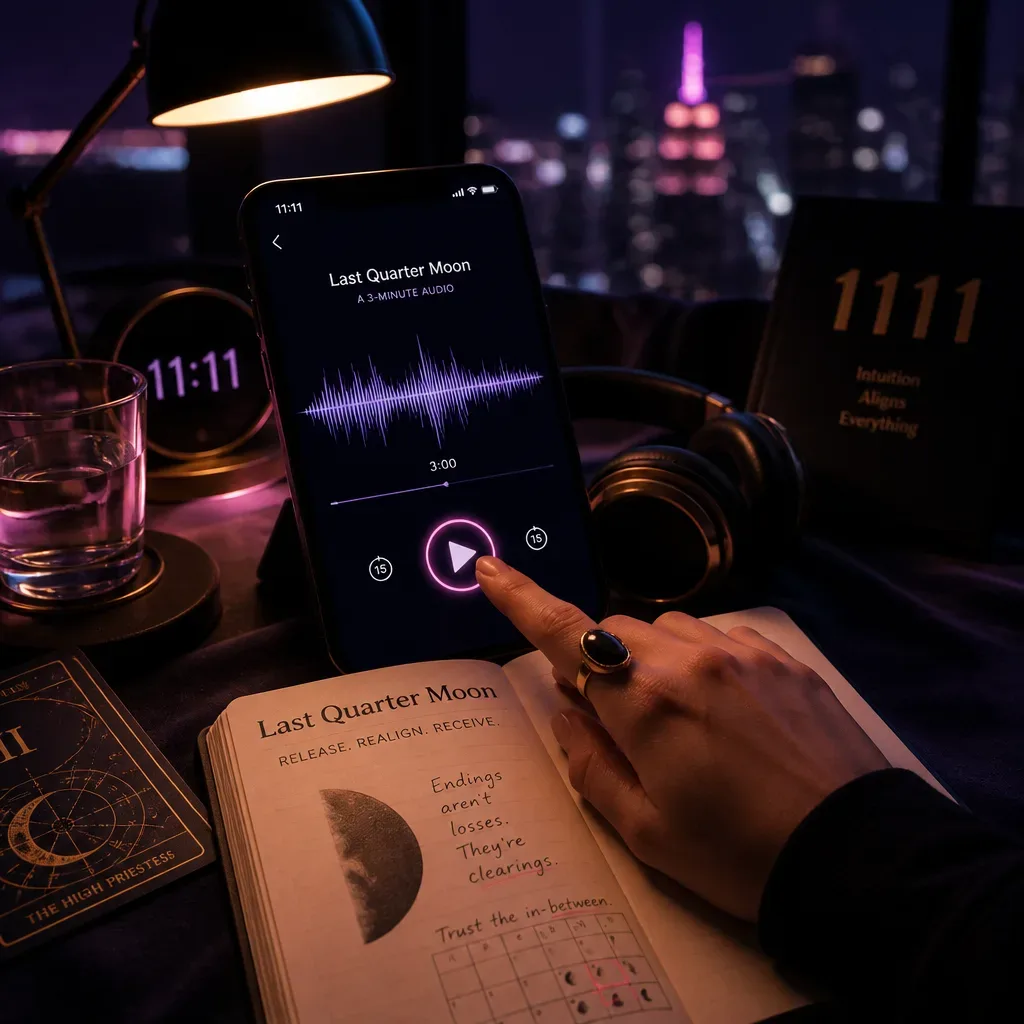
How do you prepare without turning the ritual into another performance?
You prepare by choosing a small window, reducing the room, and deciding in advance that the ritual will be useful even if it is not beautiful.
Start with timing. Use any reliable moon calendar and find the last quarter moon in your local timezone. If the exact time is inconvenient, choose a window within 24 hours before or after. The moon does not snap from one meaning to another at 14:37. Astronomically, phases are continuous; the exact phase time is a marker, not a trap.
Then set the room. Not the whole apartment. The room. One lamp, one place to sit, one pen. If you use a candle, light it because it helps your nervous system understand that the ordinary mode has changed. Do not spend 40 minutes arranging the altar and then claim you are too tired for the actual practice. That is the old perfectionism wearing a moon necklace.
Dr. Andrew Huberman often points to the role of light exposure and repeated cues in regulating alertness and behavior. You do not need a lab protocol here, but you can borrow the principle: consistent sensory cues teach the body what comes next. Same chair. Same headphones. Same brief listen.
Before you begin, write the date and the lunar phase at the top of the page. One line is enough: “Last quarter moon, October 21, 2026.” Specificity has a strange power. It turns a mood into an event. It gives the moment a witness.
Prepare with this 4-part setup:
- Check the last quarter moon time in your timezone.
- Choose a 9-minute window you can actually keep.
- Put your Dream-Self audio within reach and your notifications out of reach.
- Write one sentence: “I am here to release what has already ended.”
For broader context on how intention and repetition work together, the Manifestation pillar gives the bigger frame. This ritual is the smaller door. Small doors are underrated.
What are the exact steps for the 3-minute Dream-Self ritual?
The exact ritual is 9 minutes: 3 minutes to settle, 3 minutes to listen, and 3 minutes to name the release and next action.
Minute 0 to 3 is the settling gate. Sit down. Feel your feet. Look at the half-lit moon if it is visible, or simply name the phase if it is not. In Berlin, where I live, the sky often acts like privacy glass. The moon may be hidden. The ritual still counts.
Take 6 slower breaths. Not theatrical breaths. Ordinary ones with a longer exhale. A 2017 review in Frontiers in Psychology found slow breathing practices were associated with emotional control and autonomic regulation, though study designs varied. Translation: your body can receive a cue before your mind finishes arguing.
Minute 3 to 6 is the audio. Play your Dream-Self Moment once. Do not multitask. Do not journal while it plays. Do not evaluate whether it is working while it is working on you. The point is to listen from the version of you who already crossed the threshold.
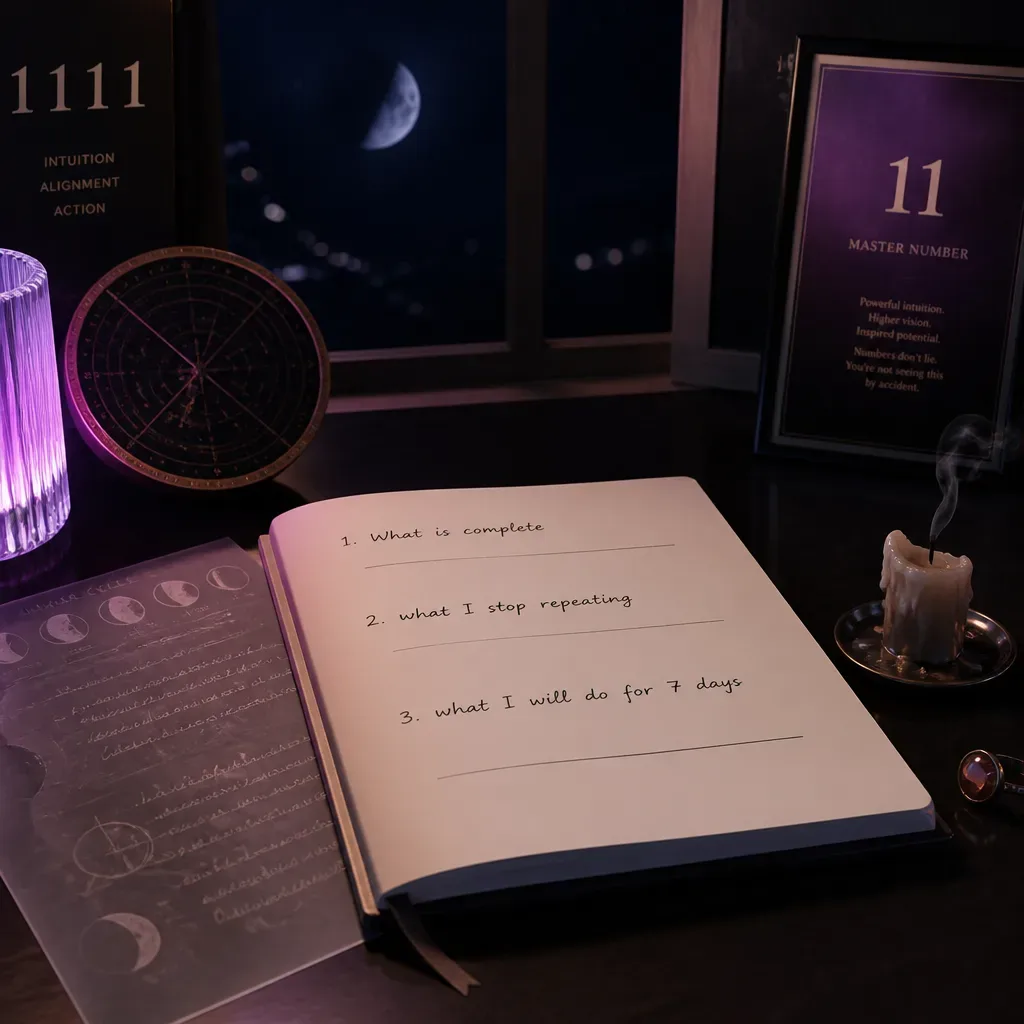
Minute 6 to 9 is the naming. Write quickly. No polishing. Use this sequence:
- “This cycle showed me…”
- “I am done repeating…”
- “For the next 7 days, I will…”
Keep the final line behavioral. “I will trust myself” is a beautiful weather system. “I will check my account every Friday at 10 a.m.” is a door handle. Ritual becomes real when it touches Tuesday.
You can close by placing one hand on the page for 11 seconds. Not because 11 is magic on command, but because master number 11 has long been treated in numerology as a symbol of intuition, signal, and the doubled line. Eleven seconds gives the mind a small shape. The room hears you stop.
What should you release, and what should you keep?
You should release the pattern that costs attention after it has stopped giving truth, and keep the lesson that arrived through it.
This is where the last quarter moon gets precise. Releasing does not mean rejecting the whole season. It means separating the compost from the seed. A relationship may be complete, but your new boundary stays. A project may need to end, but the discipline you built belongs to you. A mistake may have been real, but shame does not get permanent residency.
Tara Brach’s RAIN practice, widely taught in mindfulness settings, begins with recognition and allowing before deeper inquiry. That sequence is useful here. Recognize what happened. Allow that it happened. Then decide what it means now. Skipping straight to release can become spiritual avoidance with better lighting.
Try this sorting table:
| What happened | What to release | What to keep |
|---|---|---|
| A plan stalled | The fantasy that force will save it | The data about timing |
| Someone disappointed you | The need to make them the villain | The boundary you now understand |
| You broke your own promise | The self-attack | The smaller promise that can hold |
| A sign repeated | The obsession with decoding | The attention it asked from you |
Specificity is the whole spell. “I release fear” is too large to carry out of the room. “I release checking his profile before bed” has a pulse. It knows where it lives.
Small studies on expressive writing, including James Pennebaker’s work beginning in the 1980s, suggest that structured writing about emotional experiences can support psychological and even physical health markers for some people. The key word is structured. Three sentences can be more honest than 3 pages written to impress your future biographer.
If your release line feels too dramatic, lower the volume. The moon does not require a speech. It recognizes the decision underneath.
How do you carry the ritual into the next 7 days?
You carry the ritual forward by repeating the audio daily and choosing one visible behavior that proves the release is active.
The last quarter moon opens the final week before the dark moon and next new moon. That gives you about 7 days of waning light to practice subtraction. Do not fill those days with 14 new rules. Choose one. The nervous system believes what you repeat, not what you announce.
This is where the AYA Method becomes the spine again. Listen to the Dream-Self audio each morning or at the same daily cue you already have. Coffee. Shower. First light through the window. In my apartment, the sun visits for about 90 minutes on good days, and I have learned not to make that into a productivity sermon. I listen. That is enough.
Use a simple 7-day carryover:
- Day 1: Read your release line once.
- Day 2: Remove one object, tab, note, or reminder connected to the old pattern.
- Day 3: Listen to the audio before checking messages.
- Day 4: Take the next action you named, even imperfectly.
- Day 5: Notice resistance without making it a prophecy.
- Day 6: Repeat the action or reduce it until it is doable.
- Day 7: Write one sentence about what changed in the room.
Pew Research Center has reported for years that large shares of adults use smartphones near constantly; in its 2024 technology reporting, 90% of U.S. adults owned a smartphone. That matters because attention is not abstract anymore. It lives in the object beside your bed. A release ritual that ignores your phone is sometimes only theater.
If angel numbers or repeated timings show up during the week, record them without handing them the steering wheel. Seeing 11:11 can be a signal. It is not a substitute for the next clean action. Synchronicity is punctuation, not the sentence.
For a wider lunar frame, return to Astrology and manifestation. For language that supports the week without taking over the practice, use the Affirmations pillar. Let each tool keep its proper size.
The gate is open for less.