astrology manifestation
Waning Gibbous Ritual: 3-Minute Gratitude Audio
A waning gibbous ritual for release, gratitude, and a 3-minute audio practice that fits the lunar season without making the moon do all the work.

A waning gibbous ritual is a gratitude-and-release practice done after the full moon, when the light is still visible but already decreasing. Use a 3-minute audio to name what arrived, thank what taught you, and stop feeding what has finished its season.
What is a waning gibbous ritual actually for?
A waning gibbous ritual is for integration: you gather the meaning of what peaked at the full moon and decide what deserves to stay.
The moon does not need you to be theatrical. It has been doing this for roughly 4.5 billion years, according to NASA’s lunar science summaries. The human part is smaller and more difficult: to witness the cycle without pretending every feeling is a prophecy.
The waning gibbous phase begins after the full moon and lasts until the last quarter, about one week inside the moon’s 29.53-day synodic cycle. It is still bright enough to see by, but the dial has turned. That is the signature. Not darkness. Not disappearance. A measured decrease.
In kitchen terms, this is not the shopping list. It is not even the feast. It is the moment after everyone has eaten, when you notice what was left on the table. The pot tells the truth. So does the body.
A good waning gibbous ritual does three things:
- Names what came into form during the last cycle
- Gives thanks without exaggerating the lesson
- Releases one specific weight before the next gate opens
The practice belongs naturally beside Astrology and manifestation, because lunar timing gives attention a calendar. It also belongs beside the Manifestation pillar, because naming desire without reviewing the evidence turns the whole thing into noise.
Gratitude is not politeness dressed in incense. Gratitude is attention with receipts.
Robert Emmons and Michael McCullough’s 2003 gratitude research in the Journal of Personality and Social Psychology found that people who kept weekly gratitude lists reported higher well-being than comparison groups over 10 weeks. That does not make gratitude magic. It makes it measurable enough to respect.
Why use a 3-minute gratitude audio instead of silent reflection?
A 3-minute gratitude audio gives the ritual a spine, so your attention does not wander into performance, planning, or old arguments.
Three minutes is 180 seconds. That is long enough for the nervous system to hear a pattern and short enough that you cannot reasonably claim you have no time. At a slow pace of about 120 spoken words per minute, a 3-minute audio can hold around 300 to 360 words, with pauses. That is plenty.
The audio matters because listening changes the posture of the ritual. You are not trying to think your way into a new state. You are receiving language at the speed of breath. Dr. Andrew Huberman has often discussed how auditory cues and breath pacing can influence physiological state; the broader neuroscience point is simple enough: rhythm gives the body something to follow.
This is where the AYA Method fits cleanly. The AYA Method is a daily audio manifestation practice. Each day you listen to a short personalized recording — your Dream-Self Moment — narrated from the version of you who has already manifested the life you intend. Listening is the practice. Repetition is the work. The audio is the method.
For this ritual, you can listen to your Dream-Self Moment first, then play or record a 3-minute gratitude audio specific to the waning gibbous phase. The daily affirmation and Manifestation Board can support the practice, but they are not the center. The audio is the method. The moon is the timing.
A ritual becomes serious when it can survive an ordinary Tuesday.
Here is the structure I use when the moon is still fat in the sky and my kitchen is finally quiet:
- Thirty seconds naming the date, moon phase, and present feeling.
- One minute naming three things that arrived or became visible.
- One minute naming what those things taught, cost, or clarified.
- Thirty seconds releasing one demand from the next cycle.
If you already work with Affirmations pillar, keep the language specific. “I am grateful for support” is fine. “I am grateful that Ana watched the children on Thursday so I could finish the proposal” has more voltage. The mirror knows the difference.
How do you prepare the space without making it complicated?
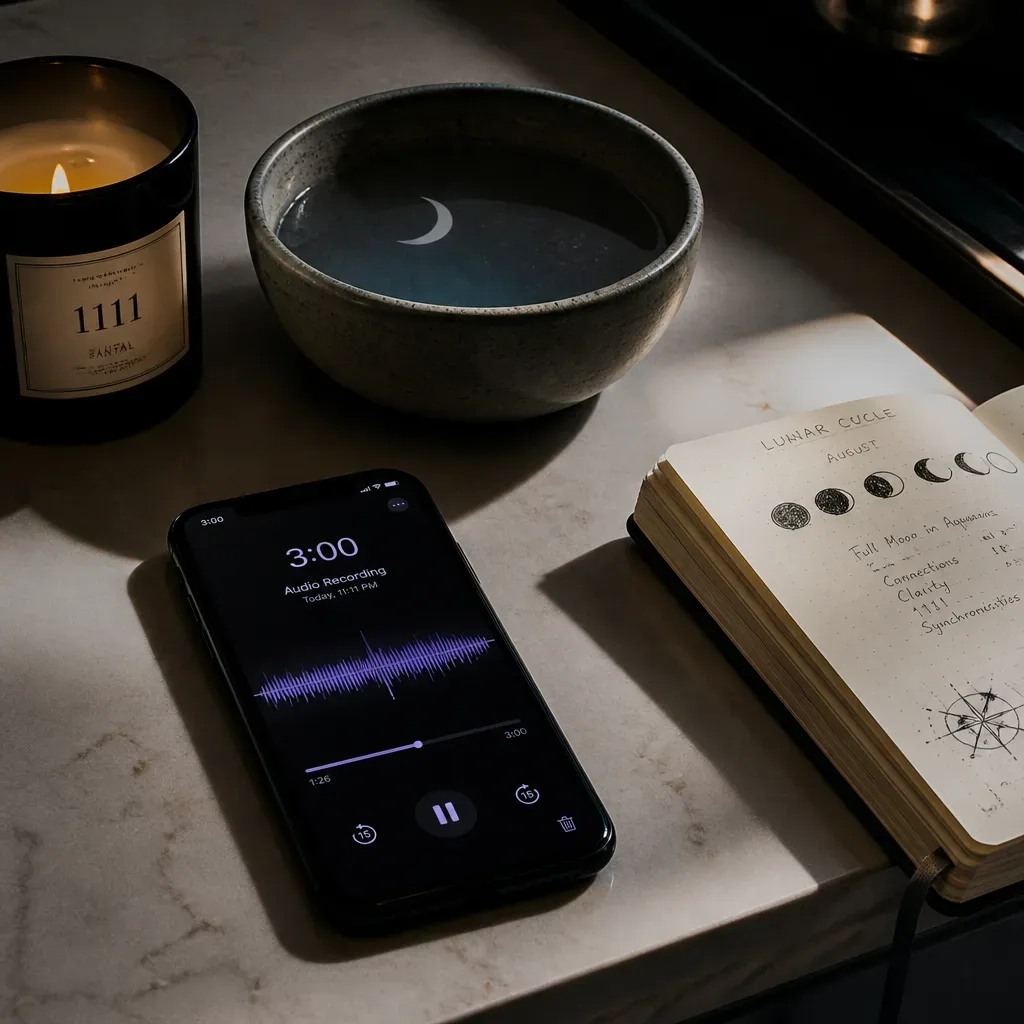
Prepare the space by clearing one small surface and choosing four simple witnesses: light, water, paper, and salt.
The surface can be a kitchen table, a windowsill, a nightstand, or one corner of the counter where the mail usually piles up. I like the counter because my family tells the truth there. The coffee stains, the fruit bowl, the knife marks on the cutting board. A ritual does not become less sacred because it happens near a toaster.
Use these four objects:
| Object | What it represents | Practical note |
|---|---|---|
| Candle or lamp | Attention | Use a safe flame or a small light |
| Bowl of water | Reflection | Change it after the ritual |
| Notebook | Witness | Write by hand if possible |
| Pinch of salt | Discernment | Optional, but very old kitchen wisdom |
Salt has been used for preservation for thousands of years; archaeological evidence places salt production in China as far back as 6000 BCE. I do not need that number to know my grandmother trusted salt more than speeches, but the number helps. Some materials carry a long memory.
Before you begin, remove anything from the surface that argues with the ritual. Bills can wait 12 minutes. The phone can be face-down unless it is playing your audio. If you need a timer, set it once. No checking. No rearranging the room to look like a photograph.
You are not decorating a self-image. You are making a place where attention can sit down.
This preparation should take 3 to 5 minutes. If it takes 40, the ritual has been hijacked by aesthetics. The waning gibbous moon is not asking for a production. It is asking for evidence, gratitude, and one honest release.
If you track lunar timing through Astrology and manifestation, note the sign the moon is in, but do not let the sign become an excuse. A Taurus waning gibbous may bring body and resources into focus. A Pisces waning gibbous may heighten feeling and dreams. Either way, the question is the same: what did this cycle show you?
What should the 3-minute gratitude audio include?
The audio should include three movements: recognition, thanks, and release, spoken in plain present-tense language.
You can record it in your own voice, use a personalized audio practice, or write a script and read it slowly into your phone. Most phones record clean enough audio for this purpose. The point is not studio quality. The point is recognition that does not vanish when your mood changes.
Use about 300 words maximum. The average adult speaking rate in English often falls between 120 and 150 words per minute, according to common speech-language benchmarks, but ritual audio works better slower. Leave air. Let the words land.
Here is a simple script frame:
- “Tonight, under the waning gibbous moon, I witness what has arrived.”
- “I thank the visible gifts and the difficult instructions.”
- “I keep what is true, useful, and alive.”
- “I release one demand that no longer belongs to the next cycle.”
- “I return my attention to the life I am building in real time.”
Notice the language. It does not beg. It does not flatter the sky. It does not pretend pain was secretly convenient. A precise ritual can hold grief without turning it into branding.
If your practice is already rooted in the AYA Method, let your Dream-Self Moment set the tone first. Then make the gratitude audio lunar and immediate. Your Dream-Self Moment speaks from the fulfilled self. The waning gibbous gratitude audio speaks from tonight’s table, tonight’s body, tonight’s evidence.
That distinction matters. Joe Dispenza often writes about rehearsal and elevated emotion in personal change practices, while contemplative teachers like Tara Brach emphasize compassionate presence. The bridge between them is attention. You are not forcing a result. You are training the nervous system to recognize a signal when it arrives.
Here is a short comparison:
| Practice | Best use | Length | Center |
|---|---|---|---|
| Dream-Self Moment | Daily identity rehearsal | Short daily audio | Future self already living it |
| Waning gibbous audio | Gratitude and release | 3 minutes | Present evidence and integration |
| Daily affirmation | Language cue | 10 to 60 seconds | One chosen sentence |
| Manifestation Board | Visual reminder | As needed | Images and symbols |
The sentence that matters is the one your body believes enough to repeat tomorrow.
How do you perform the waning gibbous ritual step by step?
Perform the ritual by moving from observation to gratitude to release, with the audio placed at the center.
Give yourself 12 minutes total. That is less time than many people spend scrolling before sleep; Pew Research Center reported in 2024 that a large majority of U.S. adults use YouTube, and about half use Instagram. Attention is not missing. It is assigned.
Here is the full sequence:
- Check the moon. Confirm it is between the full moon and last quarter. If you use an app, check once and put the phone down.
- Light the candle or lamp. Say the date out loud. Naming time makes the room pay attention.
- Write three receipts. List three things that arrived, changed, ended, or became obvious since the new moon.
- Play the 3-minute gratitude audio. Sit still. Hands open or resting on the table. Let the recording lead.
- Choose one release. Write one sentence: “I stop carrying ___ into the next cycle.”
- Touch the water. Not dramatic. Just enough to mark the shift.
- Close with one action. Choose something to do within 24 hours.
That last action is important. A ritual without behavior is just a beautiful pause. The behavior can be small: wash the cup, answer the email, clear one drawer, schedule the appointment, take the nap you keep treating like a moral failure.
If you use a Manifestation Board, update one image or word after the ritual. One. Not fifteen. The board is a complement, a visible cue. The listening remains the core if you are practicing the AYA Method.
The waning gibbous phase is also a useful time to revisit broader intention work inside the Manifestation pillar. What did you ask for at the beginning of the cycle? What answered back? What arrived looking less glamorous than expected but more accurate?
Synchronicity is not always a door flying open. Sometimes it is the third quiet no, arriving on cue.

What do you write after the audio ends?
After the audio ends, write one page of evidence, not a page of wishes.
Evidence keeps the ritual from floating away. Write what happened, what you noticed, what repeated, and what your body understood before your mind approved it. If the number 11:11 appeared three times this week, write it down. If someone said the exact phrase you had written in your notebook, write it down. If nothing sparkled but you slept eight hours for the first time in a month, write that down too.
Sleep is not a minor detail. The CDC has reported that about one in three U.S. adults do not get enough sleep. A lunar practice that helps you put the day down is not decorative. It is practical medicine for attention, even when it uses candlelight.
Use these prompts:
- What did I receive this cycle that I almost dismissed?
- What became clear after the full moon?
- What am I grateful for that still feels complicated?
- What pattern has finished teaching me?
- What is the smallest next right action?
Do not write to sound wise. Write to be accurate. The notebook is not auditioning for anyone.
A 2021 review in Frontiers in Psychology noted that gratitude interventions are often associated with improved well-being, though effects vary by design and population. That caveat matters. Gratitude is not a universal solvent. It is a practice of perception, and perception is one part of change.
If you work with Affirmations pillar, turn the strongest line from your writing into one daily affirmation for the next three mornings. Not a grand declaration. A clean one. “I keep what is true.” “I let the finished thing finish.” “I can receive without bracing.”
The moon wanes. The sentence remains.
What mistakes should you avoid during a waning gibbous ritual?
Avoid turning the ritual into a performance, a prediction machine, or a disguised planning session.
The first mistake is overloading the ritual. Ten crystals, six playlists, four decks, two apps, and no honest sentence. More objects do not mean more attention. Often they mean the opposite. The waning gibbous moon favors reduction. The phase itself is a visual instruction.
The second mistake is using gratitude to silence grief. Do not do that. If something hurt, name the hurt. If something ended, name the ending. In clinical and contemplative settings alike, emotional labeling has been associated with better regulation; UCLA affect-labeling research from Matthew Lieberman and colleagues has often been cited for showing that naming emotion can reduce amygdala response. Name it cleanly.
The third mistake is asking the waning moon to do new moon work. New moons are better for planting intentions. Full moons are better for illumination. Waning gibbous moons are better for thanks, interpretation, and release. You can read more about timing in Astrology and manifestation, but the practical rule is simple: do the work that matches the light.
The fourth mistake is chasing signs without changing behavior. Angel numbers, master numbers 11, 22, and 33, repeated songs, repeated phrases: these can be meaningful signals. They can also become distractions if you never answer them with action. A signal is only useful if it changes how you enter the room.
Use this quick correction table:
| If you notice this | Do this instead |
|---|---|
| You keep adding tools | Remove half of them |
| You are forcing gratitude | Start with one true sentence |
| You want a prediction | Ask what the last cycle proved |
| You feel scattered | Return to the 3-minute audio |
| You want to start over completely | Release one thing, not your whole life |
Ritual should make you more honest, not more dramatic.
Close the practice by pouring out the water, blowing out the candle or turning off the lamp, and putting the notebook somewhere visible. Within 24 hours, do the action you named. That is how the moon work enters the calendar.
Leave the salt where it is.