astrology manifestation
Lunar Eclipse Manifestation: A 3-Minute Audio Reset
Use lunar eclipse manifestation as a quiet 3-minute audio reset: listen, release one old script, and return to your future self without ritual overwhelm.

The moon goes red and the room stays ordinary. Lunar eclipse manifestation is a short reset you use during an eclipse to stop rehearsing one old story and listen to the self you’re choosing now. Three minutes is enough: sit, hear your audio, name one release, and leave the rest alone.
What does lunar eclipse manifestation actually mean?
Lunar eclipse manifestation means using the eclipse as a timing cue, not as a force that fixes your life for you.
A lunar eclipse happens only at a full moon, when Earth moves between the Sun and the Moon. NASA describes it as sunlight passing through Earth’s atmosphere and tinting the Moon red during totality. Some eclipses last for minutes; the full visible event can stretch for more than 3 hours. That length can make the night feel large. Your practice doesn’t have to be large with it.
In astrology, eclipses are often treated as interruption points. Something is seen. Something is no longer easy to unsee. If you already read the sky this way, the eclipse can help you mark a threshold. If you don’t, the astronomy is enough. A rare event gives the mind a date stamp. Research on memory has long shown that distinctive cues make recall stronger; psychologists call this cue-dependent memory, a concept studied since the 1970s.
The mistake is thinking the eclipse has to be dramatic. It doesn’t. A quiet reset respects the body. You’re not asking the night to answer every question. You’re asking yourself to stop repeating one sentence that has made you smaller.
A ritual becomes real when it can survive an ordinary Tuesday.
You can place this practice beside astrology and manifestation if the sky helps you listen. You can also place it beside plain habit science if that feels truer. Both paths ask for the same thing: attention, repeated gently.
Why should the reset be audio-first?
The reset should be audio-first because hearing a future-self scene gives your mind less to perform and more to receive.
Writing can become analysis. A candle can become staging. A long list can become another test you’re scared to fail. Audio asks less of you. You press play. You listen. For 3 minutes, you let the words arrive in a voice made for you. That matters when perfectionism is already loud.
The AYA Method is a daily audio manifestation practice. Each day you listen to a short personalized recording — your Dream-Self Moment — narrated from the version of you who has already manifested the life you intend. Listening is the practice. Repetition is the work. The audio is the method.
This is close to what habit researchers see in other areas: repetition with a stable cue helps behavior become easier to return to. In a 2009 study in the European Journal of Social Psychology, Phillippa Lally and colleagues found that habit formation took 66 days on average, with a wide range from 18 to 254 days. The number isn’t a rule. It’s a mercy. It says you don’t become new by trying hard once.
Dr. Andrew Huberman often speaks about attention as a gate for change in the nervous system. You don’t need to make that grand. During a lunar eclipse reset, audio gives attention one lane. No scrolling. No searching for the right sentence. No making the practice look good.
For more grounding, keep the manifestation pillar nearby. It holds the wider language. The eclipse reset is smaller. It’s one door, opened quietly.
How do you do the 3-minute lunar eclipse audio reset?
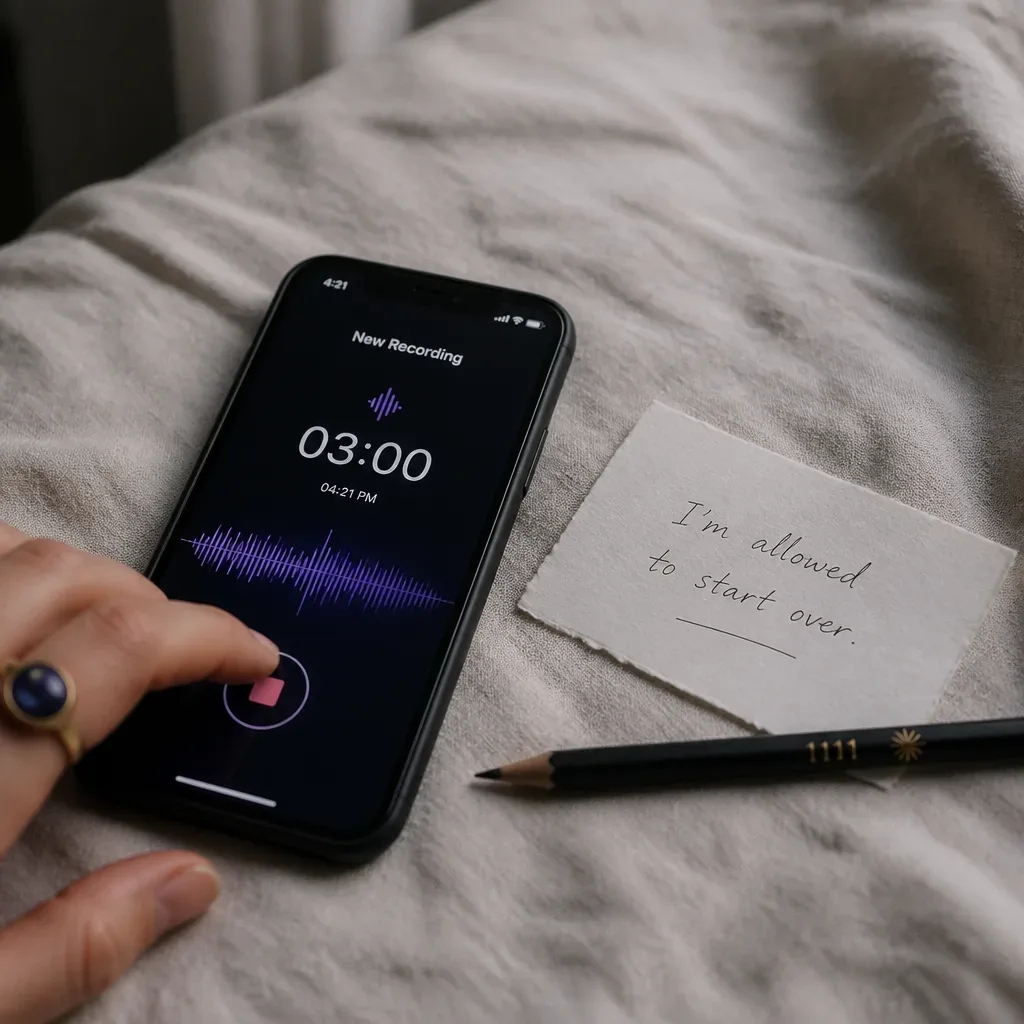
You do it by giving each minute one job: settle, listen, and choose.
Set a timer if you need containment. Three minutes is 180 seconds. That number helps the mind stop bargaining. You’re not committing to a whole evening. You’re committing to one small return.
- First 30 seconds: sit down. Put one hand on your chest or your lap. Let your eyes lower. If you track breath, try 4 slow breaths. Studies of paced breathing often use around 6 breaths per minute to support heart-rate variability; you don’t need precision, only softness.
- Next 30 seconds: name the old script. Say it plainly. “I’m done proving I’m worthy by staying exhausted.” One sentence is enough.
- Next 90 seconds: listen to your Dream-Self Moment. Let the audio speak from the version of you who already knows how to live from the intention.
- Final 30 seconds: choose one next action. Make it small enough to do within 24 hours. Send the message. Drink water. Close the laptop at 9. Delete the draft you wrote to punish yourself.
Here is the shape in a simpler view:
| Time | Practice | What it protects |
|---|---|---|
| 0:00–0:30 | Sit and breathe | Your body from rushing |
| 0:30–1:00 | Name one release | Your mind from spiraling |
| 1:00–2:30 | Listen to the audio | Your attention from performing |
| 2:30–3:00 | Choose one action | Your future from staying abstract |
The shorter the practice, the harder it is for perfectionism to hide inside it.
If you want one supporting sentence after the audio, use a daily affirmation as a complement. Keep it clean. Affirmations work best when they don’t ask you to pretend. “I can be loved without overgiving” is better than a sentence your body rejects.
What should you listen for during the eclipse?
Listen for the sentence that feels true enough to repeat tomorrow.
A lunar eclipse can make people reach for big declarations. Be careful with that. The nervous system often trusts the specific more than the grand. If your audio includes a scene, listen for concrete details: where you are standing, how your shoulders feel, what you no longer apologize for, what your morning sounds like.
Spoken audio is naturally brief. Many narration guides place comfortable speech around 125 to 160 words per minute. In 3 minutes, that’s roughly 375 to 480 words. You don’t need all of them. One sentence may be the whole medicine of the night. Write it down only if writing helps you remember.
Use this simple filter:
- Is it kind? If it shames you, it’s not your future self.
- Is it specific? If it could belong to anyone, make it more yours.
- Is it possible today? If it requires a new life by morning, make it smaller.
- Is it repeatable? If you’d avoid it tomorrow, soften it.
Neville Goddard wrote often about living from the wish fulfilled. You don’t have to inherit every part of his philosophy to use that one idea carefully. For this reset, “fulfilled” doesn’t mean finished. It means you let the audio speak from a self who is no longer negotiating with the old script.
If astrology is part of your practice, note the sign of the eclipse after you listen, not before. Too much interpretation can crowd out your own knowing. The sky can point. It shouldn’t speak louder than your body.
What if the eclipse feels emotionally intense?
If the eclipse feels intense, make the practice smaller instead of making yourself braver.
Some people sleep strangely around full moons. The research is mixed, but it’s interesting. A 2013 paper in Current Biology by Cajochen and colleagues reported that participants slept about 20 minutes less around the full moon in a small sample of 33 people. Later studies have not all found the same effect. Still, many readers know the feeling of a bright night and a busy mind.
You don’t have to decide whether the Moon caused it. Care for the body in front of you. If you’re already tender, skip the release sentence and only listen. If listening feels like too much, breathe for 60 seconds and stop. A practice that ignores your limits isn’t devotion. It’s pressure in nicer clothes.
Try these quiet boundaries:
- Put the phone on Do Not Disturb before you begin.
- Keep the light low, but don’t sit in darkness if it makes you uneasy.
- Don’t reread old messages during the reset.
- Don’t make a life decision after midnight if you’re flooded.
- Drink water before interpreting anything.
In clinical settings, grounding often starts with orientation: noticing the room, the date, the chair, the floor. This is simple because simple works. The National Center for PTSD teaches present-moment orientation as one way to reduce overwhelm. You can borrow that without turning the eclipse into therapy.
Your future self will never demand that you abandon your body to reach her.
If you need human support, choose that. The audio is a method for manifestation. It’s not a substitute for medical care, trauma care, sleep, food, or safe company.
How do affirmation and the Manifestation Board fit without taking over?
They fit as complements when they help the audio stay alive after the reset.
The daily affirmation can give language to the one sentence you heard. The Manifestation Board can give the eye a small image to return to. But neither one replaces listening. This matters because tools multiply quickly. Soon you’re managing a system instead of hearing the self you came to meet.
A 2016 review in Health Psychology Review found that action planning and self-monitoring can support behavior change when they stay concrete. That’s the line to keep. A board can help if it points to one lived detail: the cup on the desk, the calm calendar, the closed door, the walk home before dark. It becomes noise when it asks you to collect someone else’s life.
If you use an affirmation, write it after the audio, not before. Let the Dream-Self Moment lead. Then choose one sentence from what you heard. You can keep it beside the affirmations pillar if you want more language, but don’t turn the sentence into a performance.
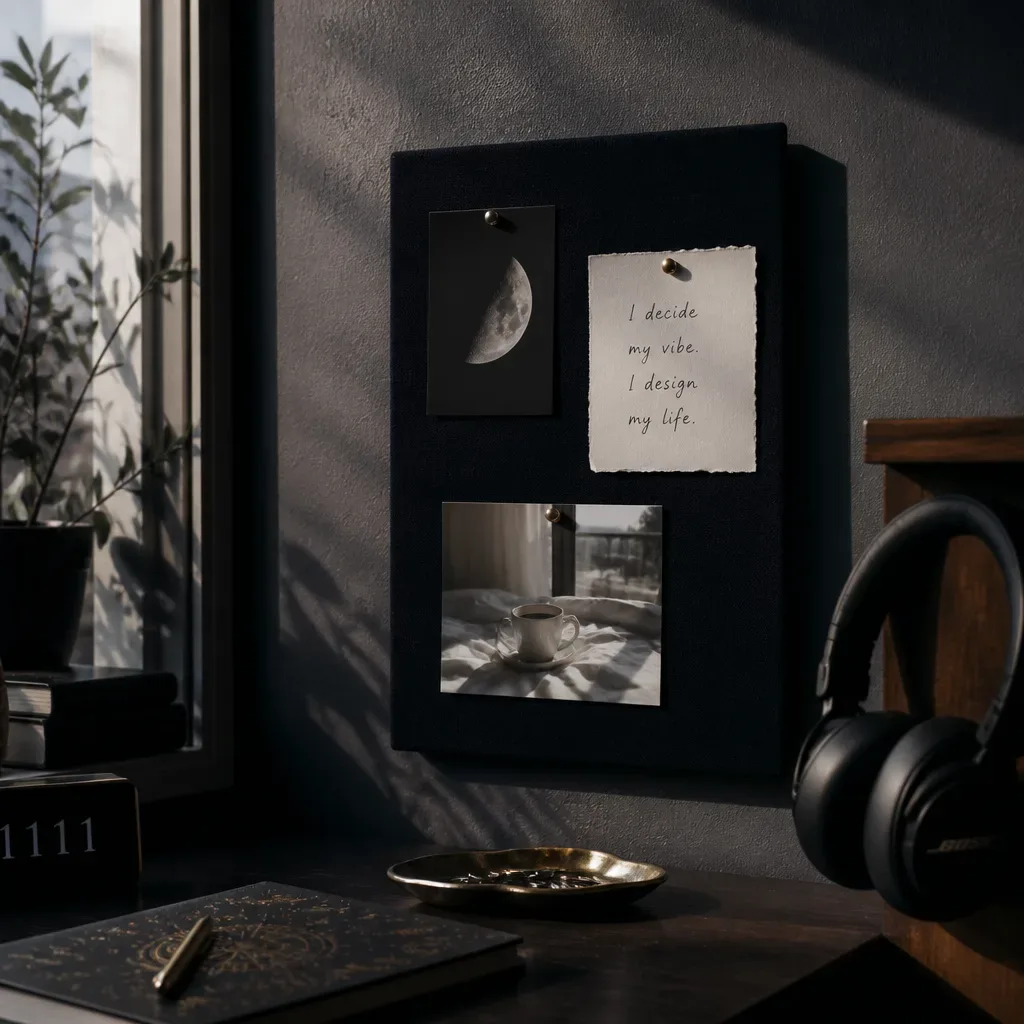
A Manifestation Board can also be very quiet. One image. One word. One color you recognize as home. Research on visual cues in habit design is practical here: environmental prompts help because they reduce the need to remember. You’re not trying to impress your future self. You’re giving her a place to land.
Use this rule: if the complement makes you listen more clearly, keep it. If it makes you compare, remove it.
How do you keep the practice going after the eclipse?
You keep it going by returning to the audio the next day, without asking the next day to feel special.
The eclipse is a marker. The practice is the repetition. This is the part that can feel plain, and that’s why it works. You listen when the moon is red. Then you listen when the laundry is folded badly, when the train is late, when your face in the mirror looks tired, when nothing symbolic is happening at all.
Princeton’s former PEAR lab studied intention and random event generators for decades, and the findings remain debated. You don’t need contested research to justify a daily practice. You can stand on steadier ground: attention changes choices, repeated cues support habits, and hearing a desired identity stated clearly can interrupt old self-talk. In cognitive behavioral research, self-statements are often examined because the words people repeat shape emotion and behavior.
Here is a 7-day after-eclipse rhythm:
- Day 1: Listen to the same Dream-Self Moment again.
- Day 2: Notice one place the old script tried to return.
- Day 3: Repeat the affirmation once, then stop.
- Day 4: Add or remove one image from your Manifestation Board.
- Day 5: Take the smallest action linked to the audio.
- Day 6: Rest without making rest productive.
- Day 7: Listen again and write one sentence that still feels true.
Pew Research Center reported in 2018 that 29% of American adults said they believe in astrology. That number doesn’t prove astrology works. It proves many people already use symbolic timing to make meaning. If you’re one of them, let the eclipse be a bell. Then let daily listening be the room you return to.
You can read more about the wider connection between astrology and manifestation, or return to manifestation in its simplest form: choosing what you rehearse until your choices begin to agree.
Softly now. The moon can be far away and still help you come home.