astrology manifestation
11:11 Manifestation Ritual With 3-Minute Audio
A quiet 11:11 manifestation ritual using a 3-minute Dream-Self audio, one clear intention, and a small daily return to what already feels true.

At 11:11, you pause, name one clear intention, and listen to a 3-minute Dream-Self audio that speaks from the life you’re choosing. The ritual is simple: the clock is the cue, the audio is the method, and one small action makes the moment real.
Why does 11:11 feel like a good time to practice?
11:11 works because it’s easy to notice, easy to remember, and already carries meaning for many people.
The clock does something kind. It interrupts without shouting. Four matching numbers appear, and for a second, your mind stops sorting emails and receipts and whether the laundry in the machine has become a damp little tragedy. That small stop matters. In habit research, a stable cue is one of the clearest supports for repeated behavior. Wendy Wood and David Neal have written for years about cues and automaticity, and one 2002 study by Wood, Quinn, and Kashy found that about 43% of daily actions were repeated in familiar contexts.
Some people call 11:11 an angel number. Some call it a pattern the brain loves. Both can sit at the same table. Pew Research Center reported in 2018 that 29% of U.S. adults said they believe in astrology, and astrology-adjacent timing practices are often used less like proof and more like permission. A clock can become a chapel if you treat it gently.
If you read about astrology and manifestation, you already know the quiet argument: timing doesn’t have to control you to help you pay attention. It can be a frame. A bell. A way to say, here, now, listen.
A ritual doesn’t have to be large to be real. It has to be repeatable.
That is why 11:11 manifestation works best when it stays small. Not a twenty-step ceremony. Not a performance. Three minutes of audio. One intention. One next step. Enough.
What do you need before the 11:11 manifestation ritual?
You need a quiet cue, one honest intention, and a 3-minute audio that speaks from your future self.
Before the clock arrives, decide what kind of ritual you can actually keep. Phillippa Lally’s 2009 study in the European Journal of Social Psychology found that habits took 66 days on average to become automatic, with a range from 18 to 254 days. The number is humbling. It also frees you. If a practice needs months, it should not be built like a wedding cake.
Start with one desire. Not twelve. Not the entire life plan taped to the wall with tragic optimism. I say this as a vision-board person. I’ve glued too many photos onto poster board and called it clarity. A board can help, yes, but only when it points to something you can feel and name. The audio carries the ritual. The images, notes, and daily affirmation are complements.
Use this small preparation table:
| What you prepare | How long it takes | Why it helps |
|---|---|---|
| One intention sentence | 30 seconds | Reduces mental clutter |
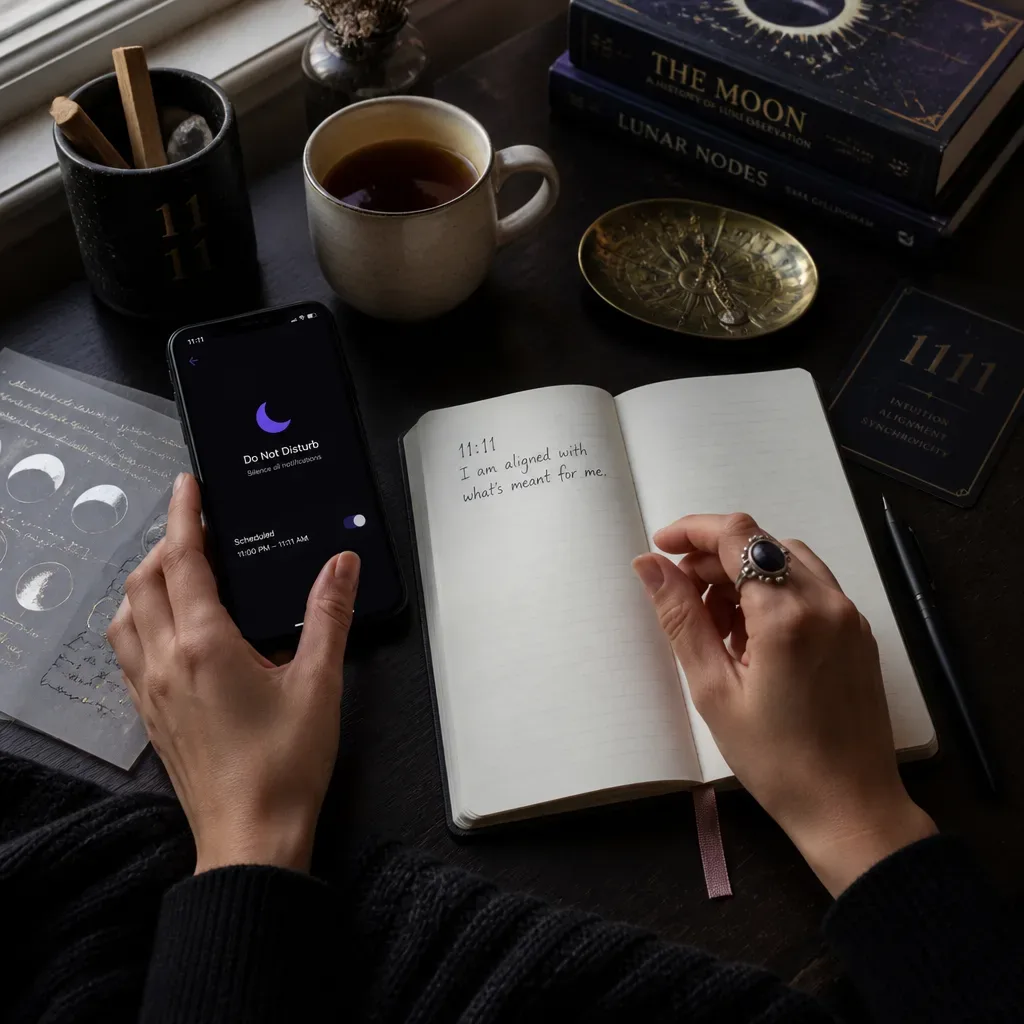
| Phone on do not disturb | 10 seconds | Protects the cue |
| 3-minute Dream-Self audio | 3 minutes | Gives the mind a rehearsed future |
| One action note | 30 seconds | Turns listening into motion |
The intention should be specific, but not brittle. A 2019 review in the journal Frontiers in Psychology described mental imagery as more emotionally vivid than verbal thinking alone. So don’t write: I want success. Write: I speak calmly in the meeting and ask for the rate I know is fair. The body understands scenes better than slogans.
If you need more language practice, the affirmations pillar can help you shape a sentence that feels true enough to repeat.
How do you do the ritual in five quiet steps?
You do the ritual by using 11:11 as the cue, then listening, writing, and choosing one small action.
Here is the version I would give to a friend who is sitting on the floor beside her bed, because the chair has clothes on it and honestly that is fine.
- Notice the time. When you see 11:11, stop. If you miss the morning one, use the night one. There are 2 chances a day, which gives the practice a forgiving shape.
- Take three breaths. Inhale through the nose, exhale slowly. Dr. Andrew Huberman has often discussed longer exhales as a way to support downshifting through the nervous system. You don’t need to become a breathing expert. You just need a door.
- Name one intention. Say it quietly. Present tense helps. So does plain speech. I am steady in the conversation. I finish the chapter. I receive the answer and respond with care.
- Listen to the 3-minute Dream-Self audio. Put it close to your ear. Let the recording speak as the version of you who already knows the scene from the inside.
- Write one next action. Under 10 minutes. Send the email. Open the document. Put the invoice in the folder. Drink water before making the call.
This is where the AYA Method belongs, without ceremony. The AYA Method is a daily audio manifestation practice. Each day you listen to a short personalized recording — your Dream-Self Moment — narrated from the version of you who has already manifested the life you intend. Listening is the practice. Repetition is the work. The audio is the method.
That last line matters. The audio is not decoration. It is not background music for a prettier life. It is the place you return to each day, the way a pianist returns to scales. A 2018 paper in Psychological Science found that implementation intentions, the if-then plans studied by Peter Gollwitzer and others, help people act by pairing a cue with a behavior. 11:11 is the if. Listening is the then.
The ritual should leave you quieter, not more frantic. If you finish and feel the urge to redo it perfectly, smile at yourself. Perfection is often fear wearing a nicer coat.
What should your 3-minute Dream-Self audio include?
Your Dream-Self audio should include a scene, a feeling, proof from daily life, and one grounded next action.
Three minutes is enough room for a beginning, a middle, and a soft landing. Spoken language tends to move at about 130 to 160 words per minute, according to common speech-rate guidance used in broadcasting and accessibility work. That gives you roughly 390 to 480 words. Not a lecture. A small room with a lamp on.
Use first person. Use present tense. Use sensory detail. Neville Goddard often taught from the phrase feeling is the secret, and while his work is not clinical research, the instruction is useful: the scene has to feel inhabited. Joe Dispenza also speaks often about rehearsing a future self until the body recognizes the state. You can take the practical part without swallowing every claim whole.
A simple structure:
- First 30 seconds: call yourself into the present. You are here. Your shoulders drop. The room is safe enough.
- Next 90 seconds: describe the desired scene as already real. Where are you? What do you do first? Who notices?
- Next 45 seconds: name the ordinary proof. Calendar entries. A paid invoice. A calmer kitchen. A message answered without panic.
- Final 15 seconds: choose one action for today.
Keep the words yours. If you would never say radiant, don’t put radiant in your audio. The mind trusts the voice that sounds like home. For a wider base on how intention practices are framed, the manifestation pillar is a useful companion.
How does 11:11 connect with astrology without making the clock your boss?
11:11 can sit beside astrology as symbolic timing, not as a rule you must obey.
Astrology has always been, among other things, a timing language. New moons, returns, transits, houses. People use these markers to ask better questions. What is beginning? What is ending? What is asking for patience? 11:11 is less formal than a birth chart, but it works in the same emotional neighborhood: a repeated sign asks you to pause and read your own life.
Still, the clock is not the authority. You are. In Princeton Engineering Anomalies Research, often called PEAR, researchers studied intention and random event generators for nearly 28 years, reporting small statistical deviations in some experiments. The findings remain debated, and they should be held carefully. What is not debated is that attention changes behavior. When you pause twice a day to remember what matters, you are more likely to notice the next honest step.
This is why I like pairing 11:11 with audio rather than only a wish. A wish can float away before you wash your cup. A recording gives shape. It repeats the same inner script until it becomes familiar. The app can also hold a Manifestation Board and a daily affirmation, but those are supports. They are not the center.
If you want to place your ritual near moon timing, read astrology and manifestation and keep the rule simple: use cosmic timing to listen more closely, not to hand over your choices. A true sign does not make you smaller.
What if you miss 11:11 or feel nothing when you listen?
If you miss 11:11 or feel nothing, you can still do the ritual because repetition matters more than drama.
Missing the time is not a spiritual failure. It is Tuesday. Use the next 11:11, or choose another fixed cue like after brushing your teeth. The habit field cares a great deal about repetition in context. The Lally study’s wide range, 18 to 254 days, is a good mercy here. Some practices root quickly. Some take a season.
Feeling nothing is also allowed. Many people expect a ritual to arrive with a cinematic swell. Most real change is quieter than that. In small studies on mental rehearsal, including sports psychology research reviewed across the last 30 years, imagery practice tends to work best when paired with physical action. So if the audio feels flat, lower the pressure and keep the action. Send the message. Open the file. Walk for 7 minutes. Your body may believe the movement before your mood catches up.
Here are small repairs:
- If the words feel fake, make them plainer.
- If the desire feels too large, choose one scene from it.
- If 3 minutes feels long, listen for 90 seconds today and return tomorrow.
- If you keep forgetting, set a silent 11:10 reminder.
- If you become obsessive, take one day off and come back softer.
You can also borrow language from the affirmations pillar, then record it in your own voice or use a personalized Dream-Self Moment. The point is not to impress the sky. The point is to hear yourself clearly enough to act.
The clock is only a doorway. You still get to walk through slowly.