manifestation for life areas
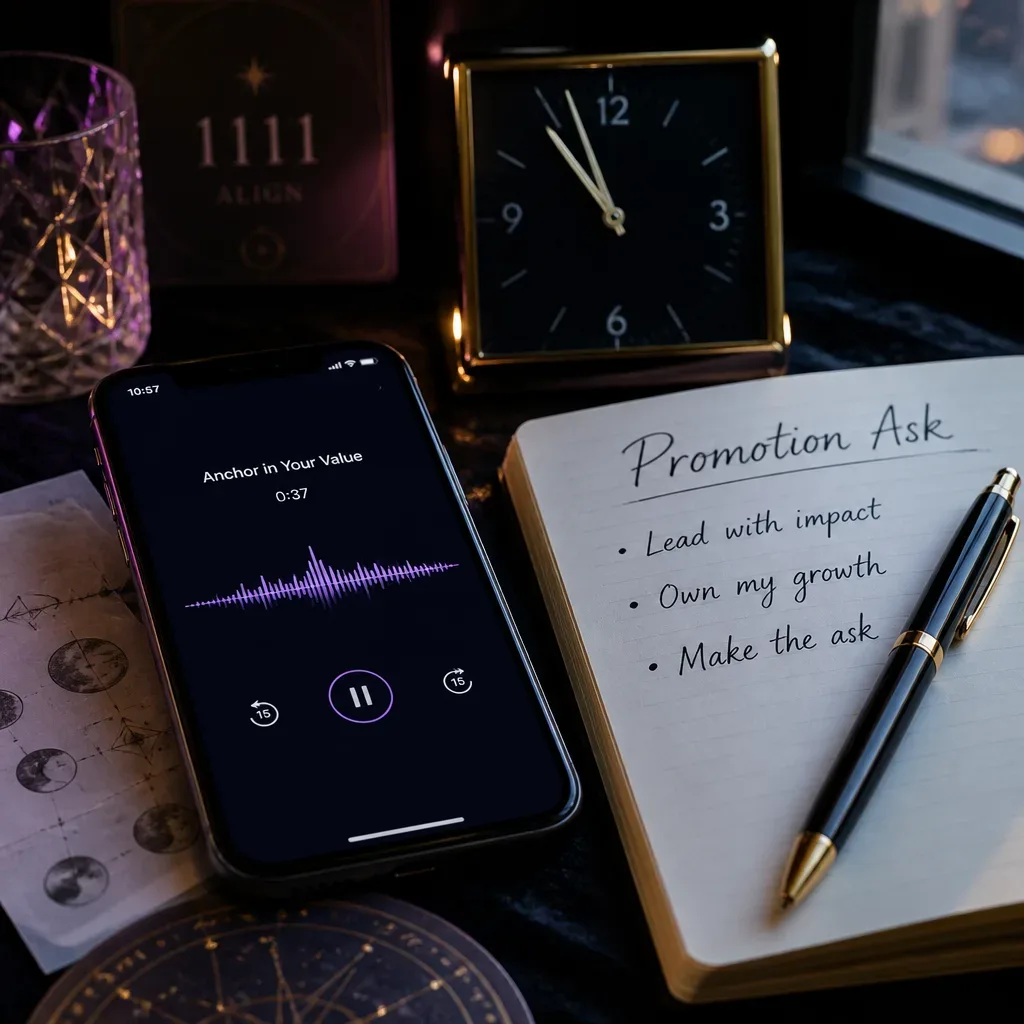
Manifest a Promotion With 3-Minute Audio Before Your 1:1
Manifest a promotion with a 3-minute audio practice before your 1:1, using identity rehearsal, clear evidence, and a calmer ask.

To manifest a promotion before your 1:1, use 3 minutes of personalized audio to rehearse the version of you already operating at the next level, then enter the meeting with one evidence sentence and one direct ask. The audio steadies your nervous system; the evidence gives the room somewhere concrete to land.
Why use audio before a promotion 1:1?
Audio works before a promotion 1:1 because it gives your future identity a voice before your manager gives the meeting a tone.
The hour matters. Not mystically, although 11:11 people will have their own notes. It matters because a 1:1 is a narrow gate. You may have 30 minutes on the calendar, but the promotion conversation often turns on 90 seconds: the moment you either name the ask or politely orbit it.
This is where the AYA Method becomes useful. The AYA Method is a daily audio manifestation practice. Each day you listen to a short personalized recording, your Dream-Self Moment, narrated from the version of you who has already manifested the life you intend. Listening is the practice. Repetition is the work. The audio is the method.
A 2023 Gallup workplace report found that managers account for about 70% of the variance in team engagement. Translation: your manager’s perception has gravity. You do not control it completely, but you can control the signal you bring into the room. Promotion asks die when they arrive foggy.
Audio also changes the pacing. Reading an affirmation can become a performance, especially for recovering perfectionists like me, the people who can make even a sticky note feel like an exam. Listening asks less. You press play, let the voice carry the state, and stop trying to manually adjust every emotion.
A promotion is not only a reward for work already done. It is a wager on the person you are becoming under more scope.
The point is not to hypnotize your manager through the conference room wall. The point is to stop meeting your own readiness as if it were suspicious.
What should the 3-minute promotion audio include?
The audio should include the role you are claiming, the evidence that supports it, and the calm body language of someone already carrying the scope.
Three minutes is enough because the brain does not need a TED Talk before a Tuesday 1:1. It needs a cue. Research on implementation intentions, popularized by psychologist Peter Gollwitzer, shows that specific if-then plans can improve goal follow-through across many studies. The same principle applies here: if I enter the meeting, then I name the promotion ask clearly.
Your audio should not be generic. “I am successful” may sound clean, but the room needs details. Your Dream-Self Moment should speak from a future date close enough to feel plausible: 30 days after the promotion conversation, or the first week in the expanded role.
Use this structure:
- Identity: “I speak as the person already trusted with this scope.”
- Evidence: “I can name the project, metric, or decision I owned.”
- Tone: “I do not rush, apologize, or decorate the ask.”
- Ask: “I say the role or level out loud.”
- Next step: “If the answer is not yes, I ask for the path.”
The daily affirmation and the Manifestation Board can support this, but they are not the spine. The spine is the audio. A single sentence written after listening is useful. A board with 14 images is optional. The dial does not need glitter to move.
For the broader theory behind this, the Manifestation pillar explains why identity, attention, and action have to sit in the same chair. A promotion conversation is exactly that chair.
| Audio element | Why it matters in a 1:1 | Example line |
|---|---|---|
| Role name | Makes the ask specific | “I am ready to move into Senior Product Manager.” |
| Measurable proof | Reduces abstraction | “I led the launch that raised activation by 12%.” |
| Regulated tone | Prevents over-explaining | “I can pause without filling the silence.” |
| Next step | Keeps a no from becoming fog | “What would need to be true by Q2?” |
Specificity is not less spiritual. Specificity is the signal dressed for work.
How do you do the 3-minute practice right before the meeting?
Do the practice by listening once, breathing normally, writing one evidence sentence, and entering the meeting without reopening the negotiation in your head.
Set a timer if you tend to turn preparation into a second job. I say this with affection and a Berlin kitchen table covered in old notebooks: more preparation is not always more readiness. Sometimes it is anxiety in a blazer.
Here is the 3-minute sequence:
- Minute 1: listen without fixing yourself. Put on the audio. Sit or stand. Let the first minute establish the future self as already present. Do not analyze whether you “believe it enough.” Belief is not a bouncer at the door.
- Minute 2: match the posture. Lower your shoulders. Let your voice drop half a register. Dr. Andrew Huberman has often discussed physiological sighs and breath as ways to downshift arousal; even 2 or 3 slow exhales can change the meeting you bring with you.
- Minute 3: write the sentence. One line only: “I’d like to discuss moving into X level because Y result shows Z scope.” That is the bridge between audio and action.
The sentence might read: “I’d like to discuss moving into Lead Designer because I’ve owned the checkout redesign, mentored two junior designers, and reduced handoff revisions by 18%.” Notice the absence of begging. Notice the lack of biography.
If you use Affirmations pillar work, keep it spare. One affirmation can follow the audio: “I can be clear without being harsh.” That is enough. Twelve lines may look devoted, but devotion is not the same as impact.
The strongest pre-meeting ritual is the one that leaves you more available to the actual conversation.
What do you say when asking for the promotion?
Say the promotion directly, attach it to evidence, and ask what decision process turns the conversation into a real path.
Many people sabotage the ask at the exact second the signal arrives. They say, “I was wondering if maybe we could talk about growth.” Growth is a houseplant. A promotion is a business decision. Name the level, title, scope, or compensation band you want discussed.
A useful script has 4 parts:
- Opening: “I’d like to use part of today’s 1:1 to discuss my path to Senior Analyst.”
- Evidence: “Over the last 2 quarters, I led the reporting migration and cut manual review time by 9 hours a week.”
- Scope: “I’m already operating across teams, not only inside my assigned lane.”
- Decision question: “What would need to happen for this promotion to be approved this cycle?”
LinkedIn’s 2024 workplace learning reporting has repeatedly pointed to career development as a major retention issue, and Gallup has found that employees who strongly agree someone encourages their development are more likely to be engaged. Your ask is not an interruption. It is part of the work.
If astrology is part of your timing language, use it as a mirror, not an alibi. A new moon can be a clean page. Mercury retrograde can remind you to review the evidence twice. The meeting still needs the sentence. For that angle, Astrology and manifestation is useful when timing feels symbolic but the calendar invite is very real.
The room does not need your entire history. The room needs the cleanest proof of your next level.
How does manifestation stay practical at work?
Manifestation stays practical at work when it changes your behavior, language, and attention before it asks reality to rearrange itself.
This matters because workplace manifestation can get slippery. If you treat the promotion as proof that the cosmos approves of you, every delay becomes a verdict on your worth. That is bad mysticism and worse management strategy. A promotion depends on budgets, headcount, calibration meetings, manager skill, and timing. In many companies, promotion cycles happen only 1 or 2 times a year. The gate may be real even when your readiness is real too.
Joe Dispenza writes and teaches often about rehearsing a future state until the body recognizes it. You do not have to accept every claim in his wider system to use one grounded piece: mental rehearsal can influence how you show up. Athletes have used visualization for decades; small studies in sport psychology suggest imagery can improve performance when paired with physical practice.
At work, the paired practice is evidence. Manifestation without evidence becomes theater. Evidence without identity can become timid. Put them together and the signal sharpens.
Use this quick check before the meeting:
- Do I know the title, level, or scope I am asking about?
- Can I name 1 to 3 results from the last 6 months?
- Can I connect those results to business value?
- Do I know who approves the promotion?
- Can I ask for the timeline if the answer is not yes?
For adjacent career and life-area practice, stay close to the Manifestation pillar, then make it concrete inside your calendar. The stars may mark the season. The meeting notes mark the next step.

What if your manager says not yet?
If your manager says not yet, treat the answer as data and ask for the promotion criteria in writing.
This is the moment where the practice proves itself. Anyone can sound centered when the answer is yes. The real gate is the no, the not yet, the “we need to see more.” Your nervous system may hear rejection. Your future self needs information.
Ask 3 questions before the meeting ends:
- “What specific scope or outcome is missing for this level?”
- “Who else is involved in the decision?”
- “Can we set a date to review progress against those criteria?”
These questions matter because vague feedback can keep you working harder without moving closer. A 2022 McKinsey report on talent noted that lack of career development was one reason employees left roles during the reshuffling years. People do not only leave bad jobs. They leave unclear rooms.
Write the answers down within 10 minutes of the meeting. Send a short recap the same day: “My understanding is that promotion readiness will be assessed against X, Y, and Z by May 15.” This is not aggressive. It is a witness. It keeps the dial visible.
Then return to the audio the next morning. Not to pretend the no did not happen. To keep your identity from collapsing into one person’s sentence. Neville Goddard’s work centered heavily on assumption, but assumption at work should not mean denial. It means you continue to inhabit the version of you who can receive data and still proceed.
A delayed yes still asks you to stay in the room.
How do you repeat this without turning it into pressure?
Repeat the practice daily during promotion season, but keep it small enough that it does not become another perfectionist costume.
I am suspicious of rituals that require a new notebook, a candle, 40 minutes, and a personality transplant. They often look beautiful for 5 days. Then real life arrives at 7:42, the coffee is burnt, Slack is already blinking, and the ritual becomes proof that you failed before breakfast.
Keep the promotion practice plain:
- 3 minutes of audio in the morning or before the 1:1
- 1 evidence sentence in your notes app
- 1 weekly review of results, numbers, and scope
- 1 direct conversation every cycle, not 6 indirect hints
The AYA Method works best here because it lowers the friction. Listening is repeatable. Repetition is the work. A 2020 review in the British Journal of Health Psychology found that habit formation depends strongly on stable cues and repetition, not heroic motivation. Three minutes before a recurring 1:1 is a stable cue. Use it.
You can add a daily affirmation if it helps you name the emotional edge: “I do not need to overperform to be taken seriously.” You can add a Manifestation Board if visual reminders keep the role in view. But do not confuse the complements with the method. The audio is the method.
Promotion seasons have their own numerology. Two quarters of proof. One manager. Three minutes before the room. Sometimes the master number is 11:11; sometimes it is the meeting invite that starts at 11 and ends at 11:30, asking whether you will finally say the sentence.
Say it cleanly. Let the signal arrive dressed as you.