money manifestation
Manifest a Raise With a 3-Minute Future-Self Audio
Manifest a raise with a short future-self audio before asking: calm your body, name your value, and speak clearly in the meeting.

Your phone is face down beside your notes. To manifest a raise, use a 3-minute future-self audio to hear yourself asking clearly, then bring evidence: your number, your results, and your timing. The audio steadies you. The salary case carries the meeting.
Why use a future-self audio before a raise conversation?
A future-self audio helps you rehearse the identity of someone who can ask without shrinking.
Money conversations are body conversations first. Your throat tightens. Your chest gets busy. You start softening the sentence before you’ve said it. That doesn’t mean you’re not ready. It means your nervous system has learned that asking for more can cost you belonging.
A short audio gives your brain a specific scene to return to. Research on mental practice has been studied for decades in sports and performance settings; one widely cited review by Driskell, Copper, and Moran in 1994 found that mental practice had a positive effect on performance, especially when the task was familiar and the rehearsal was specific. Salary negotiation is not a free throw. Still, specificity matters.
This is where the AYA Method comes in quietly. The AYA Method is a daily audio manifestation practice. Each day you listen to a short personalized recording — your Dream-Self Moment — narrated from the version of you who has already manifested the life you intend. Listening is the practice. Repetition is the work. The audio is the method.
A raise request asks you to speak from the self who is no longer waiting to be noticed. That self is not louder. She is cleaner. She knows the number. She knows the work. She can hear silence after her ask and not rush to take it back.
The raise begins before the meeting, in the moment you stop negotiating against yourself.
If you want the larger frame for this kind of practice, the Manifestation pillar explains how intention, repetition, and behavior belong in the same room. For the raise, the room is very practical. You need proof. You need language. You need three quiet minutes before you ask.
What should the 3-minute future-self audio say?
The audio should describe one finished scene: you asked for the raise, stayed steady, and left with a clear next step.
Keep it short because short is repeatable. Dr. Andrew Huberman has often discussed how the nervous system learns through repetition and state-dependent cues; even without treating one protocol as a cure-all, the point is useful here. A cue you can repeat in 3 minutes is more likely to happen than a 25-minute ritual you only do once.
Write it in the first person, present tense, as if the meeting has already happened. Not fantasy. Memory from the near future. You are not begging the future to come closer. You are practicing being the person who can meet it.
Use this structure:
- Name the moment. “I sent the meeting request. My hands were warm. My notes were simple.”
- Name the proof. “I spoke about the client renewal, the new reporting system, and the work I now own.”
- Name the ask. “I asked to move my salary to $82,000, beginning next quarter.”
- Name the pause. “I let the sentence stand. I didn’t explain over myself.”
- Name the next step. “We agreed on an answer date, and I left knowing I had represented myself well.”
In salary conversations, a number makes the practice honest. Pew Research Center reported in 2022 that 60% of workers who changed employers from April 2021 to March 2022 saw real earnings increase, compared with 47% of those who stayed. That doesn’t mean you must leave. It means pay often changes when people make movement visible. Your ask is one kind of movement.
A future-self audio doesn’t need perfect wording. It needs believable details. The chair. The document. The exact sentence. The breath after the ask.
A vague future comforts you for a minute. A specific future teaches you how to behave.
If affirmations help you keep the sentence clean, use them as a complement. The Affirmations pillar can help you choose words that don’t feel fake in your mouth.
How do you prepare the raise request before you listen?
Prepare the evidence first so the audio has something real to hold.
Manifestation without facts can become avoidance in soft clothes. You don’t need a 40-slide deck. You do need enough data to keep your voice from floating away. The U.S. Bureau of Labor Statistics publishes wage data by occupation, and sites like Payscale, Levels.fyi, and professional salary guides can give rough market anchors. Use at least 2 sources when you can, because salary websites can vary by sample size and industry.
Start with your current salary, your desired salary, and your strongest business case. If you don’t know the company’s compensation cycle, ask HR or a trusted manager when reviews happen. Timing matters. A 2023 Payscale report noted that many organizations still tie pay changes to annual review cycles, even when duties shift midyear.
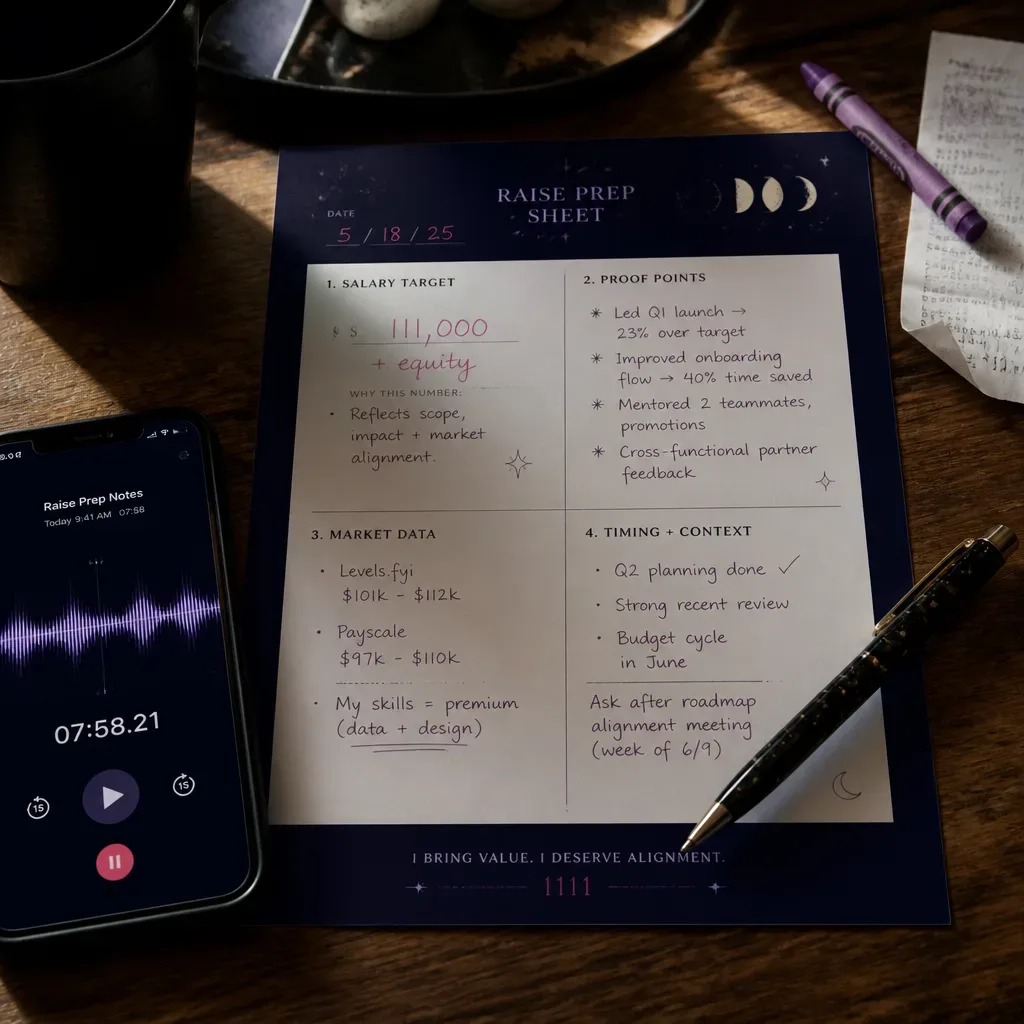
| What to prepare | Quiet question to answer | Example |
|---|---|---|
| Salary target | What number am I asking for? | “$82,000, or a 10% adjustment.” |
| Scope change | What do I own now that I didn’t own before? | “I now manage monthly client reporting.” |
| Results | What changed because of my work? | “Renewal risk dropped across 3 accounts.” |
| Market data | What does the role pay elsewhere? | “Two salary sources show $78,000–$88,000.” |
| Timing | When should the change begin? | “At the start of Q4.” |
A good raise request is not a confession of need. It is a business sentence with receipts.
You can also write a one-page note for yourself. Not to read like a script. To keep your mind from scattering. In a 2015 study published in the Journal of Behavioral Medicine, implementation intentions, or “if-then” plans, were associated with better goal follow-through across health behaviors. Work conversations differ, but the mechanism is useful. “If I get nervous, then I look at my first proof point.” Small plan. Less drift.
How do you listen without turning it into pressure?
Listen once with your body included, not as a test you can pass or fail.
Before you press play, sit like someone who doesn’t have to perform calm. Feet on the floor. Jaw loose. Phone in your hand or beside you. If you have 3 minutes, take all 3. If you only have 90 seconds, listen to the part with the ask and the pause.
This matters because stress changes speech. The American Psychological Association has reported for years that money is one of the most common sources of stress for adults in the United States; in its 2023 Stress in America report, 82% of adults said money was a significant source of stress. A raise request can carry rent, childcare, debt, and old family stories into one small meeting room.
Don’t use the audio to force certainty. Use it to return to the version of you who can be kind and exact at the same time. If your heart races, let it race. If your mind says, “Who do you think you are,” answer with your notes.
Try this before the meeting:
- Listen with both feet touching the floor.
- Put one hand on the page with your salary target.
- Let the future-self voice finish before you edit anything.
- After the audio ends, say the ask once out loud.
- Stop practicing before you become frantic.
Calm is not the price of asking. Clarity is enough.
If you like timing your practice with lunar or seasonal cues, keep it simple. Use the cue as a reminder, not as permission. Astrology and manifestation can be a soft calendar for reflection, but your raise request still belongs in your calendar invite, your proof points, and your voice.
What do you say when you ask for the raise?
Say the number early, connect it to results, and stop talking after the ask.
The meeting can be kind. It can also be brief. Many people lose the thread because they explain the whole emotional history of being underpaid. You may have one. It may be true. It still doesn’t need to lead. Lead with value.
Here is a simple script:
“Thank you for meeting with me. I wanted to discuss my compensation based on how my role has grown and the results from the last 6 months. I now own monthly reporting, I helped retain 3 at-risk accounts, and I trained the new coordinator. Based on that scope and market data for this role, I’d like to adjust my salary to $82,000 beginning next quarter.”
Then pause.
Negotiation researchers Linda Babcock and Sara Laschever helped bring public attention to gender differences in asking in Women Don’t Ask in 2003. The work has been debated and expanded since then, but one point stays useful: many people, especially women, are socialized to wait for recognition instead of naming terms. You are allowed to name terms.
If your manager asks for time, ask for a date. If they say the budget is tight, ask what is possible now and what must be true for the rest. If they say your work isn’t at the level yet, ask which 2 or 3 measurable outcomes would change that assessment.
Use these sentence stems:
- “What timeline can you commit to for a decision?”
- “What range is available for this role at my current scope?”
- “If the full amount isn’t possible now, what partial adjustment is possible?”
- “What specific outcomes would make this raise possible by the next review?”
A raise conversation is successful when it replaces fog with terms.
For more money-specific framing, save money manifestation for after the meeting, when you’re deciding what to practice next.
What if your body gets loud right before the meeting?
Treat the body noise as a signal to simplify, not a reason to cancel yourself.
Right before asking, your body may act like you’re doing something unsafe. Sweaty palms. Shallow breath. Sudden need to check email. This is ordinary. The National Institute of Mental Health estimates that about 31.1% of U.S. adults have an anxiety disorder at some point in their lives. Even without a diagnosis, high-stakes conversations can bring anxiety symptoms forward.
Use a 60-second reset after the audio. Not to become blank. To come back.
- Inhale through the nose for 4 counts.
- Exhale slowly for 6 counts.
- Look at the salary target.
- Read your 3 proof points.
- Say, “I can ask while my body is loud.”
Dr. Andrew Huberman has popularized the “physiological sigh,” a double inhale followed by a long exhale, based on respiratory physiology research. You don’t need to make it sacred. You can use one or two slow exhales to reduce the feeling that the meeting is a threat.

If tears come easily for you, plan for that too. Keep water nearby. Slow down. You don’t have to apologize for having a body. You can say, “I care about this conversation, so I’m going to take a moment and continue.” That sentence is allowed.
Your nervous system can be loud and your request can still be clean.
If the meeting is virtual, place your proof points just below the camera. If it’s in person, bring one printed page. Specific objects help. A page can hold the thread when your mind wants to run.
How do you keep practicing after the answer?
After the answer, keep the audio tied to self-respect, not to one person’s yes.
If the answer is yes, receive it without immediately promising more labor. Ask when the change will appear in writing. Ask whether title, bonus, or scope should be updated too. A raise that lives only in a nice conversation is not finished. It needs documentation.
If the answer is not yet, get terms. A 2022 Pew analysis found that workers who changed jobs during a tight labor market were more likely to see wage growth than those who stayed. Again, this is not advice to leave tomorrow. It is a reminder: your employer is one path, not the whole map. If the internal path stays vague, your practice may need to include applying elsewhere.
Revise the audio after the meeting. Your future self may now sound different. Maybe she says, “I asked, and I didn’t disappear.” Maybe she says, “I got the timeline in writing.” Maybe she says, “I saw the answer clearly, and I began looking for a role that paid the truth of my work.”
You can keep the practice small:
- Listen each morning for 3 minutes for 7 days.
- Track one visible action after each listen.
- Update your proof page every Friday.
- Send one follow-up when promised dates pass.
- Stop using the audio to wait. Use it to move.
The daily affirmation and Manifestation Board can support the practice if they help you remember the sentence. They are complements. The audio remains the method.
Your raise is not a spell. It is a meeting between your work, your words, your timing, and the self who no longer hides the number.
Stay with the number that feels true.