money manifestation
Money Manifestation in Debt: A 3-Minute Audio Reset
Use money manifestation in debt without denial: a 3-minute audio reset for calming your body, naming the number, and choosing one next step.

The bill is on the table. Your chest is tight. Money manifestation in debt means using a short audio practice to face the number without pretending it isn’t real, calm your body, hear your future self clearly, and take one practical step today.
What does money manifestation in debt actually mean?
Money manifestation in debt means practicing future-self attention while staying financially honest.
Debt asks for numbers. Manifestation asks for identity. The work is not to choose one and abandon the other. It is to let the number be a number, then listen for the self who can meet it. In the United States, the Federal Reserve Bank of New York reported household debt above $17 trillion in 2024. That number matters because debt is common, but shame makes it feel private.
Debt is a number, not a name.
When you practice Manifestation from inside debt, you are not saying the balance is beautiful. You are saying your fear does not get to write the whole story. The Consumer Financial Protection Bureau has reported that many people avoid financial tasks when they feel confused or ashamed. Avoidance is not a character flaw. It is a nervous system strategy that became too expensive.
This is why the audio matters. The AYA Method is a daily audio manifestation practice. Each day you listen to a short personalized recording — your Dream-Self Moment — narrated from the version of you who has already manifested the life you intend. Listening is the practice. Repetition is the work. The audio is the method.
The daily affirmation and Manifestation Board can help you remember what is true. They are complements. They are not the center. When money feels charged, sound reaches you before strategy does. A 2022 American Psychological Association survey found that money was a significant source of stress for a majority of U.S. adults. You may know what to do and still not be able to begin. That is where a 3-minute reset becomes useful.
| Debt thought | Audio reset response |
|---|---|
| I’ve ruined everything. | I can tell the truth in one small piece. |
| I can’t look at it. | I can look for three minutes. |
| I should be further along. | I’m here now, and here is workable. |
| Nothing will change. | One repeated action can change the next hour. |
Why does debt make manifestation feel unsafe?
Debt makes manifestation feel unsafe because the body often reads money pressure as threat before the mind can reason with it.
A late notice is paper. Still, your pulse can rise. Your stomach can drop. Dr. Andrew Huberman has often described stress as a shift in physiology before it becomes a thought you can edit. That does not mean every money practice needs a lab coat. It means your body deserves to be included.
When you say an impossible sentence, your body may refuse it. I am rich can feel like a costume when the rent is overdue. A gentler sentence may be truer: I can make one honest call. Research in the Journal of Behavioral Medicine has linked self-affirmation practices with reduced stress responses in some settings. The key is not grandeur. The key is believability.
The nervous system trusts what it can repeat.
This is also where debt shame gets loud. Pew Research has reported that many households carry credit card balances at least sometimes, and the Federal Reserve has found that a meaningful share of adults would struggle with a $400 emergency expense. You are not an exception to ordinary human pressure. You are a person under pressure.
Try naming the feeling before naming the plan:
- Fear: the body preparing for loss.
- Shame: the self trying to hide.
- Anger: the part of you that knows this has cost too much.
- Numbness: the system asking for less input.
- Relief: the small signal that truth is survivable.
Manifestation does not require you to be cheerful about debt. It asks you to rehearse the self who can stay. That is different. Neville Goddard wrote often about the feeling of the wish fulfilled, but the useful part here is not fantasy. It is state. What state would help you open the app, answer the email, or sit with the spreadsheet for 10 minutes?
A softer state is not a smaller life.
How do you do the 3-minute audio reset?
You do the reset by pairing one visible debt detail with three minutes of body settling, audio listening, and one next action.
Set a timer for 3 minutes. Not 30. Not the whole afternoon. Small time works because it lowers the threshold. Stanford behavioral scientist BJ Fogg has written for years about tiny habits: when the action is small enough, repetition becomes more likely. Three minutes is not a cure. It is a door you can open.
Here is the reset:
- Choose one number for 20 seconds. Open one balance, one payment due, or one note. Do not open five tabs. Do not punish yourself with the full archive.
- Breathe for 30 seconds. Feet on the floor. Longer exhale. Jaw soft. If you can, place one hand on your chest.
- Listen for 2 minutes. Play your Dream-Self Moment. Let the future-self voice speak from steadiness, not denial.
- Write one sentence for 20 seconds. Make it believable. I can respond to one thing.
- Take one action after the timer. Pay $5, schedule a call, set a reminder, or write the date you’ll return.
The order matters. If you act while flooded, you may avoid, overspend, or make a plan too harsh to keep. If you listen first, you give the body a different cue. In small studies, brief breathing and mindfulness practices have shown reductions in acute stress markers. You do not need to become a different person before you begin. You need a repeatable entrance.

Use this reset when the debt thought arrives in the body. At the sink. Before opening your banking app. After a collection letter. Before bed, when the ceiling becomes a screen for every unpaid thing. The practice is portable because the audio is portable. That is the mercy of it.
For more language that does not fight your body, the Affirmations guide can help you choose sentences that are firm without becoming false.
What should your Dream-Self Moment say about money?
Your Dream-Self Moment should speak from a future where you handle money with steadiness, truth, and ordinary care.
Do not make the audio perform wealth. Make it speak safety and competence. The version of you who is no longer ruled by debt may not sound glamorous. She may sound rested. She may say: I answer the first email. I keep my promise to myself. I know the balance. I choose the next right payment. I let help reach me.
The future self does not have to be dramatic to be real.
Joe Dispenza often frames rehearsal as a way the brain and body begin to recognize a new state. You do not have to adopt every claim from any teacher to use the simple idea: repeated mental rehearsal can change what feels familiar. Sports psychology has used mental imagery for decades, with reviews showing benefits when imagery is paired with physical practice. For debt, the physical practice is the call, the payment, the boundary, the budget.
A strong money audio may include 4 parts:
- Recognition: You say the number without flinching.
- Regulation: You feel your body stay present.
- Identity: You hear yourself as someone who follows through.
- Action: You name the next small money behavior.
Here is a sample script shape, not a script you have to copy:
I’m looking at the number now. I’m not disappearing. I’ve learned to answer money with calm hands. I make the next payment I can make. I ask for help when help is wise. I do not confuse debt with my worth.
Keep it close to your real life. If you earn hourly wages, let the audio know that. If you are rebuilding after burnout, let it know that too. Talia, before coffee, would write the sentence on the back of an envelope: I am allowed to come back slowly and still come back. One sentence can be enough for a morning.
How do affirmations and a Manifestation Board help without becoming the method?
Affirmations and a Manifestation Board help when they support the audio practice rather than replacing it.
Think of them as small reminders around the core. The audio is the method because listening changes the room inside you. A daily affirmation can give you one line to carry after the reset. A Manifestation Board can give your eyes a gentle cue for where you are practicing toward. But neither one should become another task you use to measure your worth.
The Astrology and manifestation piece may be useful if timing matters to you. Some people like to mark a new moon, a payday, or the first day of the month as a return point. The date can hold the practice, but it does not do the work for you. Repetition does.
Choose an affirmation that your body can accept. Self-affirmation theory, first developed by Claude Steele in the 1980s, suggests that reflecting on values can protect the self under threat. That is why values-based money lines can be more helpful than grand claims. Try these:
- I can face one number today.
- I’m still worthy while I repay.
- I can ask before it gets worse.
- I keep one promise to myself.
- I let the truth be smaller than the fear.
A Manifestation Board for debt should be quiet and practical. Not only images of a new apartment or clean kitchen, though those may matter. Add a screenshot of a calendar reminder. A photo of your desk cleared enough to pay bills. A note that says Call by Tuesday. The image should return you to action.
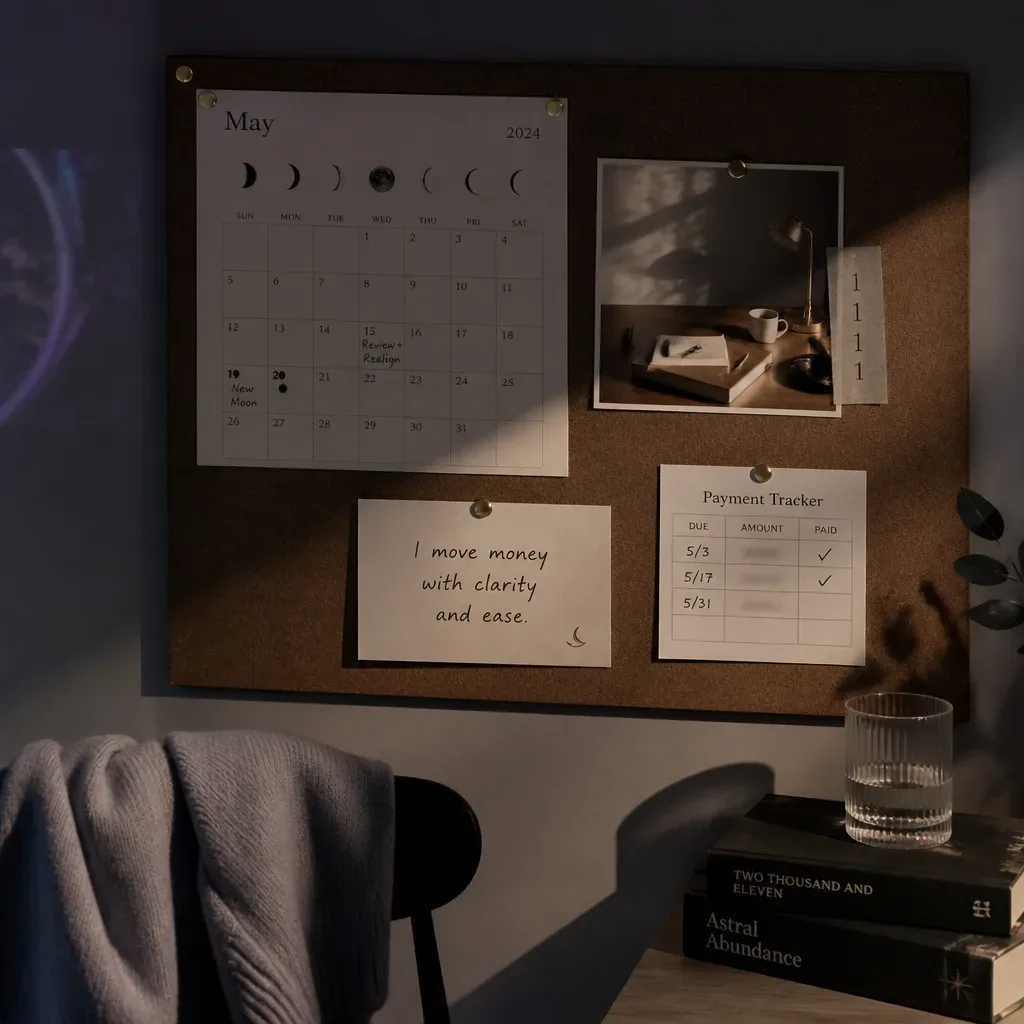
A vision without a next step can become another place to hide.
If you want the larger frame, read the money pieces inside Manifestation and return to the audio after. Reading can prepare you. Listening is where the practice enters the body.
What do you do after the audio ends?
After the audio ends, you take one small financial action before your fear starts negotiating.
The action should be so clear that you can finish it in 2 to 10 minutes. A 2023 report from the Financial Health Network found that many Americans were not financially healthy across spending, saving, borrowing, and planning indicators. That does not mean every action must fix every category. It means small acts count because financial repair is often built in sequences.
Choose one of these after-audio actions:
- Pay the minimum on one account.
- Move $1 to savings, only to prove you can begin.
- Email a lender and ask about hardship options.
- Call a nonprofit credit counseling agency.
- Put the due date in your calendar with two reminders.
- Cancel one subscription you no longer use.
- Write down the exact total of one debt category.
The point is not the size. The point is contact.
Behavioral change research often returns to feedback loops: cue, action, reward. Your cue is the debt thought. Your action is the audio reset plus one money step. Your reward must be felt. Not shopping. Not punishment. A hand on the heart. A check mark. Tea. A walk around the block. Let the body know you survived the number.
If you miss a day, do not turn the practice into another debt. Return the next time the thought appears. The Affirmations page can help you find a repair sentence for missed days: I return without making the gap mean failure.
This is also where you protect yourself from magical thinking. The audio does not pay the bill. It helps you become the person who can look, decide, ask, earn, refuse, repay, and rest. That is not small.
When should you get financial help too?
You should get financial help when debt is affecting safety, housing, food, legal standing, or your ability to make minimum payments.
Manifestation can help you stay present. It should never keep you alone. If you are receiving court papers, wage garnishment notices, eviction threats, or repeated collection calls, contact qualified support. In the U.S., the National Foundation for Credit Counseling connects people with nonprofit credit counselors. If you are elsewhere, look for regulated debt advice, legal aid, or a consumer protection agency.
The Federal Trade Commission warns about debt relief companies that charge high upfront fees or promise results they cannot guarantee. Be careful with anyone who uses urgency to take your money. A steady helper will explain costs, risks, timelines, and your right to say no. A real plan can feel plain. Plain is often good.
Use this quick check:
| If this is true | Consider this support |
|---|---|
| You can pay but feel avoidant | 3-minute reset plus calendar reminders |
| You’re missing minimum payments | Nonprofit credit counseling |
| You’ve been sued or threatened | Legal aid or consumer attorney |
| Debt is tied to trauma or compulsive spending | Financial therapist or licensed therapist |
| Income does not cover basics | Benefits screening, local aid, budgeting support |
There is no shame in adding skill to hope.
If you use the AYA Method during this season, let the Dream-Self Moment include help. Hear the future version of you say: I asked before it collapsed. I answered the letter. I let someone sit beside me with the numbers. The self you are practicing toward is not isolated. She is resourced. She is honest. She is still yours.
The number can wait while you come home to your own voice.