aya method deep dive
Manifestation Intake: 28 Steps to Dream-Self Audio
A manifestation intake turns one desire into clear details for Dream-Self audio. Use this 28-step guide to name, refine, and record what feels true.

A manifestation intake is the quiet set of questions that turns desire into Dream-Self audio. You name what you want, locate the truth beneath it, shape it into present-tense language, and use it as the source for the daily recording you will listen to again and again.
What is a manifestation intake really doing?
A manifestation intake gathers the raw desire and makes it specific enough to become audio.
It is not a quiz you pass. It is closer to standing at the counter before cooking for someone you love. You take out the salt, the onions, the bowl. You look at what is actually here. A desire becomes usable when you stop decorating it and start measuring it. Intake is where a desire stops performing and starts telling the truth.
In the AYA Method, the wording matters because the audio is the practice. The AYA Method is a daily audio manifestation practice. Each day you listen to a short personalized recording — your Dream-Self Moment — narrated from the version of you who has already manifested the life you intend. Listening is the practice. Repetition is the work. The audio is the method.
A good manifestation intake asks for 3 kinds of clarity: the desire, the lived scene, and the voice. The desire tells the practice where to look. The lived scene gives the mind something concrete. The voice makes it personal enough to return to daily. Research on mental imagery often separates vague wishing from sensory simulation; in a 2016 review in Current Directions in Psychological Science, imagery was described as more emotionally active than verbal thought alone.
This is why a sentence like I want to feel safe with money is only the beginning. The intake asks what safety looks like at 8:12 on a Tuesday. It asks what bill you open without tightening your jaw. It asks what your shoulders do. The audio can only carry what the intake is brave enough to say.
Why are there 28 steps instead of one big question?
There are 28 steps because desire usually tells the truth in layers, not all at once.
One big question can make you perform. Twenty-eight small questions let you stay near the real thing. In behavior research, specificity matters. Peter Gollwitzer’s work on implementation intentions, including a 2006 meta-analysis with Paschal Sheeran covering 94 studies, found that if-then plans reliably improved goal follow-through compared with broad intention alone. A manifestation intake is not an if-then plan, but it respects the same human fact: the mind works better with cues it can recognize.
The number 28 also gives the intake a shape. Four weeks have 28 days. The lunar cycle is about 29.5 days. Many people already understand a month as a container for becoming used to something. You are not trying to force a result in 28 days. You are giving your attention enough rooms to walk through before it speaks.
| Intake phase | Steps | What it clarifies |
|---|---|---|
| Desire | 1 to 5 | What you want and why now |
| Truth | 6 to 9 | What is already present and what interrupts it |
| Scene | 10 to 16 | How the fulfilled desire lives in ordinary detail |
| Voice | 17 to 23 | How the Dream-Self Moment should sound |
| Complements | 24 to 28 | How affirmation, image, and audio support each other |
The intake is not meant to make you certain about everything. It is meant to make you honest about one thing. Pew Research Center reported in 2023 that 70% of U.S. adults describe themselves as spiritual in at least some way, which means many people are already trying to name inner life without always having clean language for it. The 28 steps give language without making the mystery too loud.
What should you prepare before you begin?
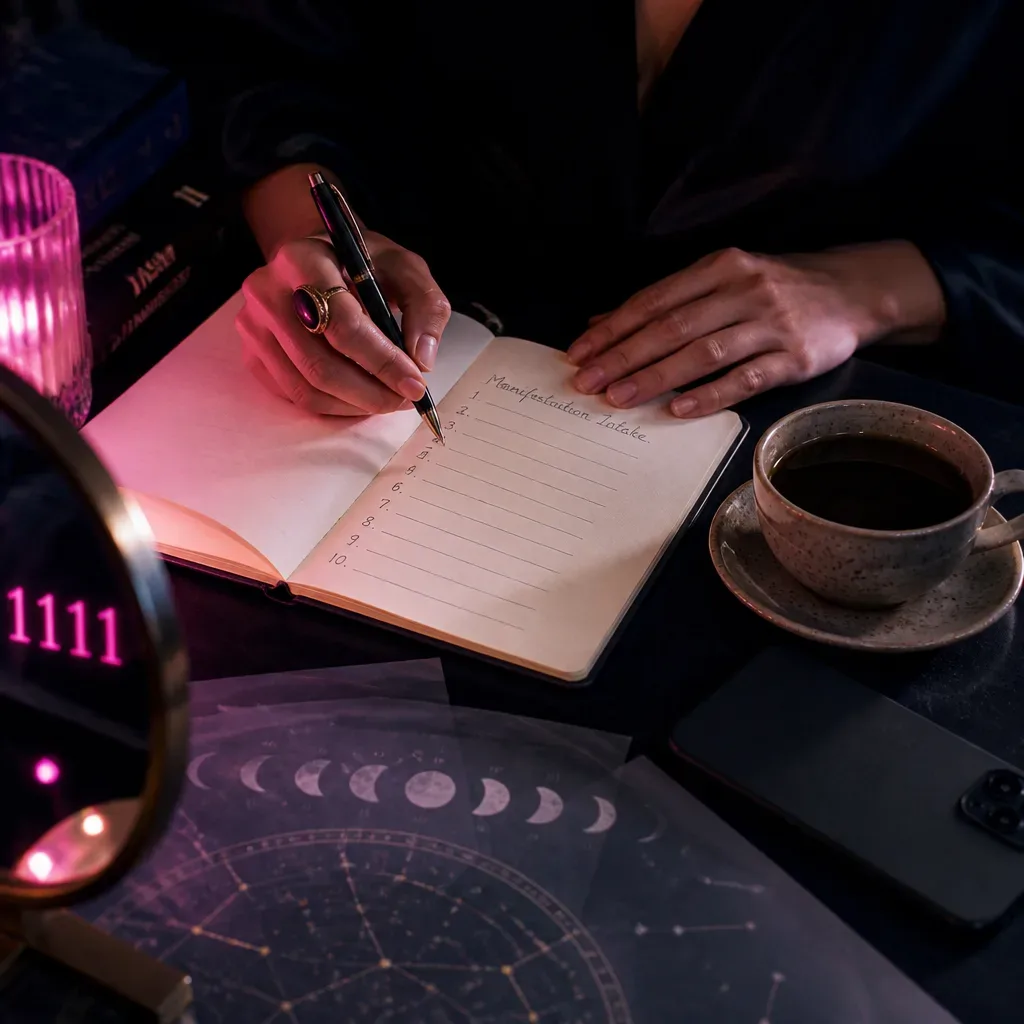
You should prepare one desire, 35 quiet minutes, and a place where your body can settle.
That may be a table. A parked car. The edge of your bed. I like a kitchen table because kitchens understand wanting. They know what it means to wait for dough, to rinse rice 3 times, to feed someone before the words are ready. You do not need candles or ceremony. You need enough quiet to hear when a sentence is false.
Before you begin, choose one desire. Not 7. Not the full architecture of your life. One. A 2009 study by Phillippa Lally and colleagues in the European Journal of Social Psychology found that habit automaticity took a median of 66 days, with wide variation from 18 to 254 days. That range is a mercy. It reminds you that repetition is personal. One clear audio is easier to repeat than 12 competing ones.
You may want these simple materials:
- A notebook or notes app
- A glass of water
- Headphones, if you are creating audio soon after
- 35 minutes without switching tasks
- One object that feels like home to you
If you use astrology as a timing language, keep it gentle. You can read more about astrology and manifestation, but do not let a transit become another way to delay truth. The intake works on an ordinary Wednesday. It works before laundry. It works when the moon is not dramatic. The self you are listening for is not far away.
What are the 28 steps from desire to Dream-Self audio?
The 28 steps move from plain desire to a clear direction for the Dream-Self Moment.
Use this list slowly. If one step brings up a lot, stay there for 2 minutes before moving on. James Pennebaker’s expressive writing research often used sessions of about 15 to 20 minutes, and later studies found that structured writing can help people organize emotion. This intake is not therapy, and it does not replace care. It is structured listening.
- Name one desire.
- Write the plain version in one sentence.
- Name the deeper want beneath it.
- Choose the life area it belongs to.
- Describe why it matters now.
- List what is already true.
- Name the friction that keeps repeating.
- Write the old sentence you are tired of carrying.
- Write the new sentence that feels more honest.
- Describe one future morning.
- Describe your future body in that morning.
- Describe the room around you.
- Name one relationship that has softened or clarified.
- Name one choice you now make easily.
- Name one boundary that protects the desire.
- Name one devotion that feeds it.
- Choose 3 words for the emotional tone.
- Let the narrator speak from the already-lived place.
- Change future tense into present-tense detail.
- Remove language that sounds like proving.
- Add one sensory anchor.
- Add one ordinary action.
- Name the evidence you will notice within 7 days.
- Write one daily affirmation as a complement.
- Choose one Manifestation Board image as a complement.
- Read the whole intake aloud.
- Soften any wording that sounds unlike you.
- Save the direction for your Dream-Self audio.
Notice the order. You do not start with the affirmation. You do not start with the image. The daily affirmation and Manifestation Board can help, and affirmations can be a clean way to rehearse one true sentence. But here, they support the audio. They are not the pillars. Listening is the center.
How does the intake become a Dream-Self Moment?
The intake becomes a Dream-Self Moment when its clearest details are spoken from the version of you who already lives them.
This is the turn. You stop writing about the desire from outside it. You speak from inside the fulfilled life. Neville Goddard wrote often about assuming the feeling of the wish fulfilled, including in Feeling Is the Secret in 1944. You do not have to agree with every old metaphysical claim to understand the usefulness of the stance. The voice changes when it is no longer begging.
A Dream-Self Moment needs 4 ingredients from the intake. First, the desire in plain language. Second, a normal scene that proves it has landed. Third, a sensory anchor the body can recognize. Fourth, a sentence of self-recognition. Not a slogan. A sentence that sounds like it could come from your own kitchen at night.
Here is a simple before-and-after:
| Intake note | Audio direction |
|---|---|
| I want steadier money | You open the banking app and breathe normally |
| I want love that feels calm | Your phone lights up and your body does not brace |
| I want to write again | You sit down for 20 minutes before checking messages |
| I want a home of my own | Your key turns in the lock and the room is yours |
The audio should not flatter you. It should recognize you. Dr. Andrew Huberman has often discussed the role of repeated cues and nervous system state in learning; the specific claim changes by study, but the practical point is steady: repetition works better when the cue is clear. A Dream-Self Moment is a cue you return to each day.
For a wider foundation, the manifestation guide explains the broader practice. The intake is narrower. It is the place where broad wanting becomes one listenable scene. A desire that can be heard daily has already become less abstract.
How do you answer without overthinking every line?
You answer without overthinking by choosing the truest available sentence, then letting the audio carry it for a while.
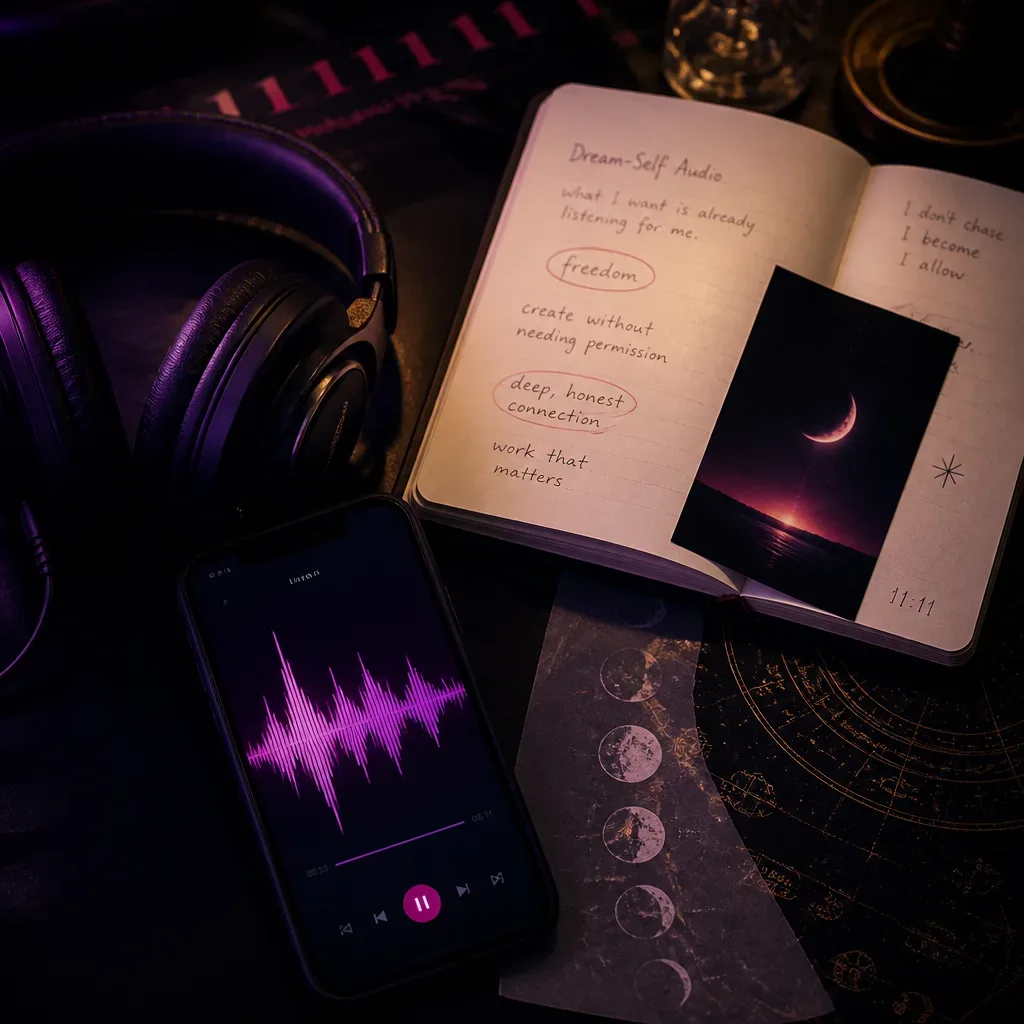
There will be a moment when you want to improve every word. That is usually fear dressed as taste. Give yourself a rule: each answer can be 1 to 3 sentences. No answer needs to be beautiful. The purpose is not literature. The purpose is recognition. If your body softens when you read it back, keep it.
In small studies on self-affirmation, such as work by David Creswell and colleagues published in the mid-2000s and 2010s, values-based reflection has been linked with lower stress responses under pressure. That does not mean every affirmation changes a life. It means language can affect state, especially when it is tied to what someone truly values. Your intake should sound like value, not performance.
Try this 5-minute repair if you get stuck:
- Read the question aloud once.
- Write the first honest answer, even if it is plain.
- Circle the 1 word that feels most alive.
- Add one sensory detail.
- Stop before you start decorating it.
The same is true for the visual complement. A Manifestation Board can be useful when it gives the eye a place to rest. It should not compete with the audio. If you use one image, choose something exact: a blue mug on your desk, a passport in a drawer, a linen shirt drying by a window. The smaller the image, the easier it is to believe.
When should you redo your manifestation intake?
You should redo your manifestation intake when the desire has changed, not when you are simply restless.
Restlessness often appears around day 3, day 7, and day 14. That is normal. Many meditation and habit apps report steep drop-off after the first week, and public app-retention benchmarks often show fewer than 25% of users returning to a typical app after day 30. Your task is not to chase novelty. Your task is to listen long enough for the words to become familiar.
Redo the intake if one of these is true:
- The desire no longer feels honest.
- A real-life change has made the old scene inaccurate.
- The audio contains a sentence your body rejects every time.
- You have received the thing and now need a new Dream-Self Moment.
- The desire was too broad and needs to become one clear thread.
Do not redo it because the first listen did not move you. Some truths arrive quietly. The Princeton Global Consciousness Project has logged more than 500 events since 1998 in its controversial study of random number generators and collective attention; it is not proof of manifestation, and it should be read carefully. Still, it points to an old human instinct: attention matters to us. In this practice, your attention becomes daily and personal.
If you want a rhythm, keep one intake for at least 28 days unless it feels clearly false. Then review it. Mark what became easier to believe. Mark what still feels distant. You are allowed to revise. You are also allowed to stay.
What makes the intake feel true enough to use?
An intake feels true enough when the final audio direction sounds like someone you could become by returning daily.
True enough is different from certain. Certainty may not come at the beginning. You are listening for a quieter signal: the sentence you do not want to rush past. Joe Dispenza often speaks about rehearsing a future state before outer proof arrives; you do not need to adopt every framework to use one grounded idea. Rehearsal changes what the mind notices.
Before you save the intake, read these 4 checks:
- Does the desire fit into one sentence?
- Is there at least one ordinary scene?
- Is there one sensory detail your body recognizes?
- Does the voice sound kind, steady, and already at home?
If all 4 are present, the intake is ready. It does not need more shine. It needs repetition. A 2018 review in Nature Reviews Neuroscience described memory as active and reconstructive, not a fixed recording. That is why daily listening matters. You are not forcing belief in one dramatic sitting. You are giving the mind a repeated, recognizable pattern.
Keep the daily affirmation short if you use it. Keep the Manifestation Board simple if you use it. Let them point back to the Dream-Self Moment. The audio is where the desire becomes a voice you can meet each morning, or at night, or in the small room between errands.
Your future self speaks softly first.