money manifestation
Money Mindset Shift: 3-Minute Audio Before Banking
A quiet money mindset shift for the moment before you check your bank: listen to a 3-minute future-self audio, steady your body, then look.

Your thumb hovers over the banking app. The money mindset shift is simple: listen before you look. A 3-minute future-self audio gives your nervous system a steadier opening, so the bank balance becomes information, not a verdict. You still face the number. You just don’t abandon yourself first.
What is a money mindset shift before banking?
A money mindset shift before banking is the choice to meet the number from steadiness instead of shame.
It begins before the password. That matters. The American Psychological Association reported in its 2023 Stress in America data that money was a significant source of stress for 63% of adults. For many of us, checking a balance is not a neutral task. It can feel like opening a small door into every old story: I should be further along. I ruined it. I can’t be trusted.
A shift does not mean you decide the number is secretly fine. It means you stop treating the number as a moral score. The Federal Reserve’s 2023 Survey of Household Economics and Decisionmaking found that 63% of adults could cover a $400 emergency with cash or its equivalent, which also means a large minority could not. Financial strain is common. Shame makes it lonelier.
In manifestation, the inner state matters because it shapes what you notice, tolerate, repeat, and choose. Not by magic. By attention. If you open the bank app already braced for punishment, you may miss the plain next step. If you open it from a more stable place, you can see the same number with more options.
A bank balance is data. It is not a name for you.
This practice is small on purpose. Three minutes. One listen. One check. One next action. Small is not lesser. Small is how a frightened body learns that money can be met without collapse.
Why listen before looking at the numbers?
Listening first gives your mind a kinder script before panic supplies the loudest one.
Sound enters quickly. A voice can become a cue, and cues matter in habit research. Psychologist Peter Gollwitzer’s work on implementation intentions, first summarized in 1999, showed that specific if-then plans improve follow-through across many settings. If I am about to check my bank, then I listen first. The simplicity is the point.
The AYA Method is a daily audio manifestation practice. Each day you listen to a short personalized recording — your Dream-Self Moment — narrated from the version of you who has already manifested the life you intend. Listening is the practice. Repetition is the work. The audio is the method.
The bank app can pull you into a very old kind of time. Past mistakes. Future bills. The audio returns you to now. Dr. Andrew Huberman often describes the practical value of breathing and attention cues for shifting alertness; clinical breathing research says something similar in quieter terms. A 2017 review in Frontiers in Human Neuroscience linked slow breathing practices with changes in emotional control and autonomic function.
| Before the audio | After the audio |
|---|---|
| You open the app from dread. | You open the app from a chosen state. |
| The number feels like a verdict. | The number becomes information. |
| You refresh, compare, spiral. | You look once and choose one step. |
| Shame leads the next action. | Care leads the next action. |
This is not denial. It is preparation. Athletes rehearse before performance. Musicians tune before playing. You can tune before meeting money.

How do you do the 3-minute practice?
You do it by making the moment so clear that fear has fewer places to hide.
Set the rule before you need it. The rule is not I will never be scared. The rule is: before I check money, I listen for three minutes. According to PwC’s 2023 Employee Financial Wellness Survey, 57% of employees named finances as the top cause of stress in their lives. A rule helps because stress makes improvising harder.
Try it this way:
- Put the phone face down for ten seconds. Let your hands rest. Feel the table, the blanket, the edge of the sofa. Ten seconds is enough to mark a threshold.
- Play the 3-minute audio. Use a Dream-Self Moment or another future-self recording that speaks in your own language. Not grand. Not perfect. True.
- Breathe through one full sentence. Choose a line you can believe at least 51%: I can look without leaving myself.
- Open the bank app once. Look at the balance, the pending charge, or the bill date you came to see. Do not wander.
- Write one useful fact. For example: Rent clears Friday. Card payment due on the 14th. Grocery money left: 62.
- Take one next action. Pay, schedule, transfer, ask, cancel, or wait on purpose.
- Close the app. The closing is part of the practice.
There is a difference between checking and circling. Checking gives you information. Circling keeps asking the same number to become a different number. If you tend to reopen the app, set a timer for 180 seconds of audio and 60 seconds of banking. Four minutes total is still less than most fear loops.
Your daily affirmation can help here, but it is a complement. The audio remains the method. If you use an affirmation, keep it plain. The affirmations that hold up best are not sugary. They are believable enough to repeat when your shoulders are tight.
The practice is not to feel rich. The practice is to stop making fear the treasurer of your life.
What should your money audio say?
Your money audio should sound like your future self being specific, calm, and honest.
A good script does not scold you into discipline. It speaks from the version of you who already knows how to look, decide, and return. Neville Goddard wrote in 1944 about the feeling of the wish fulfilled. Joe Dispenza later popularized mental rehearsal as a way of practicing future states. You do not need to adopt every claim around either teacher to use one grounded idea: rehearse the self you want to become before the old self takes the wheel.
Use concrete lines. Three minutes can hold about 390 to 450 spoken words at a slow pace. That is enough for a beginning, a few true statements, and a close. Do not fill it with promises you cannot believe. A 2009 study by Joanne Wood and colleagues in Psychological Science found that very positive self-statements can make some people with low self-esteem feel worse. Believability matters.
Include lines like:
- I look at money with clear eyes.
- I do not punish myself into responsibility.
- I can make one honest choice today.
- I know the difference between a number and a sentence about my worth.
- I am allowed to learn without hating who I was.
If you use a Manifestation Board in the app, let it support the picture, not carry the practice. A board can show the apartment, the paid invoice, the calmer morning. The listening is what you return to daily. The voice is where the new pattern gets rehearsed.
You can also bring in timing. Some people check money after payroll. Some check every Monday. Some check before a necessary purchase. If your chart gives you language for timing, astrology and manifestation can be a reflective companion. Still, the bank balance is here, on Earth, today. Treat it that way.
What if the bank balance still scares you?
If the number still scares you, the practice has not failed; it has simply brought you to the truth.
Fear after checking is not proof that you did it wrong. It may be proof that the situation needs care. The Consumer Financial Protection Bureau has noted for years that financial well-being includes both present security and freedom to make choices. When money is tight, the body knows. A calm practice should not ask you to call danger comfort.
So stay honest. If the balance is lower than expected, say the number out loud once. Not ten times. Once. Then write the next useful fact. Is there a bill due in 2 days? A transfer arriving in 5? A subscription to cancel today? Specifics reduce the fog. In cognitive behavioral approaches, naming the thought and testing the evidence are common first moves; the same spirit helps here.
Use a tiny triage list:
- Urgent: due in 72 hours, affects housing, food, transport, or safety.
- Important: due this month, needs a call, plan, or payment date.
- Optional: can wait, pause, cancel, or be made smaller.
The point is not to become fearless. It is to become less alone inside the fear. You can be scared and still call the provider. You can be embarrassed and still move $25. You can regret a purchase and still eat dinner. Responsibility does not require self-attack.
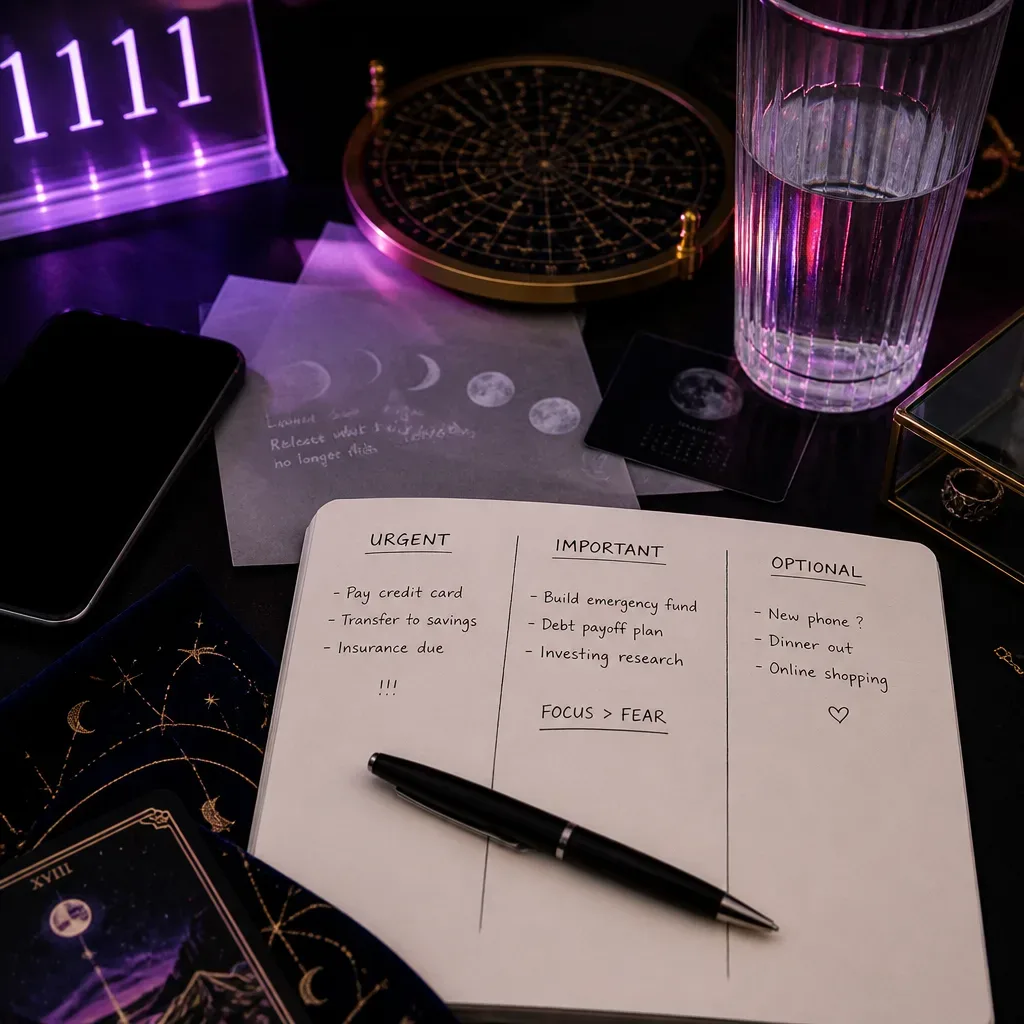
If you are in immediate financial danger, add human help. Call the lender. Speak to a nonprofit credit counselor. In the U.S., the National Foundation for Credit Counseling has worked with millions of clients since 1951. A 3-minute audio is a doorway into steadier action, not a substitute for support.
Real change often sounds like a quieter sentence you can finally believe.
How do you keep the practice real without pretending?
You keep it real by pairing every inner sentence with one outer action.
This is where money manifestation can become mature. You listen. You look. You act. The action may be small, but it must exist. A 2021 meta-analysis on habit formation in Health Psychology Review found that repetition in stable contexts supports automaticity over time. Same cue. Same practice. Same kind of next step. The body starts to learn.
Here is a simple pairing table:
| Inner sentence | Outer action |
|---|---|
| I can look clearly. | Check one account only. |
| I can repair slowly. | Schedule one minimum payment. |
| I can ask without shrinking. | Send one message about timing. |
| I can pause before buying. | Wait 24 hours before checkout. |
| I can tell the truth. | Write the actual balance. |
Pretending sounds like I have no limits. Practice sounds like I can meet the limit and choose. There is a large difference. The first leaves you split from reality. The second brings you home to it.
If you want a broader frame for the word manifestation, read the manifestation guide slowly. The useful question is not whether you can think a bill away. You cannot. The useful question is who you become while you handle the bill.
A money mindset shift is not a mood. It is a repeated relationship with money moments. Before checking. Before spending. Before asking. Before avoiding. Each time, you have a chance to practice the self who can stay.
How does this become a daily money ritual?
It becomes daily when you attach it to a moment that already happens.
You do not need a new morning routine. You need a clean hinge. Before checking your bank. Before opening a budgeting app. Before payday spending. The hinge is important because BJ Fogg’s behavior model, published in Tiny Habits and Stanford behavior design work, argues that small behaviors stick better when tied to existing prompts. You already reach for the phone. Place the audio there.
Keep the ritual spare:
- Same place if possible.
- Same 3-minute recording for at least 7 days.
- Same rule: listen before looking.
- Same close: one action, then out.
After a week, notice one metric. Not whether your whole financial life changed. One metric. Did you check less often? Did you avoid fewer days? Did you make one call sooner? Did you spend 24 hours less in shame? The National Endowment for Financial Education has long emphasized that behavior and confidence both shape financial well-being. Confidence is built by evidence.
The app can hold the thread. Your Dream-Self Moment gives you the voice. A daily affirmation can echo one sentence. A Manifestation Board can keep the visual direction nearby. But the order stays clear: listening is the practice.
If you miss a day, return without ceremony. No punishment ritual. No dramatic reset. Just the phone face down, the audio on, the number met plainly. That is how trust is rebuilt, not with one grand promise, but with many quiet returns.
The number is allowed to be true, and so are you.