manifestation 101
Neville Goddard SATS: 3-Minute Audio Before Sleep
Neville Goddard SATS can be practiced with a short Dream-Self audio before sleep. Here is a quiet 3-minute method for nightly repetition.

The lamp is off. Your phone is face down. Neville Goddard SATS can be practiced in three minutes by listening to a short Dream-Self audio before sleep, then resting in the felt fact that the scene is already true. The point is not effort. The point is assumption.
What did Neville Goddard mean by SATS?
Neville Goddard meant the drowsy border before sleep, when you can feel a chosen scene as already done.
SATS stands for State Akin To Sleep. Goddard used the phrase often in lectures and books such as Feeling Is the Secret, first published in 1944, and The Power of Awareness, published in 1952. He was not asking you to wish harder. He was asking you to enter the state of the person for whom the wish is no longer a wish.
That distinction matters. In ordinary wanting, the thing is still away from you. In SATS, the scene is near. You are not begging for the call. You are hearing it. You are not hoping for the new job. You are holding the badge, reading the signed offer, or telling one trusted person that it happened.
Sleep science gives the timing some practical weight. During sleep onset, the brain moves through measurable changes, often including shifts from relaxed alpha activity toward theta activity. Standard sleep staging, used in labs for decades, names N1 as the first light sleep stage. It can last only 1 to 7 minutes for many adults before sleep deepens.
That is why three minutes can be enough. Not because three is magic. Because the window is brief. A short recording respects the body. It gives the mind one true sentence to hold, then gets out of the way.
The softer the practice, the easier it is to repeat.
If you want a wider grounding in the practice around it, read the Manifestation pillar slowly, not as a rulebook, but as a map you can set down whenever you need to.
Why use a 3-minute Dream-Self audio before sleep?
A 3-minute Dream-Self audio works because it gives your sleepy mind one scene to enter without asking it to perform.
Most people make SATS too large. They build a whole life in their head, then wonder why the mind becomes tired. Goddard often taught a short scene, repeated until it felt natural. Short is not less serious. Short is how the mind can hold something at night.
This is also where the AYA Method belongs, quietly. The AYA Method is a daily audio manifestation practice. Each day you listen to a short personalized recording — your Dream-Self Moment — narrated from the version of you who has already manifested the life you intend. Listening is the practice. Repetition is the work. The audio is the method.
Audio helps when visual thinking is not easy. A 2022 YouGov survey reported that about 2% to 3% of people describe very weak or absent visual imagery, often called aphantasia. Many more can picture things, but not on command at 11:43 p.m. If that is you, you are not broken. You may simply need sound as the door.
There is also the matter of decision fatigue. By bedtime, you may have made hundreds of small choices. A recording removes one of them. You do not have to decide what to say. You press play. You listen. You return.
A good SATS audio has three traits:
- It names one fulfilled scene, not ten desires.
- It uses your language, not grand language.
- It ends before your mind becomes alert again.
The app also includes a daily affirmation and a Manifestation Board, but those are complements. For this practice, the audio is the method. The board can help you see it earlier in the day. The affirmation can give you one clean sentence. At night, the listening carries the weight.
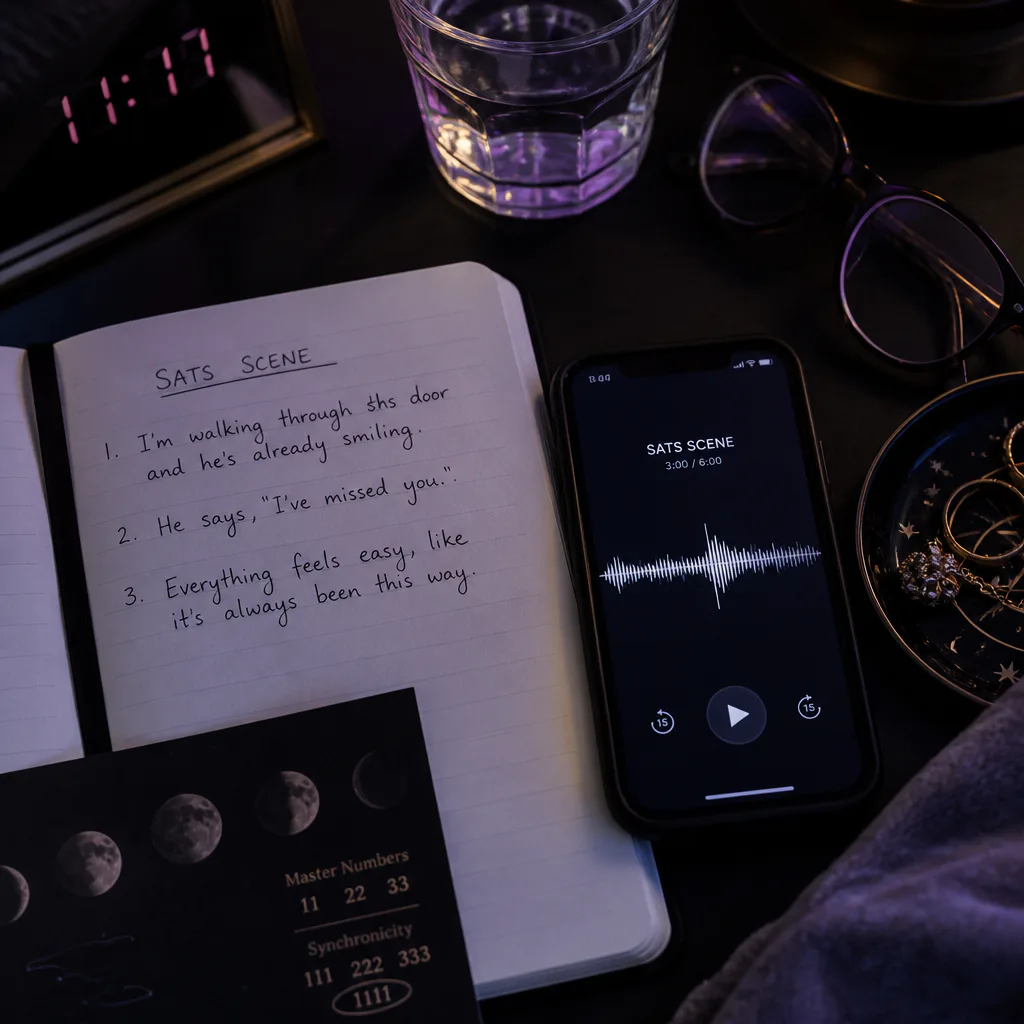
How do you create the scene for Neville Goddard SATS?
You create the scene by choosing one ordinary moment that would naturally happen after the desire is fulfilled.
Ordinary is the secret most people skip. If you want a new apartment, the scene might not be fireworks or tears. It might be your key turning in the door. If you want work that fits you, it might be seeing the calendar and feeling no dread. If you want a repair in love, it might be washing two cups after a calm breakfast.
Neville Goddard called this living in the end. The end is not a fantasy montage. It is proof. One small sensory scene can carry more truth than a hundred bright images. A 2018 paper in Nature Reviews Neuroscience described mental imagery as sharing some neural systems with perception. In plain terms, the mind can rehearse in ways the body understands.
Use this 4-part frame:
- Name the fulfilled fact. What is already true?
- Choose one proof moment. What would you see, hear, or touch because it is true?
- Add one feeling word. Calm, relieved, steady, held, free.
- Reduce the scene to 10 seconds. If it cannot be repeated, it is too big.
Here is a simple table you can use before recording:
| Desire | SATS scene | Line for audio |
|---|---|---|
| New role | You read the signed offer | I see the offer with my name on it, and my shoulders drop. |
| Better health rhythm | You close the kitchen at night | I turn off the light, knowing I kept my promise today. |
| Safe home | You place keys in a bowl | The key is in my hand. This home is mine. |
| Calm relationship | You hear a soft good morning | I hear the tenderness in the room, and I do not brace. |
Keep the line human. You do not need sacred language. In small studies on implementation intentions, including work by Peter Gollwitzer and colleagues, specific if-then cues have repeatedly helped people act on intentions. SATS is not the same as planning, but it benefits from the same clarity. A specific cue gives the mind somewhere to land.
One scene is a room. Ten scenes are a hallway with too many doors.
If your scene starts to feel false, shrink it. Instead of I am wildly successful, try I read one message that confirms I am wanted here. Truth often enters through the small door.
What should the 3-minute SATS audio sound like?
The audio should sound slow, familiar, and already finished.
Speak as if you are not trying to convince anyone. The voice can be yours, or a narrator you trust. The volume should be low enough that your body does not brace to hear it. The tempo should leave space between lines. Three minutes might hold only 250 to 350 spoken words, depending on pace; many meditation recordings sit near 90 to 120 words per minute.
Here is a quiet structure:
- First 30 seconds: settle the body and name the room.
- Next 60 seconds: introduce the fulfilled scene.
- Next 60 seconds: repeat the scene with sensory detail.
- Final 30 seconds: let one sentence remain as the audio ends.
A sample might read like this:
You are in bed. The room is quiet. There is nothing to solve right now. You see the message on the screen. It is already here. Your body knows before your mind explains it. Your name is there. The answer is yes. You breathe out. You are safe inside the new fact.
That is enough. Notice there is no argument in it. No lecture. No pressure. The audio does not push. It assumes.
Research on self-affirmation can be useful here, even though SATS is a different practice. A 2015 meta-analysis by Epton, Harris, Kane, van Koningsbruggen, and Sheeran in Health Psychology found that self-affirmation had small but meaningful effects on health behavior change. The wording mattered less than the person returning to a self that felt worth protecting.
If you are curious about how spoken sentences work beside this practice, the Affirmations pillar can help. Just remember the order here. The affirmation is a complement. The Dream-Self audio is the nightly method.
How do you practice Neville Goddard SATS in bed?
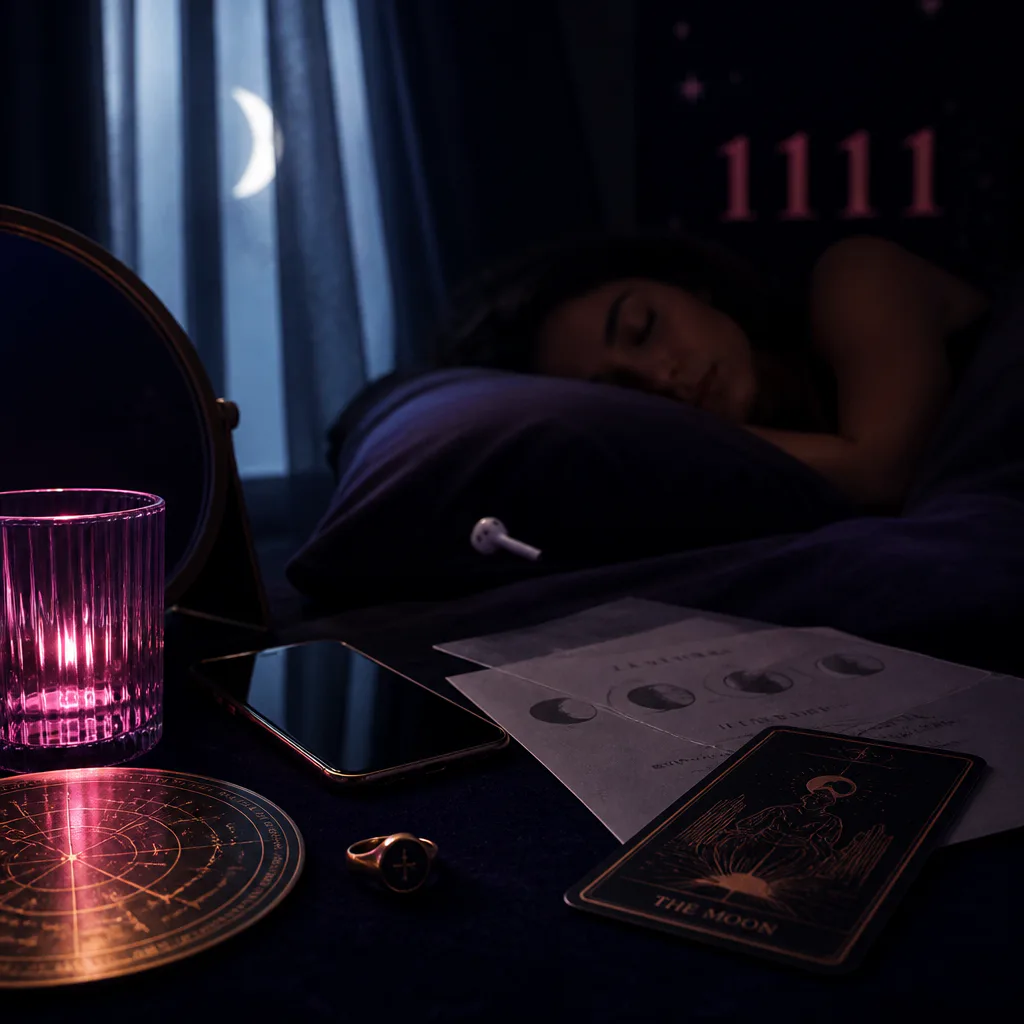
You practice by lying down, listening once, and letting the final scene carry you toward sleep.
Do not sit upright like you are taking a test. Do not replay the audio ten times to make sure it worked. Bedtime SATS asks for trust and repetition, not strain. If you can brush your teeth when tired, you can do this.
Use this nightly sequence:
- Put your phone on Do Not Disturb.
- Set the volume low.
- Lie down in your usual sleep position.
- Press play once.
- Let your breath slow without managing it.
- When the audio ends, repeat the final line once in your mind.
- Sleep, or simply rest.
Adults are commonly advised to get at least 7 hours of sleep per night, according to the Centers for Disease Control and Prevention. That matters because a manifestation practice should not steal from sleep. If your method makes you alert for 45 minutes, it is costing too much. A three-minute audio protects the night.
If thoughts interrupt, do not fight them. Label them softly: planning, remembering, worrying. Then come back to the line. Dr. Andrew Huberman has often spoken about the nervous system responding to breathing pace and light exposure near bedtime. You do not need to turn SATS into a sleep protocol, but you can respect the basics: low light, low sound, low demand.
The practice is not made better by tension. A clenched mind is still clenching, even when it is saying the right words.
Some nights you will feel the scene. Some nights you will hear two sentences and fall asleep. Both count. Falling asleep inside the assumption was part of Goddard’s instruction. Sleep is not failure. Sleep is the door closing gently behind the scene.
What mistakes make SATS feel forced?
SATS feels forced when you try to prove, monitor, or perfect the state instead of resting in it.
The first mistake is checking. Did I feel it enough? Was the image clear enough? Did my body react? This pulls you out of the state and back into measurement. A 2010 American Psychological Association report on stress noted that many adults connect stress with sleep disruption. Monitoring yourself at bedtime adds one more task to a tired system.
The second mistake is choosing a scene that is too dramatic. If the nervous system does not believe the scene can belong to you, it may treat the audio like theater. Go smaller. Choose the receipt, the key, the text, the quiet morning after the change.
The third mistake is changing the desire every night. There is nothing wrong with adjusting a stale scene, but constant switching keeps the mind from knowing the path. Habit researchers often cite repetition in stable contexts as a key part of automaticity. In a 2009 study in the European Journal of Social Psychology, Phillippa Lally and colleagues found that habit formation varied widely, with an average of 66 days for a behavior to feel automatic.
A few repairs help:
- If the scene feels fake, make it more ordinary.
- If the audio feels long, cut it by half.
- If the words feel borrowed, rewrite them in your own speech.
- If you stay awake, listen earlier, then read something plain.
You can also note timing. Some people do better after lights out. Others need the audio 10 minutes before bed, while brushing their teeth or lying on the floor. The method is daily audio. The exact posture can be kind.
For people who track timing through moon cycles or personal rituals, Astrology and manifestation can add context. Still, SATS does not need a special date. It needs your repeated return.
How do you know if your SATS practice is working?
You know it is working when the scene starts to feel familiar, and your behavior quietly begins to match it.
Do not make the first sign a miracle. Look for reduced inner argument. Look for cleaner choices. Look for the moment you do not abandon the new self in the first hour of the morning. Manifestation is not only what arrives. It is also what you stop rehearsing.
Keep a simple record for 14 nights. Not a diary that becomes another job. Just three marks: listened, slept, noticed. The noticed column might include a calmer email, a cleaner boundary, a small action you did not take last month. In behavior science, measurement often changes attention. Even a tiny tracking system can show patterns the mood misses.
Here is a minimal tracker:
| Night | Listened | Fell asleep easily | One thing I noticed |
|---|---|---|---|
| 1 | yes | no | I stopped editing the scene. |
| 7 | yes | yes | The line felt more normal. |
| 14 | yes | yes | I made the call I had avoided. |
If you want more grounding, pair this with one article on manifestation techniques, then stop reading for the night. Too much input can become another way to delay practice.
There is no need to grade the invisible. Neville Goddard SATS is not a performance. It is a nightly return to the fact you are willing to inhabit. Three minutes. One scene. One self you let become known.
The room is dark, and the new self is already speaking softly.