lucid dreaming
Reality Checks Lucid Dreaming: 3-Minute Audio Guide
Use reality checks lucid dreaming with a 3-minute audio cue to train awareness by day, remember it at night, and track results for 14 days.

Reality checks lucid dreaming practice works when the check is specific, repeated, and emotionally awake. A 3-minute audio helps because it turns the check into a cue you can rehearse daily, then carry into sleep. Use one test, one script, one tracking window, and give it 14 days.
What are reality checks for lucid dreaming, really?
Reality checks are brief tests that train you to ask whether you are awake or dreaming, then verify the answer with evidence.
The classic move is simple: look at your hand, count your fingers, read a line of text twice, or pinch your nose and try to breathe. In waking life, reality behaves with boring consistency. In dreams, text mutates, fingers miscount, mirrors lie, and physics gets theatrical on cue. Stephen LaBerge, one of the central researchers in modern lucid dreaming, helped popularize reality testing in the 1980s through Stanford sleep-lab work and later books such as Exploring the World of Lucid Dreaming.
The mistake is doing reality checks like a receipt tap. You glance, count, move on. That trains nothing except impatience. A useful check includes a real question: What would prove I am awake right now? The room needs a witness, not a performance.
Lucid dreaming research is still small compared with mainstream sleep medicine, but it is not imaginary. EEG-verified lucid dreaming was reported by LaBerge and colleagues in 1981, using prearranged eye signals during REM sleep. That matters because lucid dreaming is not just a feeling people describe after waking. In lab settings, dreamers have signaled awareness from inside REM.
Reality checks are the daytime gate. They tell the mind, again and again, to audit the scene. The audit is the practice.
A reality check is not superstition. It is a habit of inspection, placed where automatic life usually wins.
For readers coming from the wider Manifestation pillar, the overlap is familiar: attention, repetition, and identity rehearsal. But lucid dreaming adds a stricter condition. You are not only naming a future. You are training perception to catch the moment when the dial slips.
Why add a 3-minute audio to the practice?
A 3-minute audio makes reality checks easier to remember because it gives the habit a stable cue, rhythm, and script.
Most lucid dreaming advice assumes the reader has infinite consistency. That is charming and false. People forget. Calendars eat intentions. By Wednesday, the reality check that felt electric on Monday has become one more tab left open in the mind.
Audio helps because it reduces the number of decisions. Press play. Listen. Check. Repeat. In behavior science, consistency often depends less on motivation than on cue design. Wendy Wood’s habit research has estimated that roughly 43 percent of everyday actions are performed habitually in familiar contexts. The point is not to become more intense. The point is to make the right action easier to repeat.
Three minutes is long enough to change state and short enough not to become ceremonial theater. I like the number because it respects friction. If a practice needs 30 perfect minutes, it may work beautifully for the person you wish you were. If it needs 3 minutes, the person you are today can probably meet it.
There is a useful parallel with the AYA Method. The AYA Method is a daily audio manifestation practice. Each day you listen to a short personalized recording, your Dream-Self Moment, narrated from the version of you who has already manifested the life you intend. Listening is the practice. Repetition is the work. The audio is the method.
For lucid dreaming, the 3-minute track is not the AYA Method unless it is built as that personalized Dream-Self Moment. Treat it as a focused training cue. Same respect for audio. Different job.
A short audio does one thing particularly well: it keeps the question warm. Am I dreaming? What proves it? What changed? That question needs to arrive in the dream before the dream convinces you it is Tuesday.
How do you build the 3-minute reality-check audio?
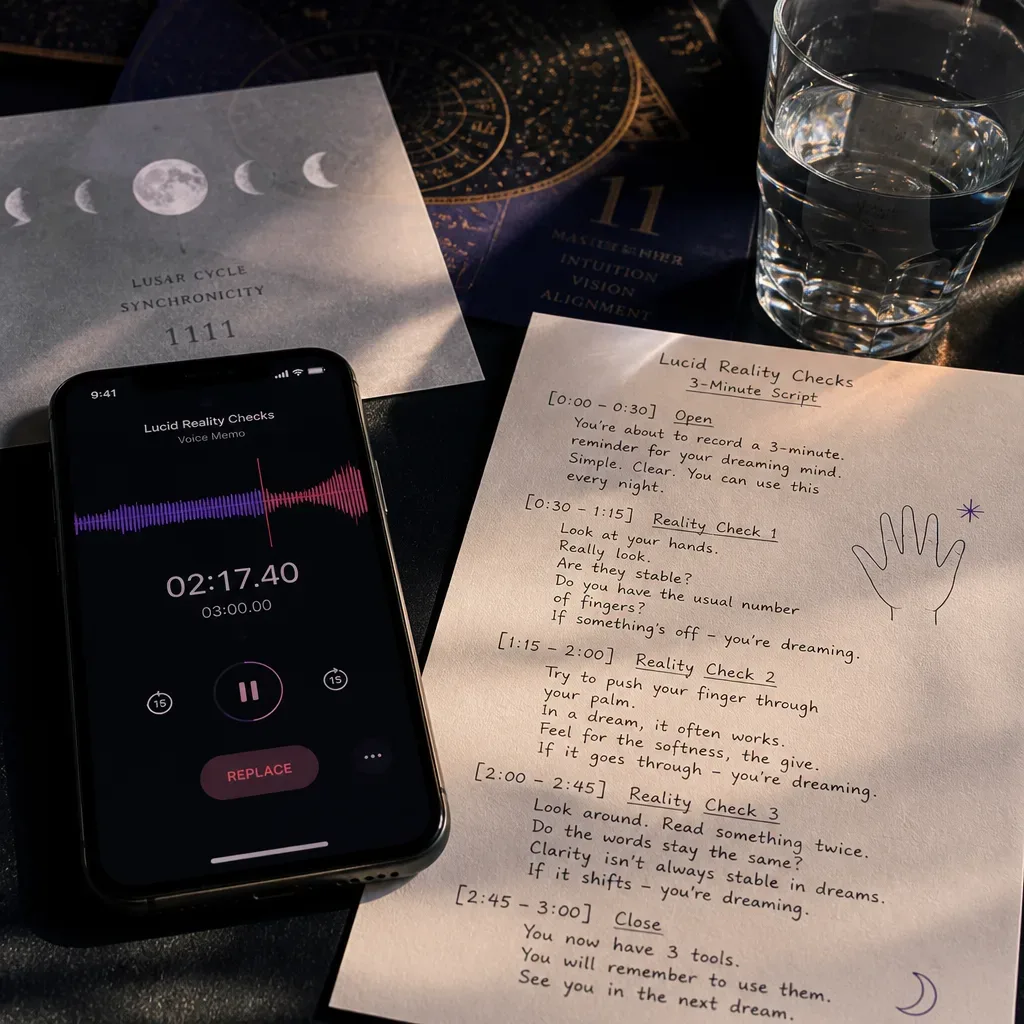
Build the audio as a short sequence: arrive, ask, test, visualize, and close.
You do not need studio gear. Your phone recorder is enough. Keep your voice calm, almost factual. The tone matters because the sleeping mind is suggestible, but it is also allergic to salesmanship. Andrew Huberman often points out, in sleep and learning discussions, that nervous-system state shapes plasticity. You want alert ease, not hype.
Use this structure:
- 0:00 to 0:30, arrive. Breathe slowly and name the room around you.
- 0:30 to 1:00, ask. Say: Am I dreaming right now? Do not rush the answer.
- 1:00 to 1:45, test. Perform one reality check with full attention.
- 1:45 to 2:30, rehearse. Picture doing the same check inside a dream.
- 2:30 to 3:00, close. Repeat one line: Tonight, I notice the signal.
The exact words can be plain. Plain survives sleep better than poetry. If you use a timed bell, keep it soft. If you add music, keep it low enough that the words remain the object. A 2017 lucid dreaming study by Denholm Aspy and colleagues tested several induction methods with 169 participants and found that MILD, the mnemonic induction of lucid dreams, performed better than reality testing alone in that study. The lesson is useful: memory cues matter.
Here is a simple script you can record:
I stop. I look at the room. I ask the clean question: am I dreaming? I check my hands. I read one word twice. I test the scene instead of assuming it. If this is a dream, I notice the signal. If this is waking life, I train the signal for tonight.
Keep the script consistent for at least 14 days. Lally and colleagues, in a 2009 European Journal of Social Psychology study, found habit formation varied widely, with an average of 66 days for automaticity across behaviors. You are not trying to reach automaticity in two weeks. You are trying to collect enough signal to know whether the practice is taking.
Which reality checks should you use?
Use one primary reality check and one backup, because too many tests scatter the cue.
Lucid dreaming forums love long menus. I understand the appeal. Counting fingers, pushing a finger through the palm, reading text twice, checking clocks, jumping to test gravity, looking in mirrors, turning lights on and off. The buffet looks powerful. In practice, it often creates drift.
Pick the test you will actually do in public without feeling like a man auditioning for a strange play. My own default is text. I read a word, look away, then read it again. In waking life, it usually holds. In dreams, text is notoriously unstable for many people, though not for all. The backup is the nose-pinch test: pinch your nose shut and try to breathe. In dreams, people often can breathe anyway.
| Reality check | Best use | Weakness |
|---|---|---|
| Read text twice | Subtle daytime practice | Requires visible text |
| Count fingers | Fast, memorable | Can become automatic |
| Nose-pinch breathing | Strong dream signal | Awkward in public |
| Check a clock twice | Good with 11:11 cues | Digital habits can dull attention |
| Test gravity with a small jump | Bodily and clear | Not ideal at work |
The number 11 can be useful here, not because it forces a dream, but because repeated numbers catch attention. If you already notice 11:11, use it as a gate. Doreen Virtue helped popularize angel-number language in the 2000s, though many readers now hold that system at a distance. Fine. You do not need to believe the clock is speaking. You only need the clock to remind you to listen.
The Affirmations pillar makes a related point: repeated language changes behavior only when it is paired with attention and action. A reality check is an affirmation with a test attached. That is why I trust it more.
The best reality check is not the weirdest one. It is the one you will do when life is ordinary.
How do you practice during the day without making it strange?
Practice by attaching the audio and reality check to ordinary cues that already repeat.
The day has enough doors. Use them. First coffee. After brushing your teeth. Before opening your laptop. The moment the clock hits 11:11. After you park. When you see the moon. You are not trying to turn your life into a dream laboratory. You are placing small gates where attention already pauses.
Here is a daytime pattern that works:
- Listen to the 3-minute audio once at the same daily cue.
- Perform your primary reality check immediately after.
- Ask for one piece of evidence, not ten.
- Name one odd detail in the room, even if nothing is odd.
- Record a one-line note only if something changed.
This takes less time than scrolling one comment thread. According to DataReportal’s 2024 global overview, average daily social media use sits above 2 hours for internet users worldwide, with regional variation. Three minutes is not a heroic demand. It is a rounding error with a pulse.
If you work in an office, use text checks. If you teach, use clock checks. If you are on your feet, use hand checks. If you are commuting, do not do anything that competes with safety. Lucid dreaming does not get a pass on common sense.
There is also a mood component. Do the check with mild suspicion. Not anxiety. Not drama. Suspicion. Dreams are excellent accountants with fraudulent books. Look twice.
For readers who track lunar cycles or timing windows, Astrology and manifestation can give the practice a calendar. New moons are good for starting a 14-day run. Full moons are good for reviewing what surfaced. The moon does not do the work for you. It gives the work a date.
How do you use the audio before sleep and after waking?
Use the audio before sleep to set the cue, and after waking to protect recall before the day edits the dream.
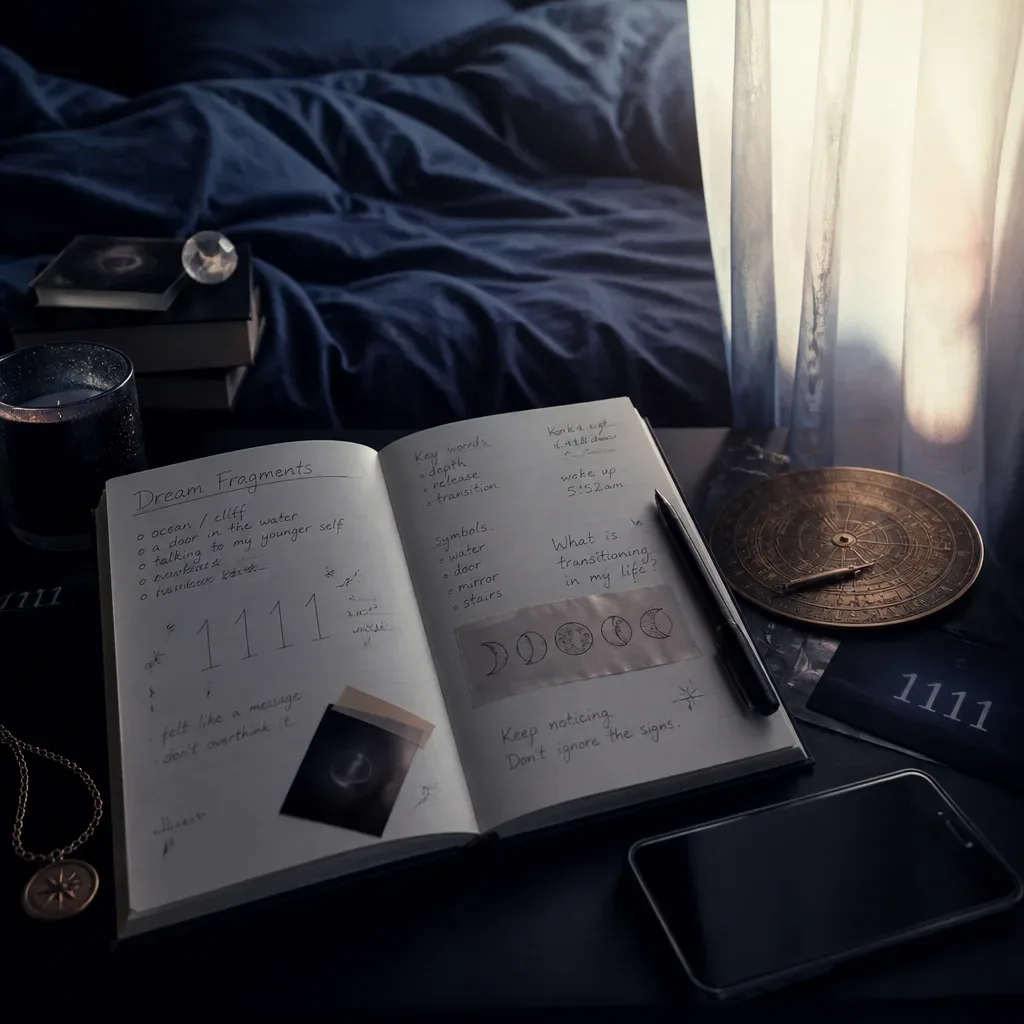
Before bed, play the 3-minute track once. Not five times. More is not always better; sometimes it is just more. After the audio, perform the check, then say the closing line quietly: Tonight, I notice the signal. If you use a dream journal, leave it open with a pen ready. That tiny physical setup matters at 3:12 a.m., when your mind is half fog and half theater.
Sleep cycles run roughly 90 minutes, though the exact timing varies by person and night. REM periods tend to lengthen toward morning, which is why many lucid dreaming methods use wake-back-to-bed after 4.5 to 6 hours of sleep. If you try that, keep the waking period gentle. Bright light, email, and argument are not subtle instruments.
A simple night protocol:
- Set journal and pen beside the bed.
- Play the 3-minute audio once.
- Do your reality check.
- Sleep normally.
- If you wake after a dream, stay still for 20 seconds.
- Write fragments before interpretation.
The 20-second stillness is underrated. Dream memory is volatile. The National Institute of Neurological Disorders and Stroke notes that dreaming occurs in REM and non-REM sleep, but vivid narrative dreaming is strongly associated with REM. Once you move, check your phone, or start planning breakfast, the dream can collapse like a wet receipt.
If you already use the AYA Method, keep your Dream-Self Moment as the main audio practice for manifestation. Put the lucid dreaming track in its own lane. The mind likes clean files. Do not make every recording do every job.
What should you track for 14 days?
Track the few numbers that reveal whether your reality checks are becoming dream cues.
I am an ex-finance man, so I distrust any method that refuses a ledger. The ledger does not need to be cold. It needs to be honest. Track four things for 14 days: sleep length, dream recall, daytime checks, and lucidity signals. That is enough to see whether the practice is alive.
Use a scale that you can fill in before coffee:
| Metric | How to score it | Why it matters |
|---|---|---|
| Sleep length | Hours slept | Lucidity often needs stable REM time |
| Dream recall | 0 to 3 | Recall usually improves before lucidity |
| Reality checks | Count per day | Measures cue repetition |
| Audio listened | Yes or no | Keeps the method clean |
| Lucidity signal | Fragment, partial, full | Captures small arrivals |
A full lucid dream is not the only win. A partial moment counts: you questioned a room, noticed impossible light, saw text change, or felt the dream tilt. In skill learning, near-misses are data. In small lucid dreaming studies, participants often show uneven results across nights, which is exactly why a 14-day window beats judging one Saturday.
The lucid dreaming guide is the broader map, but this practice is the field test. If your recall stays at zero for two weeks, fix sleep and journaling before adding more induction techniques. If recall improves but lucidity does not, strengthen the daytime question. If lucidity appears once, do not immediately redesign the whole machine. Repeat what worked.
A signal that arrives once is interesting. A signal that returns is a method.
When should you change the practice?
Change the practice only after 14 days of clean repetition, unless it disrupts sleep or creates anxiety.
The temptation is to keep tinkering. New script. New bell. New reality check. New app. New theory from a stranger who claims he became lucid every night after taping a blue triangle to his ceiling. Maybe he did. Good for him. Your job is to test your own base rate.
After 14 days, read the ledger. If you listened fewer than 10 days, you do not have a method problem. You have a consistency problem. If you listened 12 to 14 days and nothing moved, change one variable only. Switch the reality check, move the audio to a different cue, or add a wake-back-to-bed session once per week.
Lucid dreaming is sensitive to sleep quality. The CDC has reported that about 1 in 3 U.S. adults do not get enough sleep, using the common benchmark of 7 or more hours for adults. If your sleep is short, fragmented, or alcohol-heavy, do not blame the reality check first. The dream gate opens inside biology.
Use this adjustment rule:
- No dream recall: journal immediately on waking for 7 days.
- Recall but no checks in dreams: make daytime checks slower and more curious.
- Checks feel automatic: change the question, not the whole practice.
- Audio feels irritating: re-record in a calmer voice.
- Sleep gets worse: stop night use and keep daytime only.
The wider Manifestation pillar talks about repetition as a way of becoming available to a chosen identity. Lucid dreaming is more literal. You are becoming available to the moment when the dream shows its seam.
The dial does not need force. It needs your hand there when it moves.