evening rituals
Revenge Bedtime Procrastination: 3-Minute Wind-Down
Revenge bedtime procrastination can soften with a 3-minute audio wind-down that gives your mind closure without stealing tomorrow.

The phone is warm in your hand. Revenge bedtime procrastination softens when the night gets a clean ending: 3 minutes of audio, one honest sentence, and one physical cue. You are not trying to win the night. You are giving it back to yourself without taking sleep from tomorrow.
What is revenge bedtime procrastination, really?
Revenge bedtime procrastination is delaying sleep to reclaim time that felt unavailable during the day.
The research term behind it is bedtime procrastination. In a 2014 Frontiers in Psychology paper, Floor Kroese and colleagues described it as going to bed later than intended while no external circumstance prevents sleep. The revenge part is more domestic. More private. It is the feeling of, finally, no one needs me. So you stay up.
It can look like one more episode, 27 minutes of scrolling, a cart you do not check out, or reading comments from strangers with more attention than you gave your own dinner. The act is small. The meaning is not. You are not only avoiding bed. You are trying to touch a piece of your life that did not get touched before 10:43 p.m.
Sleep need is not vague. The American Academy of Sleep Medicine and Sleep Research Society recommend at least 7 hours of sleep for most adults. The CDC has reported that roughly 1 in 3 U.S. adults do not get enough. That means this is not a rare flaw hiding in your bedroom. It is a common negotiation between autonomy and exhaustion.
The quiet truth is this: your bedtime delay is often a protest with no audience. It says, I was useful all day. I would like to be mine now.
A 3-minute wind-down does not scold that protest. It listens. Then it gives the mind a door.
Why does the night feel like the only time that belongs to you?
The night feels yours because demand often goes silent before desire does.
During the day, attention is divided into pieces. Work messages. Family logistics. Errands. Food. A calendar with 9 or 12 or 17 blocks, depending on how honest your calendar is. A 2023 American Time Use Survey from the U.S. Bureau of Labor Statistics found employed people worked an average of 7.9 hours on days they worked. Add commuting, care, meals, and basic repair of the body. No wonder midnight starts looking like a tiny private country.
The problem is that the nervous system does not read privacy and rest as the same thing. You may finally have control, but your body still carries the day. Dr. Andrew Huberman has often spoken about evening light as a biological signal; bright light late at night can delay melatonin timing in many people. The screen says, stay here. The body says, please stop. The mind says, but this is my only hour.
That is why advice like just go to bed can feel almost rude. It ignores the debt underneath the delay. You are not only tired. You are under-met.
A short audio practice works because it gives your mind a felt form of self-return. Not a lecture. Not a perfect routine. A voice. A few minutes. A place to put the wanting.
Try naming the real need before you press play:
- I wanted quiet.
- I wanted choice.
- I wanted to feel unobserved.
- I wanted to remember myself.
- I wanted one thing that did not ask me to be useful.
Neville Goddard wrote often about assuming the feeling of the wish fulfilled. You do not have to take every sentence of his work literally to see the sleep lesson here. The mind rests more easily when it can inhabit an ending. The wish at bedtime may be simple: I am already home in myself.
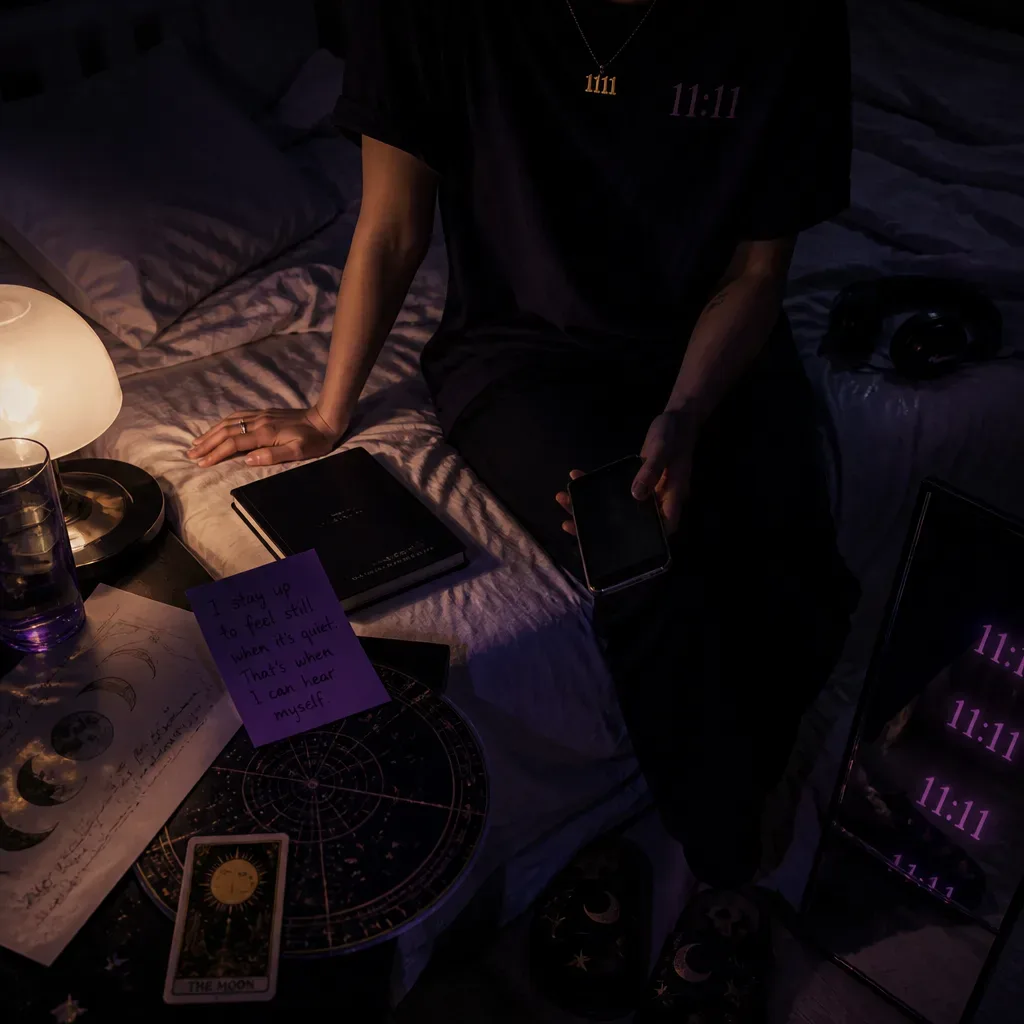
How does a 3-minute audio wind-down work?
A 3-minute audio wind-down works by replacing open-ended scrolling with a short, repeatable listening cue.
Three minutes is not magic. It is usable. In behavior design, smaller actions are easier to repeat because they create less friction; BJ Fogg at Stanford has written for years about tiny behaviors being more reliable than heroic ones. A 30-minute routine can become another thing you failed to do. A 3-minute audio can fit inside the part of you that is already lying there.
Here is the shape:
- Minute 1: tell the truth. Name what the night has been giving you.
- Minute 2: listen forward. Hear a version of you who already kept the promise.
- Minute 3: close the loop. Make one physical gesture that says the day is done.
This is where the AYA Method comes in softly. The AYA Method is a daily audio manifestation practice. Each day you listen to a short personalized recording — your Dream-Self Moment — narrated from the version of you who has already manifested the life you intend. Listening is the practice. Repetition is the work. The audio is the method.
That matters at bedtime because audio asks less of your eyes. It lets the room get darker. It lets the hand stop searching. The daily affirmation and Manifestation Board can support the practice, but they are not the center. At night, the most merciful thing is often not another task. It is listening.
A 2021 Sleep Foundation survey reported that many adults use phones in bed, and Pew has found smartphone ownership above 90% among U.S. adults under 50. The phone is already there. The question is whether it becomes a trapdoor or a threshold.
A good wind-down does not fight the phone. It gives the phone one job, then takes the job away.
What are the exact steps for tonight?
Tonight, use one sentence, one audio, and one closing cue.
Set this up before you are bargaining with yourself. If your bedtime target is 11:00, start at 10:57. Not 10:15. Not the kind of time that makes you feel like a different person has to arrive and rescue you. Three minutes before sleep is late enough to feel real.
Use this small script:
- Dim the room. Lower one light or turn off the overhead. Harvard Health has reported that blue light exposure can affect circadian timing, especially in the evening. You do not need a perfect cave. You need a signal.
- Put the phone down, screen facing away. Keep the audio reachable, not scrollable. One arm’s length is enough friction to matter.
- Say the sentence. Try: Tonight, I was trying to take back quiet.
- Play your audio. Let the voice carry the future-tense ache into a present-tense shape.
- Close with the body. Hand on pillow. Hand on chest. One slow exhale. No performance.
If you use Aya, choose the Dream-Self Moment before you are tired. The app also includes a daily affirmation and Manifestation Board, which can be useful earlier in the evening. For more on how desire becomes practice, read the Manifestation pillar. For the sentence-work around belief, the Affirmations pillar is the quieter companion.
Here is the difference between a routine that survives and one that becomes decorative:
| Bedtime plan | Time cost | What it asks of you | Why it works or fails |
|---|---|---|---|
| Full evening reset | 30–60 minutes | Planning, cleaning, journaling | Helpful, but easy to skip when tired |
| Screen ban | 1–2 hours | Strong restraint | Works for some, triggers rebellion for others |
| 3-minute audio wind-down | 3 minutes | Listening and one cue | Low friction, repeatable, kind |
One sentence can be a hinge. One audio can be a room. One repeated cue can teach the body what the mind keeps forgetting.
What should the audio actually say?
The audio should sound like your future self speaking gently from the life you are practicing.
It should not hype you up. Bedtime is not the hour for a speech with drums behind it. You want a voice that lowers the stakes. In small mindfulness studies, even brief guided practices have been associated with reduced pre-sleep arousal, though the quality of evidence varies by design and sample size. The point is not to force sleep. It is to reduce the inner argument that keeps sleep away.
A strong 3-minute bedtime audio has 4 parts:
- Recognition: You see why staying up made sense.
- Permission: You do not need to punish yourself into rest.
- Future self: You hear from the version of you who kept the promise.
- Closure: You receive one clear end.
A sample line might be: I know why you wanted more night. You were looking for yourself. I am here now. We do not have to steal from tomorrow to feel real tonight.
Joe Dispenza often speaks about rehearsing a future state until the body begins to recognize it. Again, you do not need to adopt every claim around his work. The useful part is rehearsal. The brain learns by repetition. A 2009 European Journal of Social Psychology study by Phillippa Lally and colleagues found habit formation took a median of 66 days, with wide variation. So keep the practice small enough to repeat on a bad Tuesday.
If astrology is part of how you reflect, you can pair the audio with a moon or transit note without making it complicated. The point is not prediction. It is timing and attention. The piece on astrology and manifestation can help if that language already feels natural to you.
The best bedtime audio does not make you bigger. It makes the room safe enough to stop proving.
What if you resist the routine because bedtime feels like losing?
If bedtime feels like losing, the routine must give you a felt win before it asks you to stop.
This is the part people skip. They try to replace revenge bedtime procrastination with discipline, and then wonder why discipline loses to a glowing rectangle at 12:18 a.m. The delay is giving you something. Maybe novelty. Maybe privacy. Maybe the tiny pleasure of not being answerable. If you do not give that need a new place to go, it will return through the thumb.
So build a win into the first 30 seconds. Say, I got here. That counts. Then press play.
Behavioral sleep medicine often uses stimulus control: bed is for sleep and intimacy, not work or alertness. The classic instruction is to get out of bed if you cannot sleep after about 20 minutes, though clinicians tailor this. Your 3-minute audio is different. It is not meant to keep you in bed awake for an hour. It is a threshold ritual. If you are still wired after it, sit in low light, do something dull, and return when sleepy.
Here is the quiet repair plan for resistance:
- Do not call yourself lazy. Shame is stimulating.
- Name the need. Choice, silence, pleasure, privacy.
- Give it 3 minutes of respect. Audio is not a punishment.
- Remove one temptation, not all of them. Move one app, one charger, one device.
- Repeat tomorrow even if tonight was messy. The pattern learns by contact.
The Princeton Engineering Anomalies Research program, often called PEAR, studied intention and random systems for nearly 3 decades. Its findings are debated, and they should be read carefully. Still, the cultural interest around that research points to something ordinary: people want intention to have form. At bedtime, form is everything.
You are allowed to want the night. You are also allowed to keep the morning.
How do you make the habit last longer than three nights?
You make it last by keeping the ritual small, measurable, and emotionally honest.
Do not track perfection. Track returns. Put a small mark beside each night you pressed play, even if you scrolled after. The mark is not a gold star. It is evidence. You are teaching yourself that you can come back without a courtroom.
Use a 7-night test. Seven is long enough to notice friction and short enough not to become a life rebrand. Sleep researchers often recommend consistent sleep and wake times because circadian rhythms respond to repetition. You can borrow that principle without becoming strict. Same cue. Same audio window. Same closing act.
Try this simple scorecard:
| Night | Pressed play? | Screen down after? | Sleep felt easier, same, or harder? |
|---|---|---|---|
| 1 | Yes / No | Yes / No | Easier / Same / Harder |
| 2 | Yes / No | Yes / No | Easier / Same / Harder |
| 3 | Yes / No | Yes / No | Easier / Same / Harder |
| 4–7 | Keep going | Keep noticing | No drama |
If you want to weave the practice into a fuller intention setting rhythm, keep the center clear: audio first. The AYA Method is not a list of chores. Listening is the practice. The app may hold your affirmation or Manifestation Board, but the nightly return is the voice you can hear when the room is dim.
You can also revisit manifestation as a broader practice, or use affirmations to write the one sentence that starts the wind-down. Keep it plain. Keep it yours.
Revenge bedtime procrastination asks for ownership. The wind-down answers with a smaller kind of ownership: I choose to stop before the night has to take from me.
Put the phone down softly. Good.