evening rituals
Sunday Night Reset Routine With Dream-Self Audio
A quiet sunday night reset routine using Dream-Self audio, a small room reset, and one honest plan so Monday arrives without taking over your night.

The mug is still beside the sink. Your bag is half-packed. A sunday night reset routine should make Monday easier without stealing your last quiet hours. Keep it to 25 minutes: one visible reset, one short plan, one Dream-Self audio, and one gentle close before sleep.
What should a sunday night reset routine actually do?
A sunday night reset routine should lower Monday friction, not fix your whole life before bed.
Sunday has a strange talent. It can look peaceful and still make your chest tighten at 6:12 p.m. In surveys, workers often describe Monday as the most disliked weekday; a 2021 YouGov poll in the UK found Monday was the least favorite day for 58% of respondents. The point isn’t that Monday is dangerous. The point is that the mind starts rehearsing it early.
A good reset gives that rehearsal a smaller script. You are not trying to become a different person by sunrise. You are removing three or four small obstacles: the missing keys, the mystery lunch, the crowded calendar, the vague fear that you’ve forgotten something. Small is not lesser. Small is where a nervous system can begin.
Sleep matters here. The CDC has reported that about 1 in 3 U.S. adults get less than 7 hours of sleep in a 24-hour period. If your reset becomes a two-hour productivity pageant, it may cost the very rest it was meant to protect. The routine has to be kind enough to repeat.
Use this simple shape:
- Clear one visible place. Not the whole room. One place.
- Look at the next three days. Not the whole future.
- Listen to your Dream-Self audio. Let the audio speak before the anxious voice does.
- Write one sentence. Not a manifesto.
- Close the room. Let sleep know it has permission to arrive.
A reset is not a performance of control. It is a small way of saying, I can meet what is next without abandoning myself.
Why begin with the room instead of the calendar?
Begin with the room because the body believes what it can see.
A calendar can be useful, but it can also open ten doors at once. A room is more merciful. You can pick up the sweater from the chair. You can put the glass in the sink. You can place your headphones where your hand will find them. In research on clutter and attention, a 2011 Princeton Neuroscience Institute study found that visual competition in the environment can reduce focus. Your desk is not your soul, thank God. Still, your eyes are taking notes.
Choose one visible surface and give it five to seven minutes. The bedside table works. The kitchen counter works. The chair that has become a second closet also works, though I say that with deep personal knowledge. Set a timer. Do not negotiate with the whole apartment.
Here is the rule I use before recording my Monday podcast notes: make one place honest. If the table will hold your morning tea, clear the table. If your bag will go by the door, put it there. The weekly reset becomes real when it touches an object.
A 2023 Sleep Foundation guide notes that consistent bedtime cues can help the body prepare for sleep, especially when they are repeated. This is why the room comes first. You are not cleaning for virtue. You are building a cue.
Try this tiny room reset:
- Put away 10 items, then stop.
- Fill or wash the water glass.
- Place Monday’s first object where it belongs.
- Remove one thing from the bed that isn’t for sleep.
- Set headphones within reach for your audio.
The room does not need to look beautiful. It needs to stop asking you questions.

How do you plan the week without waking the worry?
Plan only the next three days, because the brain can act on near detail more easily than distant fog.
Sunday planning goes wrong when it becomes a trial. You open the calendar, see Thursday, remember a message from last month, and suddenly you are reorganizing your identity at 9:40 p.m. Don’t do that to yourself. Monday through Wednesday is enough. Behavioral research often points toward specificity as a support for action; Peter Gollwitzer’s work on implementation intentions found that if-then plans can improve follow-through across many studies.
Use one page. Divide it into three lines: fixed, chosen, softened.
| Line | What it means | Sunday example |
|---|---|---|
| Fixed | What is already scheduled | 9 a.m. call, school drop-off, appointment |
| Chosen | One priority you can name | Draft the proposal outline |
| Softened | One friction you can reduce | Put oat milk on the list |
This is not a full productivity system. It is a way to stop the week from arriving as a blur. The Journal of Behavioral Medicine has published work on expressive writing and stress, including studies where brief written reflection helped people process worry. You don’t need to write pages. You need a container.
If a task has more than one step, write only the first visible step. Not finish taxes. Open tax folder. Not be healthier. Put walking shoes by the door. The future becomes less frightening when it has handles.
This is also where manifestation stays honest. You are not using intention to bypass the ordinary. You are letting intention choose the ordinary. A dream that cannot touch your Monday bag, your calendar, or your first email is still floating above you. Bring it down gently.
The sentence I like is plain: This week, I return to one true thing. Then name it. Rest. Courage. Consistency. Asking earlier. Leaving on time. No one has to clap. The page only has to know.
Where does Dream-Self audio belong in the reset?
Dream-Self audio belongs after the room is softened and before the final plan hardens.
This order matters. If you listen too early, the room may still be shouting. If you listen too late, the calendar may have already written the story. Place the audio in the middle, where it can become a bridge. Your body has done one visible thing. Your mind has seen the next few days. Now you listen.
The AYA Method is a daily audio manifestation practice. Each day you listen to a short personalized recording — your Dream-Self Moment — narrated from the version of you who has already manifested the life you intend. Listening is the practice. Repetition is the work. The audio is the method.
That last line is important. The audio is the method. The app also includes a daily affirmation and a Manifestation Board, but those are complements. They can help you see and name what matters. Still, the central practice is listening to the Dream-Self Moment, again and again, until the future voice becomes familiar enough to answer the present one.
There is a reason repetition works its way into so many practices. A 2009 study by Phillippa Lally and colleagues in the European Journal of Social Psychology found that habit formation took a median of 66 days, with wide variation. The number is not a command. It is a reminder that identity often learns by return.
Before you press play, do three things:
- Sit where you won’t start tidying again.
- Put both feet on the floor or lie down fully.
- Let the first 10 seconds be quiet before the audio begins.
Do not multitask the listening. Don’t fold laundry. Don’t check tomorrow’s weather. The practice is not background sound. Your future self should not have to compete with your sock drawer.
One recording. One listening. One return.
What should you write after listening?
Write one honest sentence, because the practice needs a landing place.
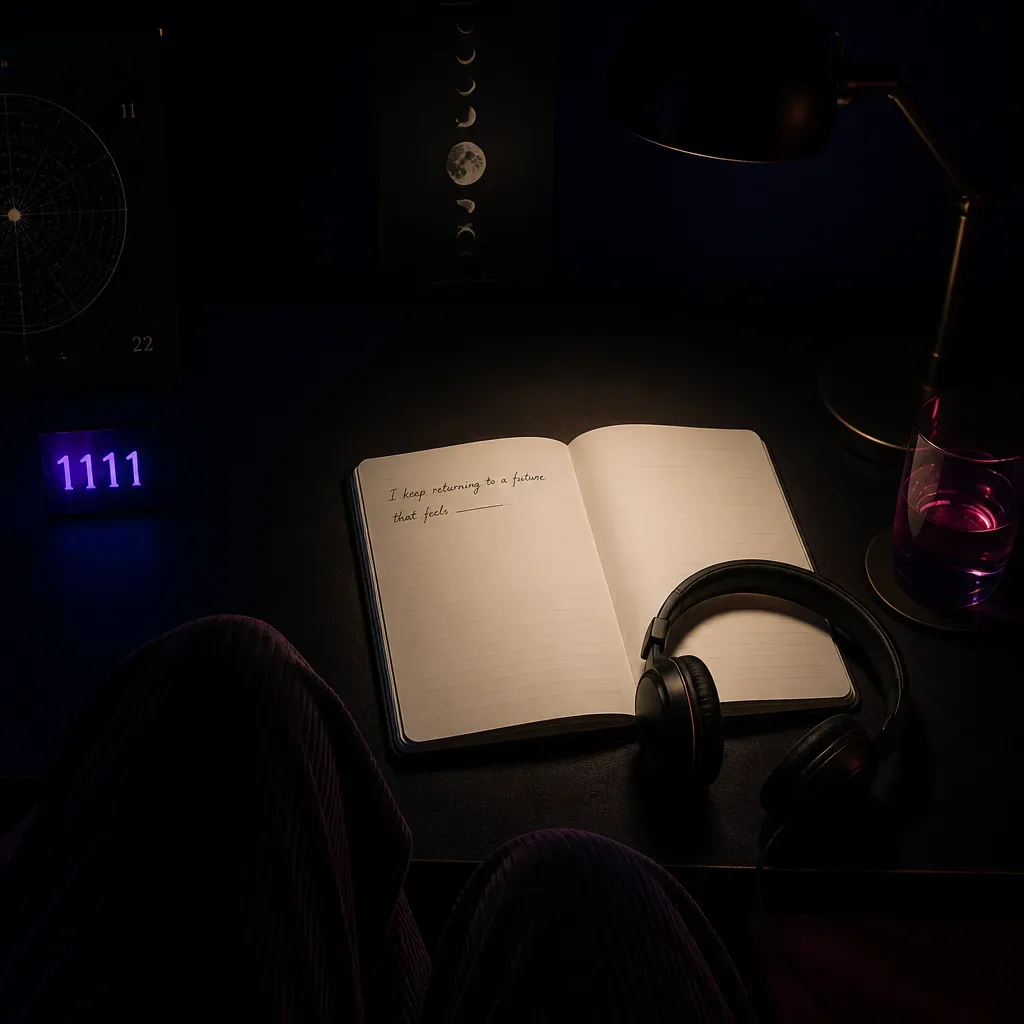
After Dream-Self audio, you may want to write a page. You may also want to stare at the wall and say, well, that was rude, because the truest things are often inconvenient. Either is allowed. Still, for a Sunday night reset, keep the writing small. One sentence is enough.
A useful sentence has three qualities: it is specific, believable, and close to action. It does not need to sound spiritual. It should sound like you on a quiet day, telling the truth. Research on self-affirmation, including work summarized by Geoffrey Cohen and David Sherman in a 2014 Annual Review of Psychology article, suggests that values-based reflection can help people stay steadier under threat. The word can be simple. The value can be ordinary.
Use one of these prompts:
- This week, I return to ___ when I feel rushed.
- The next version of me practices ___ in small ways.
- On Monday morning, I can make this easier by ___.
- I don’t need to solve ___ tonight.
- I already know the first step is ___.
There is a difference between an affirmation and a sentence you can live with. Affirmations can support the practice when they are honest enough for your body to believe. If a phrase feels too far away, soften it. I am calm forever becomes I can come back to calm for one breath. The second sentence may do more good because it has somewhere to stand.
If astrology is part of how you mark time, you might also use Sunday as a weekly threshold. Keep it grounded. A moon note or birth-chart reflection can be a lens, not an order. The piece on astrology and manifestation speaks to this better than a Sunday panic ever will.
The sentence is not magic. It is a place to put your hand.
How do you close the routine so it does not become more work?
Close the routine with a clear stop, because the brain needs a finished signal.
This is the part people skip. They reset, plan, listen, write, and then open their phone for one tiny thing. Twenty minutes later they are reading about a former classmate’s kitchen renovation and wondering why their soul feels noisy. The reset needs an ending. Without one, the evening leaks.
Dr. Andrew Huberman has often spoken about light timing and sleep-wake rhythms, and the basic science is widely supported: bright light late at night can delay sleep timing for many people. You do not need to become a sleep scientist. You can dim the room. You can stop asking your eyes to act like it is noon.
Choose a closing cue that takes two minutes or less:
- Plug in your phone outside arm’s reach.
- Turn one lamp off and leave one soft light on.
- Put tomorrow’s clothes on a chair.
- Wash your face slowly.
- Read one page of something that does not ask you to improve.
The cue should say: planning is over. This is not laziness. It is boundary. In APA’s 2023 Stress in America reporting, many adults described stress as interfering with daily functioning. A small closing ritual will not remove real pressure. But it can stop you from adding more pressure at the exact hour your body is asking for repair.
This is where I like the Manifestation Board as a complement, not as homework. If you use it, glance once. Let the image remind you of direction. Then leave it alone. The board is there to be seen, not interrogated.
A practice becomes trustworthy when it knows when to stop. Sunday night does not need your last ounce of effort. It needs your permission to end.
What if you only have ten minutes?
If you only have ten minutes, keep the audio and remove everything that is decorative.
Some Sundays are not spacious. People get sick. Trains run late. Families require five versions of you at once. A routine that only works under perfect conditions is not a routine. It is a mood board with unreasonable lighting.
Use the 10-minute version:
- Minute 1: Put one object where Monday needs it.
- Minutes 2-3: Check only Monday’s first fixed appointment.
- Minutes 4-8: Listen to your Dream-Self Moment.
- Minute 9: Write one sentence.
- Minute 10: Turn off one light and stop.
This version protects the center. The audio remains because listening is the practice. Planning shrinks. Cleaning shrinks. The reset survives. In small behavior-change studies, reducing a habit to a minimum version often helps repetition because the starting cost drops. BJ Fogg’s Tiny Habits model, taught at Stanford, uses this exact principle: make the behavior small enough to do now.
You can also use a 3-question check if the page feels like too much:
| Question | Answer length |
|---|---|
| What is fixed tomorrow? | One line |
| What can I soften tonight? | One object or action |
| What did the audio ask me to remember? | One sentence |
This is enough. Really. The mind will often argue that if you cannot do the full version, you should do nothing. That is old drama in a tidy coat. Do the small version.
If you practice the AYA Method daily, Sunday is not special because it saves you. It is special because it lets the listening meet the week at the door.
How do you make this routine repeatable next Sunday?
Make it repeatable by keeping the same order, the same time window, and the same low bar.
Repetition loves fewer decisions. If every Sunday reset has a new format, your brain has to build the bridge again. Keep the sequence stable: room, calendar, audio, sentence, close. You can change the candle, the notebook, the chair. Do not keep changing the bones.
A 2022 Pew Research Center survey found that 62% of U.S. adults said they sometimes or often felt too busy to enjoy life. Whether your number is close to that or not, the lesson is plain: a routine that adds complexity will not last. Your reset has to respect the life it is entering.
Put it on the calendar as a 25-minute appointment, but name it gently. Not Weekly Optimization. Please don’t. Try Sunday close, reset and listen, or come home to Monday. Names matter because they tell the body what kind of room it is walking into.
You can also pair the reset with an existing cue. After dinner. After the last load of laundry. After the children are in bed. Habit researchers call this anchoring, and it reduces the need for willpower. The cue carries the practice.
Here is the full version to keep:
| Time | Practice | Purpose |
|---|---|---|
| 0-5 min | Reset one surface | Reduce visual noise |
| 5-10 min | Review three days | Name what is real |
| 10-16 min | Listen to Dream-Self audio | Rehearse the future self |
| 16-20 min | Write one sentence | Give the listening a landing |
| 20-25 min | Close the room | Signal sleep and enoughness |
A Sunday reset should feel like a hand on the shoulder, not a supervisor at the door. If it becomes harsh, make it smaller. If it becomes boring, good. Boring is often the sound of something finally becoming safe.
The week can meet you softly.