evening rituals
Bedtime Routine for Anxiety With Dream-Self Audio
A bedtime routine for anxiety using a 3-minute Dream-Self audio, nervous-system cues, and a quiet sequence you can repeat tonight.
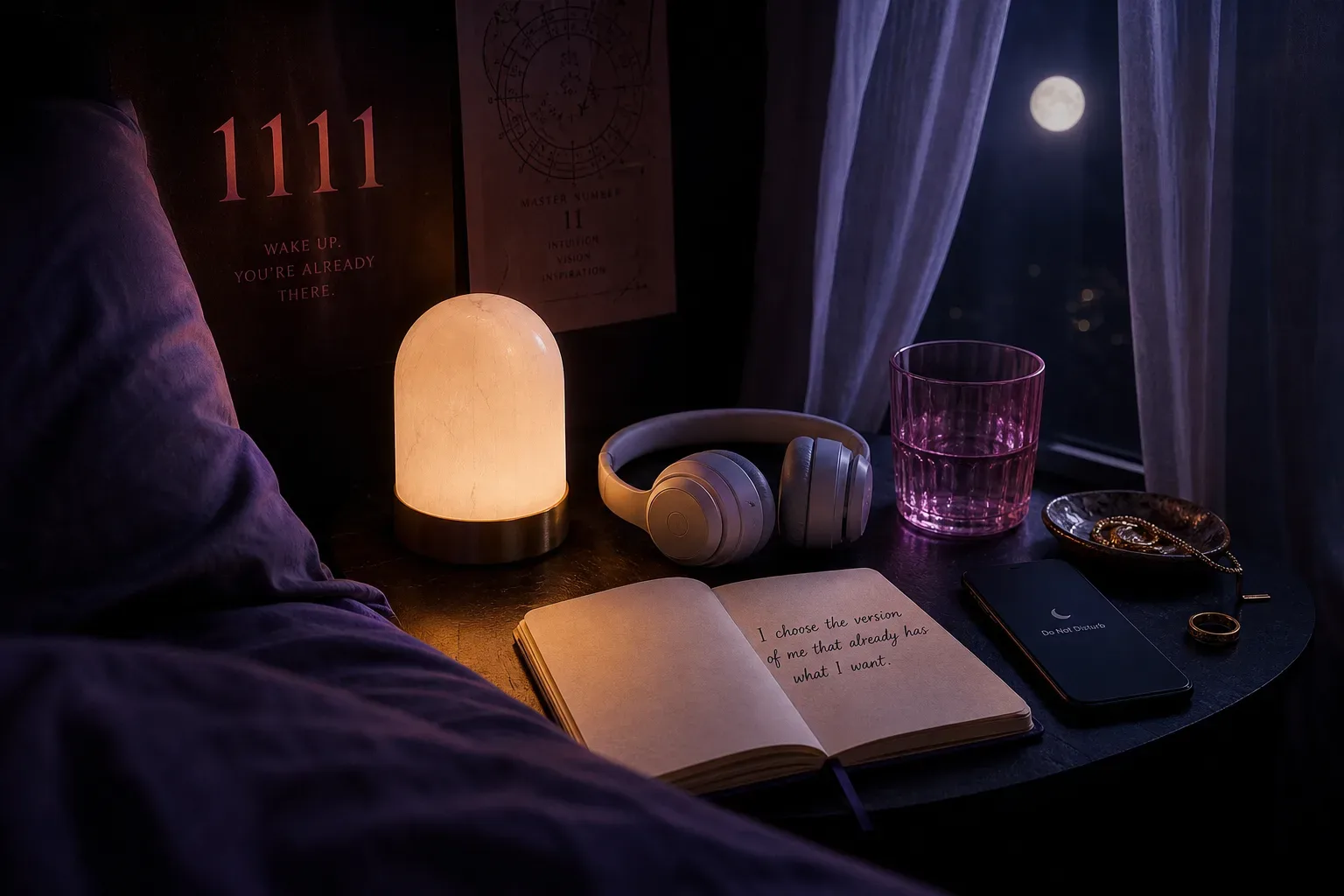
A bedtime routine for anxiety works best when it gives your nervous system one repeatable signal: the day is over, the body can soften, and the mind has somewhere safer to land. A 3-minute Dream-Self audio can become that signal when you pair it with dim light, slower breathing, and the same closing cue nightly.
What should a bedtime routine for anxiety actually do?
A bedtime routine for anxiety should reduce decisions, lower arousal, and give the brain a predictable end-of-day script.
Anxious nights are rarely dramatic at first. They start at 10:44 with one ordinary thought: did I answer that message. Then the dial moves. By 11:11, the body is awake enough to audit the entire life. The trick is not to win the argument. The trick is to stop opening the courtroom.
The American Psychological Association has reported that stress affects sleep for many adults, and CDC data has consistently placed insufficient sleep near 1 in 3 U.S. adults. Those numbers matter because anxiety at bedtime is not a personality flaw. It is a physiological timing problem wearing your voice.
A good routine does 3 things in order:
- It closes input. Less light, fewer tabs, no new emotional material.
- It downshifts the body. Breath, warmth, stillness, or a repeated audio cue.
- It redirects identity. Not “I am broken,” but “I am someone who can meet the night.”
That third step is where the AYA Method belongs. The AYA Method is a daily audio manifestation practice. Each day you listen to a short personalized recording, your Dream-Self Moment, narrated from the version of you who has already manifested the life you intend. Listening is the practice. Repetition is the work. The audio is the method.
Anxiety loves an open loop. A ritual is a loop with a gate.
If you already use a daily affirmation or a Manifestation Board, keep them nearby as complements. They can name the direction. They are not the spine here. At night, the spine is the audio: 3 minutes, one voice, one signal, on cue.
Why does anxiety get louder at night?
Anxiety gets louder at night because the brain has fewer distractions and the body may still be carrying daytime activation.
During the day, the mind is edited by noise. Messages arrive. Doors open. Someone asks for the file. At night, the room becomes a mirror. That is when the unfinished loops report for duty, often with excellent attendance.
Sleep researchers often describe insomnia through conditioned arousal: the bed becomes associated with wakefulness, worry, or effort. Cognitive Behavioral Therapy for Insomnia, or CBT-I, is considered a first-line treatment by groups including the American College of Physicians, which issued guidance in 2016 recommending CBT-I before medication for chronic insomnia in adults.
The body also runs on timing. Dr. Andrew Huberman often points to light as a major regulator of circadian rhythm, with morning light and evening darkness acting like bookends for the nervous system. You do not need to make your bedroom monastic. You do need the lights to stop sending noon-level instructions at 10:30.
Here is the simple night math:
| Anxiety trigger | What it tells the body | Better bedtime signal |
|---|---|---|
| Bright overhead light | Stay alert | One low lamp |
| Scrolling in bed | More input is coming | Phone outside the sheets |
| Solving tomorrow | Threat remains active | One written next step |
| Silence with no anchor | Fill the room | Dream-Self audio |
The brain is not weak because it repeats fear. It is loyal to whatever it thinks keeps you alive.
This is why a bedtime routine for anxiety should not be elaborate. A 12-step ritual can become another performance. The moment it asks too much, it joins the problem. The better ritual is small enough to survive a bad day.
For the broader philosophy behind intention, repetition, and attention, the Manifestation pillar gives useful context. At bedtime, we are not trying to force sleep. We are giving sleep fewer reasons to defend itself.
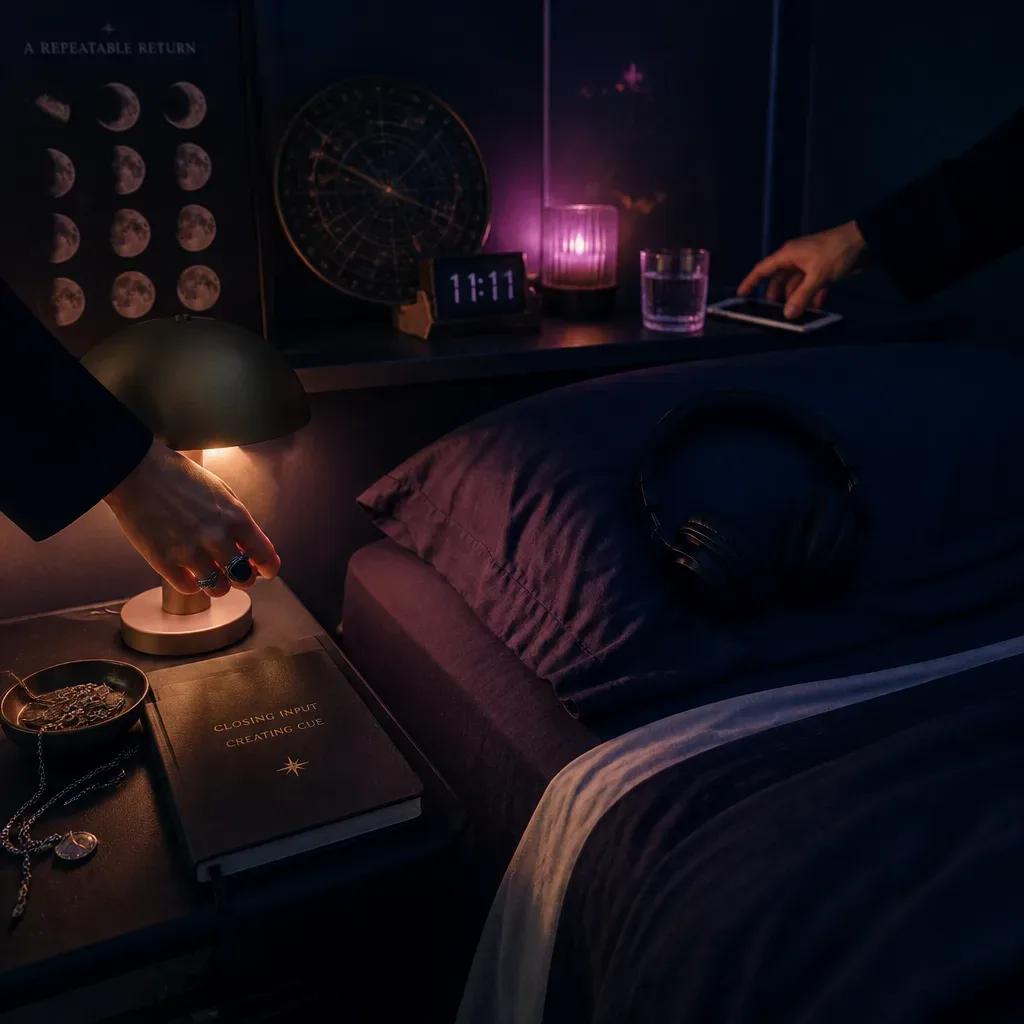
How do you set up the room before the 3-minute audio?
Set up the room by removing alerting cues 20 to 30 minutes before bed and making the audio the last intentional input.
The room does not need to look like a retreat. It needs to stop arguing with the body. If the lamp is bright, the phone is hot in your palm, and the laptop is still breathing on the desk, the room is saying, “Stay available.” Anxiety hears that clearly.
Start 20 minutes before bed. The National Sleep Foundation has long emphasized consistent sleep schedules and calming pre-sleep routines as practical sleep hygiene. Consistency is the point. If the cue changes every night, the body has to interpret it every night.
Use this 5-part setup:
- Dim one light, ideally below eye level.
- Put the phone on Do Not Disturb or across the room.
- Place water, tissues, or medication where you will not need to search.
- Open the audio before you get under the covers.
- Decide that the recording is the final “content” of the night.
That last line matters. Many people listen to meditation after 47 minutes of scrolling. The nervous system is not a filing cabinet. It does not neatly place panic headlines in one drawer and a soothing voice in another.
A manifestation practice is cleaner when the signal is cleaner. The Affirmations pillar explains how repeated language can shape attention, but at bedtime the sentence should not become a debate. One affirmation is enough. Something like: “I can let the day end before everything is fixed.”
If you follow lunar timing, angel numbers, or master numbers, use them as punctuation, not pressure. Seeing 11:11 can be a signal to return to the practice. It does not mean you failed if you are still anxious at 11:12.
The room does not have to be perfect. It has to be consistent enough for the body to believe it.
What is the exact 18-minute routine?
The exact routine is an 18-minute sequence: close input, downshift the body, listen to the Dream-Self audio, write one next step, and let the room go dark.
I like 18 minutes because it is long enough to register and short enough not to become a second job. In numerology, 18 reduces to 9, often read as completion. You do not have to believe that for it to be useful. Completion is exactly the assignment.
Follow this sequence for 7 nights before changing it:
- Minute 0 to 2: Close the gate. Put the phone away, dim the light, and stop negotiating with the day.
- Minute 2 to 5: Breathe with a longer exhale. Try inhaling for 4 counts and exhaling for 6 counts. In small studies, slow breathing has been associated with increased parasympathetic activity and reduced perceived anxiety.
- Minute 5 to 8: Listen to your 3-minute Dream-Self audio. Do not multitask. The future self gets the floor.
- Minute 8 to 11: Write one unfinished loop. One sentence only: “Tomorrow I will send the invoice at 9.”
- Minute 11 to 14: Repeat one closing affirmation. Keep it plain. No performance.
- Minute 14 to 18: Lights down, body still. If thoughts come, label them “planning” or “remembering,” then return to the last line of the audio.
The 3-minute recording is the center because it gives the mind a story that is neither denial nor disaster. It is the voice from the life you are claiming, spoken as if it has already arrived. Joe Dispenza often writes about rehearsing future states; whether you take his work literally or psychologically, rehearsal changes what the brain treats as familiar.
This is also where astrology and manifestation can be used with restraint. A moon phase can mark the season. A transit can name the weather. But the nightly audio is the appointment you actually keep.
Your bedtime routine should be so clear that anxiety cannot turn it into a committee meeting.
What should the Dream-Self audio say at bedtime?
The Dream-Self audio should speak from a calm future identity, use present-tense certainty, and avoid arguing with anxious thoughts.
A bedtime audio is not a pep talk. It should not be loud, glittering, or full of promises your body does not believe at midnight. The best script sounds like someone trustworthy entering the room quietly and taking the chair beside the bed.
Keep it to about 350 to 450 spoken words for 3 minutes, depending on pace. Many audiobook narrators read around 150 words per minute, but anxiety responds better to slightly slower delivery. Leave air inside the sentences. The pause is part of the medicine.
Use this structure:
| Audio moment | Purpose | Example line |
|---|---|---|
| Opening cue | Signals safety | “The day has ended, and I am allowed to stop.” |
| Future identity | Redirects self-image | “I am the woman who keeps her own rhythm.” |
| Evidence | Makes it believable | “I answered what needed answering today.” |
| Permission | Reduces pressure | “Nothing more has to be solved in the dark.” |
| Return line | Gives the mind a handle | “I meet tomorrow from a rested body.” |
Notice what is missing: no war on anxiety. The mind does not calm because it has been insulted into silence. Tara Brach’s work around radical acceptance is useful here; naming what is present often softens the fight around it. You can say, “Fear is here,” without handing fear the microphone.
If you want to add an affirmation after the audio, use only one. The Affirmations pillar has more on phrasing, but bedtime language should be spare. Too many sentences become another stack of instructions.
A good Dream-Self audio does not pretend the night is empty. It gives the night a better witness.

What if the routine does not work the first night?
If the routine does not work the first night, keep it anyway and measure repetition, not perfect sleep.
Anxiety loves to grade the ritual immediately. You listen once, still feel wired, and the mind announces: failed. That is not data. That is impatience wearing a lab coat.
Most behavioral sleep changes take time because the bed, the room, and the hour already have a history. CBT-I programs often run 4 to 8 weeks, not one night, because conditioning is learned through repetition. Your 18-minute routine is not a sedative. It is a new association being installed by attendance.
Track only 3 things for the first week:
- Did I start within 30 minutes of my intended time?
- Did I listen to the full 3-minute audio?
- Did I avoid adding new input afterward?
Do not track how fast you fell asleep unless a clinician has asked you to. For anxious people, sleep metrics can become another mirror with teeth. Wearables can be useful, but a 2023 discussion in sleep medicine circles raised concerns about orthosomnia, a term used when people become preoccupied with optimizing sleep data.
If you are awake after 20 to 30 minutes, many CBT-I protocols suggest leaving the bed briefly and doing something quiet in low light until sleepiness returns. That is not a failure. It protects the bed from becoming the place where you practice frustration.
A ritual is not magic because it works instantly. It is magic because it tells the truth repeatedly until the body starts to answer.
If panic attacks, trauma memories, or severe insomnia are part of your nights, bring in professional support. A bedtime routine for anxiety can sit beside therapy, medication, or clinical sleep care. It does not need to replace any of them to be worthy.
How do you make this routine last beyond a week?
Make the routine last by keeping the core fixed and changing only the small seasonal details.
The core is simple: dim the room, slow the body, listen to the Dream-Self audio, close one loop, go dark. Keep that intact for at least 28 nights. A lunar cycle is about 29.5 days, which makes 28 nights a clean practical container: long enough to observe patterns, short enough to begin tonight.
Then let the edges respond to your season. In winter, warmth may matter more. In summer, the room may need cooling. During a heavy work month, the one-line loop may be the most important part. During a tender emotional month, the audio may need more permission and fewer declarations.
You can also refresh the Dream-Self audio every month. Not because the old one expires, but because your ear gets sharper. After 30 listens, you may notice the line that lands and the line that performs. Keep the line that lands.
Here is the maintenance rule:
| Keep fixed | Adjust gently |
|---|---|
| 3-minute audio | Voice tone or pacing |
| Low light | Lamp, candle, or hallway light |
| One written loop | Notebook, card, or notes app before bed |
| No new input after audio | Exact phone location |
The practice should have a spine and a wardrobe. The spine stays. The wardrobe changes with the weather.
For a wider frame on intention and timing, return to the Manifestation pillar, especially when you are tempted to treat one anxious night as a prophecy. It is not. It is one night. The dial can line up again tomorrow.
Tonight, make the room simple enough to believe you.