subliminals
Subliminals While Sleeping: Audible Future-Self Audio
Subliminals while sleeping can shape attention, but audible future-self audio gives the mind a clearer signal before rest and after waking.
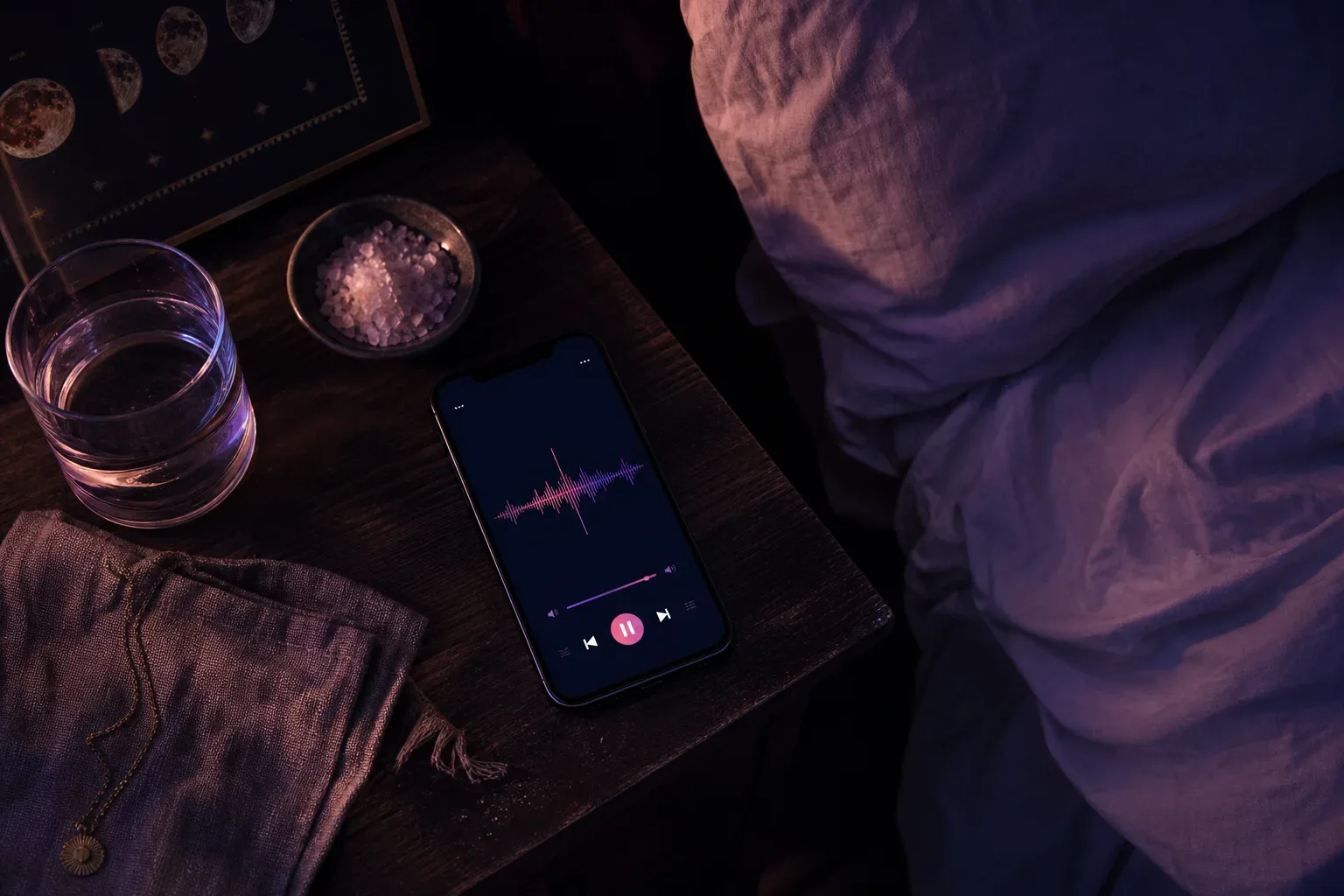
Subliminals while sleeping can be useful when they calm the nervous system and repeat a chosen direction, but audible future-self audio is usually clearer. The sleeping brain is not a blank page. It filters sound, memory, and emotion in cycles, so the signal matters more than the mystery.
Do subliminals while sleeping reach the mind?
Yes, the sleeping brain can process sound, but it does not treat every hidden message like an instruction.
She texted me at 11:11 on a Tuesday: “I played the track all night and woke up thinking of my old boss.” Not the desired result, exactly. But also not nothing. Sleep is not a sealed room. The National Institute of Neurological Disorders and Stroke describes sleep as an active state, with the brain moving through non-REM and REM cycles about every 90 minutes. The dial keeps turning.
Research on sleep learning is cautious. Studies on targeted memory reactivation, including work published in Science and Nature Neuroscience, suggest that sounds paired with learning can cue memory during sleep. That is different from installing a new identity through a whisper under music. It means the brain can respond to cues it already recognizes.
That distinction matters. A subliminal track you cannot hear may contain words, but you cannot witness them. You do not know the phrasing, the tone, or whether the message lands cleanly. A future-self audio track that you can hear before sleep gives your attention a nameable signal. The mind cannot repeat what it cannot recognize.
The better question is not whether sound enters sleep. It does. The question is whether the sound is meaningful enough, familiar enough, and timed well enough to become part of the next morning’s attention. In manifestation work, meaning beats volume. Repetition beats spectacle.
Are subliminals while sleeping safe for nightly use?
Usually, yes, if the audio is gentle, low-volume, and does not interrupt sleep quality.
The Centers for Disease Control and Prevention says most adults need at least 7 hours of sleep per night. That number is not decorative. When a manifestation practice steals rest, it has started charging interest. A track that wakes you five times is not discipline. It is noise wearing a spiritual costume.
Sleep audio should be treated like seasoning. Enough salt and the soup arrives. Too much and the whole pot becomes one note. As a cook, I respect the threshold. My grandmother could tell from the steam whether the rice needed two more minutes. Sleep has thresholds too: volume, brightness, temperature, and emotional charge.
Use this simple safety check:
- If you wake refreshed, the audio is probably not interfering.
- If you wake irritated, reduce volume or duration for 3 nights.
- If you remember the track more than your dreams, play it before bed instead.
- If earbuds hurt, use a speaker at the lowest clear setting.
- If anxious thoughts rise, choose calmer wording or stop for the night.
Dr. Andrew Huberman often emphasizes that light exposure, temperature, and consistent timing affect sleep architecture. Audio belongs in that same practical category. Not sacred. Not forbidden. Managed. A practice is only aligned if your body can afford it.
For many people, the cleanest rhythm is 3 to 10 minutes of audible future-self audio before sleep, then silence. The message enters the room while you are still conscious enough to receive it. Then sleep does its deeper work without being asked to host a lecture.
Why try audible future-self audio instead of hidden affirmations?
Audible future-self audio gives your brain a clear scene, not a secret command.
A hidden affirmation asks you to trust the producer. Audible future-self audio asks you to listen. That difference is not small. In the AYA Method, the practice is precise: The AYA Method is a daily audio manifestation practice. Each day you listen to a short personalized recording — your Dream-Self Moment — narrated from the version of you who has already manifested the life you intend. Listening is the practice. Repetition is the work. The audio is the method.
The daily affirmation and Manifestation Board can support that listening, especially if you like one sentence on paper or one image in sight. But they are complements. The audio carries the scene. It gives the subconscious something textured: your future apartment at 6:40 a.m., your hands steady before a difficult conversation, your name on the email you used to fear opening.
A 2015 review in Psychological Bulletin found that mental imagery can affect emotion and motivation because the brain responds strongly to simulated experience. Joe Dispenza speaks often about rehearsing a future state until the body recognizes it. Neville Goddard called it living in the end. Different rooms, same table: the inner scene becomes more persuasive when you can feel it.
Here is the useful comparison:
| Practice | What you receive | Best timing | Main risk |
|---|---|---|---|
| Silent subliminals | Unverified hidden messages | Overnight | You cannot check the wording |
| Spoken affirmations | Clear statements | Morning or bedtime | May feel flat without emotion |
| Audible future-self audio | Scene, voice, identity cue | Before sleep or after waking | Requires honest personalization |
This is where the Manifestation pillar becomes relevant: intention needs form. Not drama. Form. A sentence, a sound, a time on the clock. The future becomes easier to claim when it has a voice you recognize.
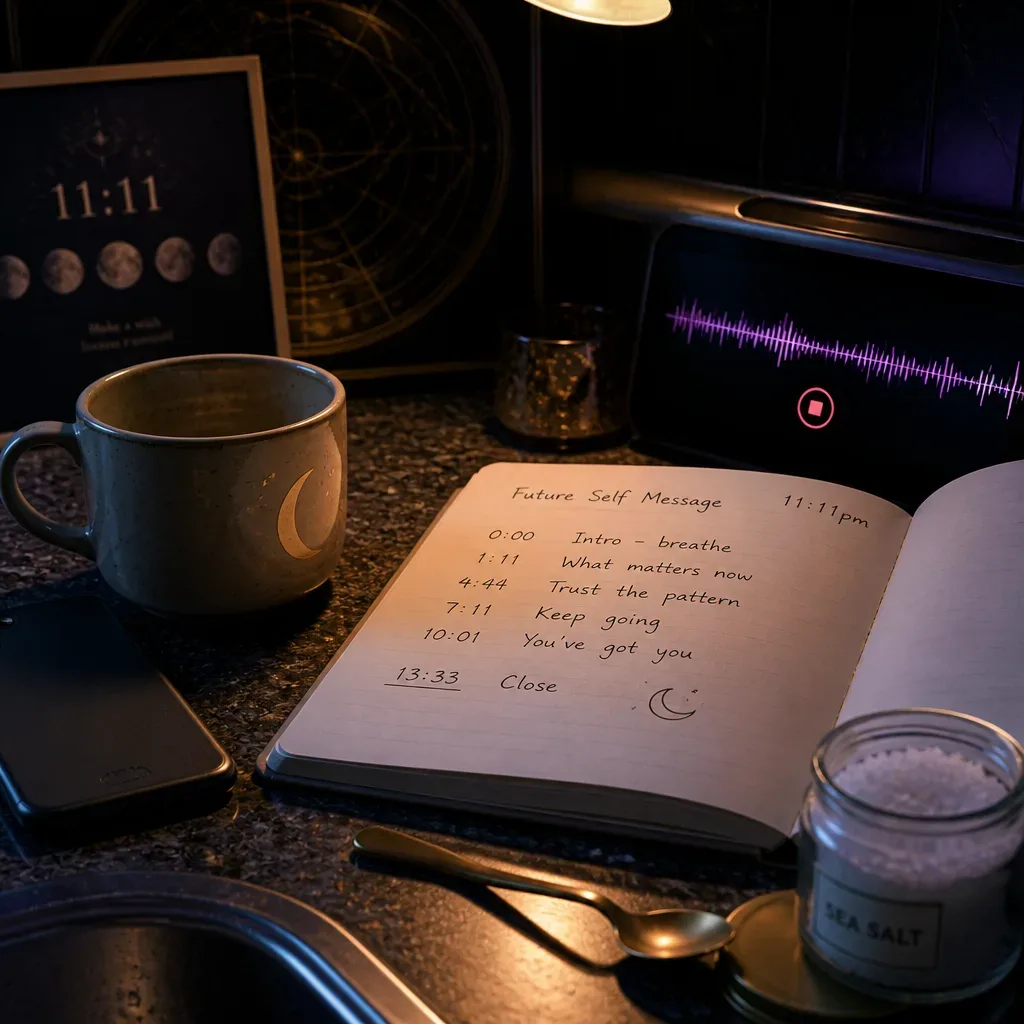
When should you listen: before sleep, during sleep, or after waking?
The best time is usually before sleep, with after waking as the second strongest gate.
The edge before sleep is called the hypnagogic state. The edge after waking is hypnopompic. Neither is a magic trapdoor, but both are suggestible thresholds. Researchers have studied these transitional states for decades because imagery, memory, and emotion can become vivid there. If you have ever solved a problem in the shower at 7:22 a.m. after failing at 10:40 p.m., you already know the brain keeps working offstage.
For subliminals while sleeping, timing decides whether the track becomes a cue or a disturbance. During deep non-REM sleep, the brain is less available to language. During lighter sleep, sound may be processed but can also wake you. REM sleep tends to carry emotional dreaming, but external audio can fragment it. That is why all-night tracks are not automatically stronger.
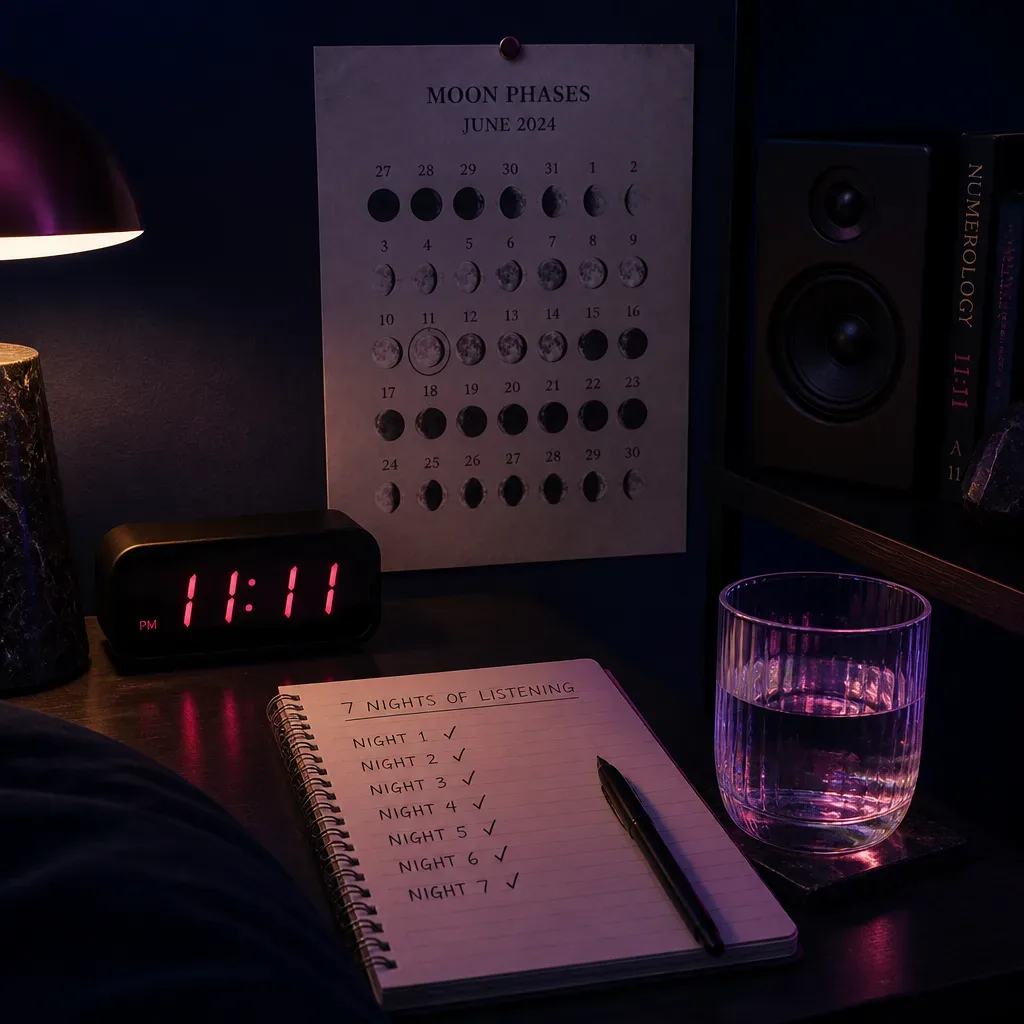
Try a 7-night timing test:
- Nights 1 and 2: listen for 5 minutes before sleep, then silence.
- Nights 3 and 4: listen on a 20-minute sleep timer.
- Night 5: skip audio and write one sentence before bed.
- Nights 6 and 7: listen within 10 minutes of waking.
- Each morning, rate sleep quality from 1 to 5 and note the first thought you remember.
This is not a laboratory. It is a kitchen. You taste, adjust, and stop pretending the recipe is universal. In small sleep-cueing studies, effects often depend on prior learning and repetition, not on one dramatic exposure. Seven nights gives you enough pattern to notice whether the signal arrived.
If you want more language-based support, read the Affirmations pillar and keep the wording simple. One good sentence can beat 44 vague ones. One honest voice can beat a thousand hidden commands.
What should future-self audio actually say?
It should describe a specific lived moment from the self you are practicing becoming.
Do not fill the track with glittering generalities. The subconscious is not impressed by adjectives. It responds to felt detail, repeated association, and emotional safety. A good future-self audio is not a sales pitch. It is a witness statement from the life you are claiming.
A strong Dream-Self Moment has four ingredients:
- Time: “It is 6:30 in the morning, and I wake without checking my phone.”
- Body: “My shoulders are loose. My breath is slow.”
- Evidence: “The invoice is paid. The kitchen is clean. The message has arrived.”
- Identity: “I move like someone who trusts her own timing.”
Tara Brach often teaches the power of naming what is present. In a different register, the same principle applies here. Name the scene. Name the behavior. Name the proof. The brain is more likely to rehearse a scene it can locate. A 2021 paper in Nature Reviews Psychology noted that self-related thought plays a central role in emotion and behavior. Future-self audio works with that self-model instead of trying to sneak around it.
Here is a simple script structure you can adapt:
- Start with a timestamp or setting.
- Speak from the future self, not the wanting self.
- Include one sensory detail.
- Include one ordinary proof.
- Close with a sentence you can believe by 1 percent.
For example: “It is Thursday morning. The coffee is warm in my hand, and the room is quiet. I have already sent the proposal. I do not rush the reply. I know how steady feels, and I return to it on cue.”
That is stronger than “I am successful” repeated under rainfall for 8 hours. Specificity is the salt of manifestation: without it, everything tastes unfinished.
How do angel numbers and sleep cues fit without getting strange?
Use numbers as attention markers, not as orders from the sky.
This is Manifest 11, so yes, we notice numbers. Master numbers 11, 22, and 33 have long numerology associations: 11 with intuition and signal, 22 with building, 33 with teaching or service. Doreen Virtue popularized angel numbers in the early 2000s, though her later religious shift complicates that legacy. We can hold the cultural reference without outsourcing our judgment.
If you keep seeing 11:11 while experimenting with subliminals while sleeping, treat it as a bell. Pause. Ask what you were thinking. Note the pattern. The number is not doing the work for you. It is pointing at the work already in motion.
The Princeton Engineering Anomalies Research program, active from 1979 to 2007, studied mind-matter questions with controversial results that remain debated. Its more useful contribution for our purposes may be the permission to study odd patterns without becoming sloppy. Synchronicity deserves observation before interpretation.
Try pairing numbers with practice in a grounded way:
| Number cue | Practical response | Audio use |
|---|---|---|
| 11:11 | Notice the thought in the room | Play your track once consciously |
| 22:22 | Choose one building action | Schedule tomorrow’s 10-minute task |
| 3:33 | Return to care and service | Ask who benefits from your becoming |
| New moon | Set the next cycle’s scene | Record updated future-self audio |
| Full moon | Review what became visible | Remove stale wording |
For broader timing work, Astrology and manifestation can help you think in cycles without surrendering your agency. Lunar months run about 29.5 days. That is enough time to test a phrase, not enough time to fake a whole life.
Numbers are punctuation. The sentence is still yours.
How do you know the audio is working?
You know it is working when your attention, choices, and emotional recovery begin to shift in observable ways.
Do not measure only by whether the exact desire arrived by Friday. Measure the early signals. Did you send the email 2 days sooner than usual? Did you stop replaying the same argument at midnight? Did you notice the old pattern before entering it? Behavior is evidence. So is recovery time.
In the Journal of Behavioral Medicine, studies on relaxation and guided imagery have linked regular practice with stress reduction, though results vary by population and method. That is the honest lane for future-self audio. It is not a remote control for reality. It is a daily cue that can change what you notice, tolerate, choose, and repeat.
Track three things for 14 days:
- Sleep quality: Rate 1 to 5.
- First thought: Write the first sentence in your mind on waking.
- Aligned action: Record one action that matched the future-self scene.
Fourteen days is long enough to see a tilt. Not a final verdict, a tilt. My own test began in the spring of my thirty-first year. I listened while grinding coffee, phone face-down on the counter, the way my mother taught me not to stir a pot while angry. By day 9, I had not become a different woman. I had become easier to interrupt before betraying myself.
That is not small. That is the gate.
If you want the broader map, keep the Manifestation pillar open beside the AYA Method. Let the Affirmations pillar sharpen your sentences, and let Astrology and manifestation help you test timing by cycle. The audio remains the spine.
Put the voice where the night can find it.