frequencies binaural
Theta Waves Manifestation With Dream-Self Audio
Theta waves manifestation can help your mind receive Dream-Self Audio more clearly. Use this 11-minute practice without drifting into fantasy.
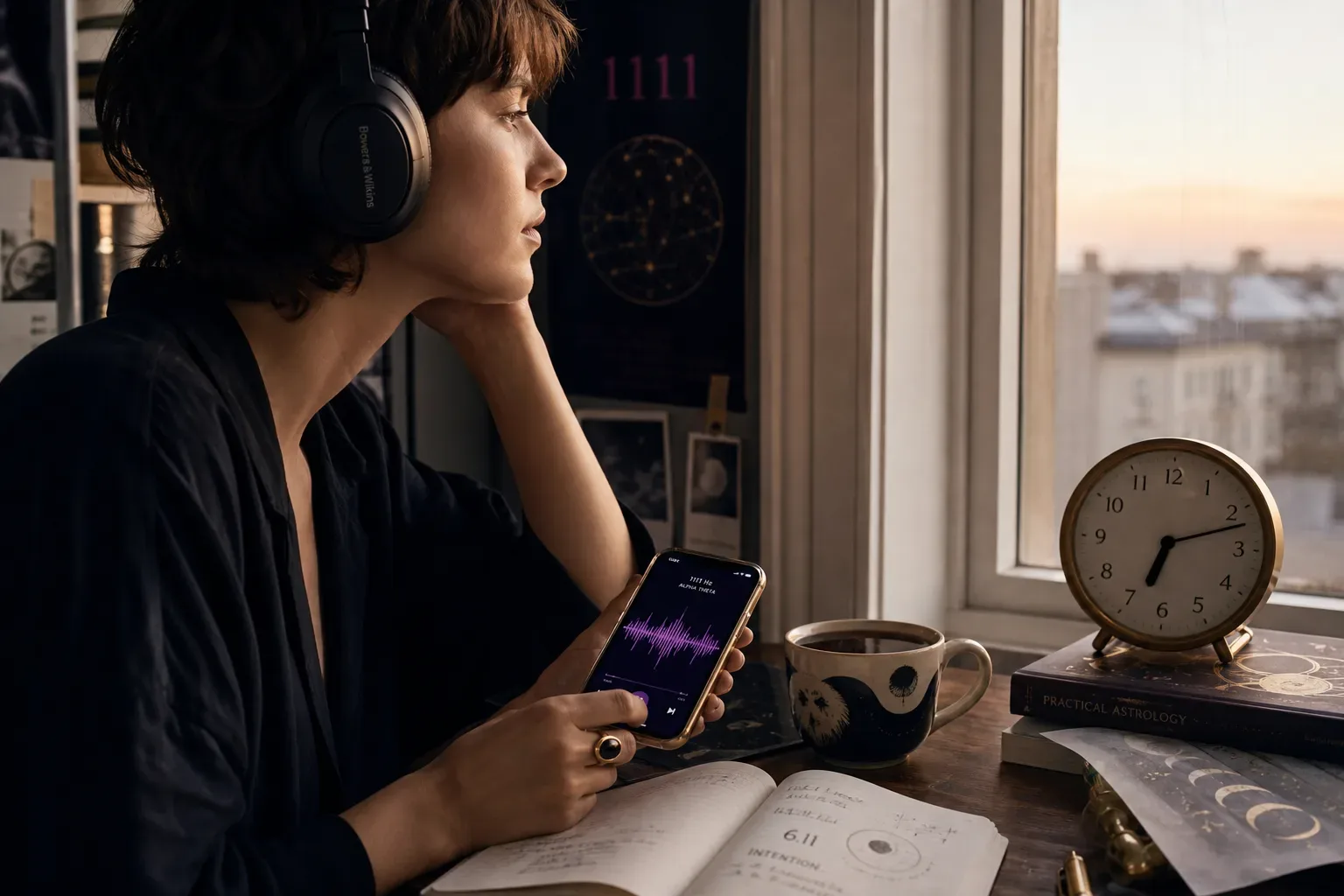
At 6:11, before the kettle clicked, I used theta waves manifestation the only way I trust it: with Dream-Self Audio, a quiet body, and one small action afterward. Theta does not do the claiming for you. It makes the mind more receptive while your future-self script gives the state a name.
What are theta waves, and why do they matter for manifestation?
Theta waves matter because they describe a receptive brain state, not a magic frequency that forces life to obey.
In EEG research, theta is generally measured around 4 to 8 Hz. It often appears during drowsiness, early sleep, meditation, memory processing, and vivid imagery. That is the first useful boundary. Theta is not a personality type. It is not a cosmic receipt. It is a rhythm the brain can move through, often when the usual executive grip loosens.
For manifestation practice, that softer grip matters. A tense mind audits every sentence. A receptive mind can rehearse identity without turning the whole thing into a courtroom. This is why many meditation traditions aim for relaxed alertness rather than blankness. Dr. Andrew Huberman often describes non-sleep deep rest, or NSDR, as a state that can support nervous-system recovery and learning; it is not identical to theta, but it points to the same practical gate: quiet the body enough for the brain to update.
Joe Dispenza speaks about moving beyond familiar emotional patterns through repeated inner rehearsal. You do not have to adopt all of his metaphysics to notice the behavioral point. Repetition in a charged state teaches the nervous system what to recognize. A 2014 review in Frontiers in Human Neuroscience noted that meditation is associated with changes in attention and self-regulation networks, though methods and results vary.
Manifestation gets sloppy when people confuse symbol with substitution. Seeing 11:11 can be a signal. It cannot send the email, set the boundary, or stop the spiral. For a grounded frame, keep the Manifestation pillar nearby: intention needs a place to land.
Theta is not the wish. Theta is the open door.
How does Dream-Self Audio use theta without making wild claims?
Dream-Self Audio uses theta as a listening condition, while the personalized recording supplies the identity rehearsal.
Here is the clean definition: the AYA Method is a daily audio manifestation practice. Each day you listen to a short personalized recording, your Dream-Self Moment, narrated from the version of you who has already manifested the life you intend. Listening is the practice. Repetition is the work. The audio is the method.
That last sentence is the spine. Not the candle. Not the notebook. Not the perfect morning that never arrives when a child wakes up at 5:42. The audio is the method. The daily affirmation and Manifestation Board can help, but they are complements. They orbit the listening practice; they do not replace it.
Theta-style listening works because it gives the script fewer obstacles. In cognitive psychology, mental imagery has been studied for decades in sport and rehabilitation settings. A 2017 meta-analysis in Psychology of Sport and Exercise found that imagery interventions can improve performance, with effects shaped by vividness, repetition, and task type. That does not prove every manifestation claim. It does show that rehearsed inner experience can influence outer behavior.
Dream-Self Audio is especially useful because it is specific. A vague sentence like “I am successful” can bounce off the nervous system. A future-self narration that says, “I close the laptop at 5:30 and do not apologize for dinner with my family” gives the mind a scene, a standard, and a cue. The dial lines up because the room is named.
If you also use written statements, keep them tight. The Affirmations pillar is useful here: an affirmation should be believable enough to repeat and sharp enough to steer behavior.
How do you prepare your mind in 3 minutes?
Prepare by making the body safe, the environment boring, and the intention narrow.
The brain does not enter a receptive state because you command it to. It changes state through cues. Light, posture, breath, repetition, and sound all count. Sleep researchers have measured how strongly light exposure affects circadian timing; even ordinary indoor lighting can influence alertness, according to work published in Journal of Clinical Endocrinology & Metabolism. So lower the light if you want the nervous system to stop scanning.
Use this 3-minute entrance before the audio:
- Minute 1: remove friction. Put the phone on Do Not Disturb, sit down, and decide that this session is not for texting, tracking, or fixing.
- Minute 2: lengthen the exhale. Try six slow breaths, with the exhale slightly longer than the inhale. Slow breathing around 6 breaths per minute has been studied for heart-rate variability and relaxation.
- Minute 3: name the gate. Say one sentence: “I am listening as the version of me who already knows what matters today.”
That is enough. The ceremony can be small and still be real. I have done this in a parked car between preschool drop-off and a deadline moved to 10:00. The mind does not need velvet conditions. It needs a repeated signal.
You can add a number if numbers help you notice. Eleven breaths. A session that starts at 7:22. A lunar date circled on the calendar. The point is not superstition; it is attention. Astrology and manifestation can work the same way when used cleanly: timing as a mirror, not as an excuse.
A ritual is not stronger because it is elaborate. It is stronger because you return to it.
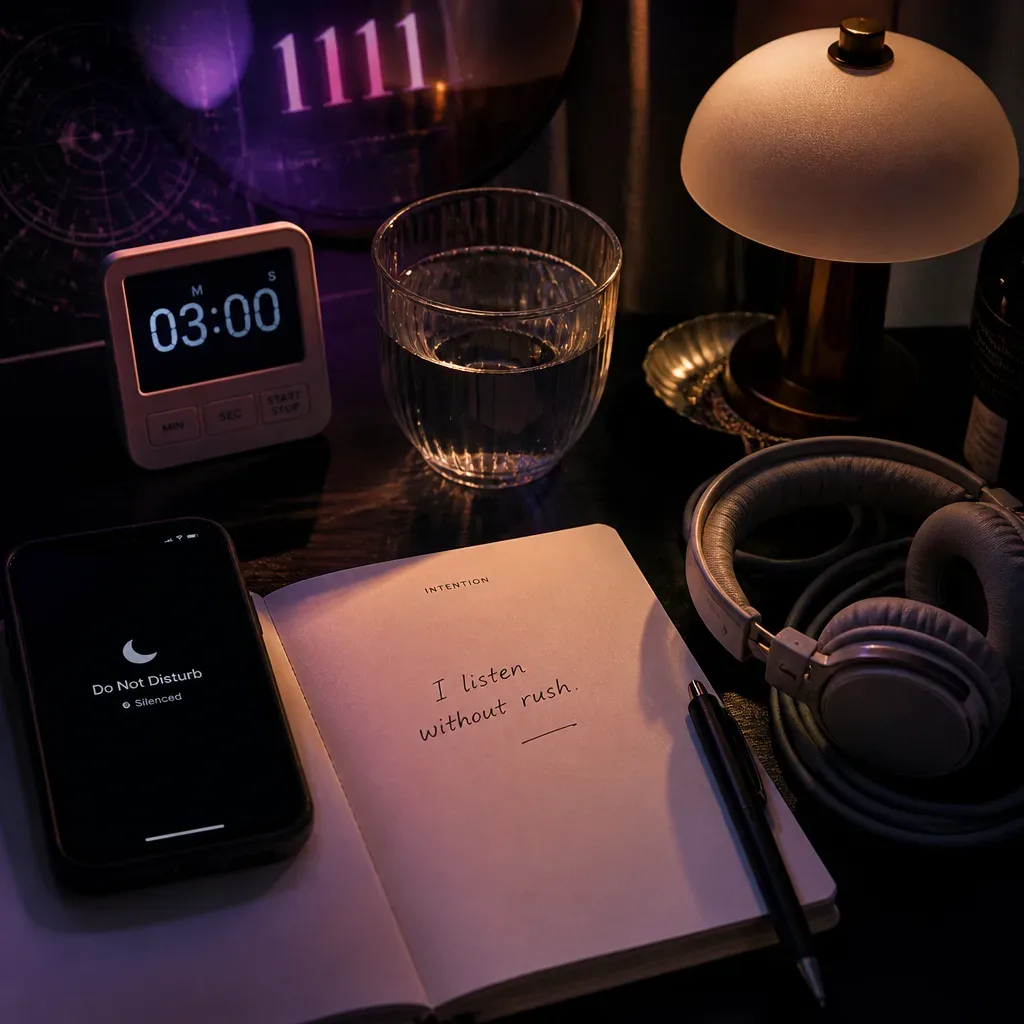
What is the 11-minute theta waves manifestation practice?
The 11-minute practice is a simple container: settle, listen, receive, and take one aligned action.
I like 11 minutes because the number has cultural charge without becoming a performance. In numerology, 11 is treated as a master number, often tied to intuition and illumination. Historically, numerology systems vary, and Doreen Virtue’s angel-number work popularized repeated-number noticing in the 2000s, though she later distanced herself from that field. Use the number as punctuation, not proof.
Here is the practice:
| Minute | What to do | Why it matters |
|---|---|---|
| 0:00–2:00 | Sit, breathe, lower sensory input | Signals safety and reduces mental noise |
| 2:00–9:00 | Listen to your Dream-Self Audio | Rehearses identity in a receptive state |
| 9:00–10:00 | Stay still, no scrolling | Lets the scene settle before language crowds it |
| 10:00–11:00 | Write one action | Converts state into behavior |
If you use binaural beats, headphones are required for the classic effect because each ear receives a slightly different tone and the brain perceives the difference. A 2019 meta-analysis in Psychological Research found small effects of binaural beats on memory, attention, anxiety, and pain perception, with results depending on frequency and exposure length. Small is still useful when the practice is daily.
Keep the Dream-Self Audio audible but not theatrical. You are not trying to drown yourself in sound. You are trying to let one future identity become familiar. Familiarity is underrated. Much of adulthood is simply doing what has become familiar, then calling it choice.
If a sentence lands, do not chase the whole recording. One charged line is enough. Maybe it is, “I answer from calm authority.” Maybe it is, “I no longer build my career from panic.” Write that down. A signal gets stronger when you witness it.
What should you do after listening so the state reaches your day?
After listening, take one small behavior that proves the identity to your nervous system.
The after-state is where many people lose the thread. They have a beautiful session, feel the tilt, then immediately open a feed designed to scatter attention. Pew Research Center reported in 2024 that a large majority of U.S. adults use YouTube and Facebook, and many adults use multiple social platforms. The exact platform is not the villain. The immediate switch is the issue.
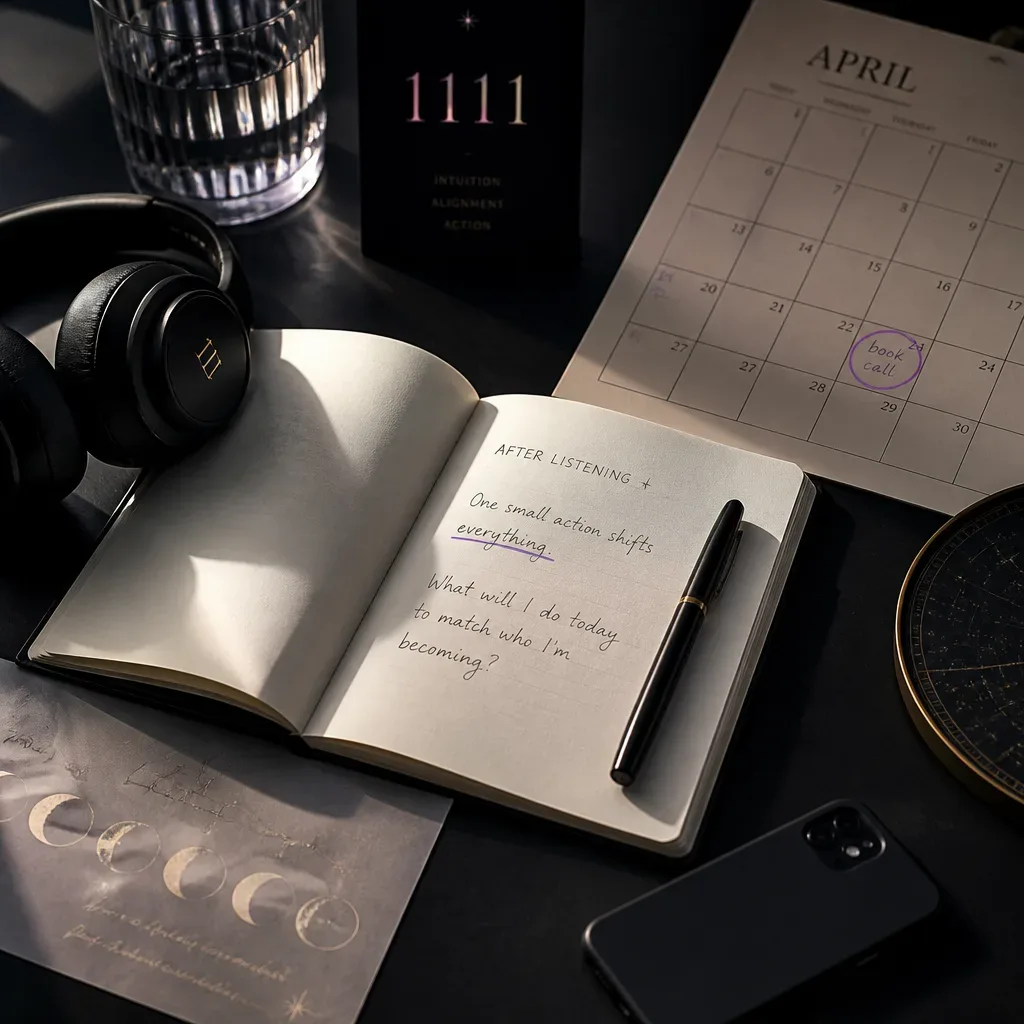
Give yourself 60 seconds before the world rushes in. Write one line. Put one thing on the calendar. Delete one obligation that belongs to your old self. Send one message from the version of you who is no longer bargaining with exhaustion.
Useful post-audio actions include:
- Name the sentence: write the line from the audio that felt most alive.
- Choose the proof: pick one behavior you can complete in under 10 minutes.
- Reduce the contradiction: remove one tiny habit that argues with the future-self identity.
- Mark the pattern: if the same number, theme, or dream repeats, record it without overreading it.
A Manifestation Board can help after listening because it gives the mind a visual anchor, but it is not the engine. The listening practice comes first. The board is a witness. If written language helps, pair the action with one line from the Affirmations pillar, then stop before it becomes homework.
This is the grown-up version of synchronicity: you notice the sign, then you answer with behavior. For wider context on intention, identity, and timing, use the Manifestation pillar as the map, not the mood board.
A sign that never changes your behavior is only decoration.
How often should you use theta audio, and when should you skip it?
Use theta audio daily if it steadies you, and skip it when it makes you foggy, avoidant, or unsafe.
Daily repetition matters because the mind learns through recurrence. In habit research, a 2009 study in the European Journal of Social Psychology found that automaticity took a median of 66 days to develop, with wide variation from 18 to 254 days. That number gets quoted because it is humbling. Your nervous system may need more than a weekend to believe a new identity.
Start with 7 to 11 minutes for 14 days. Track only three things: whether you listened, the sentence that arrived, and the action you took. Do not track your worth. Do not turn the streak into a new authority figure. I say this as someone with a long AYA streak and a child who has broken it more than once on cue.
Skip theta-style audio in these situations:
- while driving, biking, cooking, or supervising a child near water
- when you feel dissociated or unable to orient to the room
- after alcohol or sedatives
- during a work block that requires sharp external attention
- if frequency tracks trigger headaches, agitation, or panic
If you are working with trauma symptoms, psychosis, seizures, or severe anxiety, ask a qualified clinician before adding frequency-based audio. This is not a moral warning. It is a nervous-system warning. The practice should make you more present in your life, not less available to it.
Night listening can be powerful, but morning has one advantage: it leaves the day available for proof. If you listen at 6:11 and make the calm phone call at 9:30, the brain gets a clean association. Signal, identity, behavior. On cue.
What mistakes make theta waves manifestation feel foggy instead of clear?
Theta waves manifestation gets foggy when you use the state to escape decision-making instead of rehearsing identity.
The first mistake is chasing sensation. Tingling, warmth, dreamlike images, and time distortion can happen in relaxed states, but they are not the goal. Meditation researchers often warn that experiences vary widely across practitioners. A 2021 review in Perspectives on Psychological Science also noted that meditation can have adverse effects for some people, including anxiety or dissociation. More sensation does not mean more alignment.
The second mistake is using generic audio for a specific life. Rain sounds and theta tones can calm the room. They cannot narrate the career boundary, the healed money pattern, the sober Sunday, the patient parenting moment, or the quiet return to appetite after burnout. Your Dream-Self Audio should sound like your life with the volume turned toward truth.
The third mistake is treating synchronicity as command. Repeating numbers, lunar cycles, and astrology can be elegant timing tools. They can also become a way to delay the obvious. If you wait for the perfect transit to answer the email, the email becomes the planet you are actually orbiting. Use Astrology and manifestation to read the season, then make the move that belongs to it.
The fourth mistake is making the practice too large to survive Tuesday. Eleven minutes is useful because it can fit inside an actual life. A toddler can interrupt it. A deadline can compress it. A headache can turn it into three breaths and one replayed sentence. That still counts if listening remains the center.
The method that survives your real calendar is the method that can change your real life.
If all you do today is press play, hear one true sentence, and act on it once, the dial has already moved.
Listen where the room goes quiet.