morning rituals
ADHD Morning Routine With a 3-Minute Dream-Self Audio
Build an ADHD morning routine around one 3-minute Dream-Self audio, so your first minutes feel clear, gentle, and possible.

The kettle clicks. Your phone is face down. An ADHD morning routine works best when the first step is tiny, named, and already waiting. A 3-minute Dream-Self audio gives your attention one clear place to land before messages, decisions, or the old rush can take over.
What makes an ADHD morning routine actually work?
An ADHD morning routine works when it removes decisions before it asks for discipline.
ADHD is not a character flaw hiding in your alarm clock. It is often a problem of initiation, sequencing, working memory, and time sense. The National Institute of Mental Health estimates adult ADHD affects about 4.4% of U.S. adults, and many researchers, including Russell Barkley, have described ADHD as closely tied to executive function. That matters in the morning, because the morning is a stack of executive tasks wearing pajamas.
The mistake is making the routine too wide. Wake up, meditate, stretch, journal, hydrate, plan the day, make breakfast, answer no one, become new. That sounds clean on paper. In a real kitchen, with a child asking where the blue socks are, it breaks by 7:12. A routine that needs your best brain first is not kind to an ADHD brain.
Start with one cue, one audio, one next action. That is enough structure to begin without creating a new set of failures. In Lally and colleagues’ 2009 habit study in the European Journal of Social Psychology, automaticity took 66 days on average, with a range from 18 to 254 days. The number is useful because it tells the truth. Routines are not born in a weekend.
Here is the quieter frame:
- Reduce the number of choices in the first 10 minutes.
- Put the first action where your hand already goes.
- Use sound before screens.
- Name the next action before the audio ends.
- Let the routine be small enough to repeat on a bad morning.
You are not trying to win the morning. You are trying to enter it without losing yourself.
Why begin with a 3-minute Dream-Self audio?
Begin with the audio because sound can hold your attention before your mind starts bargaining.
The AYA Method is a daily audio manifestation practice. Each day you listen to a short personalized recording — your Dream-Self Moment — narrated from the version of you who has already manifested the life you intend. Listening is the practice. Repetition is the work. The audio is the method.
Three minutes is not magic. It is merciful. Many ADHD tools fail because they ask for setup before relief. A short audio asks for one press of a button. It gives rhythm, tone, and sequence. In cognitive psychology, external cues are often used to support task initiation; Wood and Neal’s 2007 habit research describes how repeated behavior can become tied to stable contexts. Same bed. Same headphones. Same first sound. The cue begins to carry some of the weight.
Manifestation, here, is not pretending. It is rehearsing identity in a format your nervous system can receive when the day is still soft. Mental practice has been studied in sports and performance settings for decades. Driskell, Copper, and Moran’s 1994 meta-analysis found mental practice had a positive effect on performance, especially when paired with physical practice. That does not prove every manifestation claim. It does suggest that rehearsing a future action can change how you approach the real one.
If you want the wider foundation, the Manifestation pillar explains the practice more fully. For an ADHD morning, keep it narrower. You listen to your Dream-Self Moment. You let it name the version of you who has already begun. Then you do the next visible thing.
The first win is not a perfect morning. The first win is not abandoning yourself before breakfast.
How do you set it up the night before?
Set it up by making the morning decision before morning arrives.
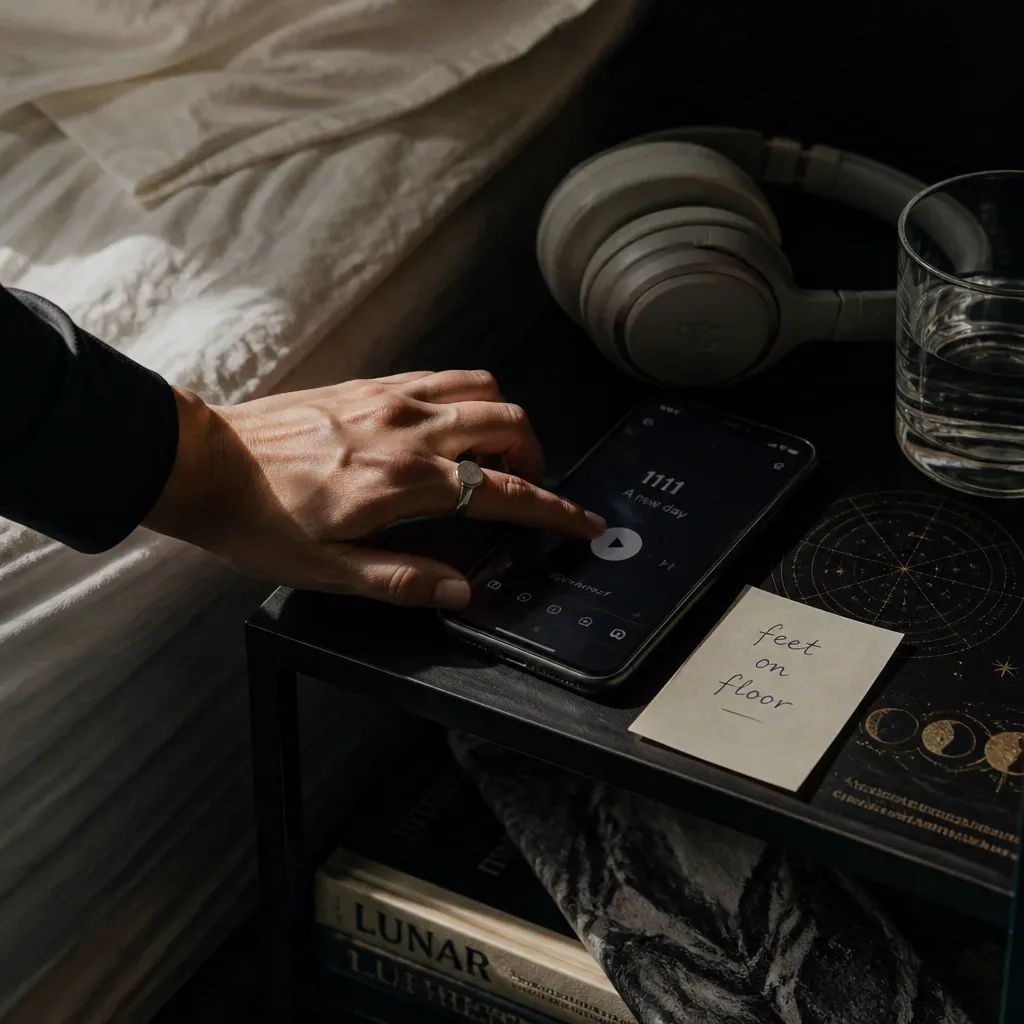
This is the part that saves you. Not motivation. Placement. Before sleep, choose the device, volume, and location for your 3-minute Dream-Self audio. If you use headphones, put them where they can be reached without opening a drawer. If you play audio aloud, set the volume low enough that it feels private. The Sleep Foundation notes that adults generally need 7 or more hours of sleep per night; a setup that steals sleep is not a morning routine. Do it in under 2 minutes.
Use this simple order:
- Put your phone on its charger, face down.
- Open the AYA app or the audio you will use.
- Place headphones beside the bed or by the sink.
- Set a glass of water somewhere visible.
- Write one next action on paper: “feet on floor,” “brush teeth,” or “make coffee.”
You are building a runway, not a personality transplant. The app may also include a daily affirmation and Manifestation Board, but those are complements. If your morning has room for only one thing, choose the audio. The Dream-Self Moment is the center because listening is the practice.
A table helps because ADHD mornings often blur. This is the difference between a routine that looks impressive and one you can actually repeat.
| Morning friction | Softer setup | Why it helps |
|---|---|---|
| Searching for headphones | Place them on the same surface nightly | Removes one decision |
| Checking messages first | Keep the phone face down and audio open | Protects the first 3 minutes |
| Not knowing what comes next | Write one action before bed | Supports working memory |
| Feeling behind immediately | Use a 3-minute start | Keeps the entry small |
Dr. Andrew Huberman often speaks about early light exposure as a circadian cue, commonly suggesting 5 to 10 minutes of outdoor morning light when possible. You do not have to make that step one. If light helps, open the curtain while the audio plays. If it does not, leave it for later. The routine should meet the morning you actually have.
What should you do during the three minutes?
During the three minutes, listen and pair the audio with one simple body cue.
Do not use the audio as background while you scroll. Do not make it compete with messages. Your attention may wander. That is allowed. Bring it back to the voice, the sentence, the image of your future self doing one ordinary thing well. In ADHD, attention is often interest-based and context-sensitive; CHADD, a long-running ADHD education organization, notes that structure and external reminders are common supports for daily functioning.
Choose one body cue. Only one.
- Sit up against the headboard.
- Put both feet on the floor.
- Drink water.
- Open the curtain.
- Walk to the bathroom.
The cue should be almost too easy. If you are parenting, caregiving, or moving through a rushed workday, this matters. I have had mornings where my child needed breakfast, the school form was missing, and my own brain felt like a drawer full of receipts. On those mornings, “listen while standing at the sink” was still possible.
The content of the Dream-Self Moment matters too. It should sound like you, but steadier. Neville Goddard wrote often about assuming the feeling of the wish fulfilled; you do not have to adopt every part of his philosophy to use one useful idea. The self you rehearse should be specific. Not dazzling. Specific. She answers the first email. She packs the bag. She speaks kindly to the child. She leaves on time twice this week.
If affirmations help, keep them brief. The Affirmations pillar can support you when you want one sentence to carry into the day. But for this routine, the affirmation is not the main event. The audio is the handrail. The next action is the step.
What happens right after the audio ends?
Right after the audio ends, do one named action before you check anything else.
This is the hinge. Three minutes can soften the start, but the routine becomes real when it points your body toward one action. Brush teeth. Start coffee. Put on socks. Take medication if prescribed and already discussed with your clinician. Feed the cat. The action should be visible and finishable in under 5 minutes.
A 2022 CDC report estimated that about 11.4% of U.S. children had ever been diagnosed with ADHD, and many adults caring for children are also managing their own attention needs. That is why the next action must survive interruption. If a child calls your name mid-routine, you need to know where to return. Not to a mood. To a step.
Try this 8-minute version:
- Minute 0: Press play before opening messages.
- Minutes 0-3: Listen to the Dream-Self Moment with one body cue.
- Minute 3: Say the next action out loud.
- Minutes 3-6: Do that one action.
- Minutes 6-8: Mark it done, then enter the rest of the morning.
Saying the next action out loud may feel strange. Do it anyway if it helps. Working memory is limited; Miller’s classic 1956 paper described short-term memory capacity as limited, though later research debates the exact number. For ADHD mornings, the practical point is simple. Do not make your brain hold what paper, voice, or sound can hold for you.
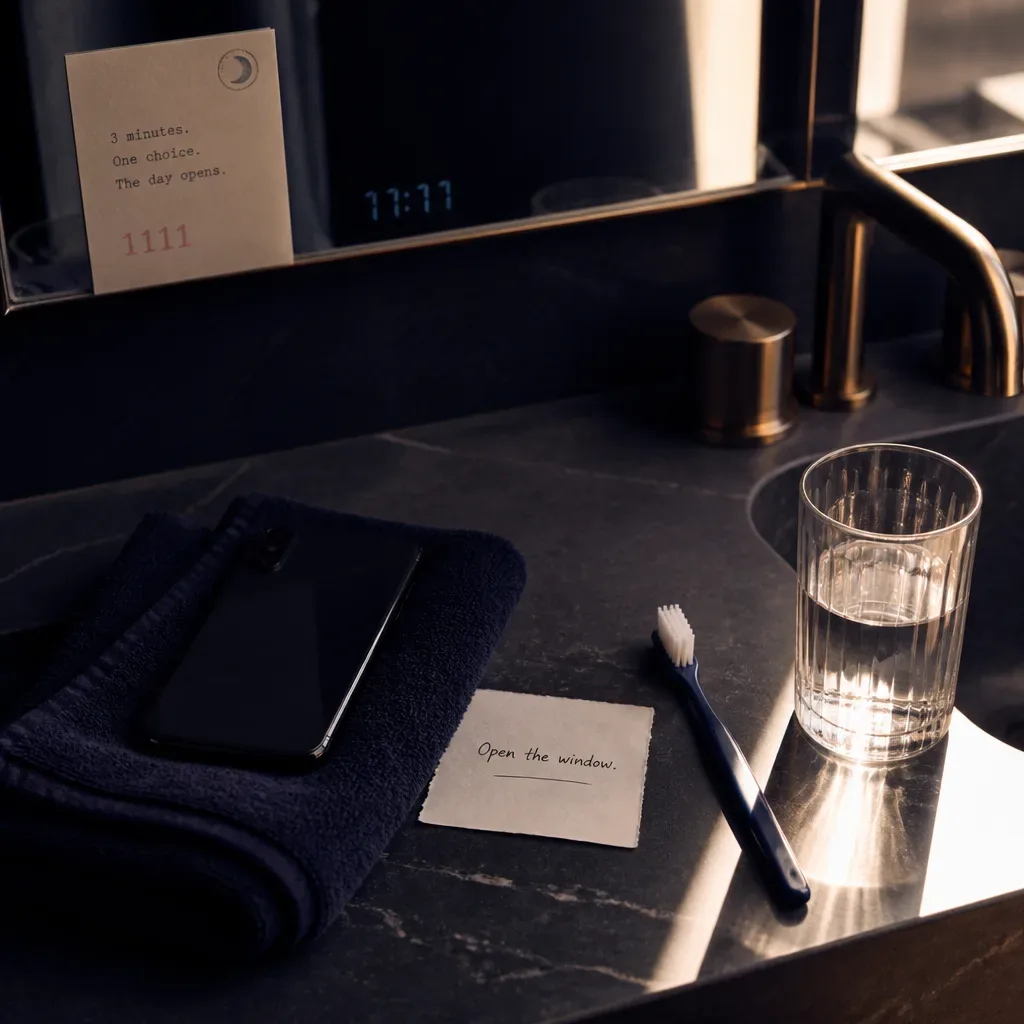
If you want to connect the routine to timing, you can use calendars, moon phases, or personal dates as reflection points. Keep them gentle. Astrology and manifestation can be a symbolic layer, not a rulebook. Your morning does not need more pressure. It needs a way back.
How do you keep it from becoming another failed routine?
You keep it alive by designing for missed days from the beginning.
This is where many ADHD routines become cruel. They work for 4 days. Then one late night, one sick child, one bad sleep, one forgotten charger, and the whole thing feels ruined. It is not ruined. It is data. In Lally’s 2009 habit study, missing one opportunity did not necessarily erase habit formation. Consistency mattered, but perfection was not the mechanism.
Make a repair plan now. Not after you miss. Now.
- If you miss the morning, listen at lunch.
- If lunch is gone, listen before bed.
- If the whole day is gone, restart tomorrow with the same 3 minutes.
- If the audio feels too long, sit up before pressing play.
- If the phone pulls you into messages, use app limits or airplane mode.
The repair plan should be boring. Boring is good. Boring means you do not have to invent a moral lesson every time life happens. Shame is a loud teacher and a poor architect. It may scare you into one clean morning, but it rarely builds a home you can return to.
You can track the streak if it feels good. Aya may show you repetition in ways that help you see continuity. Still, the streak is not the practice. The listening is. The return is. Small studies in behavior change often show that self-monitoring can support follow-through, especially when paired with clear goals. But tracking should not become a second job.
I like a 14-morning test. Short enough to begin. Long enough to learn. At the end, ask only 3 questions: Did it make starting easier? Did I know what came next? Did I feel less hostile toward the morning? If yes, keep it. If no, shrink it.
When should you change the routine?
Change the routine when friction repeats 3 times in the same place.
Do not change it because you got bored once. ADHD can make novelty feel like rescue, but novelty is not always care. Change the part that keeps snagging. If you forget headphones 3 mornings, move the audio to the bathroom speaker. If you scroll before listening 3 mornings, open the app before sleep. If the next action is too vague 3 mornings, make it smaller.
This is the editing list:
| Repeated snag | Change this | Keep this |
|---|---|---|
| You fall back asleep | Sit up before pressing play | The 3-minute audio |
| You start scrolling | Leave the audio open at night | Listening first |
| You feel rushed | Pair audio with brushing teeth | One body cue |
| You forget the next step | Use a paper note | One named action |
| You resist the wording | Update the Dream-Self Moment | The daily listen |
The American Academy of Sleep Medicine has noted that irregular sleep timing can affect daytime function. If your mornings keep breaking, look one layer earlier. Bedtime may need care. Caffeine timing may need care. Medication timing, if relevant, belongs with your clinician. A routine is not a substitute for support.
Joe Dispenza often speaks about rehearsing a future self until the body recognizes a new pattern. You do not have to make that grand. In a quiet ADHD morning routine, the future self is the one who begins again without a courtroom in her head. She presses play. She stands up. She does the one thing.
For more context on how audio, identity, and repetition work together, return to the AYA Method. For the broader practice of intention and repetition, read the Manifestation pillar. Keep the center clear: daily audio first, then the small supports that help it land.
The morning can be smaller than you were told.
Stay here for the first three minutes.