morning rituals
Coffee Manifestation Ritual With 3-Minute Audio
A coffee manifestation ritual using a 3-minute Dream-Self audio, sensory cues, and one clear intention before the day starts moving.

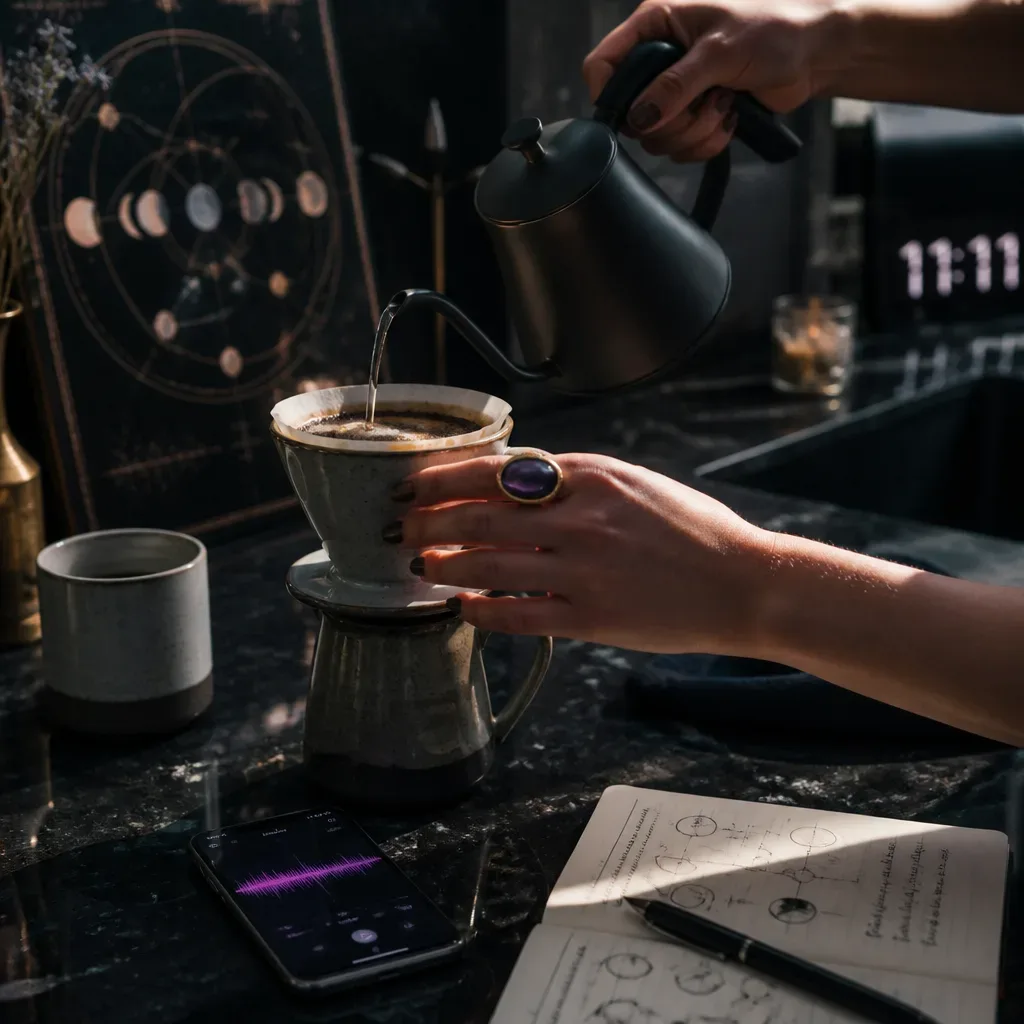
At 7:11, before the first sip, a coffee manifestation ritual can become a precise 7-minute gate: brew, listen to a 3-minute Dream-Self audio, name one intention, and take one small matching action. The coffee is the cue. The audio is the method. The day gets a signal.
What makes a coffee manifestation ritual work?
A coffee manifestation ritual works because it attaches intention to a cue your body already recognizes.
Coffee is not decorative here. It is a reliable trigger: scent, heat, sound, the small click of a kettle or machine. Habit researchers often call this a cue-routine-reward loop, popularized by Charles Duhigg after decades of behavioral science. The National Coffee Association reported in 2024 that 67% of American adults drank coffee in the past day, which means the ritual is not asking many people to add a new morning object. It is asking them to use the one already in their hand.
The core practice is listening. The AYA Method is a daily audio manifestation practice. Each day you listen to a short personalized recording — your Dream-Self Moment — narrated from the version of you who has already manifested the life you intend. Listening is the practice. Repetition is the work. The audio is the method.
That matters because vague wanting rarely survives breakfast. A ritual gives desire a container with walls. In psychology, Peter Gollwitzer’s work on implementation intentions found that specific if-then plans can significantly increase goal follow-through; one classic 1999 review identified effects across 94 independent studies. Coffee becomes the “if.” Your Dream-Self audio becomes the “then.”
A ritual is not proof that the sky is listening. It is proof that you are.
If you already have a broader practice with the Manifestation pillar, this coffee ritual is the morning dial: small, repeatable, and physical. I like practices that can survive dishes in the sink. My grandmother did not call stirring mole a mindfulness protocol, but she knew no one should stir a pot while angry. The room takes instruction.
How do you prepare the ritual before the coffee cools?
Prepare the ritual by choosing the drink, the audio, the sentence, and the first action before the morning starts negotiating.
You need fewer objects than the internet will try to sell you. A cup. A 3-minute Dream-Self audio. A notebook or notes app. A pen if you are the kind of person who still believes ink has a pulse. The American Time Use Survey has found that many adults have less than 30 minutes of discretionary time before work or caregiving begins, so the ritual must fit inside real kitchens, not fantasy mornings with linen curtains and no inbox.
Set the station the night before if your mornings tilt chaotic. Put the cup where you can see it. Queue the audio. Write the date at the top of the page. In my kitchen, the sea salt jar sits next to the notebook for reasons I will not explain. Some objects do not need a press release.
Use this quick setup:
- Choose one drink: coffee, decaf, tea, cacao, or warm water.
- Queue your 3-minute Dream-Self Moment.
- Put the phone face-down once the audio starts.
- Write one line after listening, not five pages.
- Take one matching action within 10 minutes.
The 10-minute window matters. Behavioral activation research, often used in depression treatment protocols, favors small action over mood waiting. You do not wait to feel aligned. You create evidence while the cup is still warm.
Here is the simple timing:
| Minute | Action | Why it matters |
|---|---|---|
| 0:00-1:00 | Start brewing | Creates a sensory cue |
| 1:00-4:00 | Listen to audio | Centers the identity rehearsal |
| 4:00-5:00 | Take first sip | Pairs taste with attention |
| 5:00-6:00 | Write one intention | Names the signal |
| 6:00-7:00 | Choose first action | Moves practice into behavior |
The ritual should feel exact, not precious. Precision is a form of care. In cooking, 1 teaspoon of salt can save a pot or ruin it. Intention works the same way.
What should you do during the 3-minute Dream-Self audio?
During the 3-minute Dream-Self audio, you should listen without multitasking and let the narration become a rehearsal of identity.
This is where many people get the ritual backward. They want to visualize harder, repeat more words, or decorate the moment with candles, crystals, and seventeen tabs open in the mind. The instruction is cleaner: listen. Dr. Andrew Huberman has often discussed how attention and repetition shape neural pathways, and while a 3-minute audio is not a laboratory intervention, repeated attentional focus is not nothing. Three minutes, repeated 30 times, becomes 90 minutes of identity rehearsal in a month.
If coffee is the gate, the Dream-Self audio is the room. It speaks from the version of you who has already arrived at the life you intend. This is close in spirit to Neville Goddard’s “state akin to sleep” idea, where the inner assumption is rehearsed as already true, though AYA keeps the practice grounded in daily listening rather than theatrical strain.
Do this while the audio plays:
- Keep your eyes soft or closed.
- Hold the cup, but wait for the first sip if possible.
- Notice one phrase that lands with physical recognition.
- Let the voice finish before writing anything.
- Do not check messages during the 3 minutes.
A Pew Research Center report from 2021 found that 31% of U.S. adults said they were online almost constantly. That is the rival ritual. The phone wants the first sip. Give the first sip to your future self instead.
Attention is an altar, whether you admit it or not.
After the audio ends, write one sentence in present tense. Not a paragraph. Not a manifesto. One line, clean enough to remember at 2:40 p.m. when the day has teeth. If you want to study the sentence craft more deeply, the Affirmations pillar explains how precise language supports repetition without turning the practice into performance.
How do you write the intention after the audio?
Write the intention as one present-tense sentence that names who you are practicing being today.
The most useful intention is not a wish list. It is a behavioral identity with a pulse. “I am the person who sends the proposal before noon.” “I answer with calm precision.” “I feed my household before I feed the panic.” These sentences work because they point to conduct, not fog.
James Clear has popularized identity-based habit language, but the idea is older than any bestseller: people tend to act in ways that confirm who they believe they are. In one often-cited 2011 study in the journal Health Psychology, participants who linked physical activity to identity-related motives showed stronger exercise persistence. The lesson for manifestation is sober: identity needs behavior, or it becomes costume jewelry.
Use this formula if the blank page gets theatrical:
I am the kind of person who [specific action] with [quality] today.
Examples:
- I am the kind of person who speaks clearly with warmth today.
- I am the kind of person who finishes the first draft before checking reactions.
- I am the kind of person who spends carefully and chooses from steadiness.
- I am the kind of person who serves the meal without resentment.
That last one is not small. Anyone who has cooked for family knows the difference between food made with attention and food made with a grudge. My mother used to set one extra place even when no guest was expected. She said it kept the house generous. I think it also trained the nervous system to expect arrival.
The sentence should be believable enough to repeat and strong enough to correct you. If it does not change one decision within 24 hours, sharpen it. A dull intention is just mood with better lighting.
For readers who track timing, lunar cycles, or master numbers, the intention can also respond to the day. The Astrology and manifestation guide is useful here, especially if a new moon, an 11 day, or a personal cycle gives the morning a louder signal. Use timing as punctuation, not as permission.
When should you take the first action?
Take the first action within 10 minutes of finishing the audio so the ritual turns into evidence.
The first action is the hinge. Without it, the coffee manifestation ritual risks becoming a beautiful pause that never leaves the cup. With it, the day receives proof. In clinical behavioral activation, small scheduled actions are used because action can precede motivation; meta-analyses have found behavioral activation comparable to other treatments for some forms of depression, though your morning ritual is not a substitute for care.
Choose an action so small it almost looks too plain. Send the email. Fill the water bottle. Open the document. Put the bill in the folder. Wash the pan before resentment hardens on it. The action should match the identity in your audio and your written line.
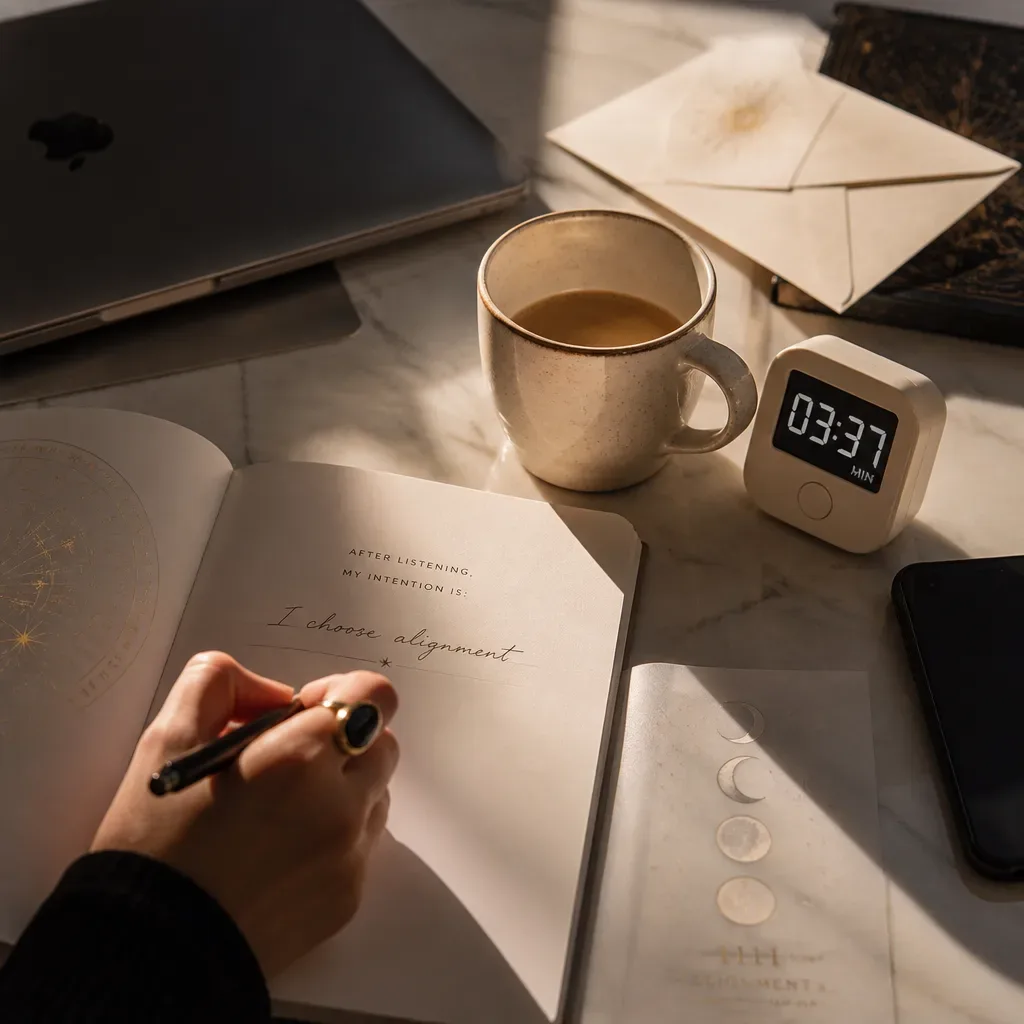
Use this decision rule:
- If the audio described confidence, take one visible action.
- If it described peace, remove one source of friction.
- If it described creative work, open the file before opening social media.
- If it described love, make one precise offering.
- If it described money, record one number honestly.
Specific numbers have a way of ending the fog. A balance. A page count. A 12-minute walk. A 9:00 a.m. message. In kitchens, timers tell the truth. In manifestation, first actions do the same.
The universe may send a signal, but your calendar decides whether you heard it.
If you use a Manifestation Board, glance at it after the first action, not before. The board is a complement. It can witness the direction, but it should not replace movement. Same with a daily affirmation. Say it if it steadies the hand. Do not let it steal the role of the audio.
How do you adapt the ritual for tea, decaf, or a rushed morning?
Adapt the ritual by preserving the cue-audio-action sequence even if the drink or timing changes.
Not everyone drinks coffee. Not everyone should. The U.S. Food and Drug Administration cites 400 milligrams of caffeine per day as a general upper limit for most adults, while pregnancy, anxiety, sleep issues, and medication can change the equation. The ritual does not require caffeine. It requires repetition.
If you switch the drink, keep the sensory cue strong. Tea has steam. Cacao has weight. Warm lemon water has brightness. Even a glass of water can work if you touch the glass, pause, and listen before the day takes your attention hostage.
Here is how to adjust without losing the spine:
| Morning condition | Keep | Change |
|---|---|---|
| No caffeine | 3-minute audio | Use tea, decaf, or water |
| Childcare chaos | First action | Listen with one earbud while preparing breakfast |
| Commute morning | Written line | Record a voice note after listening |
| No appetite | Sensory cue | Hold the cup without drinking |
| Very low mood | Tiny action | Make the action 2 minutes or less |
The signal must remain simple: cue, listen, name, act. If one morning offers only 4 minutes, do the 3-minute audio and one sentence. If you have 12 minutes, do not inflate the ritual until it collapses under its own velvet. More is not always more. Sometimes more is avoidance in a nicer robe.
There is also a seasonal version. Around the new moon, use the ritual to name beginnings. Around the full moon, name what needs to be witnessed. On dates with 11, 22, or 33, if master numbers are part of your symbolic language, let the number sharpen attention. Doreen Virtue popularized angel-number interpretations in the 2000s, though she later distanced herself from that work; the useful part is not certainty, but noticing. A number can be a bell. You still have to answer.
For a fuller foundation, keep the Manifestation pillar close and treat this ritual as the morning practice that makes the larger theory edible.
How do you know the ritual is working?
You know the ritual is working when your choices become more consistent with the identity described in the audio.
Do not measure it only by external events. Measure it by fidelity. Did you listen 5 mornings this week? Did you take a first action within 10 minutes at least 3 times? Did the same phrase from your Dream-Self audio change how you answered a message, spent money, spoke to your body, or walked into the room?
A 2009 study often associated with Phillippa Lally at University College London found that habit formation took an average of 66 days, with a wide range from 18 to 254 days depending on the behavior. That number is useful because it calms the drama. A ritual can feel meaningful on day 1 and still need day 66 to become architecture.
Track only 3 things for two weeks:
- Did I listen to the audio?
- What was my one-sentence intention?
- What was my first matching action?
Fourteen days gives you enough data to see patterns without turning your life into a spreadsheet temple. If the same intention keeps appearing, the signal is repeating. If the same action keeps being avoided, the gate is showing you where the hinge sticks.
You can also pair the ritual with the Affirmations pillar when language needs refinement, or with Astrology and manifestation when timing feels unusually loud. Just keep the hierarchy clean: the audio holds the practice; the daily affirmation and Manifestation Board support it.
Repetition is how a future stops sounding imaginary.
My own test is domestic. Am I kinder before the second cup? Do I write before I react? Did I season the beans after tasting them, not before? Precision returns first in small places. The larger life follows on cue more often than people admit.
The cup is warm. The signal has arrived.