noise colors
Brown Noise for Sleep With Dream-Self Audio
Use brown noise for sleep with Dream-Self audio in a grounded nighttime routine: volume, timing, layering, and what to avoid before bed.

Brown noise for sleep works best when it steadies the room first and supports your Dream-Self audio second. Use it quietly, play your personalized recording once while you are still awake, then let the low-frequency sound continue for 30 to 90 minutes as your nervous system stops scanning for interruptions.
What is brown noise, and why does it suit sleep manifestation?
Brown noise is a low-frequency sound profile that can make a bedroom feel less jumpy, especially when small noises keep pulling you back to the surface.
Technically, brown noise reduces power as frequency rises, about 6 decibels per octave. Translation: more low rumble, less high hiss. White noise spreads power evenly across frequencies; pink noise sits between the two. If white noise is a bright static wall, brown noise is closer to distant surf or a heavy rain behind glass.
The sleep evidence is still early. White noise has more published support, including small hospital studies where steady sound reduced awakenings from environmental noise. Brown noise is discussed by sleep clinicians and platforms such as the Sleep Foundation, but large randomized trials remain scarce as of 2026. That matters. A signal is not evidence just because TikTok found it at 2:22 a.m.
Still, the mechanism is sensible. The brain keeps monitoring the room during sleep. The World Health Organization has reported that nighttime environmental noise above roughly 40 decibels can disturb sleep for sensitive sleepers. A consistent background sound can reduce the contrast between a door click, a passing car, and silence.
For manifestation practice, that steadiness matters because sleep is not decoration. The CDC says most adults need at least 7 hours of sleep per night. Chronic short sleep is linked with poorer attention, mood regulation, and decision-making. Those are not mystical details. They are the operating system.
Sleep is not a loophole in manifestation. Sleep is where the next version of your attention gets repaired.
If you already work with the Manifestation pillar, brown noise belongs in the practical column: it reduces friction. It does not make a wish more deserving. It makes the room less likely to interrupt the person learning to hold the wish steadily.
How should you set up brown noise before bed?
Set up brown noise like a sleep tool, not a performance, and remove every feature that asks for your attention.
Start with the track. Choose plain brown noise with no rain transitions, no thunder, no voiceover, no binaural claims, and no ads. If the track loops every 60 seconds and you can hear the seam, your brain may start waiting for it. A 2012 review in Noise & Health found environmental noise affects sleep through both sound level and predictability; sudden changes are the problem.
Place the speaker or phone away from your head, ideally 1 to 2 meters from the bed. That distance matters because a sound source beside the pillow can feel louder in one ear and may invite checking. If you use earbuds, keep volume lower than you think. The National Institute on Deafness and Other Communication Disorders warns that long exposure to loud sound can damage hearing; sleep is not a reason to gamble with volume.
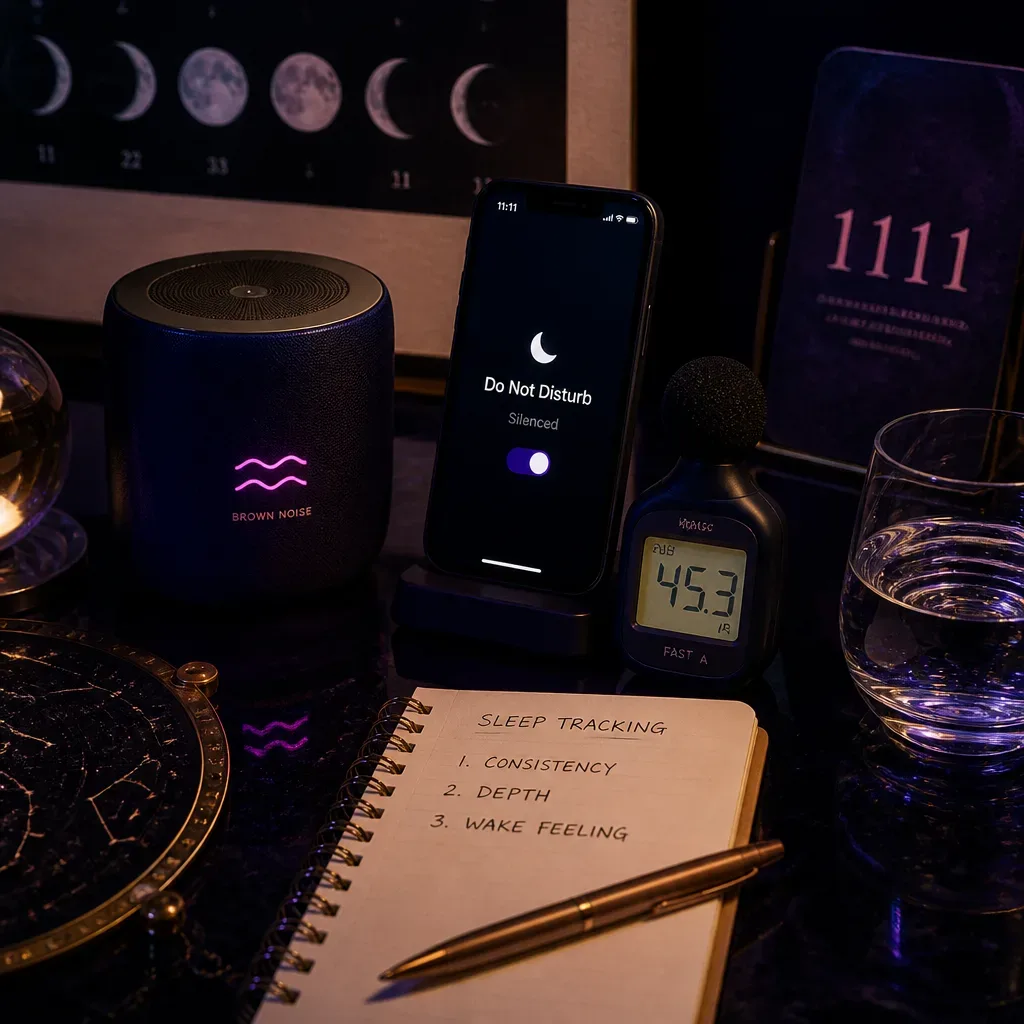
A simple setup looks like this:
- Dim the room 30 to 60 minutes before sleep.
- Put the phone face down, on Do Not Disturb, or across the room.
- Start brown noise at a barely noticeable level.
- Play your Dream-Self audio once.
- Let brown noise continue on a timer.
Here is the useful comparison:
| Noise color | Sound character | Best use at night |
|---|---|---|
| White noise | Bright, hiss-like, full spectrum | Masking sharp household noise |
| Pink noise | Balanced, softer high end | People who dislike static but want clarity |
| Brown noise | Deep, low, rounded | Sensitive sleepers who prefer a heavier floor |
Do not chase the perfect sound. A sleep routine collapses when it becomes a shopping habit. Pick one track, test it for 3 nights, and change only one variable at a time. My old finance brain likes that part. If everything changes, nothing can be read.
Where does Dream-Self audio fit in the routine?
Dream-Self audio comes before the noise becomes background, because the practice needs your attention before sleep takes the wheel.
Here is the clean definition from the AYA Method: The AYA Method is a daily audio manifestation practice. Each day you listen to a short personalized recording — your Dream-Self Moment — narrated from the version of you who has already manifested the life you intend. Listening is the practice. Repetition is the work. The audio is the method.
That order is not cosmetic. Spoken audio asks the brain to follow language, identity, sequence, and emotional tone. Brown noise asks the brain to stop tracking novelty. Use the spoken recording while you can still witness it. Then let the noise hold the room after the words have landed.
Joe Dispenza often writes about rehearsing a future identity until the body begins to recognize it as familiar. You do not have to accept every claim in his model to understand the practical layer: repetition changes what feels normal. Cognitive psychology has been measuring repetition and priming effects for decades, even when the spiritual vocabulary changes from teacher to teacher.
Neville Goddard called attention and assumption central to imaginal practice. The nighttime parallel is obvious but easy to overdo. You are not trying to force the mind into submission at midnight. You are giving it one clear scene, one named identity, and one steady exit.
The audio names the signal. Brown noise keeps the room from arguing back.
If you also use a daily affirmation, keep it brief. The Affirmations pillar is useful when language is precise, not when it multiplies. A Manifestation Board can help earlier in the evening. At bedtime, fewer inputs usually win. The audio is the method; the other tools are complements.
What volume and timing work best for brown noise for sleep?
Use the lowest volume that masks small disruptions, and start with a timer rather than an all-night commitment.
A good starting range is about 40 to 50 decibels, if you have a phone meter app. That is roughly a quiet library to a gentle shower in another room. Phone meters are imperfect, sometimes off by several decibels, but they are better than guessing at midnight with the dial glowing like a tiny tribunal.
Timing is personal, but the first test should be boring: 30 minutes for light sleepers, 60 minutes for average sleepers, and 90 minutes if you tend to wake during the first sleep cycle. Sleep cycles average about 90 minutes, although individual cycles vary. If the noise helps you cross the first gate, you may not need it all night.
Use this starting guide:
- If you wake from hallway noise, try 60 minutes.
- If your mind races before sleep, try Dream-Self audio plus 30 minutes.
- If traffic starts early, try brown noise until your usual wake time.
- If you wake with headaches or ear fatigue, lower the volume or stop.
Dr. Andrew Huberman has repeatedly emphasized regular light timing, temperature, and wake time as anchors for sleep. Sound can help, but it does not outrank caffeine timing or a room that is too warm. A 2021 meta-analysis in Sleep Medicine Reviews found that music and auditory interventions may improve subjective sleep quality for some people, but effects vary widely.
The cleanest experiment is 7 nights. Keep bedtime, caffeine cutoff, and room temperature as steady as possible. Track sleep onset, wake-ups, and morning clarity on a 1 to 5 scale. Seven data points will not impress a lab, but they will beat a mood.
A routine is only spiritual if it survives Tuesday.
Can brown noise make Dream-Self audio more effective?
Brown noise can make Dream-Self audio easier to receive by reducing distraction, but it does not replace attention, repetition, or aligned action the next day.
Think of brown noise as the floor, not the message. The Dream-Self Moment carries the identity cue. The brown noise carries the nervous system cue: nothing urgent is happening now. In behavioral terms, you are pairing a desired self-concept with a low-arousal state. That pairing is modest, repeatable, and worth respecting.
There is a reason so many traditions use sound at thresholds: bells, chants, drums, breath counts, waves. The number changes, the gate remains. Modern research on meditation is more developed than research on manifestation audio; for example, a 2014 JAMA Internal Medicine review found mindfulness meditation programs showed moderate evidence for improving anxiety, depression, and pain. Lower anxiety before bed is not a small thing.
This is also where synchronicity can be handled without losing the plot. If you keep seeing 11:11 after three nights of better sleep, name it as a signal if that helps you stay attentive. But do not confuse the master number with the practice. The dial lining up is beautiful. The daily listening is what you can actually repeat.
People interested in timing may enjoy Astrology and manifestation, especially around lunar cycles. New moons can be useful for naming a direction; full moons can be useful for review. But sleep routines should not wait 29.5 days for permission.
Princeton Engineering Anomalies Research, often called PEAR, studied intention and random systems for nearly 28 years before closing in 2007. Its findings remain debated. I mention it because the serious posture is useful: measure, repeat, question. Manifestation gets sturdier when it can tolerate a spreadsheet.
What should you avoid when using brown noise at night?
Avoid stacking too many tools, using high volume, or turning sleep into another place to prove yourself.
The first mistake is layering everything: brown noise, subliminals, binaural beats, affirmations, sleep stories, a manifestation board, a candle, two crystals, and a podcast that starts talking about tax policy at 1:17 a.m. The nervous system is not impressed by clutter. It reads clutter as work.
The second mistake is using spoken audio all night. Some people sleep through it. Others drift in and out, catching phrases at odd moments and waking more tired. Memory consolidation during sleep is real; a 2013 study in Science showed targeted memory reactivation can influence learned associations during sleep. But that does not mean more words equal better outcomes. The sleeping brain is not a filing cabinet you can shout into.
The third mistake is treating brown noise as medical treatment. If you have insomnia lasting more than 3 months, loud snoring, gasping, restless legs, panic at night, or serious daytime sleepiness, talk to a clinician. The American Academy of Sleep Medicine recognizes cognitive behavioral therapy for insomnia, CBT-I, as a first-line treatment. A sound track is not a substitute for care.
Watch for these signs that the routine needs adjusting:
- You feel irritated by the sound within 5 minutes.
- You keep checking whether it is working.
- You wake with ear pressure or headaches.
- Your Dream-Self audio starts to feel like homework.
- You sleep worse for 3 nights in a row.
The wry truth: manifestation people sometimes turn rest into a productivity contest with softer lighting. Do not do that. The point is not to become the most optimized sleeper in the room. The point is to meet the night with less resistance and wake with a cleaner signal.
What is the 25-minute brown noise and Dream-Self routine?
The 25-minute routine is a simple sequence: settle the room, listen once, let brown noise carry the transition, and record one morning note.
Minutes 0 to 5 are for the room. Dim lights. Lower the temperature if needed; many sleep specialists suggest a cool room, often around 60 to 67 degrees Fahrenheit, though comfort varies. Put the phone where your hand cannot casually reach it. Start brown noise very low, almost as if it arrived from the walls.
Minutes 5 to 12 are for the Dream-Self Moment. Lie still or sit supported. Listen once. Do not repeat lines in your head unless that happens naturally. Do not analyze whether you believe every sentence. Just witness the future-self narration as a position you are practicing. In surf terms, you are not commanding the wave. You are getting into position before it arrives.
Minutes 12 to 25 are for the fade. Let the spoken audio end. Keep brown noise on. If a thought appears, label it planning, memory, or noise, then return to the low sound. Tara Brach often teaches the power of naming experience gently; the practical benefit is that naming can reduce identification. One word is enough.
In the morning, write three numbers or notes:
- Sleep onset: fast, medium, or slow.
- Wake-ups: 0, 1, 2, or 3 plus.
- Morning signal: one sentence about what feels clear.
Run it for 7 nights before judging. If it helps, keep it. If not, change the sound color, volume, or timing. The method is not fragile. The Manifestation pillar returns to this often: claimed identity has to meet lived behavior. Better sleep is one of the least dramatic ways to make that meeting easier.
The universe may wink at 11:11, but your calendar believes what you repeat.
Leave the room quieter than you found it.