noise colors
Green Noise for Sleep: Layer Dream-Self Audio
Use green noise for sleep by layering it softly under Dream-Self audio, so the room quiets without drowning the message you came to hear.
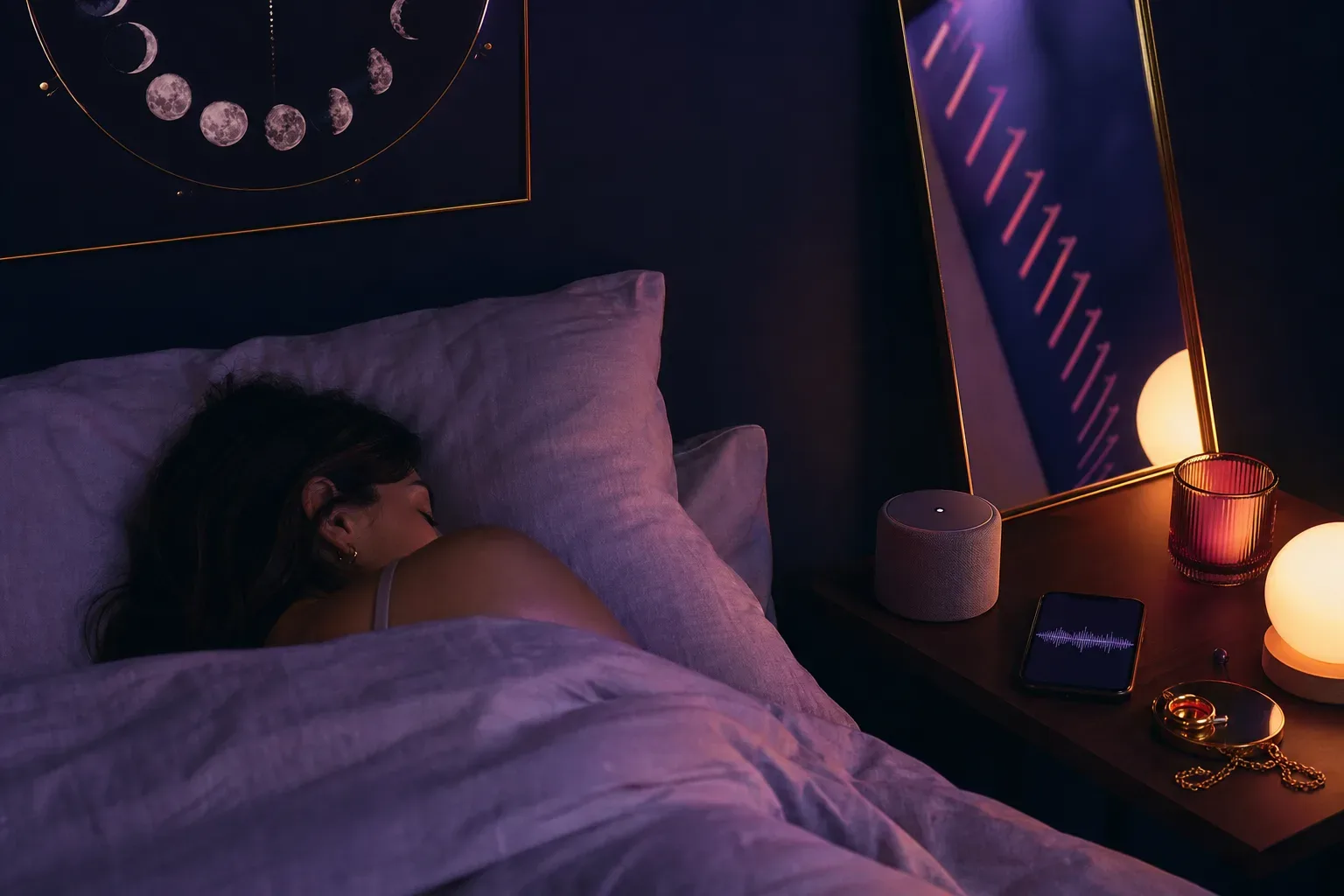
Green noise for sleep works best as a soft masking layer beneath Dream-Self audio, not as the main event. Keep the narration clear, set the green noise lower, and use it to reduce sudden room sounds while your attention stays with the future-self message you chose on purpose.
What is green noise for sleep, really?
Green noise is a steady, mid-frequency sound people use to make a room feel less interruptible.
The term is not as clinically fixed as white noise or pink noise. In audio culture, green noise usually means a nature-like band of sound: leaves, soft wind, distant water, a fan without the metallic edge. Some producers place it around the middle of human hearing, roughly 500 Hz to 2,000 Hz, though consumer tracks vary wildly. That matters. One app’s green noise may be a forest. Another may be a waterfall wearing a fake mustache.
The practical value is sound masking. Your sleeping brain can still respond to noise; a 2012 review in Noise & Health notes that environmental noise can affect sleep structure even when a person does not fully wake. The point of green noise is to narrow the contrast between silence and interruption. A door click at 2:11 a.m. lands differently in a dead-silent room than it does inside a soft acoustic floor.
That floor should not be dramatic. If you can name every ripple and bird in the track, it is not a floor. It is content. Sleep does not need more content.
Here is the useful distinction:
| Noise color | Common feel | Best use |
|---|---|---|
| White noise | Bright, hissy, full-spectrum | Masking sharper outside sounds |
| Pink noise | Balanced, softer than white | General sleep and concentration |
| Brown noise | Deep, low, rumbling | People who dislike high frequencies |
| Green noise | Natural, mid-range, room-softening | Sleep routines that include spoken audio |
The Centers for Disease Control and Prevention has reported that about 1 in 3 U.S. adults do not get enough sleep. That number is not a personality flaw. It is a design problem, a stress problem, and sometimes a room problem. Green noise addresses the room. It does not fix your life by itself. It gives the nervous system one less thing to keep scanning.
A quiet room is not always a silent room. Sometimes quiet is the sound that helps the room stop announcing itself.
Why layer it under Dream-Self audio instead of playing it alone?
Layer it underneath because the audio carries the intention, while green noise carries the room.
In the AYA Method, the practice is listening to a short personalized recording, your Dream-Self Moment, narrated from the version of you who has already claimed the life you intend. Listening is the practice. Repetition is the work. The audio is the method. Green noise is not the method. It is the velvet rope around the method, keeping random hallway sounds from barging in.
This is where people get cute and overcomplicate things. They add rain, binaural tones, affirmations, subliminals, a candle, a crystal bowl, a spreadsheet, and suddenly bedtime has a production budget. The dial was already there. The question is whether the signal is clear.
Spoken audio asks the brain to track language. Research on sleep learning is mixed, but memory studies consistently show that repetition and emotional salience matter. Joe Dispenza often speaks about rehearsing a future state until it becomes familiar to the body; you do not have to accept every claim to see the behavioral point. Repeated inner rehearsal changes what you notice the next day. The reticular activating system, a network involved in attention and arousal, is not a manifestation vending machine. It is more like a bouncer with a guest list.
Your Dream-Self Moment gives that bouncer names.
Green noise helps when the room is too sharp. If the refrigerator knocks, the upstairs neighbor drops a shoe, or traffic hits a wet road at 11:22, the masking layer keeps those sounds from becoming the star. A 2021 systematic review in Sleep Medicine Reviews found that evidence for continuous noise improving sleep is still limited and mixed, which is a useful caution. The tool is personal. Test it. Do not crown it.
Use green noise when:
- your room has sudden sounds rather than constant loudness
- silence makes every creak feel theatrical
- white noise feels too bright
- you want the Dream-Self narration to feel held, not buried
- you fall asleep better with a steady acoustic cue
The future self does not need a louder stage. She needs fewer hecklers.
How do you set the right volume without drowning the message?
Set the Dream-Self audio first, then raise green noise only until the room softens.
The order matters. If you begin with green noise, you will tend to make it too loud because the room feels satisfying once it disappears. Then the narration arrives and has to fight its way through. Start with the voice. Let it claim the center. Bring the green noise in like lighting, not like weather.
A simple ratio works for most people: keep the green noise 5 to 10 volume points lower than the narration on the same device. If your phone uses a 100-point scale, try Dream-Self audio around 35 and green noise around 25. If you use two devices, start comically low. The National Institute for Occupational Safety and Health warns about prolonged exposure above 85 dB, and sleep headphones can make volume harder to judge. Night is not the hour for proving your speaker has range.
Use this four-part test:
- Play your Dream-Self Moment at a level where every word is easy.
- Add green noise at the lowest audible setting.
- Raise it until distant room sounds feel less distinct.
- Lower it one step and leave it there for three nights.
The last step is the one most people skip. We keep adjusting because adjustment feels like control. But sleep responds to cues, and cues need repetition. Dr. Andrew Huberman has repeatedly emphasized consistent light timing and wake timing as anchors for circadian rhythm; sound can become a smaller anchor when used predictably.
Do not chase the perfect mix. Perfect is suspicious at bedtime. Clear is enough.
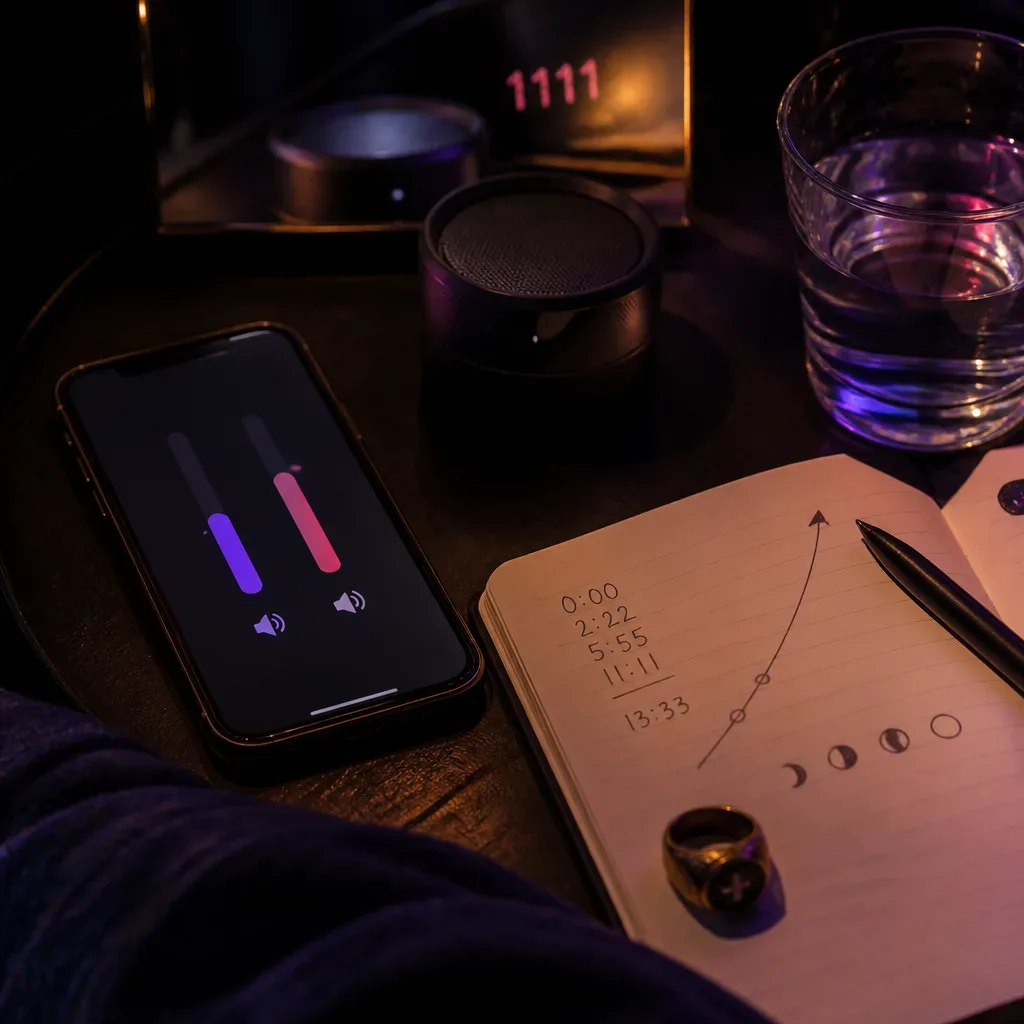
If you share a bed, do the test together while both people are awake. A 2023 YouGov sleep survey found that many couples report different sleep preferences, from temperature to sound. Nobody becomes more generous about audio settings at 1:07 a.m. Decide before the room goes dark.
The correct volume is not the one you admire. It is the one you forget.
What is the 12-minute setup for a night routine?
A 12-minute setup gives the mind a clean sequence: prepare the room, listen, then let the sound carry you down.
This is a how-to, not a ceremony. You do not need to wake earlier, buy a better personality, or become someone who owns linen spray. You need twelve minutes and fewer decisions. Sleep researchers often point to stimulus control: the bed should cue sleep, not argument, scrolling, or unfinished admin. The American Academy of Sleep Medicine recommends at least 7 hours of sleep for most adults; protecting the first 12 minutes of the night is small, but small gates count.
Here is the sequence I use after my evening walk, on the nights when my brain is acting like it has a podcast guest who will not stop talking.
The 12-minute green-noise sequence
- Minute 0 to 2: Clear the obvious noise. Close the window if traffic is spiking. Move the charger brick that hums. Put the phone face down.
- Minute 2 to 4: Set your Dream-Self audio. Choose the recording before you get into bed. No browsing. Browsing is a trap with a glass screen.
- Minute 4 to 5: Add green noise softly. Bring it in beneath the voice until the room loses its hard edges.
- Minute 5 to 10: Listen without multitasking. No email. No weather check. No “one last” anything. The words need a clean room inside you too.
- Minute 10 to 12: Let the audio end or fade. Keep the green noise on a timer if it helps you cross the sleep gate.
This is where the Manifestation pillar is useful as a wider map. Manifestation is not only wanting something loudly. It is training attention, language, and behavior to stop contradicting each other. Bedtime is a strange little courtroom where the day gives evidence. Your Dream-Self audio gets to testify too.
If you use a daily written line, keep it brief. The Affirmations pillar is a better place to deepen that practice, but at night I prefer one sentence over a paragraph. The audio is already carrying the weight. The daily affirmation is a complement, not a second steering wheel.
Twelve minutes is enough to signal a change of season inside the body. Not a grand season. A small one. The kind the nervous system actually believes.
Which green noise track should you choose?
Choose the least interesting track that still makes the room feel kind.
That sounds rude. It is also the truth. Sleep audio should not audition for you. Avoid tracks with birds, bells, lyrics, thunderclaps, guided speech, sudden stereo movement, or ads placed at the exact moment your eyelids surrender. If a track has a cinematic arc, save it for writing. At night, you want acoustic wallpaper.
Streaming platforms are crowded with “green noise” titles because the phrase now gets search traffic. That does not mean the files are equal. A 2020 report from the World Health Organization reiterated that environmental noise is linked with sleep disturbance and cardiovascular stress at population levels. The home version is humbler: unstable sound keeps asking the body to re-check the room. Stable sound lets the body stand down.
Look for these traits:
- Steady texture: no obvious loops every 20 or 30 seconds
- No foreground events: no bird calls, drops, knocks, or chimes
- Warm middle frequencies: not piercing, not muddy
- Long duration: at least 30 minutes if you use a timer
- Offline access: no buffering, no ads, no midnight betrayal
If you are sensitive to sound, test the track in daylight first. I learned this after choosing a “gentle forest” track that contained one heroic owl every 47 seconds. The owl had confidence. I had regret.
This is also where timing can become part of the ritual without becoming superstition. Some readers like starting at 11:11 because master number 11 is associated with intuition in modern numerology. Fine. Name the signal if it helps you pay attention. Just do not confuse the number with the work. The work is still listening, repeating, and behaving tomorrow as if the message counted.
For readers who track cycles, Astrology and manifestation can add another lens. A new moon may be a useful date to refresh the recording. A Saturn transit may explain why the lesson feels like a locked door with paperwork. Still, the track itself should remain boring.
The best sleep sound is not the one that impresses you. It is the one that stops asking to be noticed.
How do you know if the layer is working?
You know it is working if you fall asleep with less friction and wake without feeling acoustically invaded.
Do not judge the routine by one night. Sleep has too many accomplices: caffeine timing, alcohol, stress, hormones, temperature, light, grief, deadlines, the strange pasta you ate too late. Judge it over three to seven nights. The National Sleep Foundation has long noted that sleep quality includes latency, awakenings, and daytime functioning, not only total hours. A green-noise layer is useful if those markers move in the right direction.
Track three simple numbers in the morning:
| Marker | Question | Useful range to notice |
|---|---|---|
| Sleep latency | How long did it take to fall asleep? | Under 30 minutes is often considered reasonable |
| Wake-ups | How many times did sound wake you? | Fewer is the signal |
| Audio recall | Did you remember the Dream-Self theme? | A phrase or feeling is enough |
Do not turn the tracker into a courtroom. You are collecting clues, not prosecuting your nervous system. If green noise helps you fall asleep but erases the narration, lower it. If the narration keeps you too alert, play it earlier in the evening and reserve green noise for the final descent. If both feel like too much, use only the Dream-Self Moment for a week and compare.
The Manifestation pillar makes a useful point here: attention is not the same as strain. Many people bring a clenched face to inner work, as if tension proves devotion. It does not. Strain is just noise wearing a serious coat.
You can also connect the night routine with a morning cue. In my own practice, I walk without headphones on the way out, then listen on the way back. Morning audio and evening audio do different jobs. Morning points the dial. Evening lowers the room around it.
When a practice is working, it usually gets quieter. That is how you know it has entered the body.
What mistakes should you avoid with green noise and Dream-Self audio?
Avoid making the support layer louder, more complex, or more important than the practice.
The first mistake is volume creep. Night after night, the track gets a little louder because yesterday’s setting starts to feel normal. This is common with repeated audio exposure. Keep a written volume note for the first week: “Dream-Self 36, green 24,” or whatever your device uses. The note protects you from the 11:48 p.m. version of yourself, who believes every problem can be solved by pressing plus.
The second mistake is using green noise to avoid the message. This is subtle. If the Dream-Self Moment names a life you are not yet willing to meet, the mind may prefer the pleasant blur underneath. Neville Goddard wrote often about occupying the feeling of the wish fulfilled; whether you read him as mystic or dramatist, the instruction is demanding. You have to hear the sentence that calls you forward.
The third mistake is stacking too many tools. A Manifestation Board can be a beautiful visual complement, especially for yearly intention setting, but it does not need to appear at bedtime unless it calms you. The daily affirmation can sharpen language, but it should not compete with the recording. The audio is the method. Everything else is a supporting witness.
A final mistake: treating one bad night as a verdict. In small sleep studies, interventions often need several nights before patterns are visible, and many clinical protocols track sleep diaries for 1 to 2 weeks. Give the routine enough time to reveal itself. Not forever. Enough.
If after seven nights you feel more alert, irritated, or dependent on the sound, change the plan. Try pink noise. Try no noise. Try moving the Dream-Self audio earlier. The AYA Method is daily, but the room can be adjusted.
The signal should leave you steadier in the morning, not more managed.
Set the dial low enough to hear yourself arrive.