noise colors
Pink Noise vs White Noise for Dream-Self Audio
Pink noise vs white noise changes how your Dream-Self audio feels: steadier, sharper, softer, or more masked. Choose by attention and sleep timing.

Pink noise vs white noise comes down to what you need under your Dream-Self audio: pink noise softens the room and supports longer listening, while white noise masks sharper distractions. If the voice is the signal, pink is usually the kinder bed. If the world is loud, white holds the gate.
What is the real difference between pink noise and white noise?
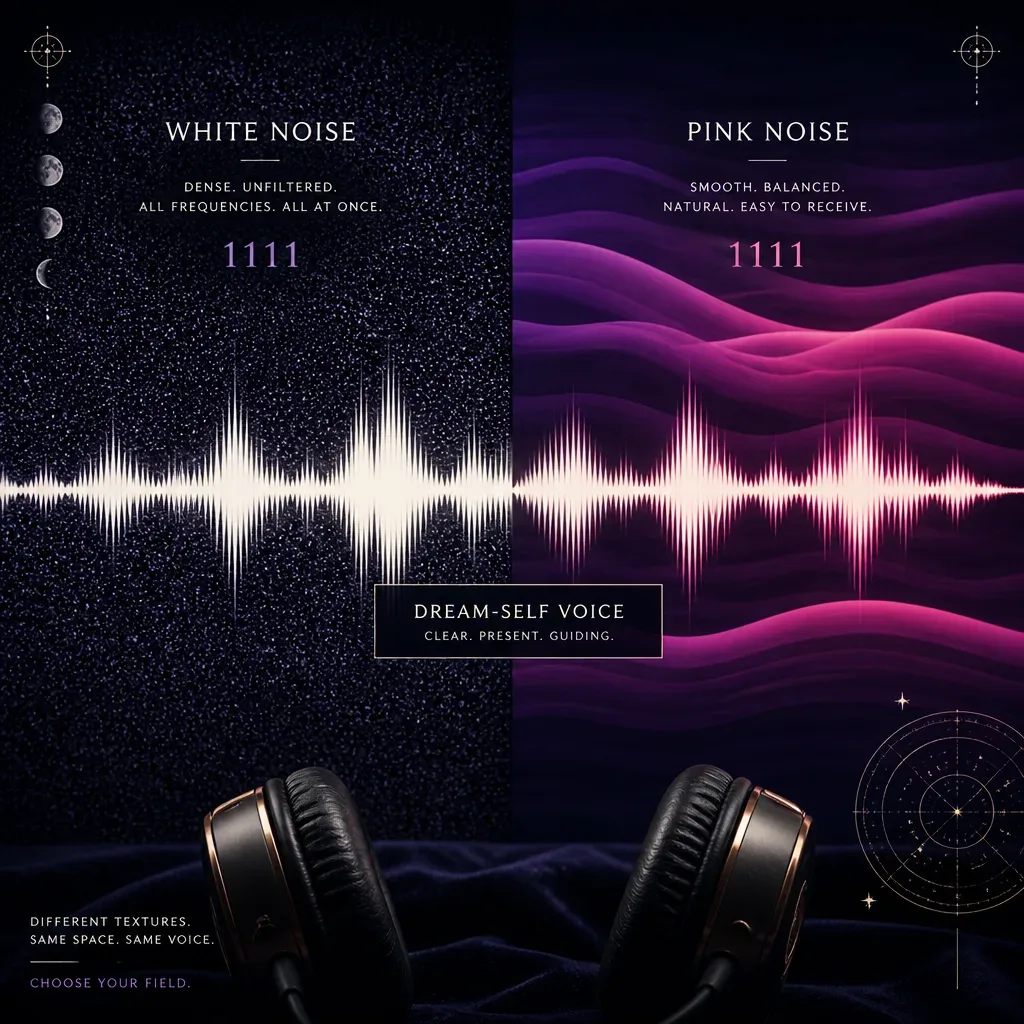
Pink noise lowers the high-end hiss while white noise gives equal power across frequencies, which is why one feels rounded and the other feels brighter.
White noise contains equal energy at every frequency band, like static from an old radio or a fan set too close to your face. Technically, that means the signal is flat across the spectrum. Pink noise drops in power as frequency rises, roughly 3 decibels per octave, so the lower frequencies feel more present. Brown noise drops even more, which is why it can sound like distant thunder or a deep airplane cabin.
The ear does not hear a spectrum chart. The ear hears a room. That is where the choice matters. Under a Dream-Self audio, white noise can create a clean privacy screen, especially if there are unpredictable sounds: a scooter at 7:02, a door, a text alert, one person in the building apparently moving furniture for sport. Pink noise is less aggressive. It tends to sit behind a voice instead of competing with it.
The National Institute for Occupational Safety and Health uses 85 decibels over 8 hours as a workplace exposure limit, but personal listening should sit far below that. For audio manifestation practice, the aim is not stimulation. It is repeated recognition. The sound bed should make the message easier to stay with, not turn your headphones into a small weather system.
Here is the clean comparison:
| Sound color | Frequency feel | Best use under audio | Watch for |
|---|---|---|---|
| White noise | Bright, even, hiss-like | Masking sudden room noise | Can fatigue the ear |
| Pink noise | Balanced, softer, low-warm | Evening listening and voice support | May not mask sharp sounds |
| Brown noise | Deep, heavy, rumbling | Short grounding sessions | Can bury narration |
The rule is almost annoyingly simple: if you strain to hear the words, the backing track has forgotten its place.
Which noise color supports Dream-Self audio better?
Pink noise usually supports Dream-Self audio better because it gives the voice a warmer floor without crowding the meaning.
The Dream-Self Moment works because you hear yourself from a future vantage point, not because the background track does theater. In the AYA Method, the AYA Method is a daily audio manifestation practice. Each day you listen to a short personalized recording, your Dream-Self Moment, narrated from the version of you who has already manifested the life you intend. Listening is the practice. Repetition is the work. The audio is the method.
That definition matters here. If the audio is the method, the background is not the method. It is furniture in the room. It can be good furniture. It can be the chair you always sit in at 6:40 before the house fully turns on. But it should not become the point.
A 2017 study in Frontiers in Human Neuroscience reported that acoustic stimulation aligned with slow-wave sleep could improve slow oscillation activity and memory-related outcomes in older adults, though this was controlled sound stimulation, not a blanket promise about every pink-noise track. The useful takeaway is modest: the sleeping and resting brain responds to timed sound. The exact sound, volume, and context matter.
For most listeners, pink noise is the better companion when the Dream-Self audio is reflective, identity-based, or emotionally specific. White noise is better when the room is hostile. A siren does not care about your intention. A radiator clank has no respect for your 11-minute practice.
Choose pink noise when:
- You listen before sleep or after waking.
- The narration is intimate or emotionally charged.
- You want the words to feel close, not announced.
- Your main issue is mental chatter, not external noise.
Choose white noise when:
- Your space has traffic, voices, or sudden interruptions.
- You are listening during work breaks or travel.
- You need privacy because other people are nearby.
- The narration is already very clear and forward in the mix.
A backing sound should witness the message, not steal the microphone.
When does white noise become the better choice?
White noise becomes the better choice when your environment is unpredictable enough that masking matters more than softness.
I have recorded podcast interviews in apartments where the city seemed personally invested in ruining sentence endings. One truck backing up can break a thought. One neighbor coughing through a wall can pull your attention out of the whole scene. White noise is useful because it creates a consistent wash. The brain can adapt to consistency more easily than surprise.
This is the same logic behind many sound machines used in offices, nurseries, and therapy waiting rooms. The American Academy of Pediatrics has warned that infant sleep machines can exceed safe levels if placed too close or played too loud; one study found some machines could produce more than 85 decibels at maximum volume. Adults are not infants, obviously, but the principle transfers. Masking should be careful, close to the problem, and not louder than necessary.
For Dream-Self audio, white noise is best when the competing sound is sharp. Think dishes, hallway voices, dogs, motorcycles, doors, old pipes. Pink noise may make those sounds less irritating, but white noise can cover them more effectively because it carries more high-frequency content.
Use this 4-step test before choosing white noise:
- Play the Dream-Self audio with no backing track for 60 seconds.
- Notice the exact distraction: voice, traffic, hum, thought spiral, room tone.
- Add white noise at the lowest possible volume.
- If the words lose emotional texture, switch to pink noise or lower the bed.
Attention is not a moral achievement. It is a condition you design.
White noise can also help if you listen in shared space and need the audio to feel private. But there is a cost. Too much white noise can flatten a voice. It can make the Dream-Self Moment sound less like a message and more like instructions coming through static. That is not always wrong. It is just a different ceremony.
If your manifestation practice is built around clarity, keep clarity sacred. The Manifestation pillar makes the bigger case for practice over spectacle: naming the aim, returning daily, watching behavior shift in the small hours. Noise color should serve that arc.
When does pink noise become the better choice?
Pink noise becomes the better choice when you want a softer, more body-friendly layer that lets the narration stay human.
Pink noise has become the darling of sleep playlists for a reason. It resembles patterns found in rain, wind, and certain natural sounds, though not all nature audio is technically pink. In small sleep studies, pink noise has been associated with deeper sleep markers and improved memory performance, especially when pulses were synchronized to slow-wave sleep. That is not a blank check for any pink-noise video online. It is a signal worth respecting.
Under Dream-Self audio, pink noise can make the practice feel less exposed. Some days the voice saying your future back to you can feel almost too direct. Pink gives it a room. It blurs the hard edges without smudging the words.
This is especially useful for evening listening. Cortisol typically follows a diurnal rhythm, peaking in the morning and declining toward night, according to endocrine research. If you are listening at 10:11 p.m., the body may not want a bright wall of white hiss. It may want a low, even field where the mind can stop performing.
Pink noise also pairs well with reflective practices around affirmations, as long as the affirmation is not treated as the pillar. The recorded Dream-Self Moment stays central. A daily affirmation can complement the audio by giving one sentence to carry afterward, like a match in the pocket.
A useful pink-noise mix often has these traits:
- The voice remains 70 to 80 percent of your attention.
- The backing sound is felt more than inspected.
- The high frequencies do not hiss above the consonants.
- The track still feels listenable after 7 days.
That last one matters. Novelty is noisy. Repetition is where the dial starts to move.
Pink noise is also kinder if you are sensitive to sound. Many people with tinnitus or sound sensitivity prefer lower, smoother noise profiles, though clinical guidance varies and an audiologist should guide persistent symptoms. Your practice should not leave your nervous system feeling argued with.
How should you set volume, timing, and placement?
Set the backing noise low, place it behind the voice, and choose timing based on whether you need focus, transition, or sleep.
The simplest volume rule is the whisper test. If you can understand every word of the Dream-Self audio while the noise sits underneath like a quiet appliance in another room, you are close. If you need to lean toward the recording, the noise is too loud. If you forget the noise exists until it stops, the dial is aligned.
For headphones, keep the overall level modest. The World Health Organization has estimated that over 1 billion young people may be at risk of hearing loss from unsafe listening practices, mostly from loud personal audio and entertainment exposure. A manifestation practice should not ask your ears to pay interest on your intention.
Timing changes the best choice. Morning listening can tolerate a little more brightness, especially if the house is active. Afternoon listening may need white noise to cut through workday residue. Night listening usually favors pink noise or no added sound at all.
Use this quick decision map:
| Listening moment | Main obstacle | Better starting point | Why |
|---|---|---|---|
| Early morning | Sleep inertia | Pink noise | Gentle enough to repeat daily |
| Commute or travel | Variable sound | White noise | Stronger masking |
| Work break | Mental switching | Pink or white | Depends on room noise |
| Before sleep | Nervous system load | Pink noise | Softer high end |
| Shared room | Privacy | White noise | Covers speech leakage better |
There is also placement. If the Dream-Self narration and the noise are mixed together in one track, the noise should sit behind the voice. If you are playing a separate noise app, lower it until the voice becomes unmistakably primary. Two audio sources can drift into competition. Competition is not a ritual.
People love to ask for the perfect decibel number. I understand the urge. It sounds official. But phone decibel apps vary, rooms vary, headphones vary, and ears vary. A better practical measure is comprehension plus aftereffect: you understood the words, and you felt steadier 5 minutes later.
How do noise colors fit with synchronicity, numbers, and attention?
Noise colors fit best as attention architecture: they do not create synchronicity, but they can help you notice what is already arriving.
This site is called Manifest 11 for a reason. People do notice 11:11, 222, 333, the same name arriving twice in one day, the job post dated the same day as the old resignation letter. Numerology traditions treat 11, 22, and 33 as master numbers, with 11 often linked to intuition and heightened perception. That does not require us to suspend critical thinking. It asks us to observe the pattern before we rush to explain it away.
Noise color works in a similar but more practical register. It changes the threshold of attention. White noise can remove interruption. Pink noise can lower friction. Neither one grants meaning. They make it more likely that you will stay with the message long enough to hear the sentence that bothers you, the one you know is true.
The Princeton Engineering Anomalies Research lab, often called PEAR, studied mind-matter questions for decades and remains controversial in scientific circles. More grounded attention research is easier to stand on: repeated cues shape behavior. BJ Fogg’s behavior model, for instance, emphasizes prompt, ability, and motivation. A daily audio cue at the same time each day is a prompt with a timestamp.
This is where astrology and manifestation can be useful too. Not as an excuse to outsource your decisions to the sky, but as a calendar of attention. A lunar cycle gives about 29.5 days to notice what returns. A noise bed gives 10 minutes of fewer interruptions. Different scale, same principle: the frame changes what you can witness.
The signal is not always louder than the noise. Sometimes the practice is learning which one you keep feeding.
If numbers help you commit, use them cleanly. Eleven minutes of audio. Seven nights of pink noise. Three mornings with no sound bed. Track what changes. Not because the spreadsheet is sacred, but because memory edits itself shamelessly.
What is the best way to test pink noise vs white noise for yourself?
The best test is a 7-day comparison that keeps the Dream-Self audio constant and changes only the backing sound.
Most people test too many variables at once. New audio, new headphones, new bedtime, new candle, new identity, same old avoidance wearing a better outfit. Then they declare the method unclear. Do less. Change one thing.
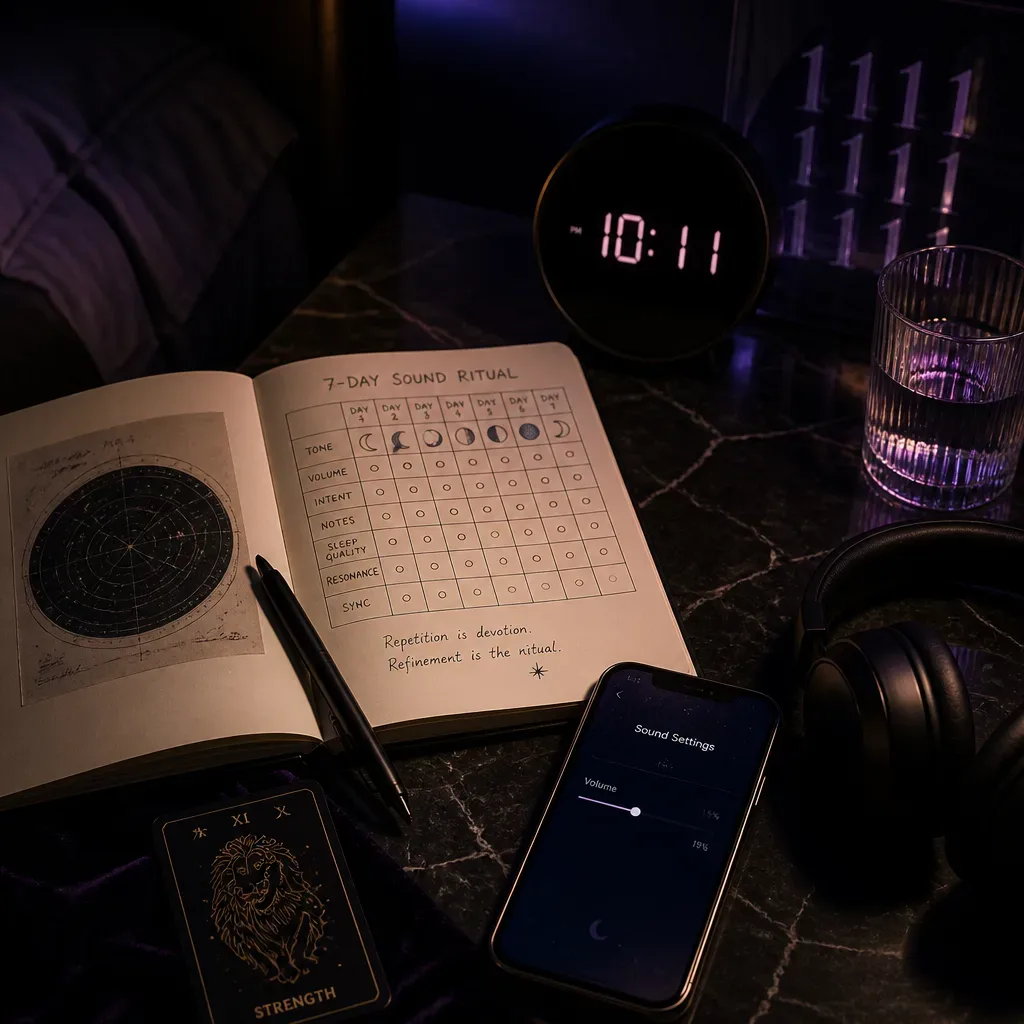
Here is the clean 7-day protocol:
- Choose one Dream-Self audio and keep it the same all week.
- Listen at the same time each day, within a 30-minute window.
- Use pink noise on days 1, 2, and 3.
- Use white noise on days 4, 5, and 6.
- On day 7, listen with no backing sound.
- After each session, write 3 numbers: clarity from 1 to 10, calm from 1 to 10, recall from 1 to 10.
- Choose the sound that supports the highest combined score, not the one that sounds most impressive.
This is not laboratory science. It is personal pattern recognition with enough structure to keep you honest. In behavioral research, even simple self-monitoring can change outcomes because it makes the invisible visible. A 2015 review in the Journal of Medical Internet Research found that digital self-monitoring was associated with behavior change across several health contexts, though results varied by design and adherence.
For the AYA practice, your notes might be brutally simple:
- Pink: heard the line about asking directly, felt calmer, nearly slept.
- White: blocked the hallway noise, but the voice felt farther away.
- No noise: beautiful at dawn, useless when bins were collected at 6:18.
That is enough data. The room has voted.
If you already use a Manifestation Board, treat it as a complement after listening, not a replacement for the audio. Put one phrase from the Dream-Self Moment on the board if it keeps returning. The board catches the sentence. The listening is still the practice.
For a wider foundation, pair this experiment with the core ideas in the AYA Method, then deepen the language work through the Affirmations pillar and the broader timing lens in Manifestation. If you track moon phases or personal cycles, the astrology and manifestation guide can help you decide when to run the test again.
The right noise is the one that disappears at the exact moment the message arrives.