astrology manifestation
First Quarter Moon Ritual: 3-Minute Audio Action
Use this first quarter moon ritual to turn intention into action with a 3-minute Dream-Self audio practice, one clear step, and lunar timing.

A first quarter moon ritual is for taking action, not wishing harder. Use the half-lit moon as a signal: listen to a 3-minute Dream-Self audio, name one decision, write one if-then step, then do it before the day closes. The gate is brief. Walk through it.
What is a first quarter moon ritual really for?
A first quarter moon ritual is for turning the intention you set at the new moon into one visible move.
The first quarter moon arrives about 7 days after the new moon, when the moon appears half illuminated from Earth. NASA’s lunar phase explainers describe this as the point when the moon is 90 degrees from the sun in the sky, which is why it looks split: light on one side, shadow on the other. That geometry is the whole teaching, if you are paying attention.
Half of the thing is visible. Half is not. The dial has moved, but not enough to let you coast.
Astrologically, the first quarter phase is a pressure point. The new moon names the seed; the first quarter asks whether you are going to protect it, schedule it, send the email, have the conversation, or let it become another pretty sentence in a notes app. In astrology and manifestation, this phase works because it gives timing a job. It turns the moon from decoration into a calendar with teeth.
I like this phase because it is not sentimental. It does not ask for a candlelit hour you do not have. I have done this ritual between school drop-off and a 9:00 a.m. call, with one shoe missing somewhere in the hallway and my coffee cooling like a small accusation. Three minutes still counted.
The first quarter moon is not asking for certainty. It is asking for motion.
This is where the AYA Method fits cleanly. The AYA Method is a daily audio manifestation practice. Each day you listen to a short personalized recording, your Dream-Self Moment, narrated from the version of you who has already manifested the life you intend. Listening is the practice. Repetition is the work. The audio is the method.
The moon gives the timing. The audio gives the inner cue. Your action gives the ritual a body.
Why does the first quarter moon favor action over reflection?
The first quarter moon favors action because its symbolism is built on tension, and tension becomes useful only when it is directed.
In lunar cycle terms, the synodic month averages 29.53 days, according to NASA. The first quarter is one of the four main lunar gates: new moon, first quarter, full moon, last quarter. It is the moment when the new cycle is no longer private. Something has to push against the room.
That is why this ritual should be short. Reflection can become elegant avoidance, especially for people who are already good at language. I say that as someone who spent 12 years in advertising writing desire for a living. A beautiful sentence can hide a stalled life if you let it.
Behavioral science backs the case for specificity. Psychologist Peter Gollwitzer’s research on implementation intentions, summarized in a 2006 meta-analysis with Paschal Sheeran, found that if-then planning had a medium-to-large effect on goal achievement across studies. The spell, if we are calling it one, is not vague optimism. It is deciding exactly when and how the next move happens.
| Lunar phase | Best use | Practice length | AYA focus |
|---|---|---|---|
| New moon | Set intention | 5–10 minutes | Name the desired direction |
| First quarter | Take action | 3 minutes | Listen, decide, move |
| Full moon | Witness results | 5–15 minutes | Notice what has become visible |
| Last quarter | Release friction | 5–10 minutes | Edit the pattern |
The first quarter moon is the season of the verb. Not the fantasy version of the verb. The actual one: call, send, ask, book, draft, decline, begin.
This is also where manifestation gets misunderstood. Manifestation is not passive receipt. It is attention, repetition, self-concept, and action braided tightly enough that your behavior starts matching the future you keep rehearsing. Without action, the signal has nowhere to land.
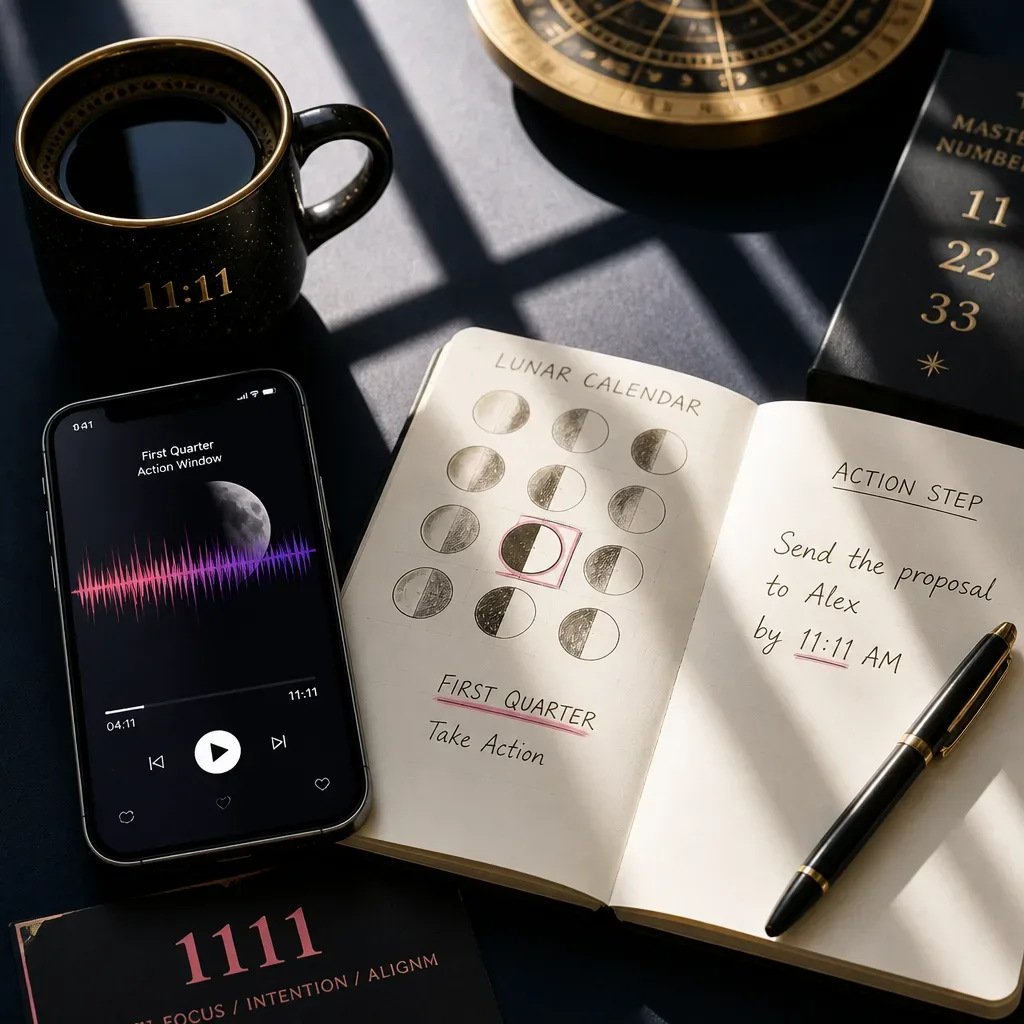
How do you do the 3-minute audio ritual step by step?
You do the ritual by pairing one short Dream-Self audio with one specific action you can complete today.
Set a timer for 3 minutes. Not because the sky will close after 180 seconds, but because a boundary keeps the practice honest. The American Psychological Association has reported for years that stress rises when people feel overloaded by competing demands; a ritual that takes less time than brushing your teeth is more likely to survive a real Tuesday.
Here is the clean version:
- Minute 0:00–0:30, name the gate. Say the action out loud: “I am sending the proposal,” “I am asking for the appointment,” or “I am choosing the class.” Keep it physical and checkable.
- Minute 0:30–2:30, listen to the audio. Play your Dream-Self Moment from the AYA Method. Do not multitask if you can help it. If you are in a parked car, fine. Parked cars count.
- Minute 2:30–3:00, write the if-then. Use one sentence: “If it is 1:00 p.m., then I send the email with the attached draft.”
- Same day, do the step. The ritual is not complete until the action has entered the world.
The daily affirmation and Manifestation Board can support this, but they are not the spine. If you use an affirmation, keep it operational: “I act before the signal cools.” If you use a board, glance once and return to the step. The audio is the method.
A 2018 study in the journal Psychological Science on fresh-start effects, by Hengchen Dai and colleagues, found that temporal landmarks can increase aspirational behavior because they create a mental separation from the previous self. A first quarter moon is one of those landmarks if you treat it that way. The date marks the tilt. Your action makes it real.
A ritual without a next step is theater. A ritual with a next step becomes instruction.
If your action is too large for one day, cut it down until it can be done before dinner. Not “start the business.” Register the domain. Not “fix the relationship.” Send the message asking for a time to talk. Not “become a writer.” Open the document and write 200 rough words.
What should you listen for in your Dream-Self audio?
Listen for the sentence that makes your next action feel already assigned.
In the AYA practice, your Dream-Self Moment is narrated from the version of you who has already arrived at the life you intend. That matters during the first quarter moon because hesitation often comes from identity lag. You are trying to act from the future while still taking attendance in the old room.
Joe Dispenza often describes mental rehearsal as a way of conditioning the body toward a chosen future; his language is more dramatic than mine, but the practical point is useful. Repetition teaches the nervous system what to expect. Dr. Andrew Huberman has also spoken often about the role of attention and repetition in neuroplasticity, with the caveat that change requires behavior, not only thought.
Listen for three kinds of cues:
- The identity cue: Who are you in the audio when the action is already normal?
- The timing cue: What does the future self treat as already decided?
- The body cue: Where do you feel less resistance as you listen?
Do not hunt for fireworks. A good cue may be boring. It may sound like, “I send things before they are perfect,” or “I no longer wait to be discovered before I ask.” That sentence is the dial lining up.
Research on mental contrasting from psychologist Gabriele Oettingen is useful here. Her work distinguishes fantasy from effective goal pursuit: people do better when they pair a desired future with the obstacle that stands in the way. The first quarter moon is practically built for that pairing. Light and shadow, on cue.
This is why affirmations work best when they do not float away from behavior. “I am ready” is pleasant. “I send the draft at 1:00 p.m.” is a command with shoes on.
What action should you choose for the ritual?
Choose the smallest action that would make the intention undeniably less theoretical.
This is the part people overcomplicate. The first quarter moon does not need your entire five-year plan. It needs one move that changes the status of the intention. From unspoken to spoken. From drafted to sent. From private to scheduled. From someday to Thursday at 2:00.
The action should meet three criteria. First, it must be visible. Second, it must be doable in one day. Third, it must create information. A sent pitch can be accepted, rejected, or ignored, and all three give you data. A fantasy gives you nothing but a mood.
Use this filter:
- If your intention is career, send one message to a real person.
- If your intention is money, review one number you have been avoiding.
- If your intention is love, make one honest invitation or boundary.
- If your intention is health, book one appointment or prepare one meal.
- If your intention is creativity, publish, submit, or share one small piece.
The “two-minute rule” popularized by David Allen in Getting Things Done says that if a task takes less than 2 minutes, do it now. This ritual uses a related principle: reduce the first move until resistance has less room to perform. The first quarter moon has a sharp edge. Use it.
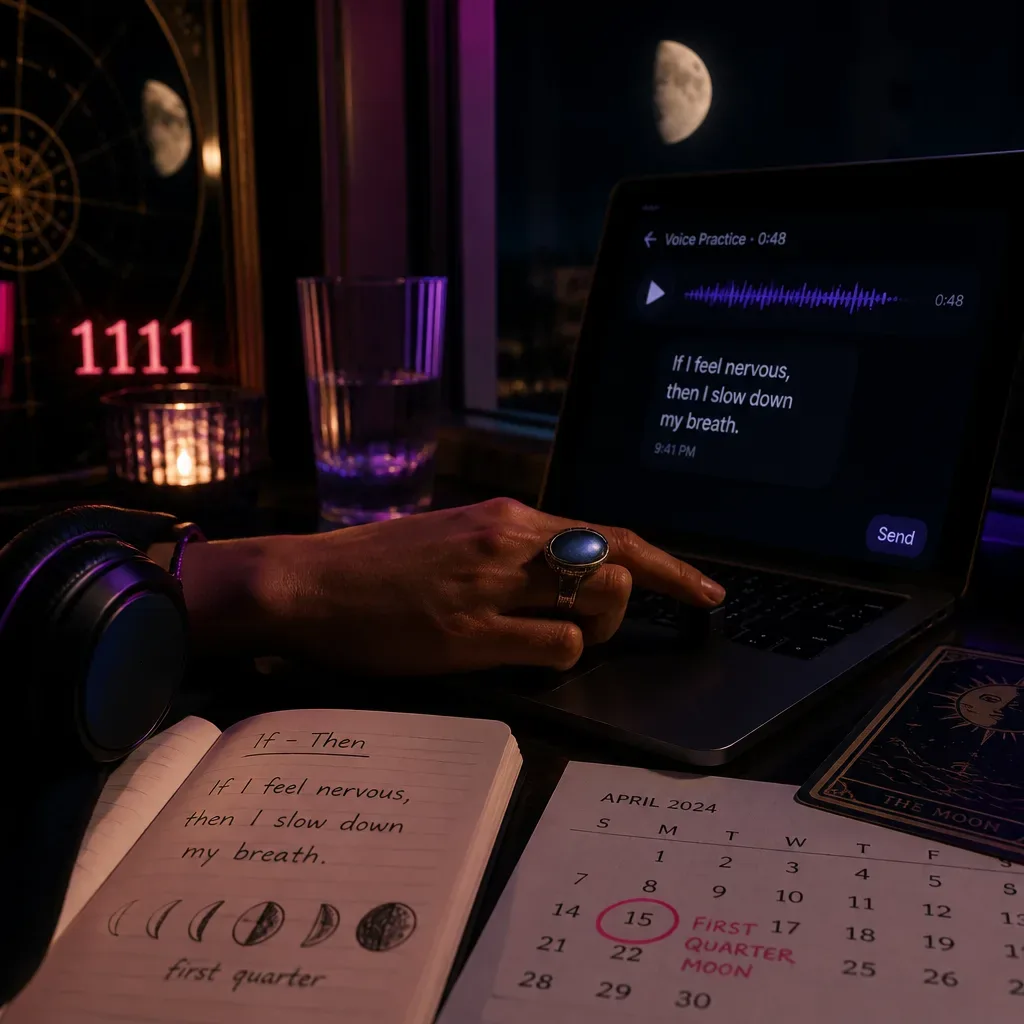
Here is a practical example. New moon intention: “I am building a calmer working life.” First quarter action: decline one meeting that does not need you, block 30 minutes for focused work, and listen to the Dream-Self audio before sending the decline. That is not glamorous. It is better than glamorous. It changes the calendar.
The Manifestation pillar covers the larger frame: intention becomes persuasive when it is repeated and embodied. This ritual is the embodiment part in miniature.
The smallest honest action is often the first place your future self becomes believable.
How do you keep the ritual from becoming another task?
You keep it alive by making it rhythmic, brief, and attached to a signal you already notice.
The first quarter moon comes once every lunar cycle, about every 29.5 days. That is frequent enough to build a pattern, but not so frequent that it becomes spiritual admin. Put it on your calendar for 6 months. Six reminders. Six action gates. No elaborate performance required.
I recommend tracking only two things: what you listened to and what you did. Not how you felt. Feelings are useful witnesses, but they are unreliable managers. The action is the receipt.
Use a tiny log:
| Date | Intention | Audio cue | Action taken | Result within 7 days |
|---|---|---|---|---|
| Oct 18 | Cleaner work rhythm | “I protect the morning” | Declined standing call | Two focused blocks held |
| Nov 16 | More direct outreach | “I ask earlier” | Sent 3 pitches | One reply booked |
The 7-day result column matters because the full moon arrives about a week after the first quarter. That gives you a natural review point. You are not forcing the outcome. You are watching what happened after you moved.
Pew Research Center reported in 2023 that 27% of U.S. adults describe themselves as spiritual but not religious. That number explains part of why lunar rituals have returned to the room: people want timing, meaning, and practice without necessarily entering a formal institution. The risk is that the ritual becomes aesthetic only. Pretty tools, no behavior.
This is where AYA keeps the practice grounded. Listen daily when you can. Use the first quarter moon when the dial asks for action. If you miss a day, return. A streak is useful, but it is not a god.
For a broader timing map, keep astrology and manifestation nearby and pair it with the AYA Method as the daily audio spine. The moon can mark the gate. The audio keeps you listening when the sky is cloudy.
Set the timer. Press play. Move while the signal is still warm.