subliminals
How to Listen to Subliminals Without Guesswork
Learn how to listen to subliminals safely, when to use them, and why an audible Dream-Self recording may work better for daily manifestation.

To learn how to listen to subliminals, keep it simple: choose one trusted audio, listen at a safe volume for 10 to 30 minutes daily, and judge it by changes in behavior, not by instant proof. If hidden messages make you uneasy, use an audible Dream-Self recording instead.
What are subliminals actually doing?
Subliminals are designed to place suggestions below ordinary awareness, usually under music, rain, or noise.
The promise is tidy: your conscious mind stops arguing, and your subconscious mind receives the instruction. That idea has a long cultural tail. James Vicary’s famous 1957 popcorn-and-Coca-Cola claim was later discredited, but the story stayed in the room because people liked the drama of invisible influence. Most good researchers are less theatrical.
In cognitive science, subliminal perception means a stimulus can be processed without conscious recognition. Kouider and Dehaene’s 2007 review in Philosophical Transactions of the Royal Society B argued that unconscious processing exists, but it is limited by attention, timing, and context. Translation: the brain may register more than you notice, but that does not mean a whisper under ocean sounds can revise your entire identity overnight.
Manifestation culture often stretches this evidence until it squeaks. A track titled “become irresistible in 24 hours” is selling urgency, not science. A small cue can tilt perception. A repeated sentence can condition expectation. Neither is the same as consent-free magic.
The safer frame is this: subliminals may act as repeated suggestion, mood cue, and attentional primer. If you listen for 30 days, you are also telling yourself 30 times that this identity matters. That visible choice counts. The hidden part gets too much credit.
The signal you can hear is the one you can choose again.
This is why I often prefer audible practices. The AYA Method is a daily audio manifestation practice. Each day you listen to a short personalized recording, your Dream-Self Moment, narrated from the version of you who has already manifested the life you intend. Listening is the practice. Repetition is the work. The audio is the method.
How should you listen to subliminals safely?
Listen to subliminals like you would take a supplement: check the source, use the right dose, and stop if your body says no.
Start with one topic. Not six. Not a 22-track queue called “complete life reset.” A single track for confidence, study focus, self-worth, or money beliefs gives your attention a clean gate. The brain likes pattern. In habit research published in the European Journal of Social Psychology, Phillippa Lally and colleagues found that automaticity took anywhere from 18 to 254 days, with 66 days as the average. Repetition needs room.
Use comfortable volume. You do not need to punish your ears to persuade your mind. The World Health Organization has warned that over 1 billion young people risk hearing loss from unsafe listening habits, especially loud headphone use. Subliminal audio does not get extra spiritual credit for being loud.
Use context wisely. If a track includes theta tones, binaural beats, or sleepy rain, do not play it while driving. Dr. Andrew Huberman has often discussed the state-shifting power of breath, light, and sound on the nervous system; whether you follow his protocols or not, the principle is plain. Audio can change alertness.
A practical listening protocol:
- Choose one subliminal for one clear aim.
- Listen for 10 to 30 minutes at a comfortable volume.
- Keep the same track for 21 to 30 days before changing it.
- Do not listen while driving if the audio relaxes you.
- Record observable shifts once a week, not every hour.
Your practice is not more powerful because it is harder to explain.
If you feel anxious, foggy, obsessive, or strangely dependent on the audio, pause. A manifestation practice should help you return to yourself, not make you more available to someone else’s hidden script. For a broader grounding in the practice, the Manifestation pillar gives the bigger map without pretending every method works the same way.
What should you check before trusting a subliminal track?
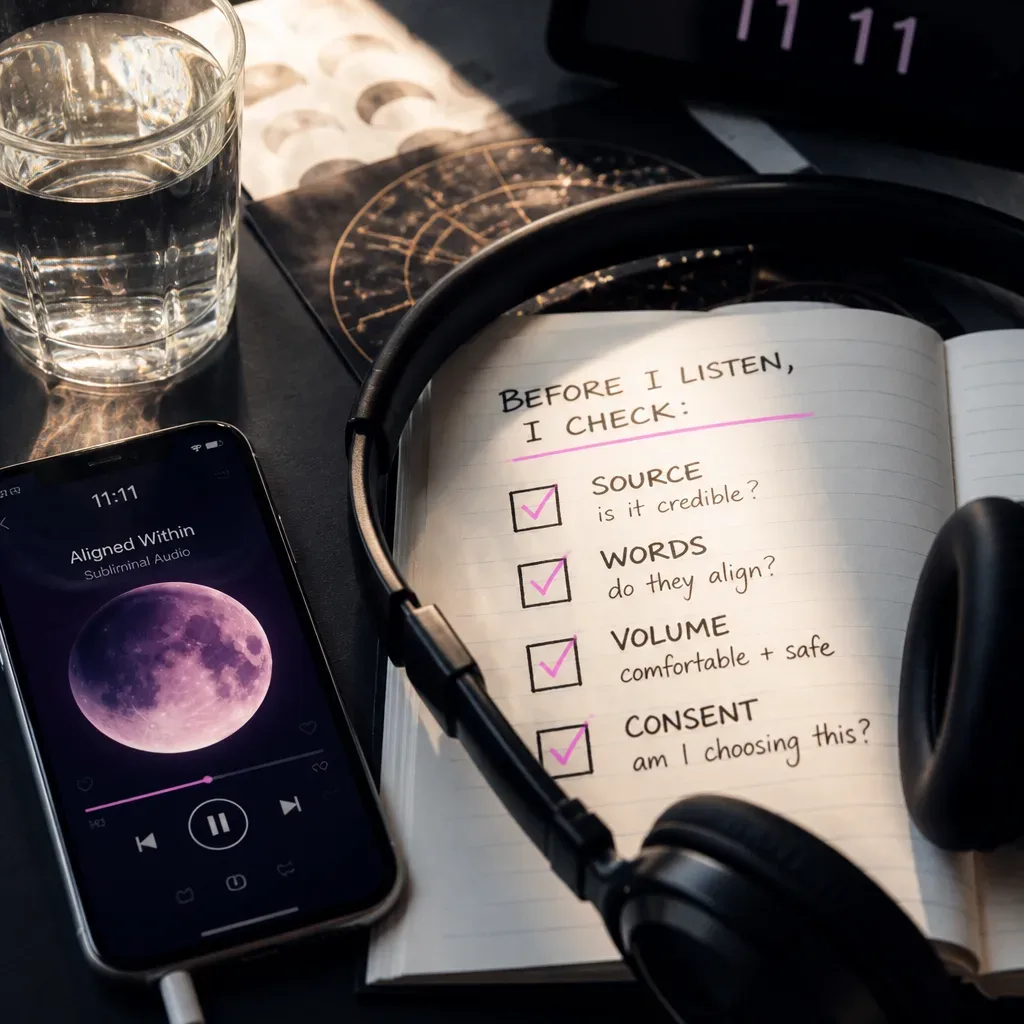
You should check the creator, the stated affirmations, the emotional tone, and your own nervous-system response.
Consent is the whole point. If the creator will not show the affirmations, ask why. Some say hidden wording protects the method. Maybe. Or maybe it protects sloppy writing. In clinical settings, suggestion is handled carefully because language has charge. The Journal of Behavioral Medicine has published decades of work on self-regulation, stress, and belief, and the pattern is consistent: what we repeat affects what we notice and attempt.
A subliminal should not turn your consent into a guessing game.
Use this quick table before you commit 30 nights to a track:
| Check | Green signal | Red signal |
|---|---|---|
| Source | Named creator, clear description | Anonymous channel, exaggerated claims |
| Wording | Affirmations are visible or summarized | No wording shared at all |
| Promise | Gradual self-concept support | Guaranteed physical changes in days |
| Body response | Calm, steady, ordinary | Anxiety, pressure, obsession |
| Routine fit | Easy 10 to 30 minute slot | Requires hours you cannot sustain |
Notice the middle column. Calm. Steady. Ordinary. The dial does not always flash 11:11 when the practice is working. Sometimes the proof is less glamorous: you reply to the email, wear the good coat, ask for the rate, stop apologizing before the sentence arrives.
If affirmations are your preferred door, keep them audible and specific. The Affirmations pillar covers how wording, tense, and repetition shape a sentence you can actually live with. A daily affirmation can complement audio practice, but it is not the spine. The audio is the method when you use AYA.
Why might an audible Dream-Self recording work better?
An audible Dream-Self recording can work better because it combines repetition with clarity, consent, emotion, and identity-based rehearsal.
This is the part I care about as a recovering perfectionist. Hidden words invite me to optimize what I cannot inspect. Audible words make me responsible. If the sentence is too grand, I hear it. If the tone is wrong, I know. If the future self sounds like a motivational poster in expensive shoes, I can refuse the performance.
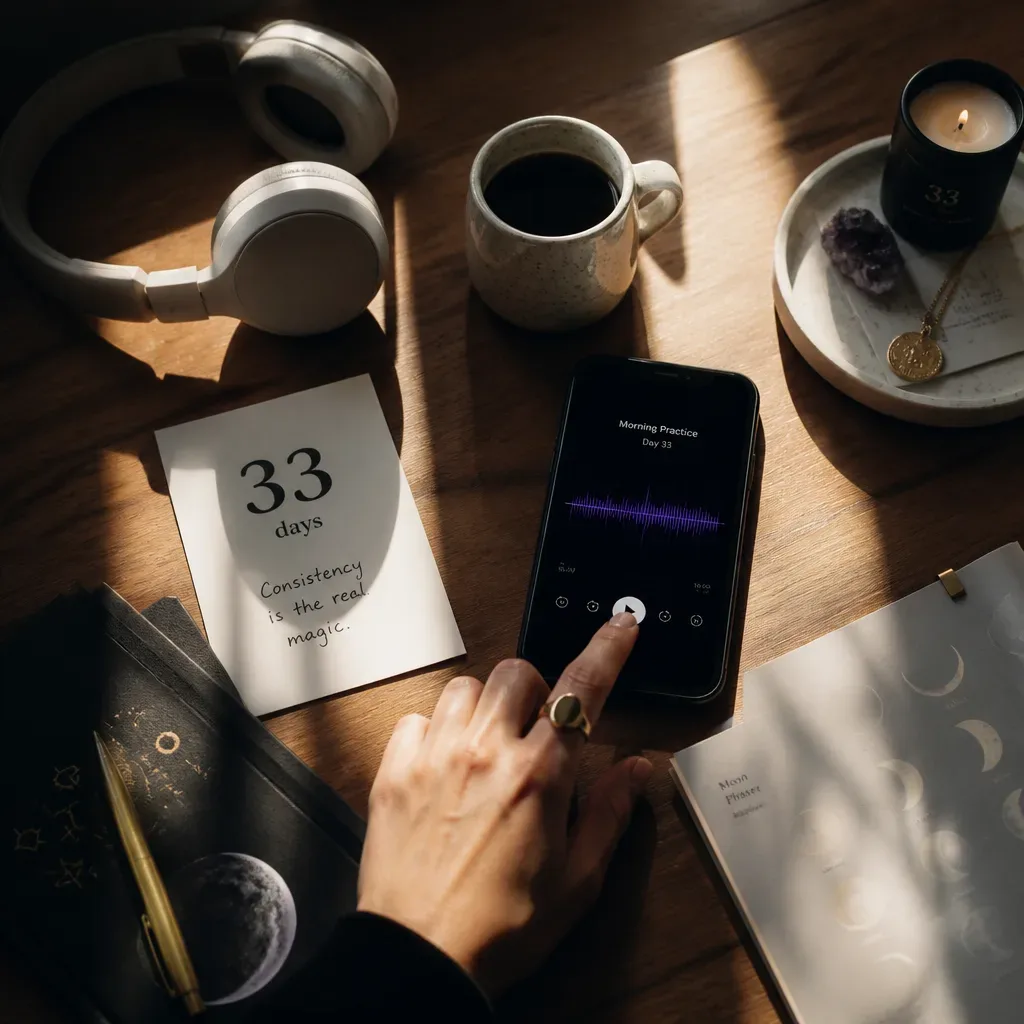
The AYA structure is more intimate. Your Dream-Self Moment is narrated from the version of you who has already arrived at the life you intend. Not as fantasy wallpaper. As a short daily audio you return to, often in the morning, sometimes with coffee, sometimes while the room is still deciding whether it is awake. In my Berlin apartment, there are about 90 minutes of sun on a good day. I do not need a complicated altar inside that window. I need one listen.
Joe Dispenza has popularized the idea that mental rehearsal can influence emotional state and behavior. You do not have to accept every claim in his universe to see the practical point: rehearsal changes readiness. Athletes have used imagery training for decades; a 2012 review in Frontiers in Human Neuroscience noted that motor imagery and physical practice can share neural circuits.
Audible Dream-Self audio gives your brain a scene, a voice, and a return point. It does not ask you to believe harder. It asks you to listen again.
Repetition is not drama; it is how the nervous system learns the route.
Here is the clean distinction:
- Subliminals hide the suggestion below awareness.
- Dream-Self audio lets you hear the suggestion and consent to it.
- Subliminals often focus on outcomes.
- Dream-Self audio focuses on identity, posture, and daily return.
- Subliminals can become a numbers game.
- Dream-Self audio becomes a relationship with the self who already knows the room.
That last point matters. The future self is not a decoration. She is a witness. She names what is already working and lets it lead.
How do you build a daily audio routine that lasts?
Build the routine around a cue you already have, not around a fantasy version of your morning.
The most reliable practice is usually the least impressive. BJ Fogg’s behavior design work at Stanford popularized the idea that tiny behaviors attach best to existing prompts. After coffee. After brushing teeth. After opening the curtains. Not after a 5 a.m. cold plunge, unless that is already your life and not your punishment costume.
Try a 33-day cycle if you like symbolic structure. In numerology, 33 is considered a master number, associated with devotion and teaching. You do not need to outsource your logic to numerology, but numbers can hold a season. A 33-day container is long enough to reveal patterns and short enough that your perfectionism cannot remodel the entire house.
Use this routine:
- Pick the same listening cue each day.
- Put headphones where the cue happens.
- Listen once, fully enough to register the words.
- Do one ordinary action that matches the audio.
- Leave the practice alone until tomorrow.
That last step is not decorative. Obsessive checking turns practice into surveillance. In 2023, the American Psychological Association reported that stress remained high for many adults after years of compounded uncertainty; constant self-monitoring rarely lowers that load. A practice should make the day more inhabitable.
Synchronicity can be useful here, but keep it grounded. Seeing 11:11 three times in a day may feel like a wink. Good. Let it remind you to listen, not to spiral. If you use timing, lunar cycles, or master numbers as cues, the Astrology and manifestation guide offers a way to work with symbols without handing them the steering wheel.
The daily affirmation and Manifestation Board can support the routine. They are complements. They are not co-equal pillars. If the practice becomes a production, cut it back until it fits in one honest pocket of the day.
How do you know whether it is working?
You know it is working when your choices begin to match the identity you are rehearsing.
Do not look only for cinematic evidence. Look for smaller tells. You stop negotiating against yourself. You choose the cleaner sentence. You send the application. You rest before collapse. You notice a familiar self-sabotage cue 3 seconds earlier than usual, and that 3 seconds is a gate.
Behavior is the receipt. In a 1996 meta-analysis, Greenwald, Draine, and Abrams found that subliminal priming effects were real in some conditions but limited, especially when claims became broad. That is a useful warning. If your audio says you are confident, the question is not whether the cosmos applauded. The question is whether you acted 1 percent more like someone who trusts herself.
Track weekly, not hourly. Hourly tracking feeds the part of you that wants proof before participation. Weekly reflection lets the quieter changes come into focus.
A simple review can include:
- One action I took that matched my Dream-Self audio.
- One sentence I stopped repeating.
- One moment I noticed the old pattern sooner.
- One practical adjustment for next week.
If you are using subliminals, add one more line: “Do I still consent to this track?” If the answer is no, stop. You do not owe loyalty to an audio because it has 8 million views.
For manifestation basics, return to the Manifestation pillar when you need clean definitions. For sentence craft, return to the Affirmations pillar. For symbolic timing, use astrology and manifestation as punctuation, not proof.
The future self is not louder than the present self. She is steadier.
This is the audible alternative in one line: hear the identity, repeat the identity, act from the identity. No hidden script required.
Let the clearest signal be enough.