mindset
Inner Child Manifestation: 3-Minute Audio for Safety
Inner child manifestation can feel safe and simple with a 3-minute audio practice that helps your body hear care before it tries to believe.

The house is quiet for once. Inner child manifestation is a 3-minute audio practice where you listen to words of safety from the self you are becoming, so the younger part of you does not have to strain to believe. You do it daily, gently, and without forcing a feeling.
What is inner child manifestation, really?
Inner child manifestation is the practice of naming what you want while first making the younger part of you feel safe enough to receive it.
The phrase can sound soft. It is not soft in a careless way. It asks a practical question: if a younger part of you learned that wanting leads to disappointment, how do you help that part hear a new future without panicking? The answer is usually not a louder goal. It is a calmer voice.
The inner child is not a separate person hiding in you. It is a useful name for old memory, old fear, and old longing that still shapes how you react now. The original Adverse Childhood Experiences study, published in 1998 with more than 17,000 adults, linked early stress with later health and behavioral risks. That does not mean your past owns you. It means your body may need repetition before it trusts a safer present.
Manifestation, at its plainest, is directed attention plus repeated identity. The Manifestation pillar goes wider on this, but here the work is narrow. You are not asking the younger part of you to dream bigger. You are asking them to stop bracing for harm while you choose.
Safety is not a prize at the end of practice; safety is the room practice needs.
Joe Dispenza often speaks about rehearsing a future until the body begins to know it. Neville Goddard wrote about feeling a wish as already real. You can use that idea without making it grand. For inner child manifestation, the future self speaks like a steady adult. Not dramatic. Not shiny. Just here.
Why does audio work better than trying to think your way safe?
Audio helps because the nervous system responds to tone, rhythm, and repetition before it agrees with an idea.
You can write a sentence in a notebook and still feel far away from it. A voice comes closer. It has breath in it. It has pacing. It gives the mind less room to argue. In daily life, children learn through repeated sound long before they can reason. Adults are not so different when they are scared.
Dr. Stephen Porges has written for decades about the social nervous system, including how voice and cues of safety can change bodily state. You do not need to master polyvagal theory to use the simple part: a calm voice can become a cue. In small studies of guided breathing and brief audio relaxation, even 5 to 10 minutes has been associated with lower self-reported stress. Three minutes is not everything. It is enough to begin.
This is where the AYA Method fits naturally. The AYA Method is a daily audio manifestation practice. Each day you listen to a short personalized recording — your Dream-Self Moment — narrated from the version of you who has already manifested the life you intend. Listening is the practice. Repetition is the work. The audio is the method.
The daily affirmation and Manifestation Board in the app can support the practice, but they are not the center. The audio is. The younger part of you may not need more content. They may need the same safe message, at the same small time, until it stops feeling foreign.
The child in you does not need a lecture. They need a steady voice.
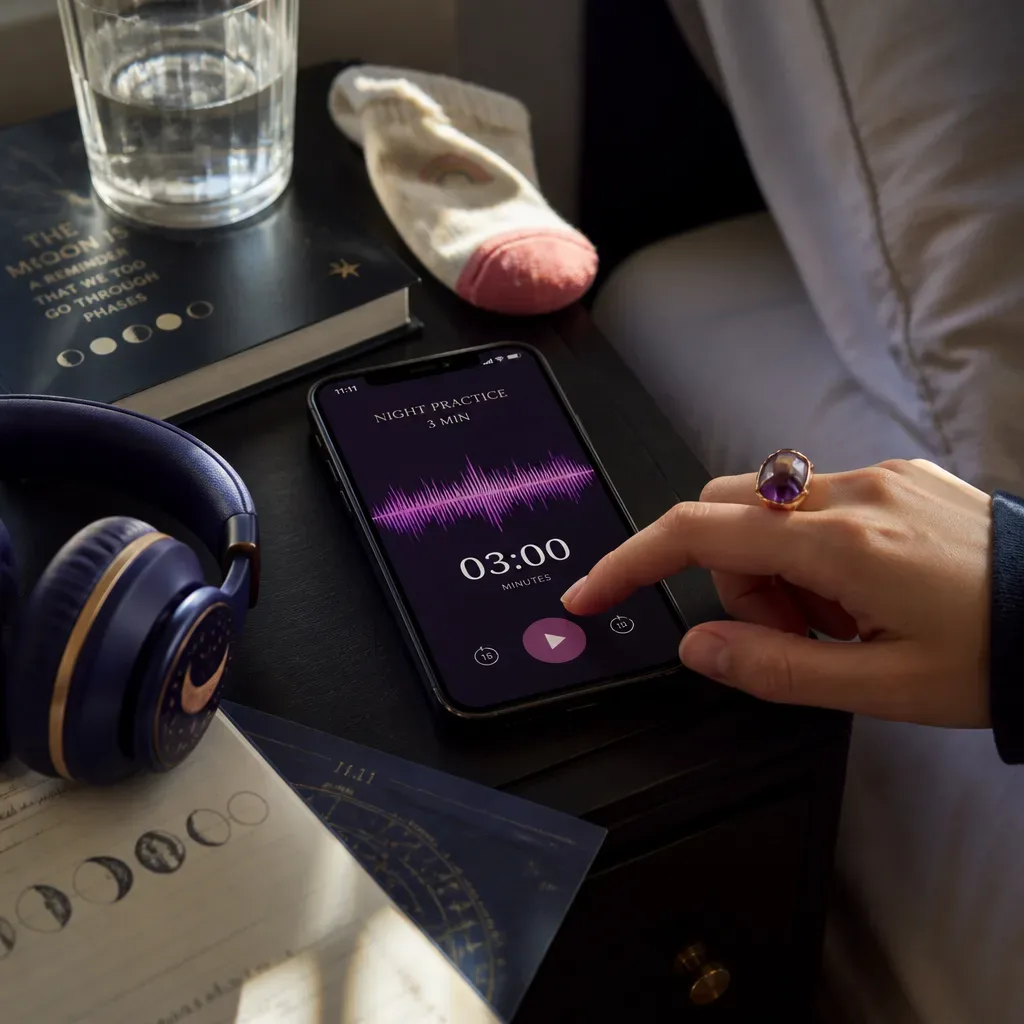
How do you do the 3-minute practice?
You do it by choosing one cue, listening without multitasking, and ending with one real sign that you are safe now.
Do not make the practice heroic. If you have a child, a job, noise outside, or dishes waiting, good. That is the actual place where your nervous system lives. A practice that only works in perfect silence is too fragile for most of us. The goal is repeatability.
A 2022 review in the journal Healthcare noted that brief mindfulness-based practices can reduce perceived stress, though effects vary by person and method. This is why the 3-minute size matters. It is short enough to do when you are tired. It is short enough to keep honest.
Use this order for seven days:
- Choose a cue. After brushing your teeth. After school drop-off. Before the first message. Keep it tied to something that already happens.
- Place a hand somewhere steady. Chest, belly, cheek, or wrist. No special posture required.
- Press play. Listen to the whole recording. Do not check the time. Do not fix your breathing unless you want to.
- Notice one fact. The fan is on. The floor is cool. The door is closed. Your body needs proof, not poetry.
- Stop there. More is not always kinder.
| Minute | What happens | Why it helps |
|---|---|---|
| 0:00 to 0:30 | You settle and hear your name or a direct address | The brain gets a clear cue |
| 0:30 to 2:15 | The future self speaks safety and permission | Repetition links desire with calm |
| 2:15 to 3:00 | You return to the room and name what is real | The practice ends in the present |
Habit researchers often cite cue, routine, and reward as a basic loop. Wendy Wood’s work on habit suggests that stable contexts make repeated behavior more automatic over time. Seven days will not rewrite everything. It will show you whether the practice is small enough to keep.
If you miss a day, do not punish the child in you for being human. Begin again at the next cue.
What should the 3-minute audio actually say?
The audio should speak to safety first, then identity, then one believable next step.
A lot of manifestation scripts start with the future and stay there. For inner child work, that can feel too far away. Start closer. The younger part of you may need to hear that nothing bad is happening right this second. Then the future can enter softly.
In self-affirmation research, including work by Claude Steele and later studies in social psychology, people often respond better when values feel personally true rather than generic. That matters here. Do not say, I am fearless, if fear is sitting on your chest. Say, I can be afraid and still be held by the life I am building.
A simple script can follow this shape:
- Safety: You are here. The room is real. No one is asking you to disappear.
- Recognition: I know you learned to stay ready. That made sense then.
- Future self: I am older now. I can choose with more care.
- Manifestation: The life I am creating includes rest, honest love, and enough room to be seen.
- Next step: Today, we only need one small act of trust.
If you use affirmations, keep them close to the body. Good affirmations do not bully you into belief. They give your attention somewhere safe to return. One sentence, repeated daily, can be more useful than 30 sentences you abandon by Thursday.
You can also borrow timing from the 3-minute breathing space used in mindfulness-based cognitive therapy, which commonly moves from awareness to breath to the wider body. Your version moves from room, to younger self, to future self. Same small container. Different words.
A future that scares the youngest part of you will be hard to keep. A future that includes them has somewhere to land.
What if your body does not feel safe yet?
If your body does not feel safe, lower the intensity until the practice feels ordinary and present.
This is the part people skip. They want the sentence to work. They want the audio to make everything loosen. Sometimes it will not. Sometimes the first honest win is that you listened for 20 seconds and stopped before you flooded yourself. That counts.
Trauma clinicians often use the phrase window of tolerance, first developed by Dr. Dan Siegel, to describe the zone where you can feel without becoming overwhelmed or shut down. Inner child manifestation should stay inside that window. If your body gets hot, numb, dizzy, or far away, open your eyes. Look at edges. Name five objects. Drink water. Text someone safe if you need to.
Make the audio less intense if needed:
- Use third person: Ben is safe enough right now.
- Lower the volume.
- Sit with your back against a wall.
- Keep your eyes open.
- Change I love you to I am staying with you.
- Stop before the future part and only practice safety for a week.
This is not failure. It is precision. In clinical settings, exposure that is too intense can backfire, while gradual exposure is often used because dosage matters. You are not doing therapy in this practice, but the lesson still applies. Smaller can be wiser.
If astrology is part of how you mark timing, you can keep it gentle too. The astrology and manifestation connection can be a calendar, not a command. A moon phase can remind you to listen. It does not have to decide whether you are worthy.
Your body is not resisting your future. It is asking whether you will leave it behind.

How do you keep inner child manifestation from becoming another task?
You keep it small, repeatable, and free from performance.
The practice is three minutes because life is already full. I am writing this from a house where someone is usually asking for socks, a charger, or the blue cup that is apparently different from all other cups. A method that cannot survive noise is not much use to a parent, a student, a nurse, a founder, or a person with wet laundry.
A 2009 study in the European Journal of Social Psychology found that habit formation took a median of 66 days, with wide variation from 18 to 254 days. That number is useful because it lowers the drama. You are not behind after one week. You are building familiarity.
Try a simple seven-day scorecard. Not to grade yourself. To see what is real.
| Day | Did I listen? | What felt safest? | One word after |
|---|---|---|---|
| 1 | Yes or no | Room, voice, hand, breath | Soft, numb, okay |
| 2 | Yes or no | Room, voice, hand, breath | Soft, numb, okay |
| 3 | Yes or no | Room, voice, hand, breath | Soft, numb, okay |
| 4 to 7 | Yes or no | Repeat what you notice | No essay needed |
If you want a wider frame for your practice, return to the manifestation guide after the seven days. If words are your main door in, keep the affirmations guide nearby. But for this practice, do not add too much. Listen first. Let the audio carry the weight.
Here is the quiet rule: if the practice makes you feel watched by your own ambition, make it smaller.
Three minutes. One voice. One younger part of you learning that wanting does not have to mean danger.
Stay with the small safe sound.